1.2 vs 1.6 Gpm Pressure Washer: Which One Should You Buy?
1.2 vs 1.6 GPM pressure washer explained: what flow changes, what PSI does, and four washers that show the range.

On this page
Top picks at a glance
As an Amazon Associate we earn from qualifying purchases.
- 1
 Westinghouse ePX3100v Electric Pressure Washer9.8/10View on Amazon
- 2
 Greenworks 3000 PSI9.7/10View on Amazon
- 3
 Westinghouse ePX3500 Electric Pressure Washer9.6/10View on Amazon
- 4
 Greenworks 1600 PSIView on Amazon
- 5
 Greenworks 1800 PSIView on Amazon
- 6
 CRAFTSMAN Electric Pressure WasherView on Amazon
- 7
 AgiiMan Pressure Washer PumpView on Amazon
- 8
 Greenworks 2000 PSIView on Amazon
- 9
 Greenworks 1500 PSI 1.2 GPM Pressure WasherView on Amazon
Two pressure washers sit on the shelf, one rated at a lower flow and one a touch higher, and the question is whether the difference matters. For car washing, the short answer to 1.2 vs 1.6 gpm pressure washer is that the higher flow rinses faster and carries soap off paint sooner, while the lower flow sips water and still cleans fine with the right nozzle. Either one washes a car; the flow decides how quickly.
More options to compare
 Greenworks 1600 PSICheck price on Amazon
 Greenworks 1800 PSICheck price on Amazon
 CRAFTSMAN Electric Pressure WasherCheck price on Amazon
 AgiiMan Pressure Washer PumpCheck price on Amazon
 Greenworks 2000 PSICheck price on Amazon
 Greenworks 1500 PSI 1.2 GPM Pressure WasherCheck price on Amazon
GarageToolHQ earns a commission when you buy through links on this page, at no extra cost to you. Read our affiliate disclosure.
1.2 vs 1.6 gpm pressure washer: the short answer
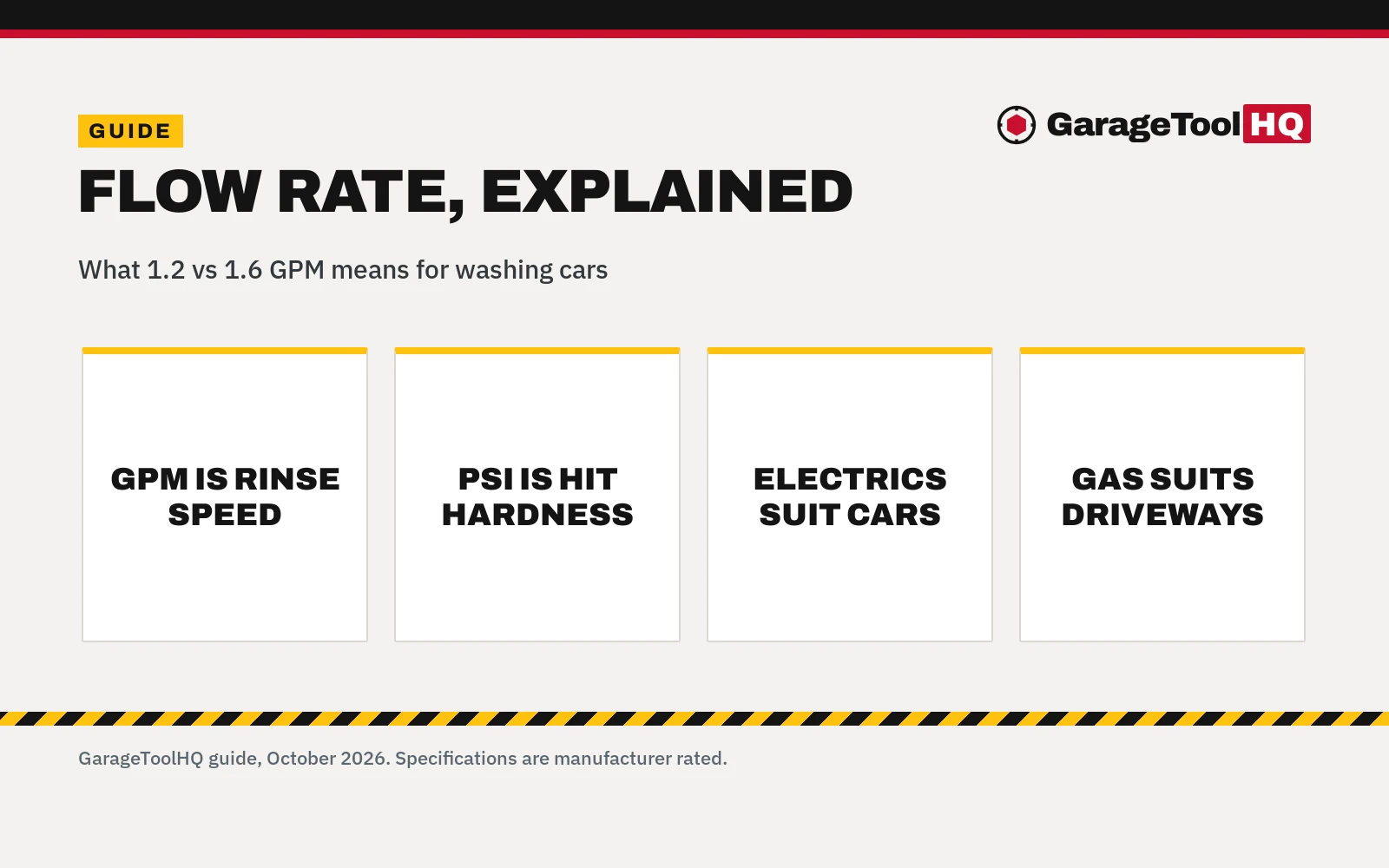
GPM is flow: how much water the machine moves. More flow means more rinsing power per pass, which is what strips foam and loosened dirt off a car. A 1.2 GPM machine like the Kärcher K1700 or the Greenworks 1600 PSI model moves 1.2 gallons per minute at 1700 and 1600 PSI respectively. Step up in flow and each pass carries more water, so the rinse goes faster.
PSI is pressure: how hard the water hits. The Greenworks 1800 PSI model runs at 1.1 GPM, so it hits harder but moves slightly less water than the 1.2 GPM pair. For cars, the balance matters more than either number alone: high pressure with low flow can etch paint, while generous flow with moderate pressure rinses safely. The listings here pair 1600 to 1800 PSI with 1.1 to 1.2 GPM, which is the electric car-washing sweet spot.
What GPM actually changes
Rinse speed is the practical difference. A higher-flow machine pushes more water across the panel per pass, so soap and grit leave sooner. A lower-flow machine needs more passes for the same rinse. On a car, where the job is mostly rinsing rather than blasting, flow earns its keep.
Water use follows flow directly. A 1.2 GPM machine uses less water per minute than a higher-flow one, which matters if you wash on a meter or from a rain barrel. The electric models here are all in the 1.1 to 1.2 GPM band, so the differences between them are small; the jump comes with the gas Simpson at 2.5 GPM, which moves more than twice the water.
Combining the two figures is a rough comparison aid, with the inputs from the listings. The gas Simpson at 3200 PSI and 2.5 GPM is far ahead of the electrics on both figures; among the electrics the differences are small. Nozzle choice and distance matter as much as the raw figures.
The gear: four washers that show the range
Kärcher K1700. The certified pick: 1700 PSI TruPressure at 1.2 GPM, CETA certified and CSA listed, with a 2 year limited warranty. Three nozzles (15°, turbo, 65°) cover precision, power and soap, and the 0.5 gal detergent tank feeds the soap nozzle. At 20.7 lb with never-flat wheels and a 20 ft hose, it is the heaviest electric here but the only one with third-party certification stated.
Greenworks 1600 PSI. The light-duty classic: 1600 PSI at 1.2 GPM, PWMA rated, with a 3 year limited warranty, the longest stated here. A 35 ft power cord with a GFCI plug, a 20 ft tangle-free hose, 25° and 40° nozzles plus a soap applicator, at 17 lb. No gas, no oil, no pull cord: push-button start.
Greenworks 1800 PSI. The harder hitter: 1800 PSI at 1.1 GPM, CSA listed, with the same 3 year limited warranty and the same 35 ft GFCI cord and 20 ft hose as its sibling, at 16 lb. The 40° nozzle handles gentle cleaning and the turbo nozzle handles heavy duty work, with a soap applicator included. More pressure, slightly less flow than the 1600.
Simpson Clean Machine. The gas outlier: 3200 PSI at 2.5 GPM from a 174 cc engine with an axial cam pump, a 25 ft hose, turbo nozzle and built-in soap tank, at 50 lb. Four quick-connect tips (0°, 15°, 40°, soap), a 16 in spray wand, and a 2-year engine, 1-year pump, 5-year frame and 90-day accessory warranty. It is 49-state compliant, not for sale in California. This is what a big flow jump looks like: more than twice the water of the electrics.
Keep electric pressure washers on a GFCI outlet, never point the wand at people or pets, wear eye protection with polishers and chemicals, and read the label before mixing any cleaning products. Read our Safety Disclaimer.
How to pick between them
For washing cars only, stay electric. The three electrics here sit in the 1.1 to 1.2 GPM band with 1600 to 1800 PSI, which is the range the listings aim at cars, trucks, motorcycles and patio furniture. The Kärcher brings certification, the Greenworks pair brings longer warranties and lighter bodies.
For cars plus driveways and siding, the gas Simpson earns its 50 lb. Its 2.5 GPM and 3200 PSI clean concrete and siding far faster than the electrics, but it is overkill for paint and needs the wider nozzles on a car. Never run a gas engine in a closed garage.
Between 1.1 and 1.2 GPM, do not overthink it. The difference is a tenth of a gallon per minute; nozzle choice, soap and technique matter more. Pick on warranty, weight and certification instead: the Greenworks pair shares the longest stated warranty at 3 years, the Greenworks 1800 is the lightest electric at 16 lb, and the Kärcher is the only one with CETA certification stated.
Frequently Asked Questions
Is 1.2 GPM enough for washing a car?
Yes. The Kärcher K1700 and Greenworks 1600 PSI both run 1.2 GPM and list cars among their uses. Pair them with the wide-angle nozzle and keep the wand moving.
Does higher GPM clean better?
Higher GPM rinses faster because each pass moves more water. The Simpson at 2.5 GPM moves more than twice the water of the 1.1 to 1.2 GPM electrics. For paint, moderate pressure with good flow beats high pressure with low flow.
What is the difference between the two Greenworks models?
The 1600 PSI model runs 1.2 GPM; the 1800 PSI model runs 1.1 GPM with more pressure. Both have a 3 year limited warranty, a 35 ft GFCI cord and a 20 ft hose. The 1800 includes a turbo nozzle; the 1600 includes 25° and 40° nozzles.
Can I use the gas Simpson on my car?
The listing includes cars among its uses, but at 3200 PSI use the 40° or soap nozzle and keep your distance. It is 49-state compliant and not for sale in California. Never run it in a closed garage.
Do these need special outlets?
The electrics run on household power; the Greenworks pair includes a GFCI plug on a 35 ft cord. The Simpson is gas powered with a 174 cc engine and needs no outlet at all.
Related: gas vs battery pressure washer, steam cleaner vs pressure washer for cars, best electric pressure washer for small driveway and wall mount vs portable pressure washer.