1/2 vs 3/4 Impact Wrench: Which One Should You Buy?
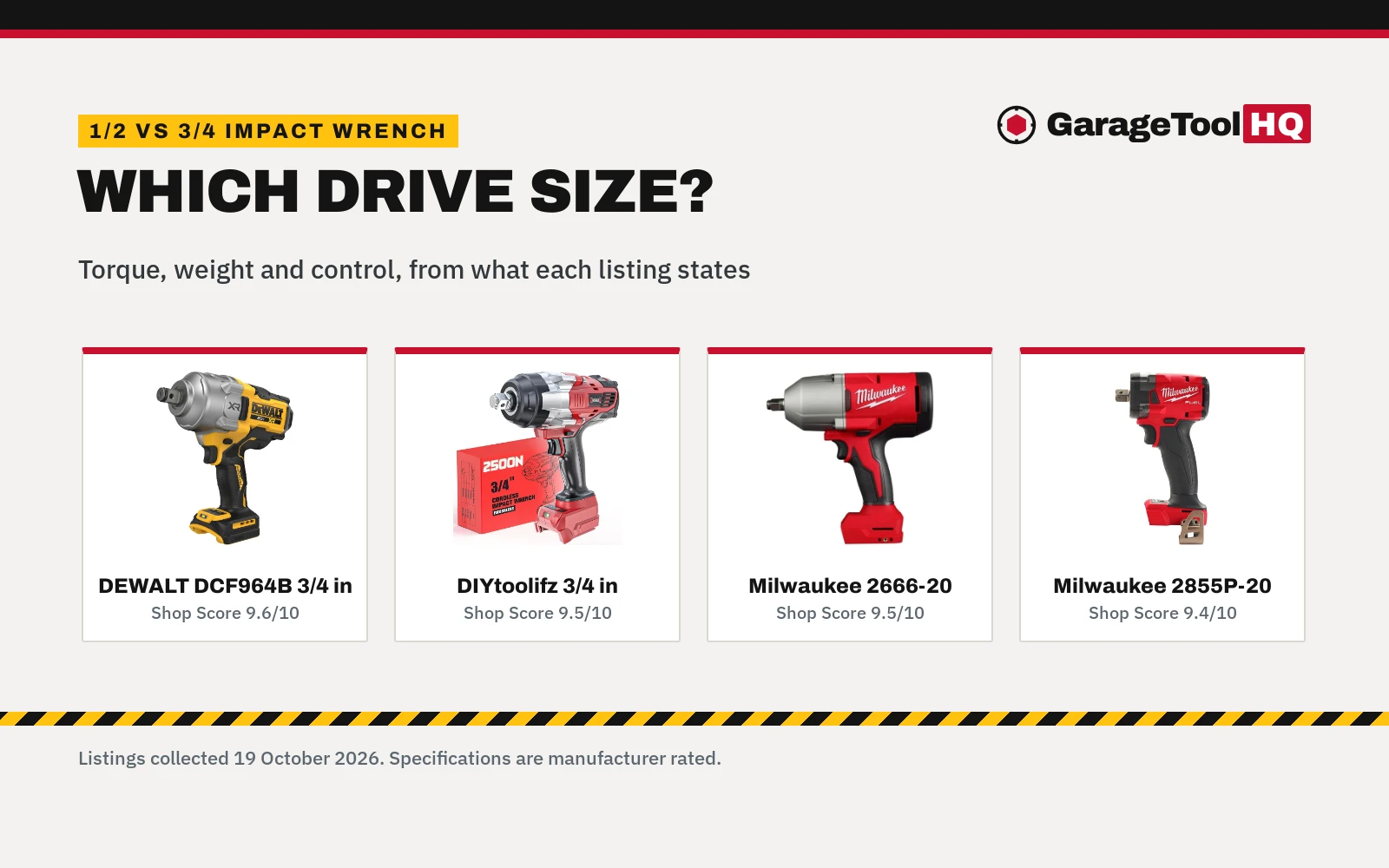
1/2 vs 3/4 impact wrench: torque, weight and control compared, with two examples of each side scored from the listings.

On this page
Top picks at a glance
As an Amazon Associate we earn from qualifying purchases.
- 1
 ARCCAPTAIN Cordless Impact Wrench9.7/10View on Amazon
- 2
 DEWALT 20V MAX Cordless Impact Wrench9.6/10View on Amazon
- 3
 CRAFTSMAN V20 RP Cordless Impact Wrench9.6/10View on Amazon
- 4
 Milwaukee ElectricView on Amazon
- 5
 Ingersoll Rand 261 3/4" Air Impact WrenchView on Amazon
- 6
 HORUSDY 50-Piece 3/8" Drive Impact Socket SetView on Amazon
- 7
 Milwaukee 2962-20 M18 18V Fuel 1/2" Mid-torque Impact WrenchView on Amazon
- 8
 Ingersoll Rand 231C 1/2" Drive Air Impact Wrench Features upView on Amazon
- 9
 Ingersoll Rand 2235TiMAX 1/2"-Drive Air Impact WrenchView on Amazon
1/2 vs 3/4 impact wrench verdict: Choose 1/2 in for cars, trucks and general garage work: the Milwaukee examples deliver 250 to 800 ft-lbs of fastening torque at 2.8 to 5.9 lb. Choose 3/4 in for heavy equipment, big trucks and rusted hardware: the DEWALT and DIYtoolifz examples deliver 1420 to 1850 ft-lbs at 7.7 to 9 lb. The 3/4 in side hits harder; the 1/2 in side is the one you will reach for daily.
Drive size is torque class. A 1/2 in impact wrench is the garage standard for lug nuts and general fasteners; a 3/4 in wrench is the heavy-duty step up for equipment, trucks and stubborn hardware. This 1/2 vs 3/4 impact wrench comparison walks through the two sides, then scores two examples of each from the listings we reviewed.
GarageToolHQ earns a commission when you buy through links on this page, at no extra cost to you. Read our affiliate disclosure.


DEWALT 20V MAX XR 3/4 Inch Cordless Impact Wrench
A 20V MAX XR 3/4 in cordless impact wrench with 1420 ft-lbs fastening and 1900 ft-lbs breakaway torque.
Pros
- 1420 ft-lbs max fastening; 1900 ft-lbs max breakaway
- Precision wrench mode against overtightening and run-off
- Paddle-style 3 speed settings
- Oil-resistant housing for harsh environments
Cons
- 9 lb: the heaviest here
- Tool only: battery not included
- No concrete warranty term stated
- Overkill for car lug nuts

DIYtoolifz 3/4" Cordless Impact Wrench Compatible
A 3/4 in cordless impact wrench with 1850 ft-lbs of torque, compatible with Milwaukee 18V batteries.
Pros
- 1850 ft-lbs (2500 N.m) claimed: the highest fastening figure here
- Compatible with Milwaukee 18V batteries
- Auto-stop reverse and 4 speeds
- LED work light
Cons
- Bare tool: battery and sockets not included
- Third-party brand on the Milwaukee battery platform
- No anvil type stated
- No concrete warranty term stated

Milwaukee Electric - M18TRADE BRUSHLESS 1/2 HIGH
An M18 1/2 in high torque impact wrench with 800 ft-lbs fastening and 1,200 ft-lbs nut busting torque.
Pros
- 800 ft-lbs fastening; 1,200 ft-lbs nut busting
- REDLINK intelligence with overload protection
- Friction ring for one-handed socket changes
- Variable speed trigger: 0-1,750 RPM, 0-2,000 IPM
Cons
- 5.9 lb: heavy for a 1/2 in
- No concrete warranty term stated
- Battery and charger status not stated
- Overkill for small fasteners

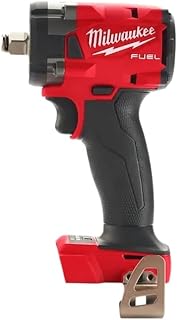
Milwaukee Electric - Compact 1/2 Impact W/PIN
A compact M18 FUEL 1/2 in impact wrench with 250 ft-lbs of torque at 2.8 lb.
Pros
- 2.8 lb and 4.9 in: the lightest and shortest here
- 250 ft-lbs: enough for most garage fasteners
- Pin detent anvil
- M18 FUEL brushless platform
Cons
- 250 ft-lbs: the lowest torque here
- Thin listing: one bullet
- No safety features stated
- No concrete warranty term stated
More options to compare
 Milwaukee ElectricCheck price on Amazon
 Ingersoll Rand 261 3/4" Air Impact WrenchCheck price on Amazon
 HORUSDY 50-Piece 3/8" Drive Impact Socket SetCheck price on Amazon
 Milwaukee 2962-20 M18 18V Fuel 1/2" Mid-torque Impact WrenchCheck price on Amazon
 Ingersoll Rand 231C 1/2" Drive Air Impact Wrench Features upCheck price on Amazon
 Ingersoll Rand 2235TiMAX 1/2"-Drive Air Impact WrenchCheck price on Amazon
1/2 vs 3/4 impact wrench: side by side
| Factor | 1/2 in (examples) | 3/4 in (examples) |
|---|---|---|
| Example products | Milwaukee 2666-20, Milwaukee 2855P-20 | DEWALT DCF964B 3/4 in, DIYtoolifz 3/4 in |
| Fastening torque | 800 ft-lbs; 250 ft-lbs (listed) | 1420 ft-lbs; 1850 ft-lbs (listed) |
| Breakaway | 1,200 ft-lbs (2666-20); not stated (2855P-20) | 1900 ft-lbs (DEWALT); not stated (DIYtoolifz) |
| Weight | 5.9 lb; 2.8 lb (listed) | 9 lb; 7.7 lb (listed) |
| Length | 6 in; 4.9 in (listed) | Not stated; 11.81 in (listed) |
| Anvil | Friction ring; pin detent (listed) | Hog ring; not stated (listed) |
| Batteries | Not stated | Bare tool / tool only (listed) |
Example figures are manufacturer rated, collected 19 October 2026; a figure from one listing describes that listing only.
Torque: the whole point of the bigger drive
Torque is what separates the sides. The 1/2 in examples list 250 ft-lbs on the Milwaukee 2855P-20 compact and 800 ft-lbs of fastening torque with 1,200 ft-lbs of nut busting torque on the Milwaukee 2666-20. The 3/4 in examples list 1420 ft-lbs of max fastening torque and 1900 ft-lbs of max breakaway torque on the DEWALT DCF964B, and 1850 ft-lbs on the DIYtoolifz. Both sides state fastening torque, so the comparison is direct: the 3/4 in examples hit roughly twice as hard as the strongest 1/2 in example here.
Weight and size
Torque costs weight. The 1/2 in examples weigh 2.8 lb on the compact 2855P-20 and 5.9 lb on the 2666-20, at 4.9 and 6 inches long. The 3/4 in examples weigh 7.7 lb on the DIYtoolifz and 9 lb on the DEWALT, with the DIYtoolifz at 11.81 inches long. If you work overhead or all day, the 1/2 in side is kinder to your arms; the 3/4 in side is a two-hand tool for the big jobs.
Anvils and control
The 1/2 in examples offer a friction ring on the 2666-20 for quick one-handed socket changes and a pin detent on the 2855P-20. The DEWALT 3/4 in example uses a hog ring anvil with 3 speed settings and a precision wrench mode to help prevent overtightening and fastener run-off. The DIYtoolifz 3/4 in example adds auto-stop reverse and 4 speeds with an LED work light. Neither 1/2 in listing states an LED or auto-stop feature, and the DIYtoolifz listing states no anvil type, so those are single-listing details, not side wins.
Buying advice: batteries, breakaway and control
Start with your batteries. The 3/4 in examples are both sold without batteries: the DIYtoolifz is a bare tool compatible with Milwaukee 18V batteries, and the DEWALT DCF964B is listed as tool only on the 20V MAX XR platform. The 1/2 in examples are Milwaukee M18 tools. The wrench that runs on batteries you already own costs the least to put to work, so check the platform before the torque figure.
Read breakaway, not just fastening torque. Fastening torque is the listed headline: 250 to 800 ft-lbs on the 1/2 in side, 1420 to 1850 ft-lbs on the 3/4 in side. Breakaway is the loosening number that matters on rusted hardware: 1,200 ft-lbs on the Milwaukee 2666-20 and 1900 ft-lbs on the DEWALT DCF964B. The Milwaukee 2855P-20 and the DIYtoolifz state no breakaway figure, so their loosening strength is unconfirmed in the listings.
Weigh the tool, not just the job. The compact 2855P-20 is 2.8 lb and 4.9 in long, the tool you grab for overhead work and tight spots. The 2666-20 is 5.9 lb and 6 in, the DIYtoolifz 7.7 lb and 11.81 in, and the DEWALT 9 lb. A 9 lb wrench with a long body is a two-hand tool; if the work is all day, the lighter 1/2 in side wins on arms alone.
Mind the small fasteners. A 3/4 in wrench at 1420 to 1850 ft-lbs will snap car studs if you are careless, which is why the DEWALT listing includes a precision wrench mode against overtightening and fastener run-off, and the DIYtoolifz an auto-stop reverse. On the 1/2 in side, the 2666-20 gives a variable speed trigger from 0 to 1,750 RPM and 0 to 2,000 IPM for control. Match the control features to the smallest fastener you will touch.
Example impact wrenches
For more choices, see the heavy duty cordless impact wrench picks and the best 1/2 in air impact wrench.
Use rated jack stands on solid ground, wear eye protection with power and air tools, keep fuel-burning equipment out of a closed garage, and follow the manual for every tool. Read our Safety Disclaimer.
Frequently Asked Questions
What is the difference between a 1/2 in and a 3/4 in impact wrench?
Drive size and torque class. In these listings, the 1/2 in examples deliver 250 to 800 ft-lbs of fastening torque at 2.8 to 5.9 lb; the 3/4 in examples deliver 1420 to 1850 ft-lbs at 7.7 to 9 lb. The bigger drive hits harder and weighs more.
Is a 3/4 in impact wrench too much for lug nuts?
For car lug nuts, yes: 1420 to 1850 ft-lbs of fastening torque will snap studs if you are careless. The DEWALT listing’s precision wrench mode exists to prevent overtightening. The 1/2 in side is the lug nut tool.
Can I use 1/2 in sockets on a 3/4 in wrench?
Only with an adapter, and the listings do not include one. The DIYtoolifz listing notes it is a bare tool: no batteries and no impact sockets included.
Do the 3/4 in examples include batteries?
The DIYtoolifz is a bare tool compatible with Milwaukee 18V batteries, which are not included. The DEWALT DCF964B is listed as tool only. Budget batteries separately.
Which side is better for a home garage?
The 1/2 in side: 250 to 800 ft-lbs covers cars and light trucks at 2.8 to 5.9 lb, against 7.7 to 9 lb on the 3/4 in side. The 3/4 in side is for heavy equipment and big trucks.
Which anvil type should I choose?
The 2666-20 lists a friction ring for quick one-handed socket changes, the 2855P-20 a pin detent, and the DEWALT DCF964B a hog ring. The DIYtoolifz listing states no anvil type. Pick the anvil that matches how you change sockets; the unstated one is a question for the maker.