Best Bench Vise Size: Sizing Guide for Home Garages (2026)
How to choose the best bench vise size for your home garage: comparing 4-inch, 6-inch, 8-inch, and 12-inch jaw widths, throat depth, and workbench mounting.

On this page
Top picks at a glance
As an Amazon Associate we earn from qualifying purchases.
- 1
 Wilton Mechanics Pro Bench Vise9.7/10View on Amazon
- 2
 Wilton Reversible Bench Vise9.7/10View on Amazon
- 3
 Yost Vises 455 Combination Vise9.6/10View on Amazon
- 4
 Forward DT08125A 5 Inch Heavy Duty Bench Vise with 360°SwivelView on Amazon
- 5
 WORKPRO Bench ViseView on Amazon
- 6
 VEVOR Bench ViseView on Amazon
- 7
 Forward CR60A 6.5 Inch Bench Vise Heavy Duty with Anvil andView on Amazon
- 8
 Table Vise or Bench Vise 3.2 InchView on Amazon
- 9
 Dual-Purpose Combined Universal Vise 3.3" with 360° SwivelView on Amazon
- 10
 Forward 30608 8 Inch Bench Vise Heavy Duty with Anvil andView on Amazon
- 11
 POWERTEC Portable Small Workbench with ViseView on Amazon
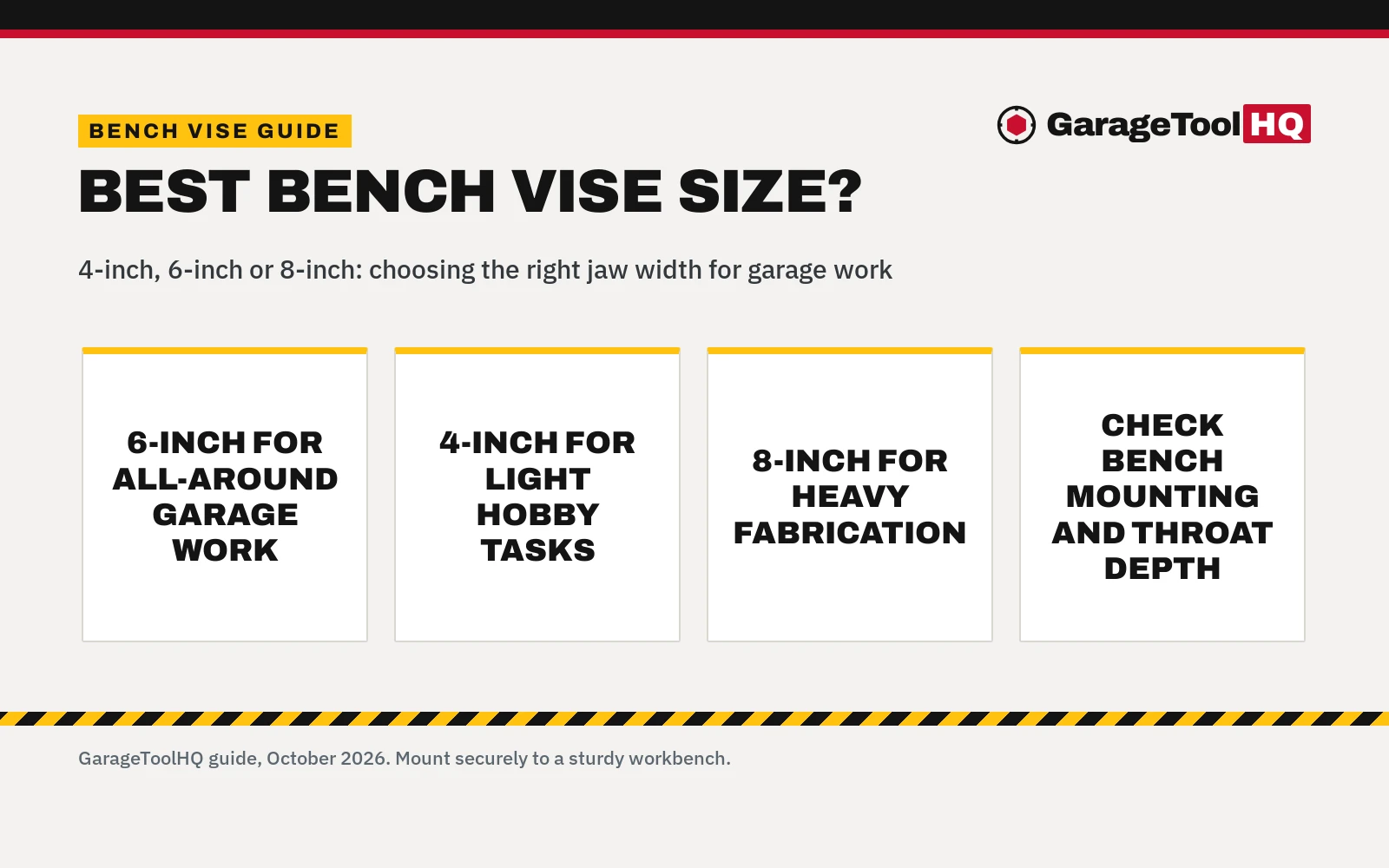
When pressing out a seized universal joint, straightening a bent bracket, or holding a steering knuckle steady during a suspension rebuild, picking the best bench vise size keeps your work safe and your workbench intact. For most home garages and automotive DIY projects, a 6-inch bench vise is the best bench vise size. A 6-inch jaw width provides the ideal balance between clamping span, throat depth, and bench footprint, handling everything from brake calipers to exhaust piping without overloading a standard wooden workbench. A compact 4-inch vise suits light hobby tasks, while heavy 8-inch and 12-inch models belong in dedicated fabrication shops or commercial truck bays.
More options to compare
 Forward DT08125A 5 Inch Heavy Duty Bench Vise with 360°SwivelCheck price on Amazon
 WORKPRO Bench ViseCheck price on Amazon
 VEVOR Bench ViseCheck price on Amazon
 Forward CR60A 6.5 Inch Bench Vise Heavy Duty with Anvil andCheck price on Amazon
 Table Vise or Bench Vise 3.2 InchCheck price on Amazon
 Dual-Purpose Combined Universal Vise 3.3" with 360° SwivelCheck price on Amazon
 Forward 30608 8 Inch Bench Vise Heavy Duty with Anvil andCheck price on Amazon
 POWERTEC Portable Small Workbench with ViseCheck price on Amazon
GarageToolHQ earns a commission when you buy through links on our product pages, at no extra cost to you. Read our affiliate disclosure.
Below: how bench vises are measured, a detailed comparison of 4-inch, 6-inch, 8-inch, and 12-inch jaw widths, how to choose the right capacity for automotive jobs, and a complete checklist for fixing a vise securely to your workbench.
What is a bench vise and how jaw sizing works
A bench vise is a heavy mechanical clamp bolted directly to a workbench, designed to hold workpieces stationary while you cut, file, hammer, drill, bend, or assemble them. The tool consists of a stationary rear base with a fixed static jaw, a movable dynamic jaw that glides along a machined slide, a threaded lead screw turned by a steel handle, and frequently an anvil surface and a swivel base.
Vises are categorized primarily by jaw width, but understanding key dimensions prevents buying a tool that cannot fit your garage projects:
- Jaw width. Stated as 4-inch, 6-inch, 8-inch, or 12-inch, this measures the straight horizontal length of the jaw gripping faces. Wider jaws distribute clamping force across broader surfaces, preventing thin metal from bowing.
- Jaw opening. This distance measures how far the dynamic jaw extends away from the static jaw before reaching the end of the lead screw travel. Opening capacity varies between specific models and makers rather than matching jaw width automatically, so verify the stated opening specification if your work involves thick assemblies.
- Throat depth. This vertical clearance extends from the top edge of the jaw faces down to the top of the slide or housing beneath them. Generous throat depth allows tall automotive parts like suspension struts, steering links, and brackets to sink deep between the jaws without bottoming out.
Why a 6-inch jaw is the best bench vise size for a home garage
For a home garage where weekend automotive repair and general fabrication take place, a 6-inch bench vise provides the ideal functional balance. A 4-inch model is frequently too cramped for automotive assemblies, while an 8-inch or 12-inch vise is excessively heavy and demanding on standard workbench construction.
A 6-inch vise serves as the standard recommendation for garage workbenches for several practical reasons:
- Automotive component clearance. Automotive repairs involve awkward shapes like brake calipers, ball joints, control arms, and exhaust tubing. A 6-inch vise offers the jaw span and throat depth needed to grip these bulky castings securely.
- Balanced clamping strength. Quality 6-inch vises deliver substantial clamping force with normal hand pressure on the handle, holding steering components rigid without slippage.
- Workbench compatibility. A 6-inch vise provides solid mass to absorb striking forces during chiseling or hammering, yet mounts cleanly on standard garage benches without pulling fasteners loose.
- Versatile feature options. Many garage-focused 6-inch workshop vises offer replaceable hardened steel jaws, built-in pipe jaws for round tubing, a rotating swivel base, and an integrated rear anvil pad.
When comparing specific workshop models, our review of the best bench vise for garage workspaces looks at jaw depth, anvil size, and casting quality across leading workshop vises.
Comparing bench vise sizes: 4-inch, 6-inch, 8-inch, and 12-inch jaws
Matching your vise to the scale of materials you handle regularly ensures dependable clamping without wasting valuable workbench space.
| Jaw Size | Typical Garage Jobs | Throat Depth & Opening | Workbench Requirements |
|---|---|---|---|
| 4-inch bench vise | Small fasteners, bicycle repairs, electrical wiring, light filing, small brackets | Compact opening and shallow throat; limits work on bulky automotive parts | Lightweight wooden bench, small portable work table, or mobile utility cart |
| 6-inch bench vise | Brake calipers, control arm bushings, universal joints, pipe cutting, steering links | Generous throat depth and wide opening; accommodates common automotive components | Sturdy hardwood bench or steel-frame table bolted to the garage wall or floor |
| 8-inch bench vise | Truck leaf springs, heavy agricultural machinery, solid axle shafts, large structural steel | Deep throat and extended opening; holds oversized fabrications securely | Heavy industrial steel workbench with reinforced framing and solid floor anchoring |
| 12-inch bench vise | Extreme industrial fabrication, structural pipe welding, heavy commercial fleet maintenance | Maximum throat clearance and massive jaw span; built for massive workpieces | Dedicated heavy industrial steel pedestal or massive reinforced steel fabrication table |
A compact 4-inch bench vise suits small electrical repairs, carburetors, and bicycle maintenance. However, the shallow throat depth and narrow opening struggle when clamping bulky automotive suspension pieces.
Moving up to an 8-inch or 12-inch bench vise enters heavy machinery territory. These oversized tools excel on agricultural tractors and diesel trucks, but their massive weight demands an industrial steel bench anchored directly into concrete.
How to fix a vise to a bench: the mounting checklist
Applying torque with a breaker bar or striking a component transfers immense stress into the table frame. Follow this checklist to mount your vise correctly:
- Support near a bench leg. Mount the vise close to a front bench leg or supported corner where the frame provides maximum stiffness, rather than across the flexible middle of an unsupported span. If your tabletop overhangs the leg, place solid blocking between the tabletop underside and the leg frame to direct striking forces straight down.
- Set the static jaw proud of the bench edge. Position the stationary rear jaw slightly forward of the front edge of the workbench. Placing the static jaw face proud of the bench allows long workpieces like exhaust pipes, steering rods, or shafts to hang straight down past the table without interference from the bench apron.
- Check handle and swivel clearance. If your vise swivels, rotate the body through its available range and spin the main handle before drilling. Ensure the handle and body clear the bench edge, walls, and storage cabinets in every working position.
- Mark and drill perpendicular clearance holes. Hold the base firmly in place and mark the mounting hole centers. Drill clean through-holes through the tabletop matching your fastener diameter.
- Secure with high-strength through-bolts. Never use lag screws or wood screws, which strip out under upward pulling forces. Always insert steel through-bolts extending completely through the tabletop.
- Add a heavy steel backing plate underneath. Slip wide steel washers or a solid steel backing plate over the bolts beneath the bench. The backing plate distributes clamping forces across a broad wooden area, preventing bolt heads from pulling through.
- Install lock washers and locking nuts. Vibrations from sawing, grinding, and hammering loosen standard fasteners. Secure every mounting bolt with a heavy lock washer and a locking nut, tightening all fasteners firmly.
- Confirm smooth jaw operation. Spin the lead screw to cycle the dynamic jaw through its full range of travel. Verify that the screw turns smoothly without binding and that the dynamic jaw faces meet the static jaw squarely and evenly.
Use the rear anvil surface only for light shaping, flattening, or driving small pins. Never strike the dynamic slide, the lead screw housing, or the jaw castings with a hammer, which can crack the body and destroy clamping alignment.
Use rated jack stands on solid ground, wear eye protection with power and air tools, keep fuel-burning equipment out of a closed garage, and follow the manual for every tool. Read our Safety Disclaimer.
Cast iron vs ductile iron and swivel base considerations
Body material and base design determine how much punishment the tool can endure during challenging mechanical jobs:
- Gray cast iron: Standard workshop vises are cast from gray iron. Gray iron dampens vibration effectively and provides adequate rigidity for everyday clamping, filing, and assembly. However, gray iron possesses limited tensile strength and can crack under heavy impact.
- Ductile iron: Heavy-duty workshop vises utilize ductile iron, also known as nodular iron. Ductile iron incorporates spherical graphite nodules that allow the metal to flex slightly under extreme load rather than fracturing, providing superior durability for hammering and bending.
- Swivel base vs stationary base: A swivel base allows the vise body to rotate horizontally, locking at various angles with clamp handles. This rotation proves invaluable in a crowded garage, allowing long exhaust tubing or brake lines to clear walls. A stationary base lacks rotational adjustment but provides maximum rigidity for heavy fabrication work.
- Replaceable serrated jaws and pipe jaws: Look for hardened steel jaw faces attached with countersunk screws. On combination workshop vises, built-in curved pipe jaws located beneath the main jaws grip round pipes, tie rods, and cylindrical shafts securely without slipping.
If you are building out your workshop space from scratch, pairing your vise with a dedicated work bench with vise setup provides an integrated clamping station with reinforced framing.
Frequently Asked Questions
What size bench vise is best for a home garage?
A 6-inch bench vise is the best bench vise size for most home garages. A 6-inch jaw width provides ample clamping capacity and throat depth for automotive tasks such as u-joints, suspension bushings, and steering components, while mounting comfortably on a standard garage workbench.
What is a bench vise used for during automotive repairs?
A bench vise acts as an indispensable mechanical clamp that grips heavy components securely. Common automotive uses include holding steering links, securing brake calipers while cleaning slide pins, pressing out bushings, stabilizing exhaust pipes for cutting, and holding brackets during fabrication or rust removal.
Is a 4-inch bench vise big enough for garage projects?
A 4-inch bench vise handles small mechanical parts, electrical connectors, bicycle components, and light sharpening work. However, the shallower throat depth and narrower jaw opening make a 4-inch vise struggle with bulky automotive parts like control arms, large pulleys, or wide steering knuckles.
When should you choose an 8-inch or 12-inch bench vise?
An 8-inch or 12-inch bench vise belongs in agricultural, heavy truck, or structural fabrication shops. These oversized vises deliver massive clamping span and deep throat clearance for heavy structural steel and truck drivelines, but their extreme weight requires a dedicated industrial steel bench anchored directly into concrete.
How to fix a vise to a bench for maximum stability?
To fix a vise to a bench, mount the tool near a front bench leg or supported corner where the frame is stiffest, setting the stationary rear jaw slightly forward of the front bench edge so long vertical workpieces clear the table. Drill clean through-holes and secure the base with high-strength steel through-bolts, heavy washers, and a solid steel backing plate underneath the bench to spread mechanical stress.
Should a garage bench vise have a swivel base?
A swivel base adds tremendous flexibility in a compact garage, allowing you to angle long metal stock, tubing, or exhaust sections so they clear nearby walls and tool cabinets. For extreme fabrication that involves heavy sledging, a rigid stationary base provides maximum strength.
Related: compare specific workshop models in our guide to the best bench vise for garage, explore sturdy clamping tables in our roundup of the work bench with vise, browse the engine and shop equipment hub, see compact options in our small workbench for garage guide, and outfit your workshop with the best bench grinder for garage.