Air Compressor Dryer and Regulator Set Up: Shop Piping and Stage Guide
How to plumb an air compressor dryer and regulator set up in your garage: correct filter sequence, auto drain installation, line sizing and pressure tuning.

On this page
Top picks at a glance
As an Amazon Associate we earn from qualifying purchases.
- 1
 NANPU 1/2" NPT Industrial Air Compressor Filter Dryer9.7/10View on Amazon
- 2
 NANPU 3/4" NPT Industrial Air Compressor Filter Dryer9.6/10View on Amazon
- 3
 AIRZOE 3/8" NPT Air Dryer for Compressor-Air Compressor Water9.4/10View on Amazon
Hooking up an HVLP spray gun to lay primer on a fender or blowing brake dust off a backing plate quickly goes wrong when water spits from your air chuck. An air compressor dryer and regulator set up prevents that problem by extracting liquid water, oil aerosols, and vapor from your supply lines while regulating pressure to your tool’s required rating. Achieving clean air requires installing filtration stages in sequence, matching regulator placement to your system layout, and routing auto drains away from the floor.
GarageToolHQ earns a commission when you buy through links on our product pages, at no extra cost to you. Read our affiliate disclosure.
Below: why component order matters, how each drying stage functions, step-by-step installation instructions, and how to set regulator pressure for common garage tools.
Air compressor dryer and regulator set up: why component order matters
Compressor pumps heat atmospheric air during compression. As warm air cools along distribution lines, moisture vapor condenses into liquid water droplets. Oil-lubricated pumps also discharge fine oil aerosols into the air stream. Without multi-stage filtration, this moisture and sludge damages pneumatic tools and ruins painted surfaces. Arranging drying and regulation equipment in the proper downstream sequence protects each stage:
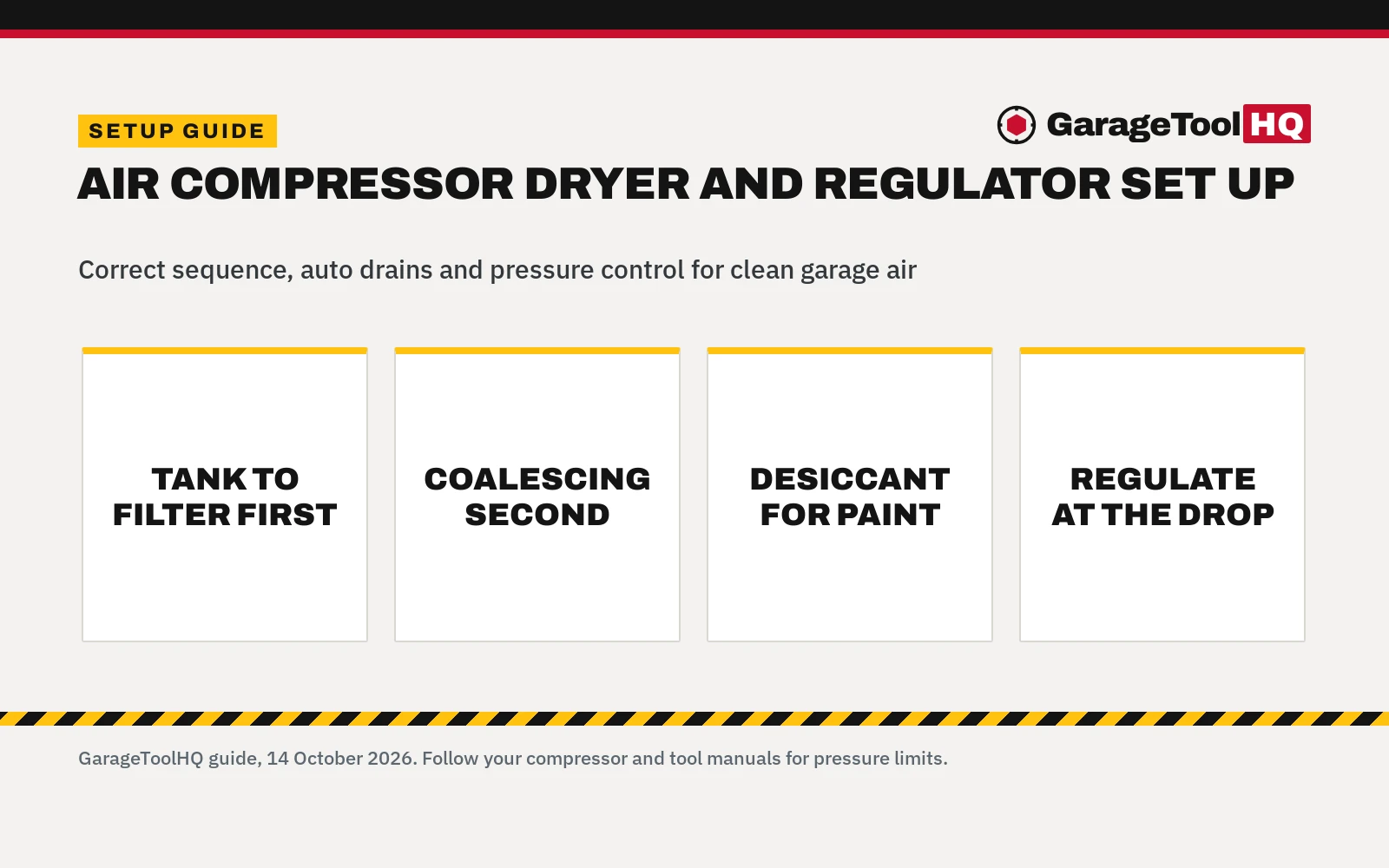
- Stage 1: Bulk moisture and particulate separation. Air leaving the tank enters a particulate filter first. Makers like Gokluuk, CAtArt, and NEPIKE specify a 5-micron element to remove 95% of liquid water droplets and debris, while NANPU uses a 5-micron brass element. Skipping this stage quickly clogs finer downstream elements.
- Stage 2: Oil mist and aerosol coalescing. Once bulk water is captured, air enters a coalescing filter. Listings from DAIERTEK, Gokluuk, and NEPIKE specify a 0.01-micron element capturing 99.98% of remaining moisture and oil aerosols (with CAtArt listing 99.9% on its four-stage model). This protects downstream desiccant media from oil contamination.
- Stage 3: Deep vapor absorption. For paint spraying or plasma cutting, air passes through a desiccant dryer. Units from Gokluuk, CAtArt, and DAIERTEK use blue silica beads that absorb residual vapor. When saturated, the beads turn from blue to pink, signaling that replacement media is required.
- Stage 4: Line pressure regulation. Pressure regulation controls output to pneumatic equipment. Packaged assemblies from Gokluuk, CAtArt, and RVMARINEPAT integrate the regulator directly on the Stage 1 body. In custom piped systems, mechanics often position a dedicated regulator after filtration at the drop point to maintain full supply pressure along main distribution lines.
Air drying and regulation stages: from tank to tool
Drying hardware ranges from modular combos to four-stage assemblies. The table below outlines how each stage handles contamination based on manufacturer specifications:
| Stage | Component | Stated Filtration & Function | Ports & Indicators |
|---|---|---|---|
| Stage 1 | Particulate Filter & Regulator | 5-micron element; removes 95% of water and solids; 0-145 psi or 0-240 PSI control | 3/8-inch, 1/2-inch, or 3/4-inch NPT; auto drain bowl |
| Stage 2 | Coalescing Filter | 0.01-micron element; captures 99.98% of oil aerosols | Pop-up visual indicator (red or green button) |
| Stage 3 & 4 | Desiccant Air Dryer | Desiccant bead chamber; deep vapor absorption | Sight glass; blue-to-pink color-changing beads |
| Shop Alternative | Refrigerated Air Dryer | Chills air to a 41 degrees dew point; Schulz ADS-35 rates at 35 CFM at 100 PSI | 1/2-inch female NPT ports; auto float drain |
| Point of Use | Drop Pressure Regulator | Fine-tunes output pressure; locking adjustment knob | 1/4-inch NPT gauge port; 0-150 or 0-240 PSI dial gauge |
Port sizes dictate flow rates. Compact units like the NANPU DFR-03 use 3/8-inch NPT ports flowing 70 SCFM at 90 PSI (with an 88 SCFM maximum airflow). For larger setups, CAtArt and NEPIKE list 3/4-inch NPT assemblies flowing up to 141 CFM at a maximum pressure of 240 PSI, while Gokluuk rates its 3/4-inch NPT four-stage unit at 20 SCFM. For stationary compressors of 7.5 hp and 10 hp, Schulz provides a 35 CFM refrigerated dryer with 1/2-inch female NPT ports rated for 175 PSI maximum compressor output.
How to install an air compressor dryer and regulator: step-by-step setup
Follow this checklist to install your filtration and regulation hardware:
- Drain the compressor tank first. Condensation collects in the tank base during operation. Open the drain petcock to purge water before installation, lowering the moisture burden on filters.
- Allow line distance for cooling. Compressed air leaves the pump hot, keeping moisture suspended as vapor. Run rigid piping before your filter station so air cools, condensing vapor into droplets filters can trap.
- Mount filter bowls vertically. Automatic drains rely on internal floats and gravity to expel water. Makers including Gokluuk, DAIERTEK, and RVMARINEPAT state that drying assemblies must be installed vertically for auto drains to operate properly.
- Follow airflow arrows. Check the aluminum bodies for directional arrows. Route air into the 5-micron particulate filter first, the 0.01-micron coalescing filter second, and the desiccant chamber third.
- Seal all NPT threads. Wrap thread seal tape around male pipe threads before assembly. DAIERTEK and Gokluuk include thread seal tape to prevent air leaks at 3/8-inch, 1/2-inch, and 3/4-inch NPT ports.
- Mount the regulator. On packaged multi-stage units, the regulator sits on the Stage 1 body. For separate drops, install the regulator with its 0-150 or 0-240 PSI gauge at the hose outlet and lock the knob to prevent pressure drift.
- Route auto drain discharge lines. Auto drains eject collected water under pressure. Attach tubing beneath each drain port and route it into a container to keep the garage floor dry.
- Inspect connections for leaks. Pressurize the system and apply soapy water across all joints. If bubbles form, depressurize the line and tighten the fitting.
Never exceed the maximum pressure rating marked on filter bowls or receiver tanks. Reference drying assemblies carry maximum ratings of 145 psi to 240 PSI, while Schulz limits compressor input to 175 PSI. Ensure your compressor ASME safety valve is unobstructed. If connecting a stationary compressor or a 115-volt refrigerated dryer drawing up to 30 A, use a licensed electrician to install the dedicated circuit.
Drain the tank after use so water does not rust it from the inside, never exceed the tool's rated pressure, wear eye protection, and run 240V units on the circuit the manual calls for. Do not run a gas engine compressor in a closed garage. Read our Safety Disclaimer.
Desiccant air dryers vs refrigerated air dryers
Comparing drying methods helps match equipment to your garage workload:
- Moisture removal mechanism: Desiccant systems use silica beads to adsorb moisture vapor, changing from blue to pink when saturated. Refrigerated dryers like the Schulz ADS-35 chill air to a 41 degrees dew point, condensing vapor into liquid that exhausts automatically without consumable media.
- Airflow capacity: Desiccant units handle flows from 20 SCFM on Gokluuk models up to 141 CFM on 3/4-inch NPT systems from CAtArt and NEPIKE. Schulz rates its refrigerated unit at 35 CFM at 100 PSI, matched to 7.5 hp and 10 hp compressors.
- Electrical requirements: Desiccant assemblies operate entirely on air pressure without wiring. Refrigerated dryers require electrical power; Schulz specifies 115 volts and a maximum current of 30 A.
- Temperature limits: Filter bowls from NANPU and AIRZOE specify a 41-140℉ (5-60℃) range. Both desiccant bowls and refrigerated units need protection from freezing conditions so liquid water does not freeze inside bowls or float drains. Schulz provides a 41 degrees dew point to condense moisture before delivery.
To understand moisture removal mechanics, read how an air compressor dryer works. To compare models, explore our guide to the best air compressor dryer for garage shops, or learn how to run hard lines in our guide on how to plumb compressed air lines in a garage.
Dialing in regulator pressure for paint spray and air tools
A pressure regulator controls air delivery to tools while accounting for inline friction. Supplying inlet pressure within manufacturer limits (145 psi on NANPU, 175 PSI on Schulz pre-filters, or 240 PSI on DAIERTEK and Gokluuk units) allows air to pass through a 5-micron particulate filter and a 0.01-micron coalescing filter without starving tools of volume when triggered.
Common garage tools demand distinct pressure settings and air quality:
- HVLP spray painting: Paint guns require completely dry air free of oil mist. Run air through a 3-stage or 4-stage drying system, adjust the regulator to your gun’s specified pressure, and use a dedicated air hose for garage painting. See top sprayers in our best HVLP spray gun for automotive paint guide.
- Air impact wrenches: Impact guns require high air volume (checking what CFM at 90 PSI means helps verify tool demand) and operate at 90 PSI at the tool inlet. Clean air prevents motor corrosion, but mechanical tools still require lubrication. Add pneumatic oil directly at the tool inlet rather than using inline lubricators on shared lines. Compare models in our best air impact wrench for home garage roundup.
- Tire inflation and blow guns: General shop tools operate reliably on single-stage filter-regulators like the NANPU DFR-03 across its 0-125 psi working range, where standard 5-micron filtration provides adequate protection.
Frequently Asked Questions
Should an air dryer be installed before or after the pressure regulator?
In piped garage systems, dryers operate upstream of point-of-use regulators because moisture condenses more efficiently at full line pressure before air expands. In packaged modular units from Gokluuk, CAtArt, and RVMARINEPAT, the regulator is built into the Stage 1 particulate filter body at the inlet, allowing you to regulate pressure for the entire assembly before air passes through coalescing and desiccant stages.
Why is moisture still coming out of my air lines after installing a water trap?
If a water trap is mounted directly at the compressor discharge, air is still hot. Moisture remains suspended as vapor and bypasses the 5-micron filter. As air travels downstream and cools, vapor condenses into liquid water. Move the filter assembly downstream along metal piping so air cools before filtration.
How do you know when to replace or recharge desiccant beads?
Desiccant bowls include a sight glass displaying color-changing silica beads. Fresh beads are blue. As they absorb moisture, they turn pink. When the beads turn pink, replace or recharge the media per manufacturer instructions.
What is the difference between a 5-micron filter and a 0.01-micron coalescing filter?
A 5-micron particulate filter captures bulk water and rust scale, removing 95% of contaminants as cited by Gokluuk and CAtArt. A 0.01-micron coalescing filter captures microscopic oil aerosols and 99.98% of fine impurities.
Do automatic float drains require electricity to work?
No. Automatic drains on modular filters from Gokluuk, DAIERTEK, and CAtArt operate mechanically. An internal float rises as water collects, opening a valve to exhaust water under air pressure without electrical power.
What size NPT fittings should I use for a garage air setup?
Most workshop filters use 3/8-inch, 1/2-inch, or 3/4-inch NPT ports. A 3/8-inch NPT unit flowing 70 SCFM (such as the NANPU DFR-03) suits small garages and single drops. For main shop loops feeding high-demand tools, 1/2-inch or 3/4-inch NPT assemblies flowing up to 141 CFM (such as CAtArt and NEPIKE units) prevent flow restriction.
Related: how an air compressor dryer works, our recommendations for the best air compressor dryer for garage use, how to plumb compressed air lines in a garage, and our air compressors hub. Also see our guides on how to drain water from an air compressor tank and routine air compressor maintenance.