Gas vs Electric Air Compressor: Which One Should You Buy?
Gas vs electric air compressor compared for the home garage: air delivery, noise, upkeep and where each runs, with real CFM and tank figures from gas listings.

On this page
Top picks at a glance
As an Amazon Associate we earn from qualifying purchases.
- 1
 Stealth Air Compressor 2 Gallon9.7/10View on Amazon
- 2
 Campbell Hausfeld 80-Gallon Vertical Electric Air Compressor9.7/10View on Amazon
- 3
 Stealth 20 Gallon Ultra Quiet Air Compressor9.6/10View on Amazon
- 4
 Metabo HPT Gas Powered Wheeled Air CompressorView on Amazon
- 5
 Ingersoll Rand SS3J5.5GH-WB 5.5 HP Gas Air CompressorView on Amazon
- 6
 VEVOR 15HP Gas Powered Air CompressorView on Amazon
Gas vs electric air compressor: which one should you buy? If you work where the outlets are far away and you need serious air for impact wrenches or a paint gun, gas is the answer, but it lives outdoors. If your work happens in the garage near a panel with room for a proper circuit, electric is quieter, cleaner and simpler to own. Picture the job: breaking loose rusted suspension bolts with an impact wrench. A gas compressor on the driveway feeds the wrench all afternoon without touching your electrical panel. An electric unit in the corner does the same job with less noise and no fuel cans, as long as the circuit and the tank are sized for it.
More options to compare
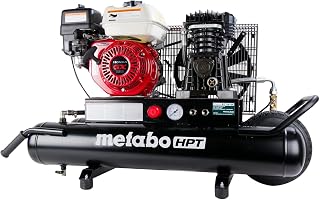 Metabo HPT Gas Powered Wheeled Air CompressorCheck price on Amazon
 Ingersoll Rand SS3J5.5GH-WB 5.5 HP Gas Air CompressorCheck price on Amazon
 VEVOR 15HP Gas Powered Air CompressorCheck price on Amazon
GarageToolHQ earns a commission when you buy through links on our product pages, at no extra cost to you. Read our affiliate disclosure.
Below: how each type makes air, what the gas listings tell us about real output, a head-to-head comparison and the questions to answer before you buy.
gas vs electric air compressor: the short answer
- Pick gas when the work happens away from outlets, when your tools are hungry for air, or when one compressor has to serve the driveway, the field and the job site. Gas brings its own power.
- Pick electric when the compressor lives in the garage, when noise matters to you or the neighbors, and when you would rather flip a switch than check oil and fuel. Electric is the lower-maintenance roommate.
- If you do both, many shops keep a big electric unit in the garage and a small gas wheelbarrow unit for remote work.
How a gas air compressor works
A gas compressor is a small engine driving a pump, usually on wheels or a truck-mount frame. The listings show what that buys you in air. The NorthStar lists a 30-gallon tank delivering 24.4 CFM at 90 PSI from a Honda GX390 engine. Ingersoll Rand’s SS3J5.5GH-WB lists a 5.5 HP engine making 11.8 CFM at 90 PSI into twin 4-gallon tanks, 8 gallons total, with a 135 psi maximum. VEVOR’s 15HP listing claims 33 CFM at 115 PSI from a 30-gallon tank. On the smaller end, Metabo HPT’s EC2510E is an 8-gallon wheelbarrow unit with a Honda GX engine and a 145 PSI maximum, and the Albott lists a 6.5 HP engine on an 8-gallon tank with a 115 PSI maximum. The trade for that output is noise and exhaust: the listings state 70 dB on the Metabo HPT, 89 dB on the Ingersoll Rand 5.5 HP and 69 dB on the Ingersoll Rand 13 HP unit.
Gas means the compressor goes where the work is, but it also means engine care: fuel, oil checks and a machine that must run outdoors. Never run a gas compressor in a closed garage; engine exhaust in an enclosed space is a carbon monoxide hazard, door open or not.
How an electric air compressor works
An electric compressor swaps the engine for a motor, which removes the exhaust, the fuel and most of the noise. It plugs into an outlet or a dedicated circuit, starts with a switch and needs little beyond draining the tank and checking the oil if the pump is oil-lubed. The catch is the leash: it only works where the wiring reaches, and big shop units need a dedicated circuit sized for the motor, which is electrician work, not an extension cord job.
Electric output per dollar runs lower than gas, so sizing matters more. Check the CFM your hungriest tool needs at 90 PSI and buy a compressor whose rated CFM at 90 PSI covers it with room to spare; a compressor that just barely keeps up will run constantly and cycle the motor hard.
Gas vs electric air compressor, head to head
| Gas air compressor | Electric air compressor | |
|---|---|---|
| Power source | Gasoline engine, works anywhere | Motor, needs an outlet or dedicated circuit |
| Air delivery examples | 11.8 CFM at 90 PSI (Ingersoll Rand 5.5 HP) to 33 CFM at 115 PSI (VEVOR 15HP) | Lower CFM per dollar; size to the tool’s 90 PSI requirement |
| Tank sizes listed | 8 to 40 gallons across the listings | Sizes vary by model; see our type guide |
| Noise examples | 69 to 89 dB per the listings | Quieter in general; check the listing’s dB figure |
| Where it runs | Outdoors only, never in a closed garage | Garage, shed or shop near power |
| Upkeep | Fuel, engine oil, pump oil, air filter | Tank draining, pump oil if oil-lubed |
| Best for | Remote work, high air demand, job sites | Garage work, noise-sensitive areas, simple ownership |
Which one fits your garage
Start with where the air gets used. If the answer is the driveway, the fence line or a buddy’s barn, gas wins on portability alone. If the answer is your own garage bay, electric wins on noise, fumes and simplicity. Next, add up the air: list your tools, find each one’s CFM need at 90 PSI and size the compressor to the hungriest one, not the average. Most of the gas listings print CFM at 90 PSI; hold electric listings to the same standard and compare like with like. See our air compressor types guide for the full map of tank styles and pump designs.
Then check the infrastructure. Gas needs nothing but fuel and fresh air. Electric needs a circuit that can carry the motor; if the panel is full or the run is long, price the electrician visit before you price the compressor. A compressor that trips the breaker every cycle is not a bargain at any price.
CFM without a pressure is marketing. The honest listings print CFM at 90 PSI, like the 11.8 CFM at 90 PSI on the Ingersoll Rand 5.5 HP or the 24.4 CFM at 90 PSI on the NorthStar. Compare every candidate at 90 PSI before you decide one out-blows the other.
Drain the tank after use so water does not rust it from the inside, never exceed the tool's rated pressure, wear eye protection, and run 240V units on the circuit the manual calls for. Do not run a gas engine compressor in a closed garage. Read our Safety Disclaimer.
Compressor safety is mostly tank and air safety. Drain the tank regularly so water does not rust it from inside, never defeat or plug the pressure relief valve, and keep the compressor’s stated maximum pressure in mind when you set the regulator. Gas units run outdoors only, and electric units on a proper circuit installed by a licensed electrician.
Frequently Asked Questions
Can I run a gas air compressor in my garage?
No. A gas compressor is a fuel engine, and engine exhaust in an enclosed space is a carbon monoxide hazard even with the door partly open. Run gas compressors outdoors, and use electric in the garage.
How much CFM do I need?
Find the CFM your hungriest air tool needs at 90 PSI and buy a compressor rated above that at the same pressure. The gas listings here print CFM at 90 PSI, from 11.8 on the Ingersoll Rand 5.5 HP to 24.4 on the NorthStar, so you can match the tool to the machine directly.
Are electric air compressors quieter than gas?
Generally yes. The gas listings state 69 to 89 dB, which is engine noise you will hear across the yard. Electric motors hum rather than roar, though big shop units are still loud up close; check the dB figure on the listing you are considering.
Do I need a dedicated circuit for an electric compressor?
Small portable electrics run on a standard outlet, but larger shop compressors need a dedicated circuit sized for the motor. Have a licensed electrician run it; the motor’s draw is not an extension-cord job.
Gas or electric for painting a car?
Painting wants steady, clean air, which means CFM headroom plus filtration. The high-output gas listings, like 33 CFM at 115 PSI on the VEVOR 15HP, have the delivery; a properly sized electric shop unit works too. Either way, add a dryer and regulator setup like our dryer and regulator guide describes, because water in the air ruins paint.
How long does a compressor tank last?
That depends on care more than the badge. Drain the tank after use so moisture does not rust it from inside, and respect the relief valve and maximum pressure. Our can air compressors explode guide covers what actually fails and how to prevent it.
Related: air compressor types for home garages, single stage vs two stage, oil free vs oil lubricated and the air compressors hub.