Breaker Bar vs Ratchet: Which One Should You Buy?
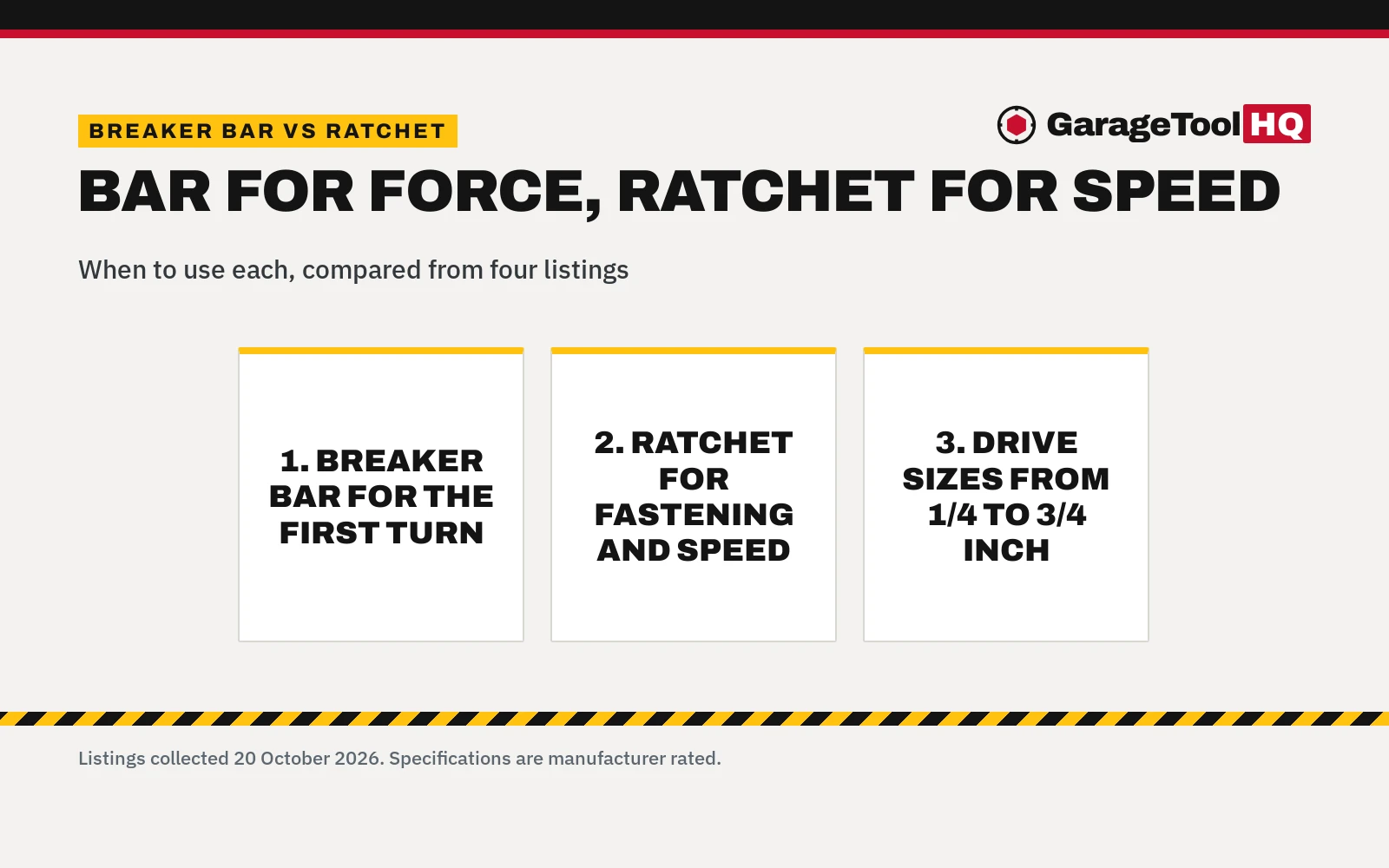
A breaker bar breaks stuck fasteners loose with pure leverage; a ratchet spins them fast. Compare four breaker bar listings and when to use each.

On this page
Top picks at a glance
As an Amazon Associate we earn from qualifying purchases.
- 1
 Neiko 00339A 3/8-Inch-Drive Premium Breaker Bar9.6/10View on Amazon
- 2
 VEVOR 3/8" Drive Impact Socket Set9.8/10View on Amazon
- 3
 DURATECH 1/2" Drive Socket Set9.4/10View on Amazon
- 4
 Neiko 00200A 1/2" Drive Extension Breaker BarView on Amazon
- 5
 DURATECH 3PCS Breaker Bar Set with Upgrade Black PhosphateView on Amazon
- 6
 DURATECH 1/2" Drive 17.5-Inch Heavy Duty Breaker Bar withView on Amazon
- 7
 DURATECH 1/2" Drive 24-Inch Heavy Duty Breaker Bar with 240°View on Amazon
- 8
 WORKPRO 16-inch Dual Drive Breaker BarView on Amazon
- 9
 WORKPRO 24-inch Dual Drive Breaker BarView on Amazon
A breaker bar wins when the bolt will not move; a ratchet wins everywhere else. A breaker bar is a long, non-ratcheting bar that multiplies your force on stuck, rusted or over-torqued fasteners. A ratchet drives fasteners on and off quickly with its gear mechanism but cannot match a breaker bar for pure loosening force. That is the whole breaker bar vs ratchet decision: break it loose with the bar, finish the job with the ratchet.
More options to compare
 Neiko 00200A 1/2" Drive Extension Breaker BarCheck price on Amazon
 DURATECH 3PCS Breaker Bar Set with Upgrade Black PhosphateCheck price on Amazon
 DURATECH 1/2" Drive 17.5-Inch Heavy Duty Breaker Bar withCheck price on Amazon
 DURATECH 1/2" Drive 24-Inch Heavy Duty Breaker Bar with 240°Check price on Amazon
 WORKPRO 16-inch Dual Drive Breaker BarCheck price on Amazon
 WORKPRO 24-inch Dual Drive Breaker BarCheck price on Amazon
GarageToolHQ earns a commission when you buy through links on our product pages, at no extra cost to you. Read our affiliate disclosure.
Breaker bar vs ratchet: the short answer
Use a breaker bar first, then a ratchet. The breaker bar has no gears to strip: it is a solid drive head on a long handle, and the length gives the leverage. The ratchet has a gear and pawl that lets the handle swing back without moving the socket, which makes fastening and unfastening fast, but those small parts are the weak link under brute force. Own both. The bar protects the ratchet, and the ratchet saves the time.
How a breaker bar works
A breaker bar is the simplest tool in the drawer: a square drive head that pivots, a long handle, no gears. You put the socket on, swing the head to the angle that clears the car, and pull. The length is the spec that matters: 15 inches of handle multiplies hand force far beyond what a short ratchet can. The head pivots so the handle can sit at an angle to the fastener, which is what reaches rusted exhaust bolts and suspension nuts in tight spots. The listings here state 180-degree flexible heads on three picks and a 230-degree pivoting head on the longest one.
How a ratchet works
A ratchet adds a gear and a pawl inside the head, so the handle can swing back without turning the socket. That is what makes it fast: you keep the socket on the nut and pump the handle. But the gear teeth are small, and a rusted fastener that needs real force can round or break them. That is why mechanics break fasteners loose with a breaker bar and only then spin them with a ratchet. The two tools are a pair, not rivals.
The four breaker bars in this guide
Four listings, ranked by what each states. The TEKTON SBH00340 is the heavyweight: a 3/4-inch drive bar 40 inches long at 8.5 lb, with a 230-degree pivoting head and an AISI 4140 steel head that the listing says is heat-treated to be stronger and more ductile than the handle. Its stated warranty has no time limits and needs no receipts. One note: the spec table lists other drive sizes and lengths, but the title names the 3/4-inch drive 40-inch bar, and the title wins. This is the bar for axle nuts and suspension bolts on trucks.
The NEIKO 00339A is the precise one: a 3/8-inch drive bar 12 inches long with a hardened Cr-Mo head and Cr-V steel handle, a 180-degree flexible head, and a stated 150 ft-lb torque rating. It states it meets ANSI standards ASME B107.110-2012, the only standard cited in this set, and a spring-loaded ball bearing holds sockets in place. The bullets also mention a 15-inch handle length option, so check which length the listing shows before ordering.
The DURATECH DT401044BBS03 is the set: 3 breaker bars in 1/4, 3/8 and 1/2 inch drives at 6, 10 and 15 inches, with 180-degree rotatable heads, black phosphate coating over forged chrome alloy steel, and a stated 508.5 N m torque rating. The 6-inch bar covers fasteners where a full-length bar cannot swing; the 15-inch covers the rest. Spring-loaded detent balls hold the sockets. No warranty term is stated.
The NEIKO 00200A is the straightforward one: a 1/2-inch drive bar 15 inches long with a rotating flex head in CR-V steel, a 180-degree flexible head, a spring-load ball bearing, and radius corners on the square drive that the listing says reduce socket wear by locking on the sides of the fastener. No torque rating and no warranty term are stated.
Which one should you buy
Match the bar to the job. The TEKTON 40-inch is for the biggest fasteners on trucks and trailers. The NEIKO 3/8-inch with its stated 150 ft-lb rating is for everyday underhood and brake work. The DURATECH set covers all three drives in one purchase, which suits a home mechanic building a drawer from scratch. The NEIKO 1/2-inch 15-inch is the classic single bar for lug nuts and suspension bolts. Whichever you pick, the rule stands: break it loose with the bar, spin it with the ratchet.
Use rated jack stands on solid ground, wear eye protection with power and air tools, keep fuel-burning equipment out of a closed garage, and follow the manual for every tool. Read our Safety Disclaimer.
Frequently Asked Questions
Can a breaker bar replace a ratchet?
No. A breaker bar cannot spin a fastener back without turning the socket, so removing a long bolt takes forever. Use the bar to break the fastener loose, then switch to the ratchet.
Can a ratchet replace a breaker bar?
Not safely. A ratchet has small gear teeth that can strip under the force a rusted fastener needs. Use the breaker bar for the first turn, where the force is highest.
What drive size do I need?
As a rule of thumb, match the drive to your sockets and the job: 1/4 inch for small fasteners, 3/8 inch for general underhood work, 1/2 inch for lug nuts and suspension, 3/4 inch for the largest fasteners. The DURATECH set covers 1/4, 3/8 and 1/2 inch in one purchase.
How long should the handle be?
Longer handles give more leverage: 15 inches is the common 1/2-inch length here, and the TEKTON goes to 40 inches for the toughest jobs. The 6-inch bar in the DURATECH set is for fasteners where a long bar cannot swing.
What does the flex head do?
The head pivots so the handle can sit at an angle to the fastener: 180 degrees on three picks here, 230 degrees on the TEKTON. That is what reaches bolts the straight bar cannot, and the TEKTON’s internal spring holds its head position while you work.
Related: the 1/2 vs 3/8 socket set comparison, the best 1/2 socket set and the 3/8 vs 1/2 torque wrench guide.