120v vs 240v Air Compressor: Which One Should You Buy?
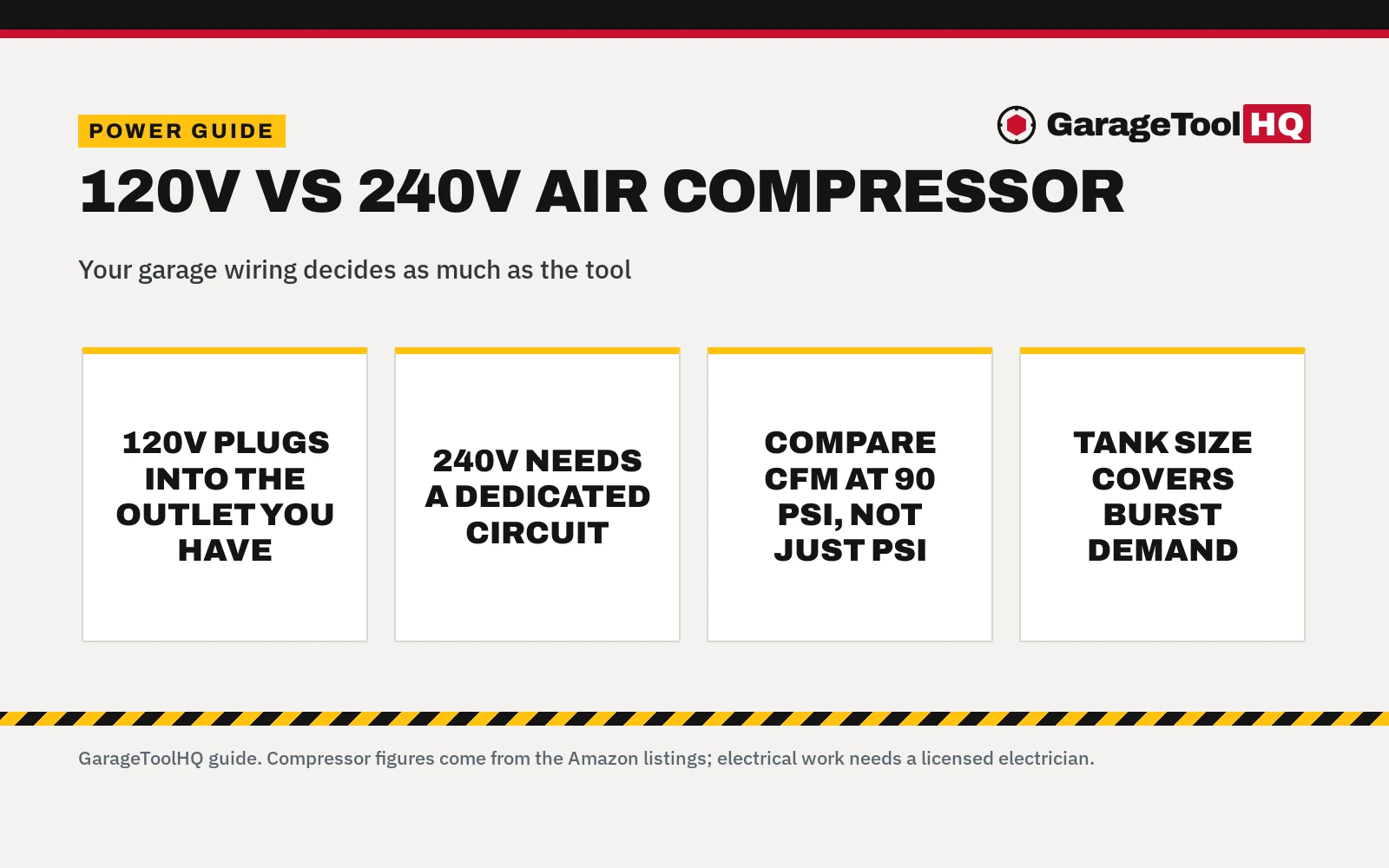
A 120V compressor suits nailers and inflation on a standard outlet; a 240V unit needs a dedicated circuit but feeds grinders, sanders and sprayers.

On this page
Top picks at a glance
As an Amazon Associate we earn from qualifying purchases.
- 1
 Klutch 20-Gallon Air Compressor9.6/10View on Amazon
- 2
 Campbell Hausfeld 80-Gallon Vertical Electric Air Compressor9.7/10View on Amazon
- 3
 Tru-Flate 16-250 Inflator 120V Tankless Wall Mount Digital9.6/10View on Amazon
Picture this job: you want to run a finish nailer and a brad nailer around the garage, or you want to sand and paint with real shop air. The 120v vs 240v air compressor question answers itself once you match the tool to the power your garage already has. A 120V compressor plugs into a regular outlet and suits light air tools, while a 240V compressor needs a dedicated 230/240V circuit and feeds demanding tools like grinders and paint sprayers.
GarageToolHQ earns a commission when you buy through links on our product pages, at no extra cost to you. Read our affiliate disclosure.
Below: what voltage actually changes, when a 120V unit is enough, when 240V earns its wiring cost, and two current compressors compared spec for spec.
120v vs 240v air compressor: what voltage actually changes
Voltage is the size of the electrical pipe feeding the motor, not the air coming out of the hose. A 120V motor on a standard circuit can only pull so much current before a breaker trips; the 120V listing here shows that constraint in practice: 2.6 SCFM and a 6-gallon tank. A 240V motor draws its current across two legs of your panel, which lets it spin a bigger pump longer, so a 240V compressor can deliver the higher CFM and bigger tank that the listing matches to grinding, sanding and painting.
The listings below show the gap clearly. The 120V model lists 2.6 SCFM at 90 PSI and a 6-gallon tank. The 230/240V model lists 7.6 SCFM at 90 PSI and a 60-gallon tank. Same metric, same pressure, nearly three times the airflow and ten times the storage. That is the whole 120V vs 240V story in one comparison: more air per minute and more stored air per cycle.
When a 120V compressor is enough
Stick with 120V when your tools sip air: finish nailers, brad nailers, pin nailers, tire inflation, blow cleaning. The 6-gallon pancake combo in the listings is built exactly for this life: it lists a 10 A maximum current, which a standard circuit handles, and it ships with three nail guns and a 25-foot hose in the box. It is oil-free, so there is no oil to check, and at 30.8 pounds with a carry handle it moves between the garage, the job site and the truck. For trim work, punch list repairs and weekend woodworking, 2.6 SCFM at 90 PSI keeps up fine.
Know the limits. The same listing’s spec table gives the compressor’s maximum horsepower as both 1 hp and 2 hp in different fields, and the air flow capacity field uses a garbled unit instead of SCFM. Trust the title and bullets, which state 2.6 SCFM at 90 PSI and 150 PSI max, and treat the table’s horsepower figures with caution. Also note the noise figure: the spec table lists 82 dB for this unit against 65 dB for the 240V stationary unit below, so the pancake is the louder neighbor.
When 240V makes sense
Step up to 240V when your tools drink air: sanders, grinders, paint sprayers, long runs of air tools that would leave a pancake cycling constantly. The 60-gallon stationary unit below lists 7.6 SCFM at 90 PSI and 6.9 SCFM at 175 PSI from a 3.7 running HP two-stage oil-lubricated cast-iron pump, which is the kind of delivery that keeps a sander spinning without pauses. Its 60-gallon vertical ASME tank stores that air in a 23 by 23 inch footprint, and the maker lists up to 10,000 hours of pump life based on the B-10 bearing rating. The trade: it weighs 255 pounds and stands 33 by 29 by 77 inches, so it lives in one spot, and the bullets state plainly that it requires a dedicated 230/240V electrical supply.
That dedicated supply is not a DIY wiring project. Have a licensed electrician size and install the circuit, and confirm the receptacle and breaker match what the compressor’s manual calls for. Electrical work done wrong is a fire risk, and it is the one part of this decision where guessing costs more than the compressor.
The gear: two compressors from current listings
Ranked by how complete and consistent each listing is.
| Compressor | Voltage | Tank | CFM at 90 PSI | Max PSI | Warranty stated |
|---|---|---|---|---|---|
| Campbell Hausfeld 60-Gallon 2-Stage Air Compressor | 230V motor, 230/240V supply | 60 gallons | 7.6 SCFM | 175 | 3 Year Limited Warranty |
| Craftsman 6-Gallon Pancake Air Compressor 4-Tool Combo Kit | 120V | 6 gallons | 2.6 SCFM | 150 | 1-Year on compressor, 6 months on tools |
1. Campbell Hausfeld 60-Gallon 2-Stage Air Compressor. The most complete listing of the two. It states a 60-gallon vertical ASME tank, a two-stage oil-lubricated cast-iron pump, 175 PSI maximum pressure, 7.6 SCFM at 90 PSI and 6.9 SCFM at 175 PSI, a 3.7 running HP motor and a 3 Year Limited Warranty. The stated job list, grinding, sanding, painting, nailing, inflation and bolting, matches what high CFM and a big tank are for. The listing is internally consistent: title says 230V, bullets say the unit needs a dedicated 230/240V electrical supply. It is stationary at 255 pounds, so it is a one-time placement, not a portable.
2. Craftsman 6-Gallon Pancake Air Compressor 4-Tool Combo Kit. The 120V answer for nailers and light work. The listing states a 6-gallon pancake tank, 150 PSI max, 2.6 SCFM at 90 PSI, oil-free construction, a 30.8-pound build with carry handle and dual quick couplers. It includes three nailers (16GA finish, 18GA brad, 23GA pin) and a 25-foot hose. Watch the spec table contradictions noted above: it lists maximum horsepower as both 1 hp and 2 hp, and gives the air flow capacity in a nonsense unit, so trust the title and bullets. The stated warranty is 1-Year on the compressor and 6 months on the included air tools and accessories.
Drain the tank after use so water does not rust it from the inside, never exceed the tool's rated pressure, wear eye protection, and run 240V units on the circuit the manual calls for. Do not run a gas engine compressor in a closed garage. Read our Safety Disclaimer.
Frequently Asked Questions
Can I run a 240V air compressor on a regular garage outlet?
No. The 240V listing states it requires a dedicated 230/240V electrical supply, which a standard 120V outlet cannot provide. Have a licensed electrician install the right circuit before the compressor arrives.
How many CFM do I need at 90 PSI?
Match CFM to your tools, not to the compressor’s marketing. The listings show the practical range: 2.6 SCFM for nailers and inflation, 7.6 SCFM for sanding, grinding and painting. Check each tool’s manual for its CFM demand and pick a compressor whose stated output at 90 PSI covers the hungriest tool you will run.
Is a 6-gallon pancake compressor enough for air tools?
For nailers and tire inflation, yes: the listing pairs a 6-gallon tank with 150 PSI max and three nail guns in the box. For continuous air-hungry tools, the small tank and 2.6 SCFM may leave you waiting for the pump to catch up, which is where the 60-gallon 7.6 SCFM listing earns its place.
Does a bigger tank replace higher CFM?
Not for continuous tools. The tank stores air for bursts; the CFM is what the pump replaces while you work. A big tank with a small pump only delays the wait, while higher CFM replaces the air as fast as a continuous tool consumes it. The 60-gallon listing gives you both: 60 gallons of storage and 7.6 SCFM of delivery.
Do I need an electrician to install a 240V compressor?
Yes. A 240V compressor needs a dedicated 230/240V circuit, and sizing wire, breaker and receptacle is licensed-electrician work, not a weekend DIY step. Plan that cost into the decision before you buy.
Related: our best air compressor for an impact wrench and best air compressor for a home garage picks, plus guides to air compressor types and air compressor maintenance.