Analog vs Digital Multimeter: Which One Should You Buy?
Analog vs digital multimeter: three analog listings and one digital listing compared by readout, stated accuracy, safety ratings and warranty.

On this page
Top picks at a glance
As an Amazon Associate we earn from qualifying purchases.
- 1
 TOPDC 100A Battery Load Tester9.5/10View on Amazon
- 2
 KAIWEETS Digital Multimeter 20000 Counts Auto-Range Voltmeter9.8/10View on Amazon
- 3
 INNOVA 3320 Auto-Ranging Digital Multimeter9.6/10View on Amazon
- 4
 Gardner Bender GMT-318 Analog MultimeterView on Amazon
- 5
 NJTY S471 Analog MultimeterView on Amazon
- 6
 Tekpower TP8260L Analog Multimeter with Back LightView on Amazon
- 7
 Sanwa YX-360TRF Linear Analog Multimeter Tester YX360TRF NEWView on Amazon
- 8
 Tekpower 8-Function 19-Range Analog MultimeterView on Amazon
- 9
 Tekpower TP7040 20-Range AC/DC Analog Multimeter GeneralView on Amazon
Analog vs digital multimeter comes down to this: pick digital when you want an exact number, pick analog when you want to watch a signal move. Of the four listings here, three are analog needle meters and one, the Fluke 179, is digital with True-RMS and a stated 0.09% basic DC accuracy against the two Gardner Bender listings’ stated plus or minus 5% (the NJTY states no accuracy figure).
More options to compare
 Gardner Bender GMT-318 Analog MultimeterCheck price on Amazon
 NJTY S471 Analog MultimeterCheck price on Amazon
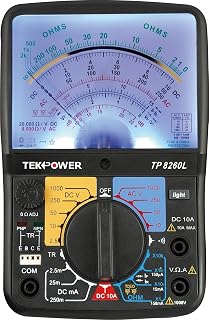 Tekpower TP8260L Analog Multimeter with Back LightCheck price on Amazon
 Sanwa YX-360TRF Linear Analog Multimeter Tester YX360TRF NEWCheck price on Amazon
 Tekpower 8-Function 19-Range Analog MultimeterCheck price on Amazon
 Tekpower TP7040 20-Range AC/DC Analog Multimeter GeneralCheck price on Amazon
GarageToolHQ earns a commission when you buy through links on our product pages, at no extra cost to you. Read our affiliate disclosure.
Below: how the needle and the digits differ in practice, what the four listings state about accuracy and safety ratings, and the four meters ranked.
What the four listings show
Three listings are analog: the Gardner Bender GMT-319 (7 function, 19 range, up to 1000V), the Gardner Bender GMT-318 (6 function, 14 range, 500V) and the NJTY S471 (8-in-1 with a needle display). One listing is digital: the Fluke 179 with a backlit digital display, an analog bar graph and True-RMS AC measurements. So the analog side has the numbers here, but the digital side has the strongest stated specs. Size and weight split the same way: the GMT-318 is the pocket meter at 4.96 ounces and 1.25 by 2.75 by 4.25 inches, while the Fluke 179 is the bench-grade tool at 742 grams and 10.98 by 16.5 by 3.5 inches. The GMT-319 and NJTY state no usable weight figure between them. On warranty, the Fluke 179 states 10 years, the GMT-318 a 1-year limited warranty, and the other two state no specific term.
Readout: needle vs digits
The NJTY listing makes the analog case directly: the needle display gives immediate feedback on fluctuating signals, which suits trend watching. The GMT-319 adds a mirror scale to reduce parallax error when reading the needle, plus an audible continuity buzzer under 100 ohms. The Fluke answers with a 6000-count digital display, display hold, auto hold and min/max-average recording, plus the analog bar graph for the cases where a moving indication helps. Neither style is wrong; they answer different questions.
Accuracy on paper: plus or minus 5% vs 0.09%
The GMT-319 and GMT-318 spec tables both state plus or minus 5% accuracy; the GMT-318 adds a 250 mA fuse and 150 mA DC current in its spec table. The Fluke 179 states 0.09% basic DC accuracy with True-RMS AC current and voltage, 1 kHz AC bandwidth, 1000 V AC/DC and 10 A AC/DC. The NJTY states no accuracy figure. On stated numbers alone the digital listing is far more precise, which is the normal reason to pay for a digital meter.
Safety ratings: CAT vs agency approved
The Fluke 179 states Measurement Category III 1000V and Category IV 600V with True-RMS. The two Gardner Bender listings state agency approved with fuse overload protection circuitry; the GMT-319 adds a separate fused jack for its 10A DC current range. The NJTY states CE and NIST in its spec table with three internal fuse tubes, two spares installed. A stated CAT rating is the clearest safety credential here, and only the Fluke lists one.
Fuses, jacks and what they protect
A meter’s fuse is the part that dies so you don’t. The GMT-319 lists a 250 mA fuse for its low-current ranges plus a separate fused jack for its 10A DC current range, which is the right architecture: the high-current path gets its own protection. The NJTY goes further on paper with three internal fuse tubes, two installed as spares for instant replacement. The GMT-318 states fuse overload protection circuitry without a fuse figure. The Fluke 179 states no fuse figure either, but its CAT III 1000V and CAT IV 600V ratings are the stronger credential: they rate the meter’s ability to survive transient overvoltages, not just its internal fuse. When comparing, a stated fuse figure beats a vague protection claim, and a stated CAT rating beats both.
Continuity, batteries and the extras in the box
Continuity checks are where cheap meters show their design. The GMT-319 states an audible buzzer under 100 ohms plus a zero ohms adjustment dial to reset the meter before resistance measurement, and it checks common 1.5V and 9V household batteries. The NJTY states an audible continuity beep. Neither the GMT-318 nor the Fluke 179 lists a buzzer threshold, though the Fluke covers continuity among its stated functions. On included extras, the GMT-319 and GMT-318 both state replaceable leads, the Fluke 179 includes a temperature probe, leads and an installed 9V battery, and the NJTY lists only the pointer multimeter itself. Replaceable leads matter more than they sound: leads wear out first, and a meter with captive leads becomes disposable.
The four meters, ranked: analog vs digital multimeter
1. Fluke 179. The only digital listing: True-RMS, 6000 counts, 0.09% basic DC accuracy, 1000 V AC/DC, 10 A AC/DC, CAT III 1000V and CAT IV 600V, backlight, built-in temperature with thermocouple, and a stated 10-year warranty. The strongest listing on paper by a wide margin.
2. Gardner Bender GMT-319. The most capable analog listing: 7 functions over 19 ranges, up to 1000V AC/DC, 10A DC on a fused jack, continuity buzzer under 100 ohms, mirror scale against parallax, and agency approved fuse overload protection. No specific warranty term is stated.
3. Gardner Bender GMT-318. The simpler analog: 6 functions over 14 ranges, 500V, agency approved with fuse overload protection, replaceable measurement leads, and a stated 1-year limited warranty. The pick for basic homeowner checks.
4. NJTY S471. The 8-in-1 analog with a needle display, hFE transistor checks, capacitance and dB measurement, CE and NIST in the spec table, and three fuse tubes with two spares. No accuracy figure and no warranty are stated.
Use rated jack stands on solid ground, wear eye protection with power and air tools, keep fuel-burning equipment out of a closed garage, and follow the manual for every tool. Read our Safety Disclaimer.
Frequently Asked Questions
Is an analog multimeter still useful?
Yes for watching trends on a fluctuating signal, which the NJTY listing calls out. For exact readings the Fluke 179’s 0.09% stated accuracy wins.
Which listing states the best accuracy?
The Fluke 179 at 0.09% basic DC accuracy. The GMT-319 states plus or minus 5%.
Which meters state a warranty?
The Fluke 179 states 10 years and the GMT-318 states a 1-year limited warranty. The GMT-319 and NJTY state no specific term.
What do the CAT ratings mean?
They rate the meter for transient overvoltages in different locations. The Fluke 179 states CAT III 1000V and CAT IV 600V; none of the analog listings states a CAT rating.
Related: our best automotive multimeter picks, how to use an automotive multimeter and diagnostics and electrical guides.