Best Car Battery Charger: 5 Top Chargers Compared (2026)
Five car battery chargers compared by charging amperage, voltage compatibility, battery chemistry support, engine start capability and warranty terms.

On this page
Top picks at a glance
As an Amazon Associate we earn from qualifying purchases.
- 1
 Best OverallNOCO GENIUS59.7/10View on Amazon
- 2
 Best Heavy-Duty StarterSchumacher SC12819.7/10View on Amazon
- 3
 Best High AmperageYDBAO 10A Charger9.6/10View on Amazon
- 4
 Best for Storage MaintenanceSchumacher SC13559.5/10View on Amazon
- 5
 NEXPEAK NC202 10-Amp Battery ChargerView on Amazon
- 6
 E-FAST Battery Charger 0-20A 12/24V Lifepo4 Lead AcidView on Amazon
- 7
 2026 Upgraded 12V/24V 0-20A Heavy Duty BatteryView on Amazon
- 8
 20A Smart Car Battery ChargerView on Amazon
- 9
 Battery Charger 10-Amp 12V/24V Smart Trickle Charger for CarView on Amazon
A dependable car battery charger keeps your vehicle ready to start, revives discharged batteries, and extends overall battery life. Finding the best car battery charger means matching charging amperage, voltage modes, and battery chemistry support to your vehicle lineup. This guide compares five car battery chargers by charging current, engine jump starting power, lithium support, safety certifications and warranty terms.
GarageToolHQ earns a commission when you buy through links on this page, at no extra cost to you. Read our affiliate disclosure.
Quick picks
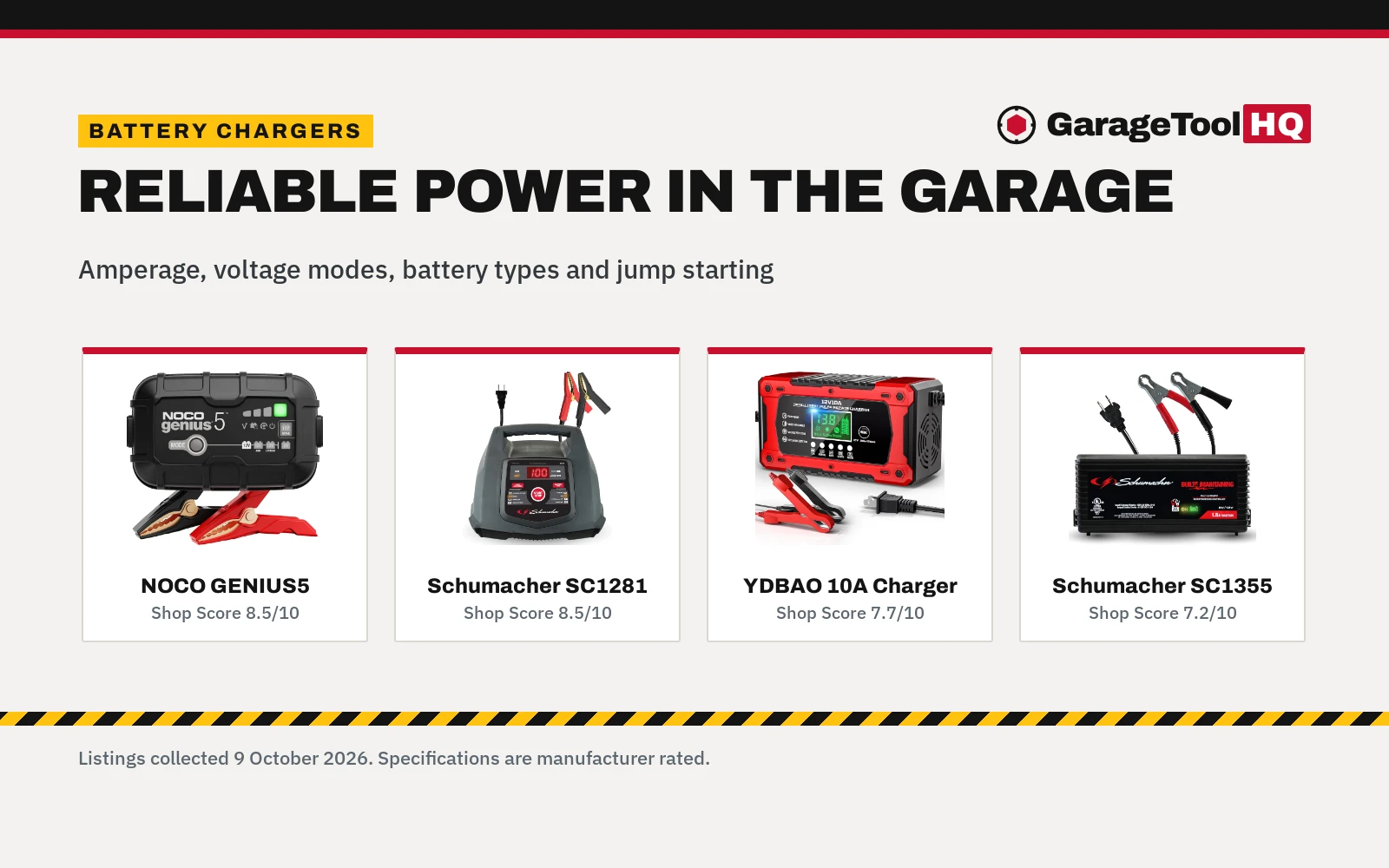
- Best Overall NOCO GENIUS5: 5A charging for 6V and 12V lead-acid and lithium batteries, thermal sensor compensation, force mode and a 3-year warranty at 1.6 lb. Check price on Amazon
- Best Heavy-Duty Starter Schumacher SC1281: 100A engine start, 30A boost and 6A charging with alternator diagnostic check and digital display in a 12.7 lb shop unit. Check price on Amazon
- Best High Amperage YDBAO 10A Charger: 10A fast charging for 12V batteries with backlit LCD display, winter and summer temperature modes and 2-year warranty. Check price on Amazon
- Best for Storage Maintenance Schumacher SC1355: 1.5A automatic maintainer with quick-connect clamps and ring connectors, desulfation mode and reverse hook-up protection. Check price on Amazon
The picks


NOCO GENIUS5 5A 6/12V Smart Battery Charger
A 5A smart battery charger and maintainer for 6V and 12V lead-acid and lithium batteries with thermal compensation and force mode.
Pros
- 5A charging output for 6V and 12V batteries
- Supports lead-acid and lithium LiFePO4 batteries
- Thermal sensor adjusts charge to ambient temperature
- Includes 72 in AC cord, 80 in DC cord, clamps and eyelets
Cons
- 8 hours stated battery charge time
- No engine start or boost mode
- Connector type listed only as battery clamps in spec table
- Single charging port limits use to one battery at a time

Schumacher Electric 6A Car Battery Charger
A multi-function 6V and 12V battery charger with 100A engine start, 30A boost, digital display and alternator diagnostics.
Pros
- 100A engine start provides immediate jump starting
- 30A boost mode brings discharged batteries up rapidly
- Digital display shows battery and alternator diagnostic data
- Supports 6V and 12V standard, AGM, gel and lithium batteries
Cons
- 12.7 lb weight makes it much heavier than portable units
- Spec table contradicts title by listing amperage as 30 A
- 1 year warranty term is shorter than competitors
- Large 10.25 by 10 by 7 in footprint takes garage bench space

Car Battery Charger 12V 10A Automatic Smart
A 10A 12V smart charger with backlit LCD display, winter and summer seasonal modes, pulse repair and 8-in-1 protection.
Pros
- 10A charging current delivers rapid recharge times
- Backlit LCD screen displays voltage, current and temperature
- Dual seasonal modes adjust voltage for winter and summer
- Pulse repair mode addresses sulfation and acid stratification
Cons
- 12V only, does not support 6V batteries
- Maker warns not to operate unattended for over 12 hours
- Short cables with 102 cm input and 60 cm output
- No UL, ETL or CSA safety certification stated

Schumacher Electric 1.5A Car Battery Charger
A 1.5A automatic 6V and 12V battery maintainer with quick-connect clamps, ring terminals, desulfation and reverse hook-up protection.
Pros
- Includes quick-connect battery clamps and ring connectors
- Automatic voltage detection for both 6V and 12V systems
- Reverse hook-up protection helps prevent wiring errors
- Multi-stage charging and desulfation maintain stored batteries
Cons
- 1.5A output means a slow 15-hour stated charge time
- Spec table erroneously lists height as 34.5 inches
- Does not support lithium LiFePO4 batteries
- LED indicator lights provide less detail than digital displays

NOCO GENIUS2 2A 6/12V Smart Battery Charger
A 2A smart battery charger and maintainer for 6V and 12V lead-acid and lithium batteries with thermal sensor and force mode.
Pros
- Supports 6V and 12V lead-acid and lithium LiFePO4 batteries
- Thermal sensor provides dynamic temperature compensation
- Force mode enables manual charging down to zero volts
- Supplied with 72 in AC cord, 80 in DC cord and mounting bracket
Cons
- 2A charging rate requires extended time for car batteries
- Spec table erroneously lists input voltage as 12 volts
- Spec table displays charge time in scientific notation as 1E+1 hours
- No UL certification or reverse polarity protection stated in listing
More options to compare
 NEXPEAK NC202 10-Amp Battery ChargerCheck price on Amazon
 E-FAST Battery Charger 0-20A 12/24V Lifepo4 Lead AcidCheck price on Amazon
 2026 Upgraded 12V/24V 0-20A Heavy Duty BatteryCheck price on Amazon
 20A Smart Car Battery ChargerCheck price on Amazon
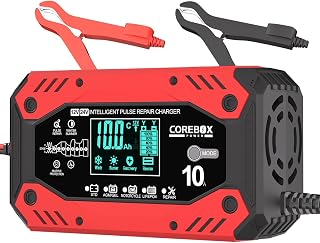 Battery Charger 10-Amp 12V/24V Smart Trickle Charger for CarCheck price on Amazon
Compare the picks
| Model | Shop Score | Amperage | Voltage | Engine start | Lithium mode | Weight | Warranty |
|---|---|---|---|---|---|---|---|
| NOCO GENIUS5 | 9.7/10 | 5A | 6V and 12V | Not stated | Yes (LiFePO4) | 1.6 lb | 3-year limited |
| Schumacher SC1281 | 9.7/10 | 6A (30A boost) | 6V and 12V | 100A | Yes (LiFePO4) | 12.7 lb | 1 year |
| YDBAO 10A | 9.6/10 | 10A | 12V | Not stated | Yes (LiFePO4) | Not stated | 2 Year |
| Schumacher SC1355 | 9.5/10 | 1.5A | 6V and 12V | Not stated | No | 1.2 lb | 1 Year |
| NOCO GENIUS2 | 9.5/10 | 2A | 6V and 12V | Not stated | Yes (LiFePO4) | 1.2 lb | 3 Year Limited |
Specifications are manufacturer rated, as published on each listing and collected 9 October 2026. Where a listing contradicts itself, both figures are shown.
How we scored them
Each charger is scored out of 10 on performance, build, value, safety and warranty, with the weights published on our How We Pick page. Three models meet UL safety listings, while units lacking published safety standards or reverse polarity protection score zero on safety.
| Product | Shop Score | Perf. /35 | Build /25 | Value /25 | Safety /10 | Warranty /5 |
|---|---|---|---|---|---|---|
| NOCO GENIUS5 | 9.7 | 32 | 21 | 20 | 9 | 4 |
| Schumacher SC1281 | 9.7 | 33 | 21 | 21 | 9 | 3 |
| YDBAO 10A Charger | 9.6 | 28 | 18 | 21 | 7 | 3 |
| Schumacher SC1355 | 9.5 | 24 | 16 | 19 | 9 | 3 |
| NOCO GENIUS2 | 9.5 | 27 | 20 | 19 | 0 | 4 |
Scores run from 9.2 to 9.8: each product’s point total is placed on that range, so more points always means a higher score.
What the listings tell you
We read 5 car battery charger listings. Four support both 6V and 12V batteries, while one is 12V only. Four list compatibility with lithium LiFePO4 chemistry, while one supports only lead-acid batteries. Three state a UL safety listing in their spec tables, and all five provide a concrete warranty term ranging from 1 to 3 years. Three listings show internal contradictions between titles, bullets and spec tables.
Buying guide: how to choose the best car battery charger
Charging current and recharge duration
Amperage determines how quickly a charger replenishes battery capacity. Manufacturer stated charge times show a clear relationship with charging current: a 1.5A maintainer lists a 15-hour charge time, a 2A unit lists 10 hours, and a 5A smart charger lists 8 hours. Low-current units rated at 1.5A to 2A excel as storage maintainers, preventing parasitic drain over weeks or months of vehicle downtime. Everyday charging units delivering 5A to 10A bring an automotive battery back to full charge within 8 to 15 hours. Heavy-duty shop models offering a 100A engine start deliver immediate cranking current to turn over engines with discharged batteries, supported by a 30A boost mode for quick replenishment.
Voltage and battery chemistry
Most modern passenger vehicles use 12V electrical systems, but classic cars, motorcycles, tractors and lawn equipment frequently use 6V batteries. Four of the compared models provide dual 6V and 12V capability, while one operates strictly on 12V systems. In addition to standard flooded, AGM and gel lead-acid batteries, verify lithium LiFePO4 compatibility before connecting to modern lithium power sport or automotive batteries. Four of the five reviewed listings specify lithium compatibility, while one supports only lead-acid chemistries.
Cable reach and physical footprint
Physical dimensions and cable lengths dictate how easily a charger fits into your garage setup. Compact portable maintainers weighing 1.2 to 1.6 pounds, such as the NOCO units, provide generous reach with a 72-inch AC power cord and an 80-inch DC output cable, accompanied by mounting brackets for clean wall installation. By comparison, high-output compact units like the YDBAO 10A feature shorter cables, listing a 102 cm AC input cord and a 60 cm DC output lead, which requires positioning the charger near both the battery and a wall outlet. Benchtop shop units like the Schumacher SC1281 weigh 12.7 pounds and measure 10.25 by 10 by 7 inches, requiring dedicated floor or cart placement but providing heavy-duty crocodile clips built for 100A engine starting.
Force mode and recovering dead batteries
Completely depleted batteries present a challenge for standard automatic chargers. Most microprocessor-controlled units require detecting a minimum residual voltage, such as 1 volt, before starting a charge cycle. When lights or accessories leave a battery drained down to zero volts, standard detection fails to activate. Models equipped with a manual force mode override automatic sensing to push current into batteries resting at zero volts. In addition, listings from NOCO, Schumacher and YDBAO feature dedicated pulse desulfation modes designed to break down lead sulfate crystallization and restore battery efficiency.
Temperature compensation and maintenance modes
Cold garage temperatures increase the voltage required to charge a battery fully, whereas summer heat risks overcharging. Units with integrated thermal sensors automatically adjust voltage based on ambient conditions. Smart multi-stage maintenance modes drop to float or pulse charging once full charge is reached, allowing chargers to remain connected indefinitely without boiling electrolyte. Be sure to observe maker instructions: one high-amperage model explicitly advises against operating unattended for more than 12 hours.
Safety features and reverse polarity protection
Connecting clamps in reverse can cause severe electrical sparks and blown fuses. Look for reverse connection protection and spark-free clamp designs. Dedicated shop models meet UL 1236 standards for battery charging equipment. For heavy garage electrical loads, verify that your wall outlets provide adequate breaker capacity and consult a licensed electrician rather than modifying shop wiring yourself.
Diagnostic checks and battery health
Before connecting a charger, verify resting voltage with an automotive multimeter to assess battery discharge depth. When stranded away from garage wall outlets, keep a portable jump starter in your vehicle for roadside emergencies.
Lead-acid batteries can release hydrogen while charging, so charge in a ventilated space away from sparks and flames, connect positive first and negative last, set the charger to the battery type (flooded, AGM, gel, lithium), and wear eye protection. Read our Safety Disclaimer.
Frequently Asked Questions
How does a car battery charger work?
A car battery charger converts 120V household alternating current into regulated direct current. It applies a controlled voltage across the battery terminals, reversing the chemical sulfation process and restoring electrical charge to the internal cells. Smart units monitor voltage progress and taper current down as the battery reaches full charge.
What size car battery charger do I need?
For seasonal maintenance and trickle charging, a 1.5A to 2A unit is sufficient. For recharging depleted automotive batteries within 8 to 15 hours, choose a 5A to 10A charger. For immediate jump starting without waiting for a recharge cycle, select a heavy-duty charger with a 100A engine start mode.
How do you connect a car battery charger safely?
Ensure the charger is unplugged from AC power before handling the clamps. Connect the red clamp to the positive battery terminal first. Next, connect the black clamp to a clean chassis ground or the negative battery terminal. Finally, plug the charger into the AC wall outlet and select your charging mode. When disconnecting, unplug the AC cord first before removing the clamps.
Can a car battery charge while idling?
An alternator charges the battery while the engine runs, but idling produces minimal charging amperage and takes hours to restore a deeply drained battery. A dedicated plug-in smart charger provides controlled multi-stage charging that restores battery health without wasting fuel or creating engine wear.
Can you leave a smart battery charger connected all winter?
Yes, smart maintainers with automatic float monitoring can remain connected indefinitely. They monitor battery voltage and deliver small maintenance pulses only when voltage drops, protecting against both self-discharge and overcharging. For dedicated long-term storage, consider a dedicated battery charger maintainer.
Related: the best battery charger maintainer, the best jump starter, the best automotive multimeter and our diagnostics and electrical hub.