Quick Connect vs Threaded Air Fittings: Which One Should You Buy?
Quick connect or threaded air fittings? Couplers own the joints that change hourly; threads own the joints that stay made. Four fitting kits compared.

On this page
Top picks at a glance
As an Amazon Associate we earn from qualifying purchases.
- 1
 22 Pieces Air Compressor Accessories Kit with 25ft Hybrid Air9.6/10View on Amazon
- 2
 Flexzilla Air Compressor Hose9.8/10View on Amazon
- 3
 22 Pieces Air Compressor Accessories Kit with Recoil Poly Air9.6/10View on Amazon
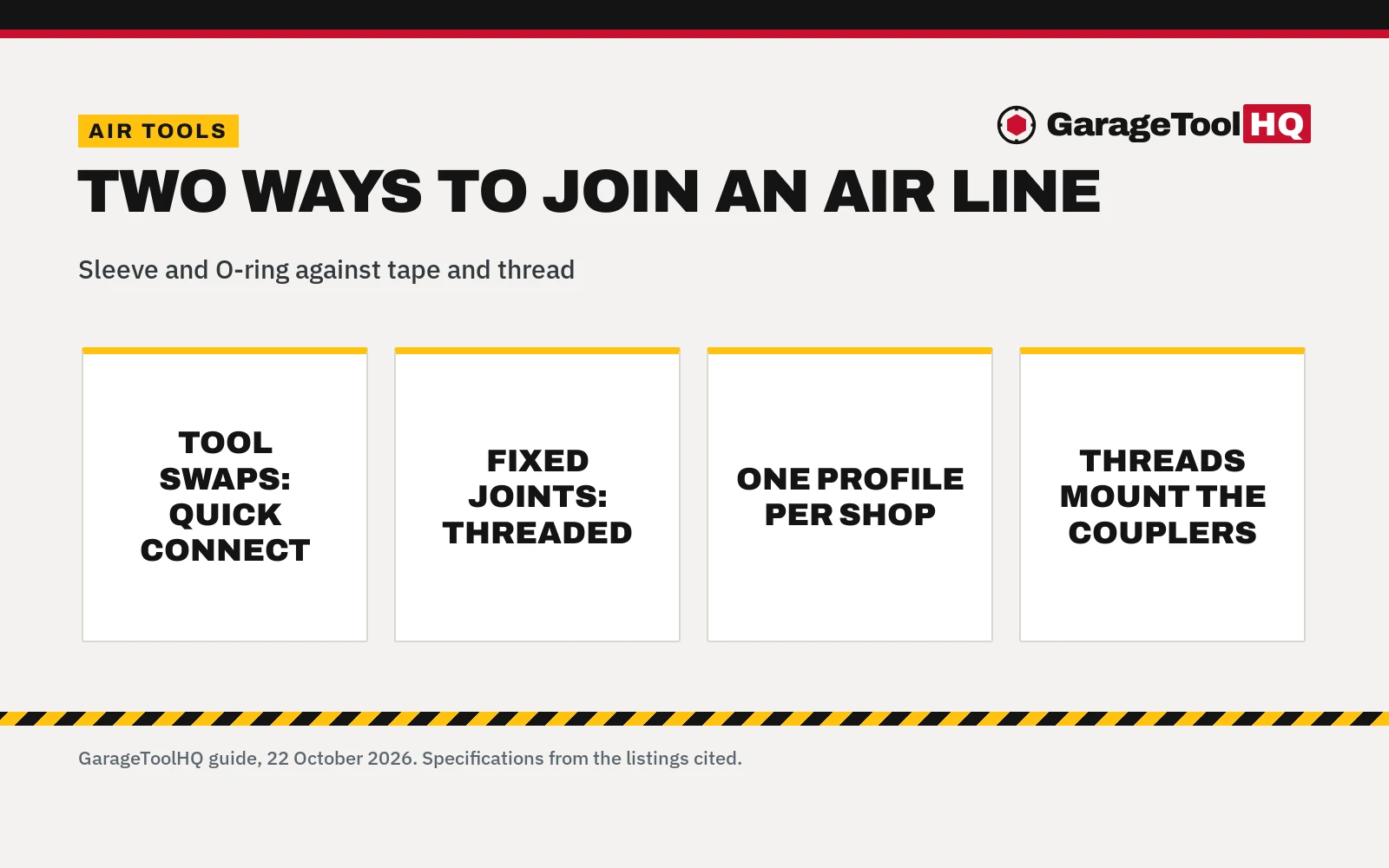
Quick connect vs threaded air fittings: which should you use? Use quick connect fittings anywhere a tool changes during the day: the coupler on the hose end and the plug on each tool, so tools swap with one pull of a sleeve. Use threaded connections for the joints that stay made: the regulator, the hose ends themselves, drops and manifolds, sealed once with tape or sealant. In a working garage the two are not rivals. Every quick coupler in the listings below is itself threaded onto something with a 1/4 inch NPT thread.
GarageToolHQ earns a commission when you buy through links on our product pages, at no extra cost to you. Read our affiliate disclosure.
Below: how the two connections seal and fail, where each one belongs in a home air system, four fitting kits from current listings, and the questions buyers ask before stocking a drawer.
Quick connect vs threaded air fittings: how each one seals
A threaded fitting seals on the thread itself. NPT threads are tapered, so the joint wedges tighter as it is made up, and the seal is finished with PTFE tape or a thread sealant filling the spiral gap. Made once and left alone, it is a strong and inexpensive joint in the system. Its cost is time and tools: every change is a wrench job, and a joint that is broken and remade often wears its threads and starts to weep.
A quick connect fitting seals on an O-ring inside the coupler, and locks with ball bearings that drop into a groove on the plug. Pull the sleeve, the bearings release, and the tool is off; push the plug in and it clicks home. Nothing about the seal depends on thread tape, which is why it tolerates repeated changes. Its costs are the coupler’s moving parts, a small pressure drop through the plug, and one hard rule: couplers and plugs come in profiles (the listings here are industrial, also called M style), and a plug only locks into a coupler of its own profile.
| Quick connect | Threaded (NPT) | |
|---|---|---|
| Seal | O-ring inside the coupler | Tapered thread wedged tight, finished with tape or sealant |
| Locking | Ball bearings into a groove on the plug | The thread itself |
| Changing a tool | One pull of the sleeve, no tools | Wrench work, and fresh tape on remake |
| Best place | Tool inlets and hose-end couplers | Regulators, manifolds, drops, coupler-to-hose joints |
| Watch out for | Profile must match: industrial (M), automotive and ARO plugs differ | Over-tightening cracks cast ports; under-sealing weeps |
Where quick connect wins
- Tool changes. One hose feeding a blow gun, an impact wrench and a tire inflator in the same hour is quick connect work.
- Repeat connections. The O-ring seal does not care how many times it is made, where a remade thread joint needs fresh tape each time.
- Gloved and one-handed work. A knurled or guarded sleeve, both stated in the listings below, works with gloves on and resists being knocked open.
- Standardizing a shop. Put the same profile plug on every tool and any hose in the building fits any tool.
Where threaded wins
- Permanent joints. The run from compressor to regulator to manifold should be threaded once, sealed, and left for years.
- High-vibration and fixed lines. A made-up thread resists being knocked loose by a dragging hose the way a coupler sleeve can be caught.
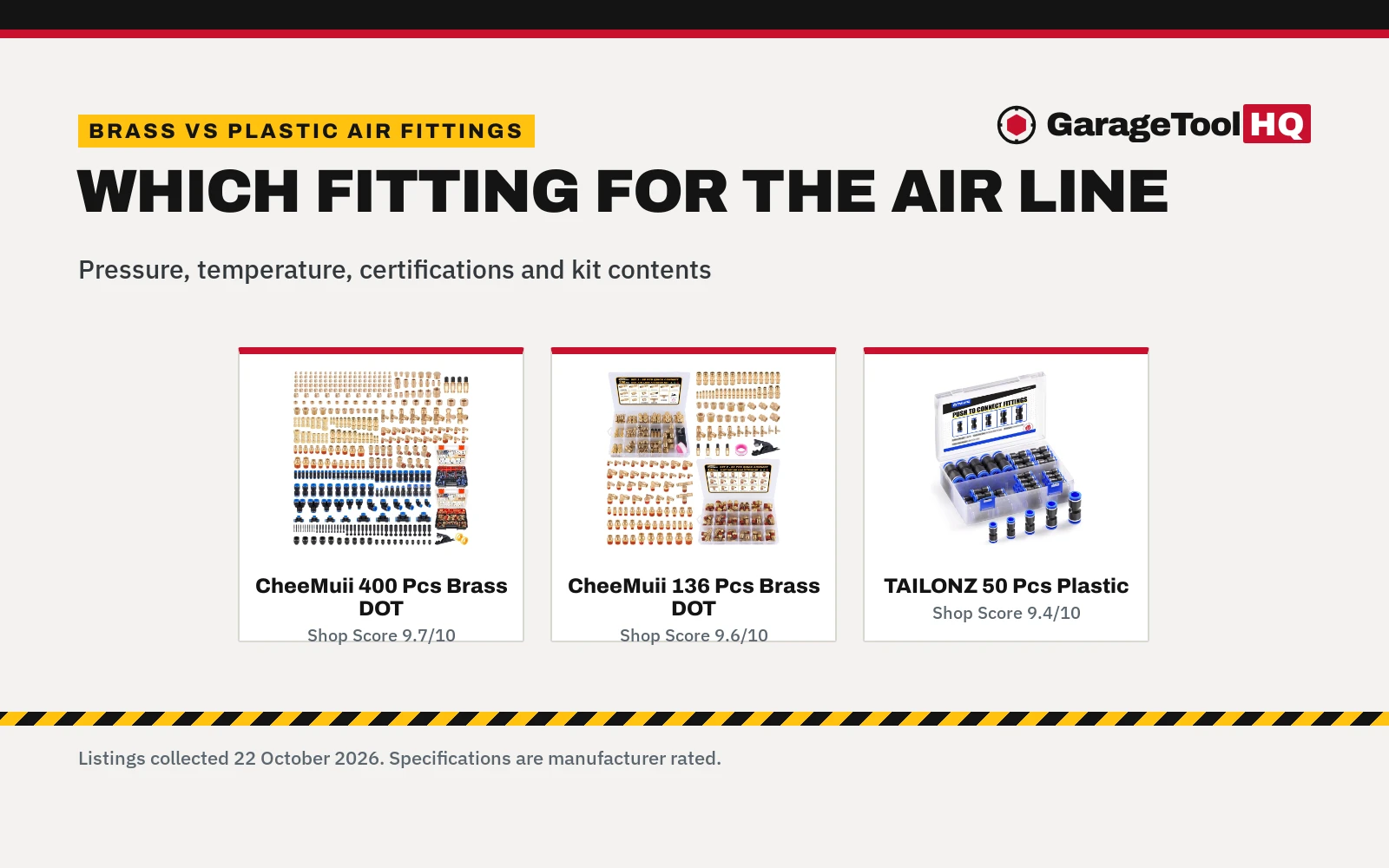
- Air lines on the vehicle. DOT air brake and suspension lines use threaded and push-to-connect brass fittings rated and approved for the job, like the CheeMuii kit below, not shop couplers.
- Cost per joint. A threaded nipple or bushing is the cheapest fitting in the drawer, which matters across a whole plumbed shop.
The gear: four fitting kits
The current listings are all quick connect kits and air line fittings, ranked by what they state and how completely they cover a home garage.
1. FYPower Aluminum Air Fittings Kit, 15 Pieces
The complete starter: couplers and plugs together in one 15-piece kit, all 1/4 inch NPT, in green anodized aluminum. The bullets state a universal coupler and industrial plugs interchangeable with most manufacturers, male threads with sealant plus Teflon tape in the kit for the threaded side of the job, and a sleeve guard that reduces accidental disconnects and protects the coupler sleeve. Who it fits: a first air setup that needs both halves of the quick connect pair and the tape to mount them.
2. SUNGATOR Brass FNPT Industrial Couplers, 10 Pack
The coupler half, done properly: ten 1/4 inch female NPT industrial couplers in solid brass, organized in a plastic case. The listing’s stated edge is 6 ball bearings for the hold, against the 4 it says lesser fittings use, and a knurled sleeve for grip that also guards against accidental disconnects. The couplers adapt to industrial I/M/D type plugs. Who it fits: a shop standardizing its hose ends on brass couplers, with plugs bought separately.
3. SUNGATOR Industrial Plugs, 25 Pack
The plug half, in workshop quantity: twenty-five 1/4 inch male NPT industrial plugs in zinc plated hardened steel, rated up to 300 Psi per the listing. The threads are pre-coated, which the maker says seals without tape and saves the wrapping time, and the profile is industrial, also called M style, compatible with M style (D type) couplers. Who it fits: anyone putting a plug on every tool in the drawer, which is most of the cost of a quick connect conversion.
4. CheeMuii Brass DOT Air Line Fittings Kit, 136 Pieces
The specialist: a 136-piece assortment of brass DOT push-to-connect air line fittings in 5/32, 1/8, 1/4, 3/8 and 1/2 inch sizes, with tees, unions, elbows, swivel elbows, bushings, couplings, four Schrader inflation valves for air suspension, a tube cutter and Teflon tape. The bullets state CA360 pure brass meeting DOT FMVSS 571.106 and SAE J1131 air brake requirements, working pressure from vacuum to 800 PSI and temperatures from -40°F to +248°F. One flaw: the spec table gives the package quantity as 76 pieces against the 136 stated everywhere else, so trust the title and bullets. Who it fits: air brake and air suspension line work on trucks, not daily tool swapping.
Can you mix quick connect and threaded fittings?
You will, because the system is built that way. The coupler on your hose end threads onto the hose. The plug on your tool threads into the tool. The regulator those hoses hang from is threaded into the line. Quick connect owns the joints that change by the hour; threaded owns the joints that change by the year. The mistakes are using each where the other belongs: a coupler where a dragging hose can catch its sleeve, or a threaded joint on a tool you swap six times a day.
Wear eye protection with every air tool, use impact-rated sockets on impact wrenches, disconnect the air line before changing accessories, and finish lug nuts with a torque wrench to the vehicle's spec. See OSHA eye and face protection. Read our Safety Disclaimer.
Frequently Asked Questions
Are all quick connect air fittings compatible?
No. Couplers and plugs are made in profiles, and a plug only locks into its own. The SUNGATOR listings here are industrial profile, also called M style, and state compatibility with I/M/D type plugs and couplers; the FYPower coupler is stated as universal and interchangeable with most manufacturers. Pick one profile for the shop and buy everything to it.
Do quick connect fittings leak more than threaded ones?
They fail differently. A threaded joint weeps when it is under-sealed or remade too often; a quick coupler leaks when its O-ring is worn or the plug is scored. Both listings families here attack the threaded side of that with pre-coated threads (SUNGATOR plugs) or sealant and tape in the kit (FYPower).
What size air fittings does a home garage need?
1/4 inch NPT is the size across the three shop kits here: the FYPower kit, both SUNGATOR packs. The CheeMuii DOT kit runs wider, 5/32 to 1/2 inch, because vehicle air lines use more sizes than shop tools do.
Do I need thread tape on quick connect plugs?
On the plug’s threaded end, the joint into the tool is still a thread joint. The SUNGATOR plugs are pre-coated to seal without tape per the maker; the FYPower kit includes Teflon tape for its threads. The quick connect end itself never takes tape: it seals on the coupler’s O-ring.
What are DOT air fittings for?
Air brake and air suspension lines on trucks and trailers. The CheeMuii kit states DOT FMVSS 571.106 approval and SAE J1131 requirements, with working pressure to 800 PSI; those are vehicle air line fittings, a different drawer from shop tool couplers.
Related: the air compressors hub, air compressor types, air compressor maintenance and the dryer and regulator set up guide.