Gasless vs Gas MIG Welder: Which One Should You Buy?
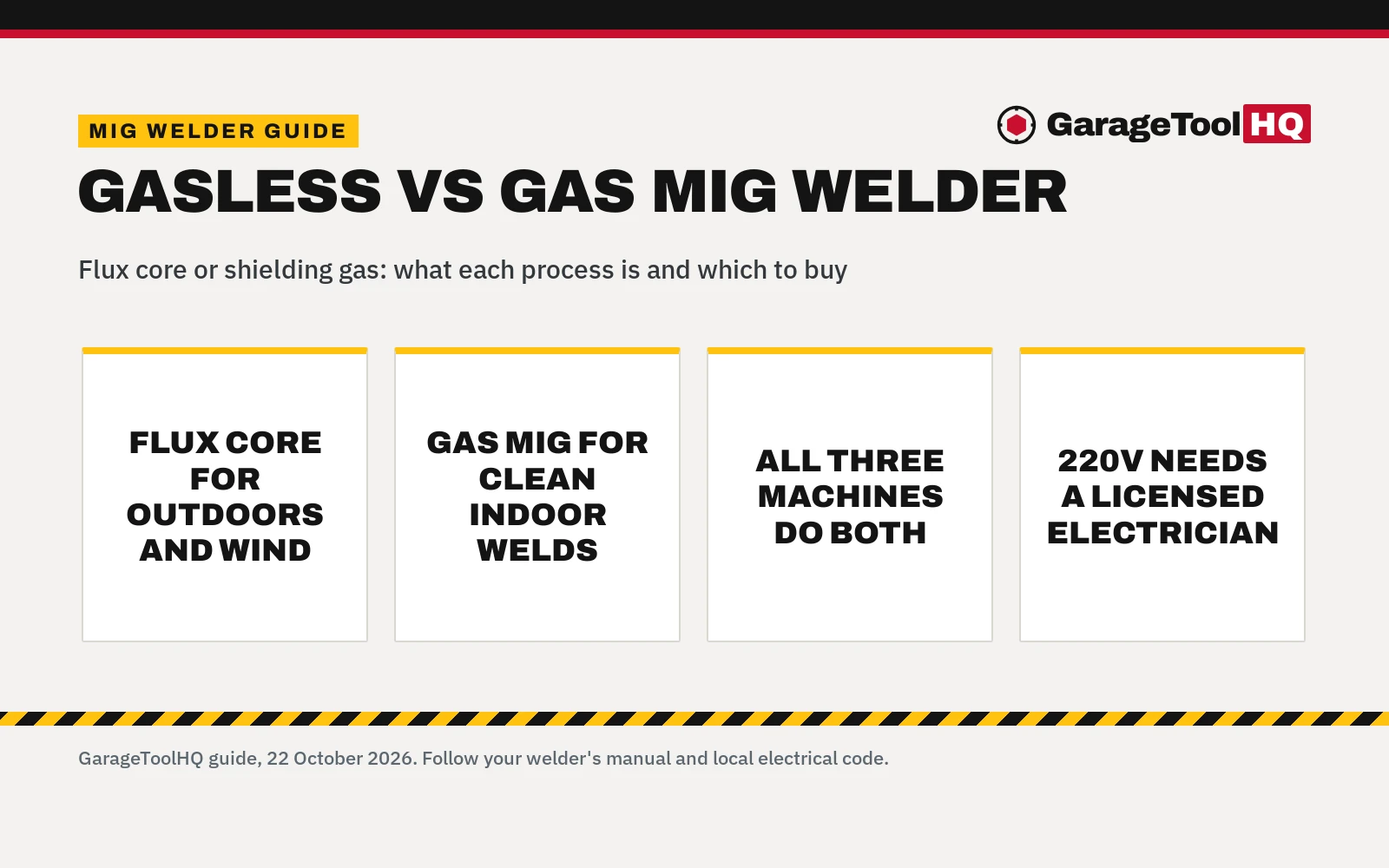
Flux core wins outdoors and in wind; gas MIG wins indoors for cleaner welds. Three dual-mode machines that do both, compared from their listings.

On this page
Top picks at a glance
As an Amazon Associate we earn from qualifying purchases.
- 1
 Weldpro 200 Amp MIG Welder9.8/10View on Amazon
- 2
 ARCCAPTAIN 200A MIG Welder 110V 220V 6 in 1 Aluminum Welding9.7/10View on Amazon
- 3
 ARCCAPTAIN 165A MIG Welder 110V 220V 4-in-1 Gasless Gas MIG9.6/10View on Amazon
- 4
 165A MIG WelderView on Amazon
- 5
 200A MIG WelderView on Amazon
- 6
 VEVOR MIG WelderView on Amazon
- 7
 150A 3-in-1 Synergic MIG Flux Core Spot Welder 120V PortableView on Amazon
- 8
 135A MIG WelderView on Amazon
- 9
 160A MIG WelderView on Amazon
Gasless vs gas MIG welder: which one should you buy? Buy gasless (flux core) if you weld outside or in wind, and buy gas MIG if you weld indoors and want the cleaner welds the listing promises on stainless or carbon steel. Flux core wire carries its shielding inside the wire, so wind cannot blow it away; gas MIG feeds solid wire under a bottle of shielding gas, which the bestarc listing pairs with clean, precise results but which loses its shield in wind. If you cannot decide, get a machine that does both: all three welders featured below run flux core and gas MIG, plus Stick and Lift TIG.
More options to compare
 165A MIG WelderCheck price on Amazon
 200A MIG WelderCheck price on Amazon
 VEVOR MIG WelderCheck price on Amazon
 150A 3-in-1 Synergic MIG Flux Core Spot Welder 120V PortableCheck price on Amazon
 135A MIG WelderCheck price on Amazon
 160A MIG WelderCheck price on Amazon
GarageToolHQ earns a commission when you buy through links on our product pages, at no extra cost to you. Read our affiliate disclosure.
Below: what each process actually is, when each one wins, three dual-mode machines that do both, and how to power them.
Gasless vs gas MIG welder: the short answer
The difference is where the shielding comes from. In gasless MIG, properly called flux core (FCAW), the wire is a hollow tube filled with flux; the bestarc listing names E71T-GS flux-cored wire for this mode. In gas MIG (GMAW), the wire is solid and a bottle of shielding gas protects the weld; the bestarc listing names ER70S-6 solid wire for that mode. The practical split the listings describe is simple: the bestarc maker says to run solid MIG mode with solid wire for clean, precise results on stainless or carbon steel, and to run gasless flux-core mode when working outdoors or in a windy environment for stable, reliable welding anywhere. So the question is really about where you weld. A farm repair on a fence line in the wind points to flux core. A patch panel in a closed garage points to gas MIG. And since every machine featured below does both, you can start with one process and switch later without buying a second welder.
What gasless MIG (flux core) actually is
Flux core wire shields the weld from the inside out, which is why the listings pitch it for outdoor work. The HITBOX HBM145 supports 0.8 mm and 1.0 mm flux core wire and ships with 0.8 mm flux core wire in the box. The bestarc MIG165 takes 0.030, 0.035 and 0.040 inch flux core wire and ships with 0.040 inch flux cored wire. The FEMEROL MIG200R takes .023, 0.030 and 0.035 inch flux core wire. The bestarc listing is explicit about the use case: when working outdoors or in a windy environment, run the gasless flux-core mode. No gas bottle means one less thing to buy, haul and refill, which is why flux core suits farm repairs, fence work and anywhere the wind moves. The trade is that you buy the wire in the right diameter for the machine; all three listings state which diameters each machine takes, so match the spool to the listing.
What gas MIG (GMAW) actually is
Gas MIG feeds solid wire while shielding gas flows from a bottle through the torch. The bestarc listing describes it directly: run the solid MIG mode with solid wire for clean, precise results when welding stainless or carbon steel. The bestarc takes 0.030 inch solid wire and ships a 0.030 inch solid wire spool in the box; the FEMEROL takes .023, 0.030 and 0.035 inch solid wire. The bestarc package includes a 2 meter hose for the gas side. Gas MIG suits indoor work: a garage with the doors closed, sheet metal, auto body panels and exhaust pipe, where calm air lets the gas shield do its job. The FEMEROL listing names welding fence, automotive exhaust pipe and metal crafts among its applications. You will need a bottle and regulator on top of the machine, which the listings do not include, so factor that into the real cost of going gas.
Which one should you buy
Match the process to the place. If your welding happens outside, on the farm, at the fence line or in a breezy barn, flux core is the practical pick, and the bestarc listing says so outright. If your welding happens inside a closed garage on clean steel, sheet metal or exhaust work, gas MIG gives the cleaner result the listings promise. Beginners get help either way: all three machines state synergic control: the HITBOX and the bestarc match voltage and wire feed speed after you set the current, while the FEMEROL matches current and wire feed speed from the wire diameter and gas material you select. The HITBOX calls itself beginner friendly with plus or minus 3V fine tuning; the bestarc lets you fine tune between minus 3V and 3V and says it suits both beginners and seasoned welders; the FEMEROL matches current and wire feed speed automatically when you select wire diameter and gas material, with manual mode for experienced welders. If you weld in both places, and most home welders do, buy a dual-mode machine and run flux core outside and gas inside. That is what the three machines below are for.
Three dual-mode machines that do both
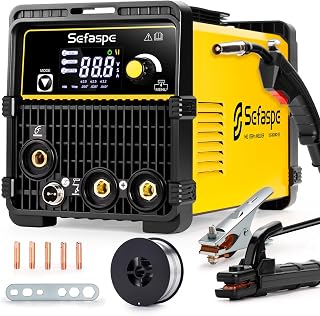
Every welder here runs both processes, plus Stick and Lift TIG, so the choice between them comes down to output, weight and what ships in the box.
HITBOX HBM145: the light one
The HITBOX is a 145A machine at 9.9 pounds, the lightest here, with 110V and 220V dual voltage. Its bullets describe Flux Core MIG, Stick and Lift TIG with synergic control and plus or minus 3V fine tuning, an LCD display, and Stick aids including adjustable hot start, arc force, anti-stick and VRD. The box includes the MIG torch, ground clamp, electrode holder, 0.8 mm flux core wire, welding rods, an adapter plug, a brush and the manual. Two notes from the listing: the title says 4-in-1 while the bullets describe three processes, and the title mentions a spool gun that the bullets say is not included, along with the Lift TIG torch. Read it as a three-process machine and you will not be surprised.
bestarc MIG165: the middleweight
The bestarc is a 165A machine with 110V and 220V dual voltage that the listing says identifies the input voltage automatically. It runs solid and gasless MIG, Lift TIG and Stick, with synergic control, a large LED display, 2T and 4T trigger modes and an IGBT inverter. It takes E71T-GS flux core wire and ER70S-6 solid wire, in 0.030, 0.035 and 0.040 inch flux core and 0.030 inch solid, and the box includes both wire types, contact tips, wire feed rollers, a 2 meter hose, a 220V to 110V adapter and a shoulder strap. The maker states protections against over-current, over-load and over-heating, plus compensation for voltage fluctuation. One contradiction: the bullets state 13.7 pounds while the spec table states 22.8 pounds; the title and bullets win, so expect the lighter figure. It was first listed December 15, 2024.
FEMEROL MIG200R: the most powerful
The FEMEROL is a 200A machine, the highest output here, with 110V and 220V dual voltage and a large LED display. It runs Gas MIG (GMAW), gasless flux core (FCAW), Stick and Lift TIG, with synergic or manual MIG; the maker says it welds mild steel up to 8.0 mm plate and names fence, automotive exhaust pipe and metal crafts as applications. It takes .023, 0.030 and 0.035 inch wire in both solid and flux core. It weighs 29.8 pounds, the heaviest here, and the box includes the MIG gun, ground clamp, electrode holder and brush. The maker states a two year warranty and built-in over-current, over-load, overheating and over-voltage protection. If your work includes thicker plate, the extra amperage is the reason to carry the extra weight.
Power and setup
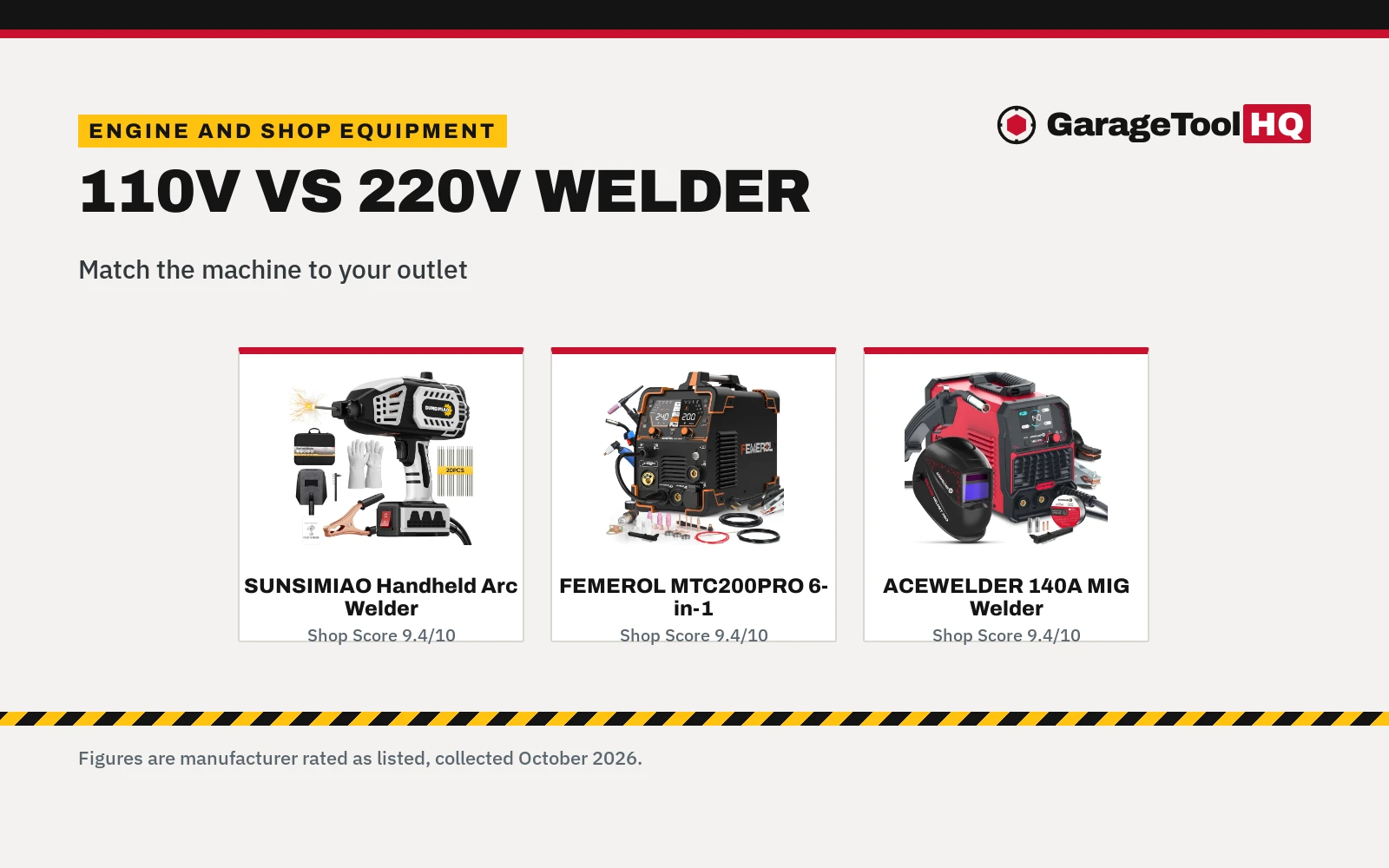
All three machines state 110V and 220V dual voltage. The HITBOX bullets say to use 110V for home garages and small jobs, or 220V for more stable output on workshop repair tasks; the bestarc says its design works in different power environments for greater convenience. Both the HITBOX and the bestarc ship an adapter for the two voltages. A 220V circuit in a garage is not a DIY wiring project: have a licensed electrician install or check the outlet before you plug a welder into it. The machines themselves are portable, with the HITBOX at 9.9 pounds and the bestarc shipping a shoulder strap, but the circuit they plug into is permanent work for a professional.
Frequently Asked Questions
Can I use gas MIG outside?
The listings say wind is the problem gas MIG cannot solve. The bestarc maker says to run the gasless flux-core mode when working outdoors or in a windy environment, and to save solid MIG mode for calm, indoor work.
What wire does flux core welding use?
Flux-cored wire, sized to the machine: 0.8 mm and 1.0 mm for the HITBOX, 0.030, 0.035 and 0.040 inch for the bestarc, which names E71T-GS, and .023, 0.030 and 0.035 inch for the FEMEROL. Solid MIG uses solid wire: 0.030 inch for the bestarc, which names ER70S-6, and .023, 0.030 and 0.035 inch for the FEMEROL.
Do I need a gas bottle for flux core?
No bottle is stated for flux core mode; the wire carries its own shielding. Solid MIG is the gas mode, GMAW per the FEMEROL listing, and the bestarc ships a 2 meter hose for it. The bottle and regulator are separate purchases the listings do not include.
Which process is better for a beginner?
All three machines state synergic control that matches voltage and wire feed speed after you set the current, which the listings pitch at beginners. The HITBOX calls itself beginner friendly; the bestarc says it suits beginners and seasoned welders; the FEMEROL sets itself automatically from wire diameter and gas selection.
Can these welders also do Stick and TIG?
Yes. All three list Stick (MMA) and Lift TIG alongside both MIG modes. Note the exclusions the listings state: the Lift TIG torch is not included with the HITBOX or the FEMEROL, and the HITBOX spool gun is not included either.
Related: best MIG welder for beginners, best flux core welder for beginners, flux core vs stick welder, and the engine and shop equipment hub. Also see our 110V vs 220V welder. Also see our best MIG welder for home garage. Also see our best 110V MIG welder.