Chain Hoist vs Come Along: Which One Should You Buy? (2026)
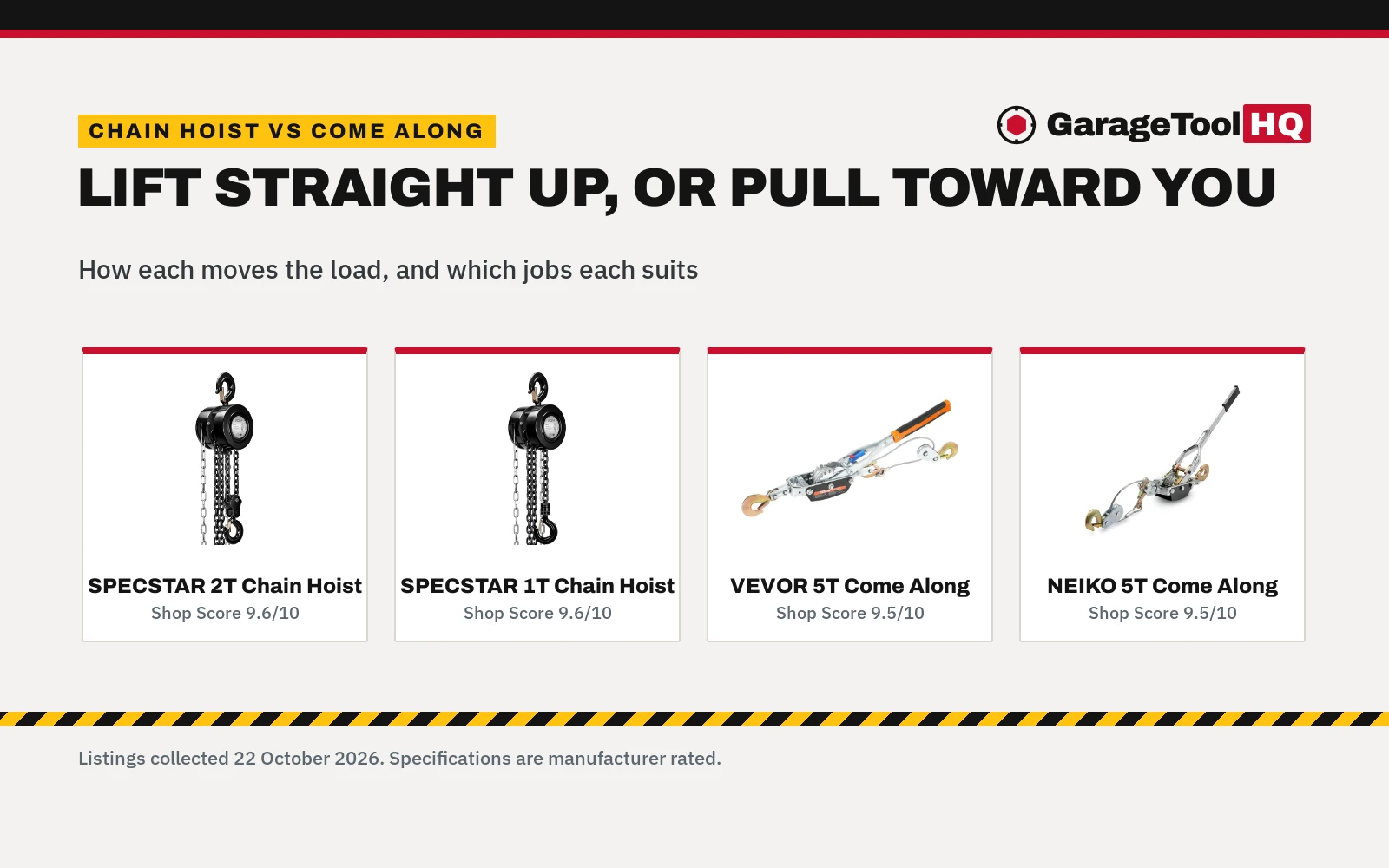
Chain hoists lift straight up on a chain fall; come alongs pull on a cable. Two examples of each compared by capacity, reach, brakes and stated standards.

On this page
Top picks at a glance
As an Amazon Associate we earn from qualifying purchases.
- 1
 SPECSTAR Hand Chain Hoist 2 Ton 4400 Lbs Capacity 10 Feet9.6/10View on Amazon
- 2
 VEVOR Come Along Winch9.5/10View on Amazon
- 3
 NEIKO 02256A Come Along Winch9.5/10View on Amazon
- 4
 JET 3/4-Ton Lever Chain Hoist Come AlongView on Amazon
- 5
 JET 1-Ton Hand Chain HoistView on Amazon
- 6
 Mini Chain Come AlongView on Amazon
- 7
 VEVOR Hand Chain HoistView on Amazon
- 8
 VEVOR 1100 lbs Electric Chain Hoist 15 FT Lifting HeightView on Amazon
Verdict: Choose a chain hoist if you lift straight up from an overhead anchor: pulling an engine, lifting a transmission into place, or holding a load suspended while you work. Choose a come along if you pull horizontally or at an angle: dragging logs, tensioning a fence, or winching a load onto a trailer.
The engine is ready to come out, and the question is what hangs it from the beam. A chain fall and a come along both move heavy things with hand power, but they are built for different directions. The chain hoist vs come along choice comes down to lift versus pull: one raises the load straight up, the other drags it toward you. This comparison puts the two side by side with two examples of each from the listings we reviewed.
GarageToolHQ earns a commission when you buy through links on this page, at no extra cost to you. Read our affiliate disclosure.
SPECSTAR Hand Chain Hoist 2 Ton 4400 Lbs Capacity
SPECSTAR 2-ton manual hand chain hoist with 4400 lbs capacity per the title and a 10 ft chain with 8.5 ft effective lift. Built to meet ASME B30.16 with a mechanical load brake and 360-degree rotating forged hooks, at 23.3 pounds.
Pros
- 2 ton / 4400 lbs rated overhead capacity
- Built to meet ASME B30.16
- Mechanical load brake against slipping
- 360-degree rotating forged hooks
Cons
- Title says 4400 lbs, bullets say 4409 lbs
- 23.3 pounds is the heaviest here
- No warranty term is stated
- 8.5 ft effective lift from a 10 ft chain

SPECSTAR Hand Chain Hoist 1 Ton 2200 Lbs Capacity
SPECSTAR 1-ton manual hand chain hoist, 2200 lbs per the title, with a 10 ft chain and 8.5 ft effective lift. Built to meet ASME B30.16 with a mechanical load brake, at 16.9 pounds.
Pros
- 1 ton / 2200 lbs rated overhead capacity
- Built to meet ASME B30.16
- Mechanical load brake against slipping
- 16.9 pounds, lighter than the 2-ton
Cons
- Bullets claim 1.25 ton / 2756 lbs max against the 1 ton title
- Spec table names VIVO-HOME as manufacturer
- No warranty term is stated
- 8.5 ft effective lift from a 10 ft chain

VEVOR Come Along Winch, 5 Ton (11,023 lbs)
VEVOR 5-ton come along with 11,023 lbs pulling capacity and an 11.5 ft steel cable. Dual-gear ratchet with anti-reverse and spring latches on the hooks, at 13 pounds.
Pros
- 11,023 lbs pulling capacity
- 11.5 ft steel cable, the longest reach here
- Dual-gear ratchet with anti-reverse
- Spring latches on the hooks
Cons
- No vertical capacity is stated
- No safety standard is named
- No warranty term is stated
- Single or double rope modes add setup choices
NEIKO 02256A Come Along Winch, 5-Ton (10,000 Lbs)
NEIKO 02256A come along rated 5 tons / 10,000 lbs pulling in the title and bullets, with a max vertical load of 2 tons / 4,000 lbs. Double gears, 3 latching hooks and a PVC-coated handle, at 13.38 pounds.
Pros
- 10,000 lbs horizontal pulling per title and bullets
- 2 tons / 4,000 lbs vertical capacity stated
- Double gears with 3 latching hooks
- Long PVC-coated handle for leverage
Cons
- Spec table says 2,000 lb pulling and 5.9 ft cable against the title
- Spec table counts 2 hooks against the 3-hook title
- No safety standard is named
- No warranty term is stated
More options to compare
 JET 3/4-Ton Lever Chain Hoist Come AlongCheck price on Amazon
 JET 1-Ton Hand Chain HoistCheck price on Amazon
 Mini Chain Come AlongCheck price on Amazon
 VEVOR Hand Chain HoistCheck price on Amazon
 VEVOR 1100 lbs Electric Chain Hoist 15 FT Lifting HeightCheck price on Amazon
Side by side
| Chain hoist | Come along | |
|---|---|---|
| What it is | Manual chain fall with steel gears | Ratcheting cable puller with dual gears |
| Rated capacity | 1 ton and 2 ton overhead (SPECSTAR examples) | 5 tons pulling; 2 tons vertical (NEIKO example) |
| Reach | 10 ft chain, 8.5 ft effective lift (SPECSTAR examples) | 10 ft to 11.5 ft cable (come along examples) |
| Holding the load | Mechanical load brake (SPECSTAR examples) | Anti-reverse ratchet, latching hooks (examples) |
| Safety standard | ASME B30.16 (SPECSTAR examples) | Not stated |
Example figures are manufacturer rated, as published on each listing and collected 22 October 2026.
Chain hoist vs come along: how each moves the load
A chain hoist is a manual chain fall: the SPECSTAR examples hang from an overhead point and lift on a chain, with industrial-grade steel gears and a mechanical load brake holding the load. The 10 ft chain gives 8.5 ft of effective lift on both examples. A come along is a ratcheting cable puller: the NEIKO and VEVOR examples wind a steel cable with a lever and dual gears, with an anti-reverse mechanism or latching hooks holding the pull. The job decides: for overhead lifting from a beam, the chain hoist is the purpose-built tool, and for pulling, the come along. The NEIKO is the one exception among these examples, stating a 2-ton / 4,000-lb vertical capacity alongside its pulling rating.
Capacity: pulling tons vs lifting tons
Read the ratings carefully because the two sides rate different jobs. The SPECSTAR chain hoists are rated for overhead lifting: 1 ton on the smaller and 2 tons on the larger, with the 1-ton bullets also claiming a 1.25 ton / 2756 lbs max against the 1 ton title. The come alongs are rated for pulling: 5 tons on both the NEIKO (10,000 lbs) and the VEVOR (11,023 lbs). The NEIKO is the only listing that states both directions: 10,000 pounds horizontal and 2 tons / 4,000 pounds vertical. Do not read a pulling rating as a lifting rating.
Reach and setup
Reach is chain or cable length. Both SPECSTAR hoists run a 10 ft chain with 8.5 ft of effective lift, and at 16.9 and 23.3 pounds they are the heaviest tools here. The come alongs carry cable instead: 10 ft on the NEIKO per the title and bullets (its spec table says 5.9 ft, and the title wins) and 11.5 ft on the VEVOR, at 13.38 and 13 pounds. A hoist hangs from a single overhead anchor; a come along spans between the load and a second anchor point, which is why the job site matters more than the spec sheet.
Brakes, gears and standards
The SPECSTAR hoists are built to meet ASME B30.16 overhead hoist standards and carry a mechanical load brake against slipping, with 360-degree rotating forged hooks. The come alongs hold the load differently: the VEVOR with an anti-reverse mechanism and spring latches on the hooks, the NEIKO with a safety latch on all hooks and double gears. Neither come along names a safety standard, so the chain hoist side is the only one with a stated standard.
Choose a chain hoist if
- You lift straight up from a beam or gantry
- You need to hold the load suspended while you work
- The job is engine pulls or machinery placement
- You want the ASME B30.16 build claim
Choose a come along if
- You pull horizontally: logs, fences, vehicle recovery
- You need a portable tool with no overhead anchor
- You want the longest reach at 11.5 ft of cable
- One-handed ratcheting suits the job
Example hoists
For more choices, see the best chain hoist roundup, and if the engine is the job, the chain hoist vs engine hoist comparison.
Check the lift's rated capacity against your heaviest vehicle, and its ceiling and concrete requirements (thickness and strength) before you buy. Install it exactly as the manufacturer specifies, use the mechanical locks before you go under, and look for ALI certification on the model. See the Automotive Lift Institute (ALI). Read our Safety Disclaimer.
Frequently Asked Questions
What is a chain hoist?
A manual chain hoist, also called a chain fall, lifts loads straight up on a chain through gears. The SPECSTAR examples here are rated 1 ton and 2 tons for overhead lifting, each with a 10 ft chain giving 8.5 ft of effective lift, and both are built to meet ASME B30.16.
Is a come along the same as a chain hoist?
No. A come along is a ratcheting cable puller worked with a lever, built for pulling rather than overhead lifting. The NEIKO and VEVOR examples are rated 5 tons for pulling, while the chain hoist examples are rated 1 and 2 tons for lifting.
Can I lift vertically with a come along?
The NEIKO listing states both directions: a max horizontal load of 10,000 pounds and a max vertical load of 2 tons / 4,000 pounds. The VEVOR listing states only a pulling capacity of 11,023 lbs, so its vertical limit is unstated. Never read a pulling rating as a lifting rating.
What does ASME B30.16 mean on these listings?
It is the overhead hoist standard the SPECSTAR listings state they are built to meet. Both SPECSTAR examples also list a mechanical load brake. Neither come along names a safety standard.
How much can these examples handle?
For overhead lifting: 1 ton on the SPECSTAR 1-ton (its bullets also claim 1.25 ton / 2756 lbs max) and 2 tons on the SPECSTAR 2-ton. For pulling: 10,000 lbs on the NEIKO and 11,023 lbs on the VEVOR, with the NEIKO also stating 4,000 lbs vertical.
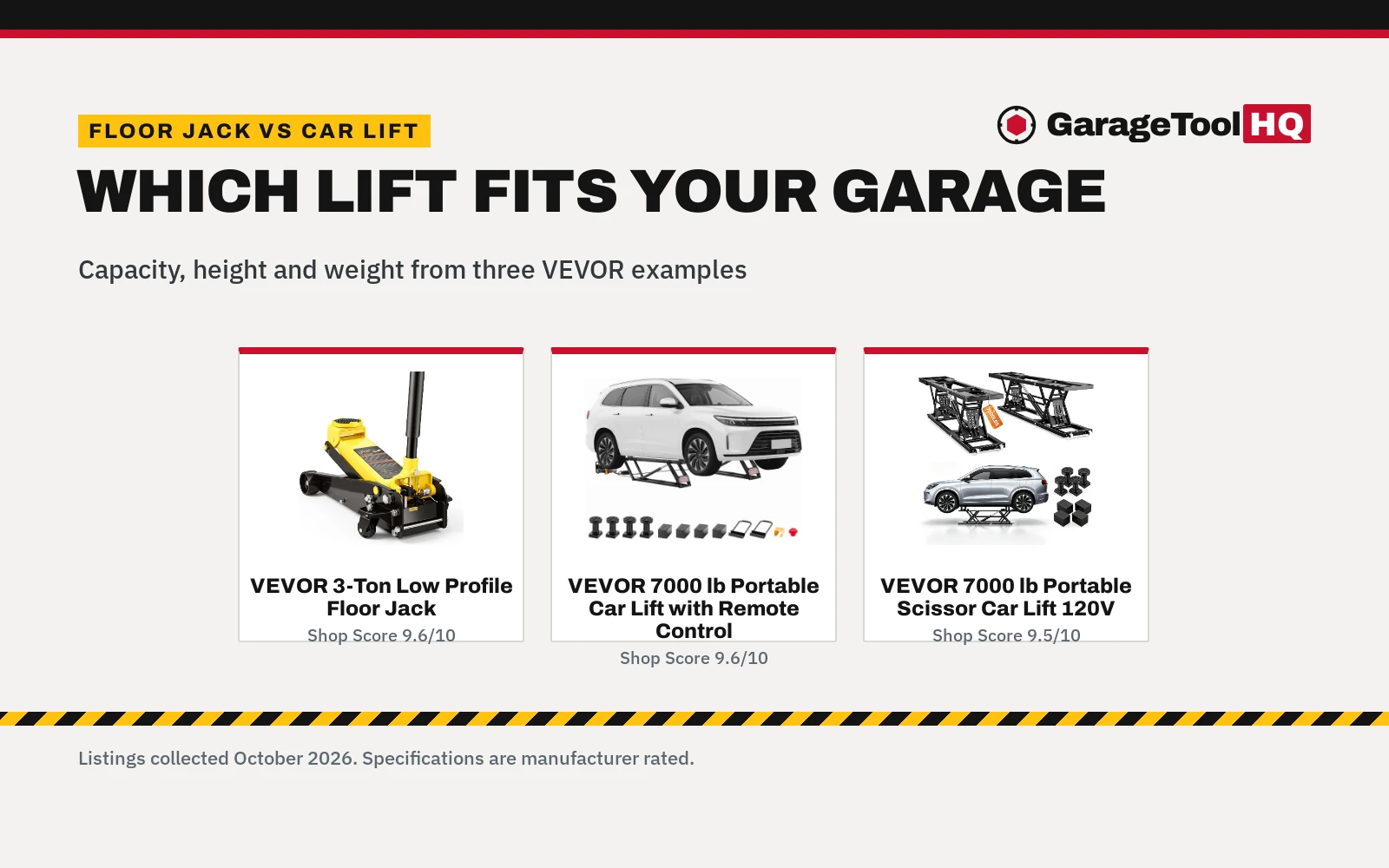
Related: the best chain hoist roundup, the chain hoist vs engine hoist comparison and the floor jack vs car lift comparison.