Iron Remover vs Clay Bar: Which One Should You Buy?
Iron remover dissolves embedded iron chemically and a clay bar pulls off bonded dirt mechanically: what each does, the order to use them, and four iron removers compared on stated formula, size and surfaces.

On this page
Top picks at a glance
As an Amazon Associate we earn from qualifying purchases.
- 1
 Turtle Wax Hybrid Solutions Iron Remover & Wheel Cleaner9.4/10View on Amazon
- 2
 Mothers 07243 California Gold Deluxe Clay Bar Kit9.7/10View on Amazon
- 3
 Adam's Polishes Swirl Killer 12mm Polisher9.5/10View on Amazon
- 4
 CARPRO IronX Iron Remover: Stops Rust Spots and Pre-MatureView on Amazon
- 5
 Vonixx Izer Iron RemoverView on Amazon
- 6
 Griot's Garage Iron and Fallout Remover for Car Detailing andView on Amazon
- 7
 Rust-Oleum Whink Rust Stain RemoverView on Amazon
- 8
 Chemical Guys Cly_402 Medium Duty Clay BarView on Amazon
- 9
 Chemical GuysView on Amazon
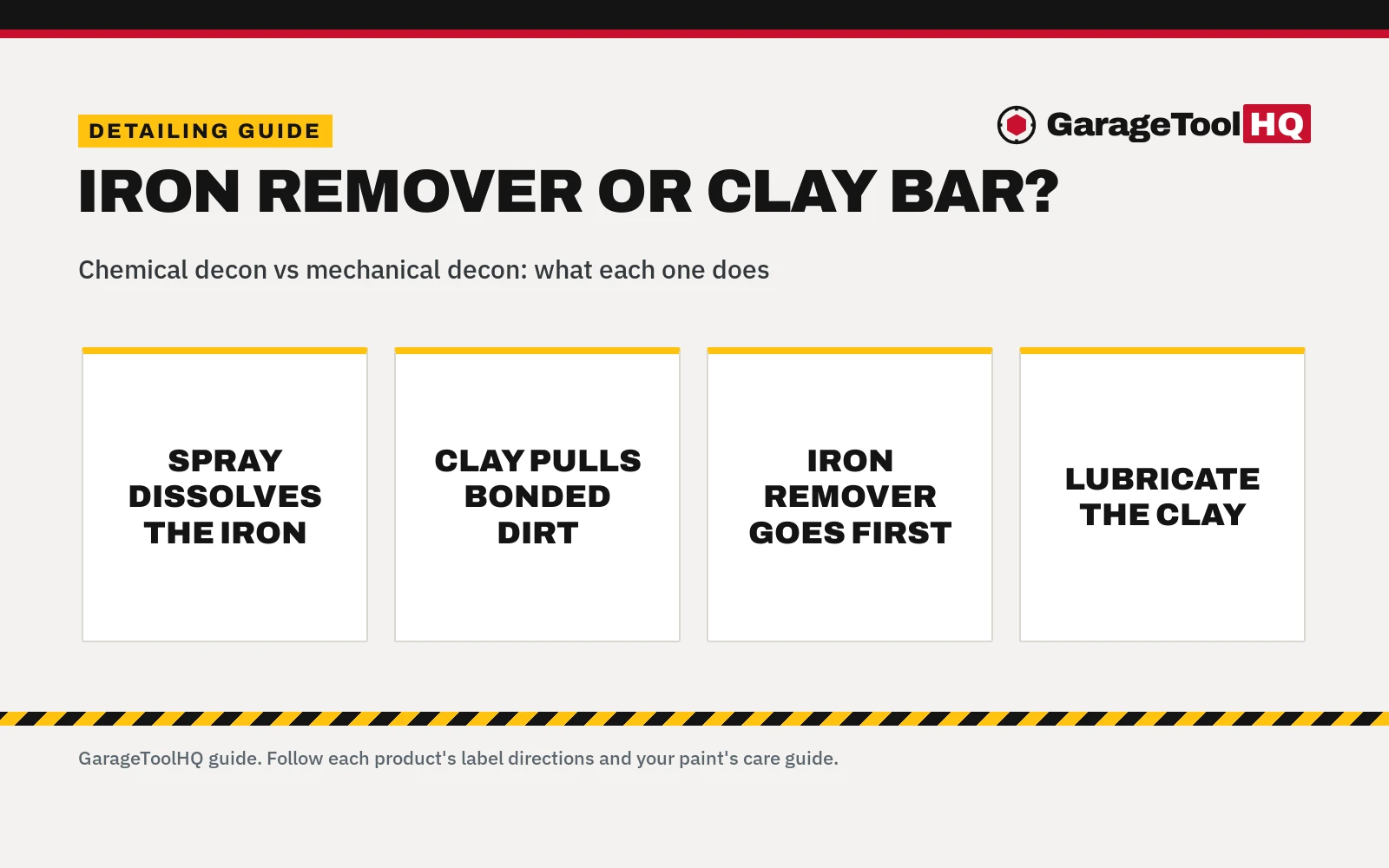
After the wash, the paint still feels like fine sandpaper, and the question is iron remover vs clay bar. They are not substitutes: iron remover dissolves embedded iron particles chemically, and a clay bar mechanically pulls off the remaining bonded contamination. Use the iron remover first, then clay.
More options to compare
 CARPRO IronX Iron Remover: Stops Rust Spots and Pre-MatureCheck price on Amazon
 Vonixx Izer Iron RemoverCheck price on Amazon
 Griot's Garage Iron and Fallout Remover for Car Detailing andCheck price on Amazon
 Rust-Oleum Whink Rust Stain RemoverCheck price on Amazon
 Chemical Guys Cly_402 Medium Duty Clay BarCheck price on Amazon
 Chemical GuysCheck price on Amazon
GarageToolHQ earns a commission when you buy through links on our product pages, at no extra cost to you. Read our affiliate disclosure.
Below: what each method actually does, the order that works, the cautions printed on the labels, and four iron removers compared on what each listing states.
Iron remover vs clay bar: what each one does
An iron remover is a chemical decontaminant. You spray it on, it reacts with embedded iron particles, brake dust and road grime, most formulations turning purple as they react; then you rinse it off. Per the Adam’s listing, the spray targets below-surface iron deposits that a clay bar cannot grab, which is why that listing tells you to use the iron remover before the clay bar.
A clay bar is mechanical. With lubricant, you glide it over the paint and it shears off bonded surface contamination: tree sap mist, overspray, industrial fallout sitting on top of the clear coat. It dissolves nothing and only touches what it can physically reach. Used dry or with too little lubricant it marrs the paint, so lubrication is not optional.
Together they cover the full job: the spray handles the iron with no touching, and the clay finishes the rest of the bonded dirt. Skip the iron remover and the clay has to do work it was not designed for; skip the clay and non-iron contamination stays behind. If the paint already feels glass-smooth after washing, neither step is needed yet.
| Method | How it works | What it removes | Watch out for |
|---|---|---|---|
| Iron remover | Chemical spray, then rinse | Embedded iron, brake dust, fallout | Do not let it dry; check each label on trim and plastic |
| Clay bar | Mechanical, with lubricant | Bonded surface dirt, sap mist, overspray | Needs lubricant; dry clay marrs paint |
Size and scent separate the four iron removers below. Three come in 16 to 23 oz spray bottles for the home garage; the Gtechniq comes as 169 fl oz of gel for high-volume use. On smell, Chemical Guys and Gtechniq list unscented formulas, Adam’s lists a citrus scent, and Turtle Wax lists a fresh scent with odor-neutralizing technology.
The order that works
- Wash first. Decontamination starts on a clean car; the wash takes the loose dirt.
- Spray the iron remover on cool paint and wheels, let it dwell per the label while it changes color, then rinse thoroughly. Do not let it dry on the surface, and keep it off trim and exterior plastic, as the Adam’s label warns.
- Clay with plenty of lubricant, working panel by panel and folding the clay to a clean face as it picks up dirt.
- Protect after. Decontaminated paint is bare paint: follow with wax, sealant or coating per its own instructions.
Iron remover is not soap. Work with ventilation, keep it off trim, plastic and raw metal where the label says so, and rinse it fully. Never mix detailing chemicals, and keep them away from kids and pets.
Keep electric pressure washers on a GFCI outlet, never point the wand at people or pets, wear eye protection with polishers and chemicals, and read the label before mixing any cleaning products. Read our Safety Disclaimer.
The gear: four iron removers, ranked
Four iron removers from the listings, ranked on stated formula, size and surface safety:
1. Turtle Wax Hybrid Solutions Iron Remover, 23 oz
The biggest spray here at 23 fluid ounces, with a pH neutral and acid free formula the listing says is safe for paint, metal, glass and all wheels. It changes from clear to purple on contact with iron, and it is the only one here with scent-blocking odor neutralizer technology for a more pleasant job. The listing states “No Warranty”.
2. Gtechniq W6, 169 fl oz
The bulk option: 169 fluid ounces of thick gel that clings to vertical surfaces, stated coating and wax safe, with a corrosion inhibitor and an additive aimed at the effects of acid rain. Unscented, and at 5.22 kg the heaviest pack by far. Note the listing’s own contradiction: the spec table lists “Item Volume: 5 ml” against the 169 fl oz title; we follow the title.
3. Adam’s Iron Remover, 16 oz
A pH neutral, acid-free 16 oz spray with a citrus scent and rich orange color, stated safe on clear coat and single stage paint, ceramic coated or not. The listing is explicit about the order of operations: use it before the clay bar. It warns to minimize overspray and avoid exterior plastic, trim and metallic parts. The spec table’s “Voltage: 12 volts” is nonsense on a spray bottle; we follow the title and bullets.
4. Chemical Guys Decon Pro, 16 oz
A 16 fl oz unscented spray that dissolves bonded iron, brake dust and fallout on wheels, calipers and paint, turning purple as it reacts. The listing says to spray it on cool surfaces and rinse off. Its spec table lists “Surface Recommendation: Glass” against a title about wheels and paint; we follow the title and bullets.
Iron remover vs clay bar on wheels
Wheels collect more iron than any other panel, straight from brake dust, which makes them the iron remover’s best case: spray, dwell, rinse, with no scrubbing. A clay bar still earns its place on wheels for tar and baked-on grime the spray does not dissolve, but the chemical step goes first. Whichever you use, work on cool wheels out of direct sun.
Frequently Asked Questions
Do I need both an iron remover and a clay bar?
For a full decontamination, yes. The iron remover dissolves embedded iron that clay cannot reach, and the clay removes bonded surface dirt the spray does not dissolve. If the paint feels smooth after washing, skip both until it does not.
Can I use iron remover on wheels?
Yes, wheels are its best case. All four listings name wheels: Chemical Guys and Turtle Wax call out brake dust explicitly, and Gtechniq’s gel clings to vertical wheel faces. Spray on cool wheels and rinse thoroughly.
Will a clay bar remove iron particles?
Only what sits on the surface. The Adam’s listing is direct on this: a clay bar removes surface deposits, not below-surface iron. That is the gap the iron remover fills, which is why it goes first.
How often should I decontaminate paint?
When the paint tells you to: after a wash, slide your fingertips over it, and if it feels gritty, decontaminate. Daily drivers in brake-dust-heavy traffic need it more often than garaged weekend cars.
Is iron remover safe on ceramic coatings?
According to the listings, yes. Adam’s states its formula is safe on paint whether ceramic coated or not, and Gtechniq states its W6 is coating and wax safe. Follow the label’s dwell time and rinse fully.
Can I clay without lubricant?
No. Clay needs lubrication to glide; dry claying marrs the paint. Use a dedicated clay lubricant or a slick detailing spray, keep the surface wet, and fold the clay to a clean face as it picks up dirt.
Related: clay bar kits, clay bar vs clay mitt, car polish vs car wax, car detailing kits for the home garage and the car detailing hub. For protection after decon, see ceramic spray vs ceramic coating.