6013 vs 7018 Welding Rod: Which One Should You Buy?
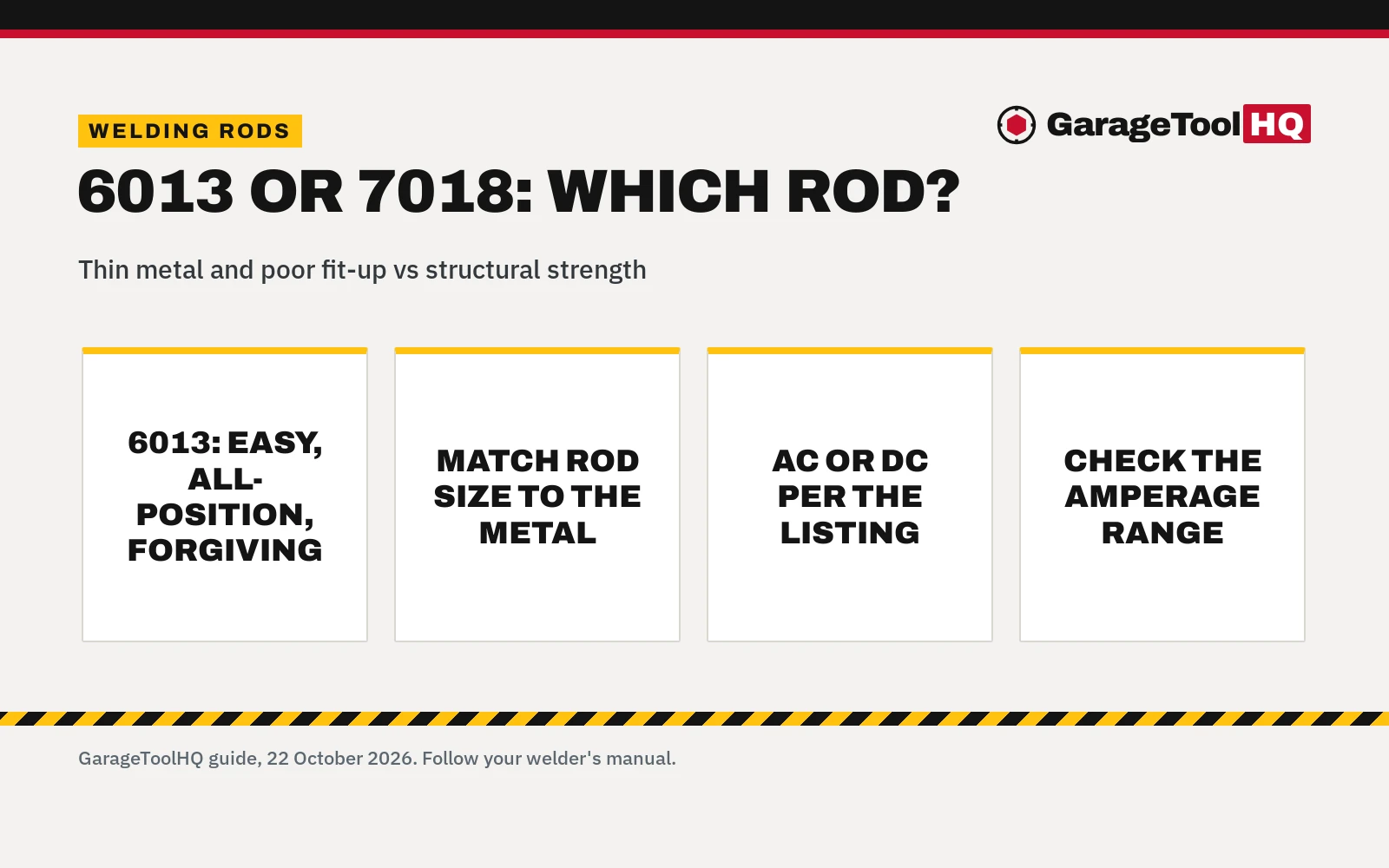
A home-garage guide to 6013 vs 7018 welding rod: what 6013 does well, when 7018 is the call, and four 6013 rods compared.

On this page
Top picks at a glance
As an Amazon Associate we earn from qualifying purchases.
- 1
 HONE Stick Welder 110v9.7/10View on Amazon
- 2
 Hpoouo 200Amp 20PCS Rods Stick Welder9.6/10View on Amazon
- 3
 Hpoouo 200Amp 20PCS Rods Stick Welder9.5/10View on Amazon
- 4
 TOOLIOM E6013 Welding Rod Carbon Steel Stick ElectrodesView on Amazon
- 5
 Forney 30510 E6013 Welding RodView on Amazon
- 6
 Forney 31105 E6011 Welding RodView on Amazon
- 7
 Tandefio 12 Pcs Low Temperature Universal Welding Rod SticksView on Amazon
- 8
 Tandefio 36 Pcs Low Temperature Universal Welding Rod SticksView on Amazon
- 9
 TOOLIOM E6011 Welding Rod Carbon Steel Stick ElectrodesView on Amazon
A cracked mower deck and a trailer tongue both need stick welding, but they are different jobs: the deck is thin sheet that burns through if the heat lingers, the tongue carries load down the road. That is the 6013 vs 7018 welding rod question in a home garage. The short answer: 6013 is the forgiving rod for thin metal, sheet metal and poor fit-up, easy to strike with a smooth, steady arc; 7018 is the rod for welds where strength matters most. The four rods below are all 6013, the beginner-friendly side of this choice.
More options to compare
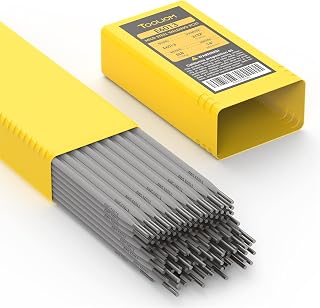 TOOLIOM E6013 Welding Rod Carbon Steel Stick ElectrodesCheck price on Amazon
 Forney 30510 E6013 Welding RodCheck price on Amazon
 Forney 31105 E6011 Welding RodCheck price on Amazon
 Tandefio 12 Pcs Low Temperature Universal Welding Rod SticksCheck price on Amazon
 Tandefio 36 Pcs Low Temperature Universal Welding Rod SticksCheck price on Amazon
 TOOLIOM E6011 Welding Rod Carbon Steel Stick ElectrodesCheck price on Amazon
GarageToolHQ earns a commission when you buy through links on this page, at no extra cost to you. Read our affiliate disclosure.
What 6013 is good at
Every 6013 listing here tells the same story: an easy-to-use, all-position, general-purpose rod for mild steel. The Forney calls out shallow penetration for poor fit-up, excellent wetting action with smooth flat beads, low spatter and excellent slag removal, running on AC or DC. The TOOLIOM adds medium-to-shallow penetration for thin metal plates, sheet metal and short welds, a soft stable arc with seldom smoke or spatter, and easy arc re-strikes. The YESWELDER repeats the pattern for light gauge metal, sheet metal and duct work. In short, 6013 is the rod that makes an average welder look tidy.
6013 vs 7018 welding rod: how to choose
Choose 6013 when the metal is thin, the fit-up is poor, or the weld needs to look clean: sheet metal, duct work, mower decks and general mild steel fabrication, all named in these listings. Choose 7018 when the weld carries structural load and strength matters most. One practical note from the listings: 6013 runs on AC or DC, and the YESWELDER notes it works well on low voltage AC machines, so it suits the common home stick welder.
Rod size and amperage
Match the rod to the metal. The Hobart 5/64 inch rod is the thinnest here, for the lightest sheet. The Forney and TOOLIOM are 3/32 inch: the TOOLIOM lists 40A to 80A, the Forney an 80 A amperage capacity. The YESWELDER steps up to 1/8 inch at 80A to 130A for heavier mild steel. Three list 14 inch rods; the Hobart states no rod length. Thinner rod at lower amps for thin metal; thicker rod with more amps when the metal can take the heat.
The gear: four 6013 rods
Ranked by score, the four 6013 rods from the listings cover the common garage sizes from 5/64 to 1/8 inch.
YESWELDER E6013, 1/8 inch, 10 pounds. The biggest box here: 1/8 inch diameter, 14 inch length, 10 pounds of rod with an 80A to 130A recommended range. It runs AC or DC, welds in all positions, and is stated for shallow penetration on poor fit-up, light gauge metal, sheet metal and duct work, with low spatter and excellent slag removal. The top score goes to the most rod with the widest stated amperage range.
Forney 30301 E6013, 3/32 inch, 1 pound. The documented 3/32 inch rod: 14 inch length, 1 pound, a stated 60,000 tensile strength and an 80 A amperage capacity. The listing describes all-position welding with excellent wetting action, smooth flat beads, low spatter and excellent slag removal on AC or DC, and states a 90 day warranty against manufacturer defects, the only warranty term among the four.
TOOLIOM E6013, 3/32 inch, 5 pounds. The middle box: 3/32 inch diameter, 14 inch length, 5 pounds, with a 40A to 80A recommended range. The listing states AC and DC dual use, all-position welding at medium-to-shallow penetration, and names thin metal plates, pipeline projects, sheet metal, short welding and cover welding. A soft stable arc with seldom smoke or spatter and easy arc re-strikes round out the description.
Hobart 6013, 5/64 inch, 1 pound. The thinnest rod here for the lightest sheet: 5/64 inch, rated 60,000 PSI, running AC, DCEP or DCEN in all positions on carbon steel. The listing is sparse beyond the basics, which is why it scores lowest, but the small diameter is exactly what thin sheet wants.
Use rated jack stands on solid ground, wear eye protection with power and air tools, keep fuel-burning equipment out of a closed garage, and follow the manual for every tool. Read our Safety Disclaimer.
Matching rod diameter to the work
The four rods here span three diameters: the Hobart at 5/64 inch, the Forney and TOOLIOM at 3/32 inch, and the YESWELDER at 1/8 inch. Thinner rods run lower amperage and suit thinner metal: the TOOLIOM 3/32 inch lists 40A to 80A, while the YESWELDER 1/8 inch lists 80A to 130A. Pick the diameter for the thinnest metal you will weld, not the thickest, because a rod that is too big for thin stock burns through before the puddle forms.
AC, DC and what your welder offers
The 6013 rods here run on AC or DC per their listings. The Forney 30301 notes excellent operation with either AC or DC, and the Hobart H117125-RDP lists AC, DCEP and DCEN. If your machine is AC-only, confirm the rod lists AC operation before buying. A rod that only lists DC will not run right on an AC buzz box, no matter how good the price.
Pack size and how much you will burn
The Forney 30301 ships as a 1-pound pack, the TOOLIOM as a 5-pound box, and the YESWELDER as a 10-pound box. A 1-pound pack suits occasional repair and learning: 6013 is a forgiving rod for practice. A 5 or 10-pound box suits steady fabrication work where you will burn through rods weekly. Buy the pack you will use within a reasonable time, because rods absorb moisture sitting open on the shelf.
Frequently Asked Questions
Is 6013 good for beginners?
Yes. The listings describe 6013 as easy to use, with a soft stable arc, easy re-strikes and slag that removes cleanly. It runs on AC or DC and welds in all positions, which is why it shows up in beginner recommendations.
What amperage should I run 3/32 6013 at?
The TOOLIOM 3/32 inch rod lists 40A to 80A, and the Forney 3/32 inch lists an 80 A amperage capacity. Start at the low end on thin metal and check your welder’s manual.
Can 6013 weld vertical?
Yes, all-position welding is stated on all four listings. The Forney and YESWELDER note the slag is virtually self-cleaning in vertical down fillets.
Can I run 6013 on AC?
Yes. All four listings state AC or DC operation, and the YESWELDER notes it works well on low voltage AC machines.
What is 6013 used for?
General-purpose mild steel work: the listings name thin metal plates, sheet metal, duct work, pipeline projects, short welds and cover welding, plus fabrication with poor fit-up where shallow penetration is a virtue.
How long are these rods?
Three listings state 14 inch rods (Forney, TOOLIOM, YESWELDER); the Hobart states no rod length, only package dimensions. Diameter and amperage are what change between the boxes.