Cutting vs Polishing Pad: Which One Should You Buy?
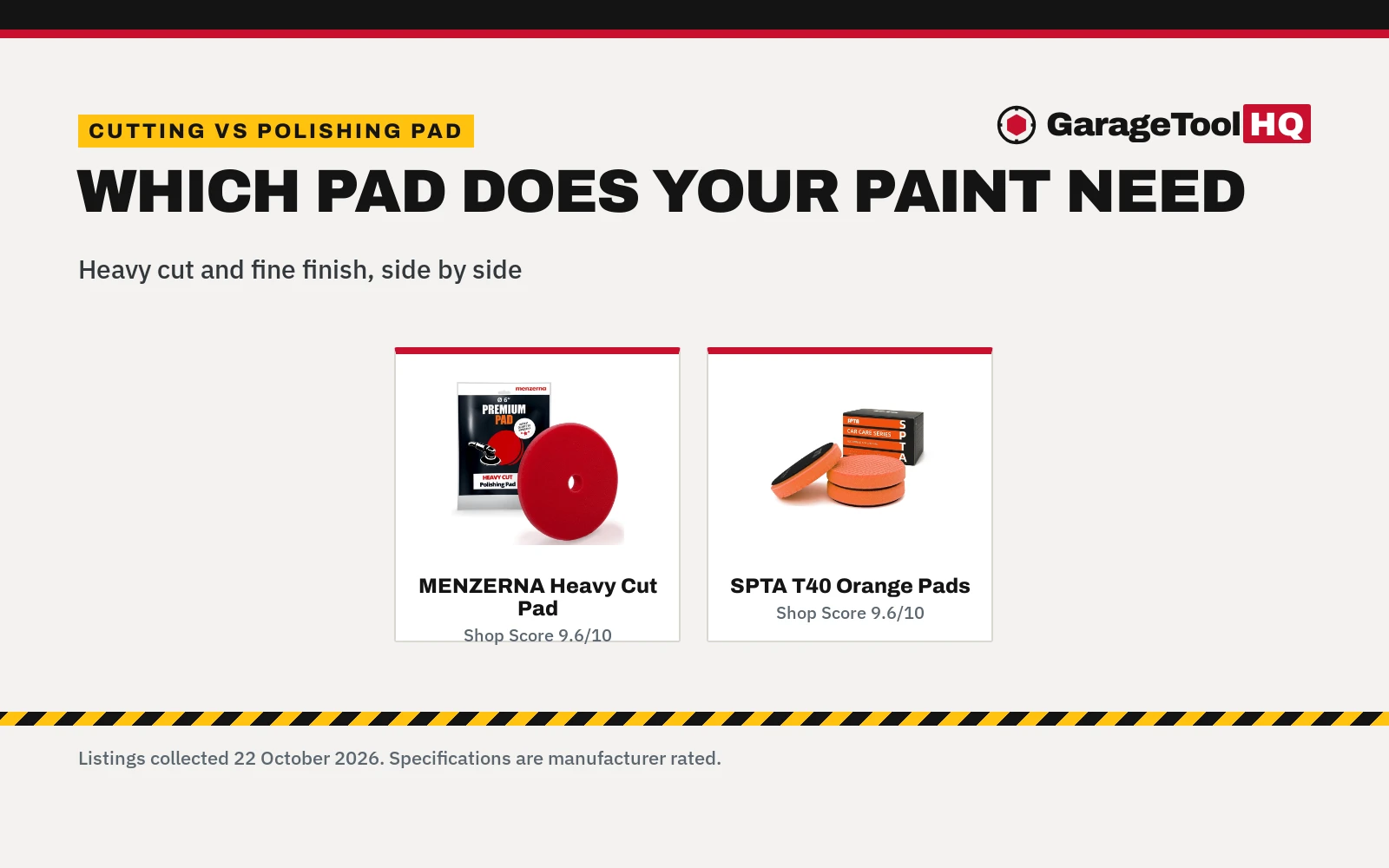
Cutting and polishing pads compared: how each corrects paint, manages heat, and which jobs each suits, with one example pad on each side.

On this page
Top picks at a glance
As an Amazon Associate we earn from qualifying purchases.
- 1
 Buffing Polishing Pads Kit9.6/10View on Amazon
- 2
 BFXM 38Pcs Car Headlight Restoration Kit9.6/10View on Amazon
- 3
 5" Buffing Polishing Pads9.6/10View on Amazon
Verdict: In this cutting vs polishing pad matchup, choose a cutting pad if the paint has heavy defects to remove, such as deep scratches or heavy oxidation, and you plan to refine the finish afterward. Choose a polishing pad if the paint needs light correction or a final finish, such as fine scratches and swirl marks, or you want to work straight through to wax.
Cutting vs polishing pad is the decision you make before the polisher ever spins up: whether the pad should do the heavy removal work or refine paint that is already close to finished. Picture a weekend detail in the garage: a hood covered in swirl marks after seasons of drive-through washes, and a Saturday set aside to bring the gloss back. A cutting pad is the aggressive side of the job, firm foam that works with a compound to level defects. A polishing pad is the gentle side, softer foam that refines the haze and finishes the paint for wax. This comparison explains what separates the two sides, then shows one example of each from the listings we reviewed.
GarageToolHQ earns a commission when you buy through links on this page, at no extra cost to you. Read our affiliate disclosure.

MENZERNA 6 Inch Polishing Pad Heavy Cut
A hard red 6 inch heavy-cut foam pad with a center hole, 1 inch thin, Velcro backed for orbital, rotary and Dual Action polishers.
Pros
- Hard foam aimed at heavy-duty work with abrasive polishes
- 6 inches in diameter, 1 inch thin, with a center hole against heat build-up
- Open-cell foam the maker says stays durable after washing
- Fits orbital, rotary and Dual Action polishers
Cons
- Only one pad in the pack
- Spec table lists 6 x 6 x 6 inches while the title says 1 inch thin
- Cutting work only: the maker recommends combining it with other densities
- No warranty term stated

T40 Orange Medium-Cut Foam Polishing Pads
A 3-pack of 6.5 inch medium-cut orange foam pads for a 6 inch 150mm backing plate, grooved for paste storage and airflow.
Pros
- 3 pads in the pack
- Grooved face that holds paste and moves air to avoid heat build-up
- 6.5 inch face sized for a 6 inch 150mm backing plate
- Suited for compounding, polishing and waxing on car paint
Cons
- Thickness not stated
- Not a heavy-cut pad: aimed at fine scratches and light oxidation
- Cleaning needs care: no solvents or alkaline cleaners
- No warranty term stated
Side by side
| Cutting pad | Polishing pad | |
|---|---|---|
| Job on the paint | Levels heavy defects with abrasive polishes | Refines light defects and finishes for wax |
| Example pad | MENZERNA Heavy Cut Pad, hard red foam | SPTA T40 Orange Pads, medium-cut foam |
| Example size | 6 inches | 6.5 inch face for a 6 inch 150mm backing plate |
| Example pack | 1 pad | 3 pads |
| Heat control | Center hole, 1 inch thin body, open-cell foam | Grooves move air across the face |
| Machines (example) | Orbital, rotary and Dual Action | Rotary and DA |
| After the step | Refine with a softer pad | Ready for wax |
Example figures are manufacturer rated, as published on each listing and collected 22 October 2026.
Cutting vs polishing pad: how each one works
A cutting pad is built to remove material. The foam is firm and dense, and it works with abrasive polishes to level scratches, marks and other imperfections. The Menzerna example below is exactly this kind of pad: hard red foam in a heavy-cut grade, with a safety edge around the rim. A polishing pad is built to refine. The foam is softer, often in a medium or light cut grade, and it works with finer polishes to clear the haze a cutting step leaves and bring up the gloss. The SPTA example is a medium-cut pad that the maker lists for compounding, polishing and waxing in one set.
Work in stages
Paint correction works in stages: the aggressive pad does the removal, the softer pad does the finishing. The Menzerna listing frames its pad as a scratch-repair tool for heavy-duty work with abrasive polishes, and recommends combining it with other densities for the full system. The SPTA listing names its targets: 2000# sanding disc marks, fine scratches and light oxidation, followed by compounding, polishing and waxing. Use the cutting side where defects run deep, and the polishing side where the paint needs refining or a final finish.
Heat control
Friction makes heat, and heat is the enemy of both the pad and the paint. The Menzerna pad fights it with a 1 inch thin body, a center hole and open-cell foam that the maker says reduces heat and stays durable after washing. The SPTA pads fight it with grooves in the face that store excess paste and move air between the pad and the paint, plus a breathable backing that lets working heat escape so the Velcro bond does not fail. Either way, a cool pad lasts longer and finishes cleaner.
| If you need | Look at |
|---|---|
| Heavy defect removal with abrasive polishes | MENZERNA Heavy Cut Pad: hard foam, 6 inches, 1 inch thin |
| Light correction and a finishing step | SPTA T40 Orange Pads: medium cut, 6.5 inch face, 3 pads |
| Heat control on a long polishing session | MENZERNA Heavy Cut Pad: center hole and open-cell foam; SPTA T40 Orange Pads: grooved face |
| One set for compounding, polishing and waxing | SPTA T40 Orange Pads: 3 pads for a 6 inch 150mm backing plate |
Sizing notes
The Menzerna pad is 6 inches in diameter; the SPTA pads have a 6.5 inch face sized for a 6 inch 150mm backing plate. Both attach with Velcro on the back, so they swap on and off a matching plate quickly. The SPTA listing notes its Velcro fasteners sit below the foam surface to prevent scratching and scorching during polishing.
Choose a cutting pad if
- Heavy scratches and defects need to come off
- You work with abrasive polishes and compounds
- You plan to refine with a softer pad after
- Scratch repair is the job at hand
Choose a polishing pad if
- Fine scratches, light oxidation and swirl marks are the target
- You want one set for compounding, polishing and waxing
- Finishing the paint for wax is the goal
- You prefer a gentler pad on the paint
Example pads
For more choices, see the best polishing pads for beginners, and for swirl-mark work, the best cutting pad for swirl removal.
Keep electric pressure washers on a GFCI outlet, never point the wand at people or pets, wear eye protection with polishers and chemicals, and read the label before mixing any cleaning products. Read our Safety Disclaimer.
Garage Fit Check
- Match the pad to the backing plate: the SPTA set is sized for a 6 inch 150mm plate, and both pads attach with Velcro.
- Pads are consumables: with good care the Menzerna pad can last up to 5 cars.
- Keep more than one density on hand: the Menzerna maker recommends combining densities.
- Wash gently and skip harsh chemistry: the SPTA listing warns against solvents and alkaline cleaners.
- Both pads are compact foam: store them flat and dry between jobs.
What to check before you buy
Match the pad to the defect
The Menzerna is a hard heavy-cut pad for scratches, marks and imperfections with abrasive polishes. The SPTA is a medium-cut pad for 2000# sanding disc marks, fine scratches and light oxidation. Buy the cutting pad for the heavy defects; buy the polishing pad for refining and the final finish before wax.
Check the backing plate
The SPTA’s 6.5 inch face is sized for a 6 inch 150mm backing plate, and both pads attach with Velcro. The Menzerna fits orbital, rotary and Dual Action polishers; the SPTA fits rotary and DA. Match the pad to the plate and the machine you own.
Plan for heat
The Menzerna fights heat with a 1 inch thin body, a center hole and open-cell foam. The SPTA uses face grooves that store paste and move air, plus a breathable backing that lets working heat escape. On a long session, the pad that stays cooler finishes cleaner and lasts longer.
Buy the pack that fits the job
The Menzerna comes as a single pad; the SPTA comes as three. With good care the Menzerna can last up to 5 cars, but pads are consumables: keep more than one density on hand, since the Menzerna maker recommends combining densities for the full system.
Frequently Asked Questions
Can I finish a car with only a cutting pad?
A cutting pad removes defects but leaves the finish hazy. The Menzerna maker recommends combining densities, and a medium-cut or finishing pad refines the gloss before wax.
What backing plate fits a 6.5 inch pad?
The SPTA listing sizes its 6.5 inch face for a 6 inch 150mm backing plate. Match the plate to the pad and check the Velcro holds before you start.
Do these pads fit rotary and DA polishers?
The Menzerna pad lists orbital, rotary and Dual Action polishers. The SPTA pads list rotary and DA polishers.
Can I wash foam polishing pads?
The Menzerna pad is washable, and the maker says the foam and Velcro hold up after washing. The SPTA listing says to clean pads after use and to avoid solvents and alkaline cleaners.
Related: the best polishing pads for beginners, the best cutting pad for swirl removal, compound vs polish, the foam vs microfiber polishing pad comparison and our car detailing hub.