Best Bench Vise Under 60 (2026): 5 Compared
Five bench vises under 60 compared by jaw size, clamping force, swivel base and stated warranty, from bolt-down ductile iron to portable clamp-on.

On this page
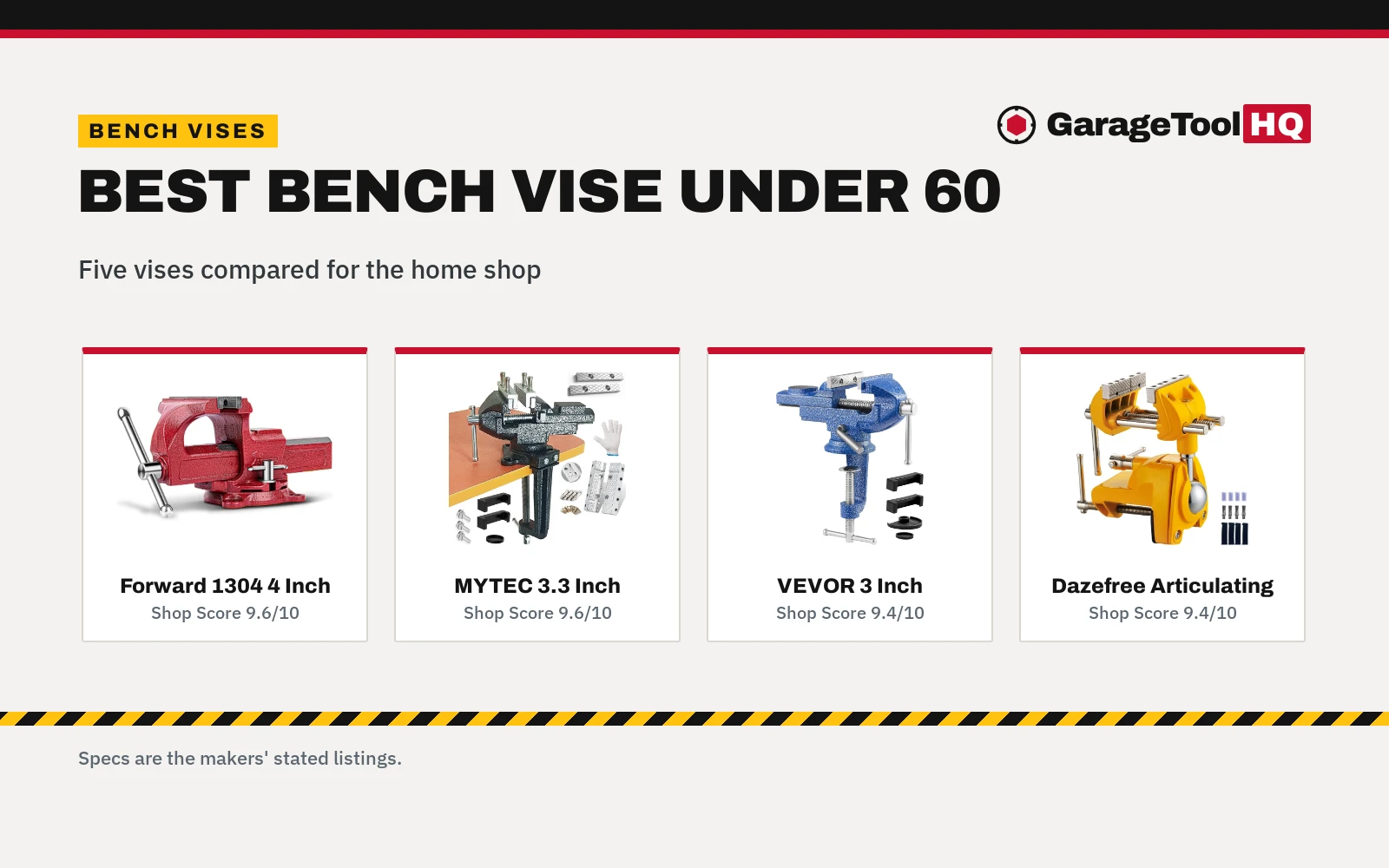
Top picks at a glance
As an Amazon Associate we earn from qualifying purchases.
- 1
 Top pickForward 1304 4 Inch9.6/10View on Amazon
- 2
 Best portableVEVOR 3 Inch9.4/10View on Amazon
- 3
 Best clamp-onDazefree Articulating9.4/10View on Amazon
- 4
 Widest jawsYost LV-49.4/10View on Amazon
- 5
 Small partsMYTEC 3.3 Inch9.6/10View on Amazon
- 6
 Fasmov Swivel 3" Universal Table Vise Tilts Rotate 360°View on Amazon
- 7
 WORKPRO Bench ViseView on Amazon
- 8
 Table Vise or Bench Vise 3.2 InchView on Amazon
- 9
 Dual-Purpose Combined Universal Vise 3.3" with 360° SwivelView on Amazon
- 10
 Yost Vises 445 Combination ViseView on Amazon
A bench vise is the third hand every home shop is missing. The first time you try to file a bracket while holding it with one hand and the file with the other, you understand why a vise bolted to the bench changes the work. Here are five picks for the best bench vise under 60, ranked by what their listings actually promise.
GarageToolHQ earns a commission when you buy through links on this page, at no extra cost to you. Read our affiliate disclosure.
Quick picks
- Top pick Forward 1304 4 Inch: 4,400 lbs clamping force in 60,000 PSI ductile iron, with a 1-year parts replacement. Check price on Amazon
- Best portable VEVOR 3 Inch: 3.5 lb cast iron vise with a 360-degree swivel base and quick release. Check price on Amazon
- Best clamp-on Dazefree Articulating: 360-degree articulating ball joint in cast steel that clamps to any bench with no bolts. Check price on Amazon
- Widest jaws Yost LV-4: 4.5 in jaw width with a swivel base, the widest jaws of the five. Check price on Amazon
- Small parts MYTEC 3.3 Inch: 3.3 in multifunctional jaw with 360-degree rotation for quick small jobs. Check price on Amazon
The picks

Forward 1304 4 Inch Bench Vise Workbench Vise
A 4 in home workshop vise in 60,000 PSI ductile iron with a 4,400 lbs clamping force, a 120-degrees swivel base, a 1.65 in x 1.65 in anvil and replaceable microgroove top jaws. It bolts down with dual locking nuts and 3 bolts in the box, and the maker backs it with a 1-year limited parts replacement, the only stated warranty in this group.
Pros
- 60,000 PSI ductile iron body, stated 3x stronger than gray iron vises
- 4,400 lbs clamping force with 4 in jaw width and 4 in jaw opening
- 120-degrees rotating swivel base with dual locking nuts and 3 bolts included
- 1.65 in x 1.65 in anvil plus microgroove tooth replaceable top jaws that swap instead of scrapping the vise
Cons
- 9.5 x 6 x 5.1 inches and 5.02 kg make it the heaviest pick here
- 4 in jaw width is smaller than the Yost LV-4's 4.5 in
- Swivel range is 120 degrees, not a full 360
- The maker rates it light duty, a home workshop vise rather than a fabrication vise

MYTEC Bench Vise or Table Vise
A 3.3 in clamp-on bench vise with multifunction jaws, quick release, 360° swivel and a stated 1350 lb clamping force.
Pros
- 3.3 in jaw with multifunction jaws, 10 screw holes and 4 clamping posts
- Stated 1350 lb working clamping force, the only figure here
- Quick release button with a locking function plus 360° swivel base
- Mounts by screws or clamp-on, with a 4 in base clamping range
Cons
- No warranty term is stated
- Bullets say 5 lb while the spec table says 2.6 kg
- 2.44 in max opening is modest next to the 3.3 in jaw
- Spec table Tensile Strength field reads 5 pounds, a nonsense entry

VEVOR Bench Vise, 3 Inch
A portable 3 in cast iron bench vise with a 360-degree swivel base, quick release, raised base for thick benches and a labor-saving handle. It weighs 3.5 pounds, measures 6.3 x 3.54 x 7.68 inches, and ships with 2 jaw covers to protect finished workpieces.
Pros
- 360-degree rotating base adjusts clamping angle for left or right hand use
- Quick release and labor-saving handle speed jaw adjustments
- Raised base fits thick wooden benches or slim metal worktables
- 2 jaw covers included to protect finished workpieces
Cons
- 3 in jaw width is the smallest bolt-down vise here
- No clamping force is stated
- No warranty term is stated
- Cast iron body has no stated material grade

Bench Vise, 360° Swiveling Articulating Vise
A cast steel articulating clamp-on vise with a 360-degree ball joint for multi-angle work and a strong table clamp that needs no bolts. The Quick Cam Ball system and ergonomic hand crank make rapid repositioning easy for carving, filing, gluing and small precision work.
Pros
- 360-degree articulating ball joint positions work at any angle
- Clamp-on design needs no bolts: true portability
- Cast steel body built for woodworking, pipe work and metal shaping
- Quick Cam Ball system and ergonomic hand crank for rapid setup
Cons
- No jaw width or jaw opening is stated
- No clamping force is stated
- No warranty term is stated
- Clamp-on mounting holds less rigidly than a bolted vise

Yost Vises LV-4 Homeowner's Vise
A compact 9-pound homeowner bench vise with 4.5-inch jaw width, 3-inch jaw opening, 240-degree swivel base and a 3.5 by 2.7 inch anvil surface.
Pros
- 30,000 PSI gray iron casting construction
- Built-in pipe jaws handle 0.6 to 1.85 in diameter pipe
- 240-degree swivel base with 3.5 by 2.7 in anvil work surface
- Lightweight 9-pound body fits smaller workbenches
Cons
- Throat depth conflicts between 2.6 in (bullets) and 2.375 in (table)
- Tensile strength listed as 30,000 PSI in bullets but 500 psi in table
- 3 in jaw opening is the smallest in this group
- No warranty term is stated (offers lifetime tech support only)
More options to compare
 Fasmov Swivel 3" Universal Table Vise Tilts Rotate 360°Check price on Amazon
 WORKPRO Bench ViseCheck price on Amazon
 Table Vise or Bench Vise 3.2 InchCheck price on Amazon
 Dual-Purpose Combined Universal Vise 3.3" with 360° SwivelCheck price on Amazon
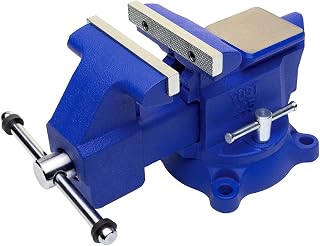 Yost Vises 445 Combination ViseCheck price on Amazon
Compare the picks
| Model | Jaw width | Swivel | Build | Warranty |
|---|---|---|---|---|
| Forward 1304 4 Inch | 4 in | 120 degrees | 60,000 PSI ductile iron | 1-year parts |
| VEVOR 3 Inch | 3 in | 360 degrees | Cast iron | Not stated |
| Dazefree Articulating | Not stated | 360 degrees | Cast steel | Not stated |
| Yost LV-4 | 4.5 in | Yes | Not stated | Not stated |
| MYTEC 3.3 Inch | 3.3 in | 360 degrees | Not stated | Not stated |
Specifications are manufacturer rated, as published on each listing and collected 22 October 2026. “Not stated” means the listing does not give the figure.
How we scored them
Performance weighs the working specs a vise lives by: jaw size, clamping force and the adjustments that make setups fast. Build covers the body material, from ductile iron to cast steel. Value compares what the listing includes against the price ceiling of this guide. Safety scores the mounting hardware and stated safe-use guidance, because a vise that shifts under load is a hazard. Warranty scores only a stated term, and only the Forward states one: a 1-year limited parts replacement.
| Product | Shop Score | Perf. /35 | Build /25 | Value /25 | Safety /10 | Warranty /5 |
|---|---|---|---|---|---|---|
| Forward 1304 4 Inch | 9.6 | 23 | 25 | 19 | n/a | 2 |
| VEVOR 3 Inch | 9.4 | 21 | 21 | 20 | n/a | 0 |
| Dazefree Articulating | 9.4 | 19 | 20 | 19 | n/a | 0 |
Scores run from 9.2 to 9.8: each product’s point total is placed on that range, so more points always means a higher score. Safety counts only for powered gear or where the listing states safety features; where it does not apply, the score is taken over the remaining 90 points.
What the listings tell you
Read the five listings side by side and a pattern appears. The traditional bolt-down vises (Forward, VEVOR, Yost) quote jaw width, jaw opening and swivel range; the clamp-on vises (Dazefree, MYTEC) quote rotation and portability instead. Only the Forward states a clamping force, 4,400 lbs, and only the Forward states a warranty, a 1-year limited parts replacement. Everything else is silence, and silence gets scored as silence: where a listing does not state a figure, the table says Not stated.
Vise anatomy: the parts that matter
A bench vise is a simple machine, but its parts decide its life. The body is the casting: the Forward’s 60,000 PSI ductile iron, the VEVOR’s cast iron and the Dazefree’s cast steel are the three stated materials here, and a stated material is the first thing to look for. The jaws do the holding. The Forward’s jaws are microgroove tooth and replaceable, which means worn teeth swap out instead of retiring the vise; the VEVOR ships 2 jaw covers so the same jaws can grip finished work without marking it. The slide bar carries the moving jaw; a smooth slide with a quick release, like the VEVOR’s, saves minutes on every setup. The base is the foundation. A 360-degree swivel base, like the VEVOR’s, Dazefree’s and MYTEC’s, lets you turn the work instead of walking around the bench; the Forward’s 120-degrees base gives most of that freedom with a stiffer lockdown from its dual locking nuts. Finally the anvil: the Forward’s 1.65 in x 1.65 in anvil is the only one stated here, and it turns the vise into a small forming station for straightening and light hammering.
Buying guide: best bench vise under 60
Jaw size and opening
Jaw width decides what fits. The Yost LV-4 leads at 4.5 in of jaw width with a 3 in jaw opening; the Forward follows with 4 in of width and 4 in of opening plus a 2 3/8 in throat depth. The VEVOR is the compact bench vise at 3 in (76.2 mm) of jaw width, and the MYTEC is the smallest at 3.3 in. Match the jaw to the work: 4 in and up for brackets, pipe fittings and automotive parts; 3 in and under for model work, small parts and gun cleaning. Jaw opening is the second number that matters. The Forward’s 4 in opening swallows thicker stock than the Yost’s 3 in, and the 2 3/8 in throat depth on the Forward decides how deep a part can sit between the jaws before it hits the slide. If you routinely hold round stock, a vise with pipe jaws is the answer, but none of the five listings here state pipe jaws, so round work goes in the flat jaws with a light hand.
Ductile iron, cast iron or cast steel
The Forward is the only listing to quote a material grade: 60,000 PSI ductile iron, which the maker calls 3x stronger than gray iron. Ductile iron bends where gray iron cracks, which is why it is the premium casting in this price band. The VEVOR is cast iron with a stated impact-resistant build; the Dazefree is cast steel, the traditional choice for articulating vises because it machines cleanly for the ball joint. The Yost and MYTEC listings do not state a body material. In this price band, a stated material beats an unstated one every time, because it tells you what the vise is before you find out the hard way. Weight is the honest proxy when the material is unstated: the Forward’s 5.02 kg and the VEVOR’s 3.5 pounds both say there is real metal in the casting.
Swivel base and mounting
A swivel base turns the vise instead of the workpiece. The VEVOR, Dazefree and MYTEC all rotate a full 360°; the Forward rotates 120°; the Yost lists a swivel base without a stated range. Full rotation matters most for filing and carving, where the work angle changes every few minutes; for straight clamping and hammering, 120 degrees with a firm lockdown is plenty. Mounting splits the field. The Forward bolts down with dual locking nuts and 3 bolts in the box, the classic permanent mount that takes the hardest use. The Dazefree and MYTEC clamp on, which means no drilling and true portability, but also lower holding rigidity: a clamp-on vise can walk on the bench under heavy hammering, so keep the clamp faces clean and tight. The VEVOR adds a raised base that fits thick wooden benches or slim metal worktables, a thoughtful touch for benches that are not the textbook two-inch top. If your bench is a slab door on sawhorses, clamp-on is the honest choice; if it is a bolted workbench, bolt the vise down and never look back.
Anvils, jaws and the small print
The Forward includes a 1.65 in x 1.65 in anvil for light hammering and microgroove tooth replaceable top jaws, so worn jaws swap instead of scrapping the vise. Replaceable jaws are the feature that separates a vise that lasts from a disposable vise: jaws wear, and a vise whose jaws cannot be replaced is retired when they do. The VEVOR ships 2 jaw covers in the box to protect finished surfaces, a raised base and a quick release for fast jaw adjustments. The Dazefree’s Quick Cam Ball system and ergonomic hand crank aim at rapid repositioning for carving, filing and gluing. Read the included-components line before you buy: bolts, jaw covers and adapters in the box are money you do not spend later.
Mounting your vise right
A vise is only as strong as its mount. The Forward’s dual locking nuts and 3 bolts want a bench top you can drill and a backing plate or large washers underneath, so the bolts cannot pull through under load. Clamp-on vises want a clean, flat bench edge: the Dazefree’s table clamp and the MYTEC’s clamp grip best on square edges, not rounded or laminated lips. Wherever the vise sits, leave clearance to swing the handle a full turn and to rotate the base without hitting the wall; a vise jammed in a corner loses half its usefulness. And keep the slide and screw lightly oiled: a dry vise handle is the first sign of a vise that will be hard to open in a year, so oil it while it still moves freely.
Garage Fit Check
- Measure the bench first: the Forward is 9.5 x 6 x 5.1 inches and weighs 5.02 kg, and it mounts with the 3 included bolts.
- Thick bench tops suit the VEVOR’s raised base, which the listing names for thick wooden benches and slim metal worktables.
- Clamp-on models like the Dazefree and MYTEC need a solid bench edge to bite; they skip bolts entirely.
- Small parts work benefits from the Dazefree’s ball joint or the VEVOR’s quick release clamp.
- The VEVOR box includes a large and a small desktop cover plus 2 jaw covers, so there is no hunting for protective caps later.
Use rated jack stands on solid ground, wear eye protection with power and air tools, keep fuel-burning equipment out of a closed garage, and follow the manual for every tool. Read our Safety Disclaimer.
Frequently Asked Questions
What size bench vise do I need for a home garage?
A 4 in vise like the Forward or the 4.5 in Yost covers most home garage work: brackets, pipe fittings, saw blades and automotive parts. A 3 in vise like the VEVOR suits smaller benches and lighter work.
Is a clamp-on vise strong enough?
For light and medium work, yes. The Dazefree and MYTEC clamp on without bolts, which suits renters and portable setups. For heavy hammering or high-torque work, a bolted vise like the Forward holds firmer.
What does jaw opening mean?
The maximum distance the jaws separate. The Forward opens to 4 in, the Yost to 3 in. Wider opening means thicker stock fits; the throat depth, 2 3/8 in on the Forward, decides how deep a part can sit in the jaws.
Do I need an anvil on the vise?
Not always, but it helps. The Forward’s 1.65 in x 1.65 in anvil gives you a flat surface for light shaping and straightening without reaching for a separate anvil.
Which vise has a warranty?
Only the Forward states one: a 1-year limited parts replacement. The other four listings state no warranty term, so buy them on the strength of their stated specs.
Related
Related: the best bench vise for home mechanics and our engine and shop equipment hub.