Bandsaw vs Chop Saw: Which One Should You Buy?
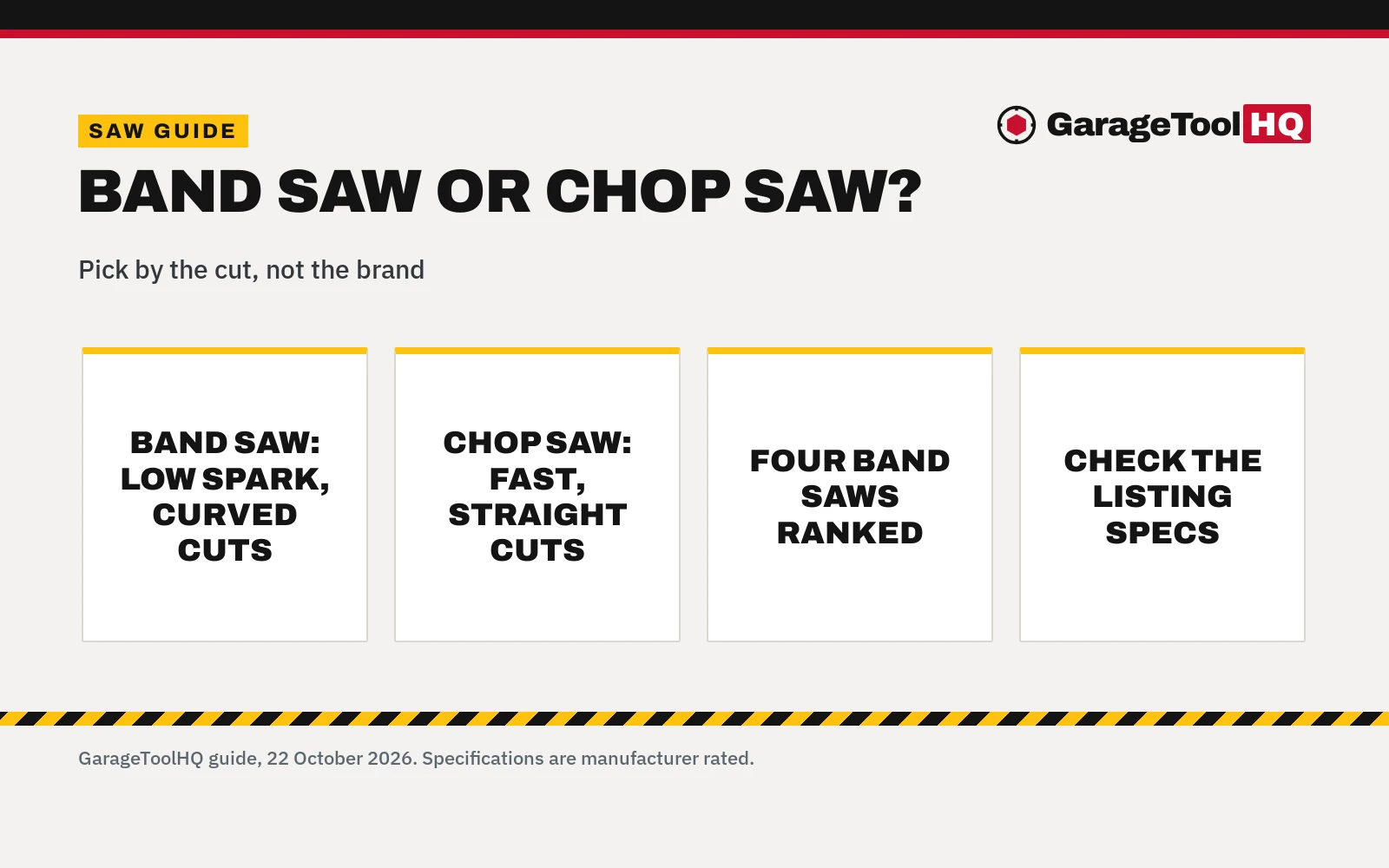
A band saw cuts quietly with low spark and handles curves, while a chop saw cuts straight through metal fast with sparks and heat: which one your garage needs, plus four band saws ranked for the job.

On this page
Top picks at a glance
As an Amazon Associate we earn from qualifying purchases.
- 1
 DEWALT Reciprocating Saw9.6/10View on Amazon
- 2
 Makita JR3070CT AVT® Recipro Saw9.6/10View on Amazon
- 3
 SKIL 13 Amp Corded Reciprocating Saw with Buzzkill Technology9.6/10View on Amazon
- 4
 Ryobi BS904G 9" BANDSAW Green BS904G Brand: RYOBIView on Amazon
- 5
 SEESII Benchtop Band Saw for Woodworking: 3A-120V BandsawView on Amazon
- 6
 20V MAX ATOMIC 1-3/4IN BANDSAWView on Amazon
Bandsaw vs chop saw: which one should you buy? If your garage jobs are conduit, pipe and bar stock cut to length with low spark and little noise, the band saw wins. If you need quick straight cuts through angle iron and tube and you can manage the sparks, the chop saw earns its place. This guide explains how the two saws differ and ranks the four band saws below from strongest to weakest listing.
More options to compare
 Ryobi BS904G 9" BANDSAW Green BS904G Brand: RYOBICheck price on Amazon
 SEESII Benchtop Band Saw for Woodworking: 3A-120V BandsawCheck price on Amazon
 20V MAX ATOMIC 1-3/4IN BANDSAWCheck price on Amazon
GarageToolHQ earns a commission when you buy through links on our product pages, at no extra cost to you. Read our affiliate disclosure.
Below: how a band saw and a chop saw cut, the four band saws in this guide ranked by their listings, and which saw fits which garage job.
Bandsaw vs chop saw: how they cut
A band saw moves a continuous toothed band around two wheels, so the teeth always travel in one direction through the work. The cut is narrow, the blade stays relatively cool, and the sparks are few. A chop saw spins an abrasive disc that grinds through the metal: fast, loud, and showering sparks and heat. Both cut metal; they feel like different tools because they are.
| Saw | How it cuts | Sparks and heat | Cut shapes |
|---|---|---|---|
| Band saw | Toothed band, continuous motion | Low spark, cooler cut | Straight and curved |
| Chop saw | Abrasive disc, grinding | Sparks and heat | Straight cuts only |
That table is the whole decision in miniature. If the job needs a curve, or the garage holds fuel cans and you want no spark shower, the band saw is the answer. If the job is ninety-degree cuts in tube and angle iron all afternoon, the chop saw’s speed is hard to argue with.
The four band saws in this guide, ranked
All four listings below are band saws; this guide has no chop saw listing, so the chop saw side is described from the comparison above. They are ranked from the strongest listing to the weakest.
DEWALT DCS374B 20V MAX
The listing describes a 20V brushless cordless band saw with a 5 in cutting capacity, 12.4 lb, bare tool only. The bullets name an integrated hang hook, an LED work light with a 20 second delay, a tool-less blade changing lever and variable speed. The spec table lists a 3 year limited manufacturers warranty. One contradiction: the spec table lists Surface Recommendation as Wood, while the title positions it as a deep-cut band saw; the title wins, but check the blade before cutting metal with it. It is the most complete listing here: stated capacity, stated weight, stated warranty term and real feature detail.
VEVOR Portable Band Saw
The listing describes a 110V corded portable band saw with an 1100W motor the bullets call 10 amp, though the spec table lists 2.9 Amp instead; the bullets win, but the listing contradicts itself. It has a removable alloy steel base. Cutting capacity is 4.7 by 4.7 in for rectangular stock and 5 in for round stock without the base, and 3.9 by 3.2 in and 3.93 in with the base. Cutting speed is 137.8 to 472.4 ft/min, variable, with 45 to 90 degree cutting and a base that swivels 0 to 45 degrees. Weight is 13 kg and the spec table lists UL. The listing covers metal, steel, aluminum, angle iron and PVC pipe.
Milwaukee 2829-20 M18
The listing describes an 18V M18 FUEL compact band saw, bare tool, 7.7 lb, with a POWERSTATE brushless motor the maker claims gives top cutting speed in its class, and which it says is over 20 percent lighter than the original M18 compact band saw. Specs state 540 FPM, 24 teeth and a high speed steel blade. The warranty entries read only Limited Warranty and Manufacturer Warranty, with no term stated. It is the lightest and most compact of the four, but the listing is thinner than the two above it.
Woodskil BS0901 9-Inch
The listing describes a 9 in benchtop band saw, 3 amp, 120V, 40 lb, with 2500 FPM blade speed and a 1720 RPM motor. Maximum cutting depth is 3-1/2 in and maximum cutting width is 9 in, with a 0 to 45 degree cast aluminum table, 120 degree miter gauge, rip fence and a 2-1/2 in dust exhaust port. The surface recommendation is metal and wood, and the bullets call it an ideal choice for woodworking. The warranty entry reads only Extended, with no term stated. This is the woodworking saw of the group, with soft metal as a secondary use.
Which saw for which job
Cutting exhaust tubing, conduit or threaded rod to length in a garage that shares space with fuel and solvents: the band saw, for the low spark and the quiet. Cutting angle iron and square tube for a welding project where straight ninety-degree cuts matter more than anything: the chop saw, with the sparks managed. Cutting curves in sheet or notching: only the band saw can do it. If you can only own one, the band saw covers more jobs; if your work is all straight stock, the chop saw is the quicker tool.
Use rated jack stands on solid ground, wear eye protection with power and air tools, keep fuel-burning equipment out of a closed garage, and follow the manual for every tool. Read our Safety Disclaimer.
Cutting safety in the garage
Metal cutting makes sharp edges, hot chips and, with a chop saw, a spark shower. Wear eye protection every time a saw runs, and keep the blade guard in place on a band saw. Unplug the saw or pull the battery before changing a blade. Keep fuel cans, solvents and anything flammable clear of the spark path, and sweep up metal shavings before they migrate into the rest of the garage. Check the saw’s manual before the first cut.
Frequently Asked Questions
Can a band saw cut metal?
Yes. The Milwaukee and VEVOR listings are metal-cutting saws: the VEVOR names metal, steel, aluminum and angle iron, and the Milwaukee is built for pipe. The DEWALT is a deep-cut band saw, though its spec table lists wood as the surface recommendation. The Woodskil benchtop saw lists metal and wood, with woodworking as its main job and soft metal as the secondary one.
What is the difference between a band saw and a chop saw?
A band saw cuts with a continuous toothed band: low spark, narrow kerf, and the ability to cut curves. A chop saw grinds through with an abrasive disc: faster on straight cuts, but loud, hot and sparking. Pick by the cut shape and the spark situation, not by brand.
Can I use a chop saw inside the garage?
Only with the sparks managed. A chop saw throws sparks and heat, so clear flammable vapors and materials from the spark path and never cut with the garage closed up around fuel cans, solvents or a running parts washer. When in doubt, cut outside.
What blade speed works for metal?
Metal wants slower speeds than wood. The VEVOR lists 137.8 to 472.4 ft/min variable, the Milwaukee lists 540 FPM, and the Woodskil lists 2500 FPM with wood as its main use. Match the speed to the material the listing states.
Is the Woodskil benchtop saw good for metal?
Its listing says metal and wood, and calls it an ideal choice for woodworking, so treat it as a wood saw that handles soft metal. For regular metal cutting, one of the portable metal-cutting band saws above is the better fit.
Related: bench vises for metal fabrication, drill presses for metal work and shop vacuums for metal shavings.