Spot Welder vs MIG Welder: Which One Should You Buy? (2026)
spot welder vs mig welder: which should you buy? A spot welder joins sheet metal fast with no filler; a MIG welder handles thicker stock and more joint types. Four MIG machines compared.

On this page
Top picks at a glance
As an Amazon Associate we earn from qualifying purchases.
- 1
 Weldpro 200 Amp MIG Welder9.8/10View on Amazon
- 2
 ARCCAPTAIN MIG205MP MIG Welder with Plasma Cutter9.7/10View on Amazon
- 3
 ARCCAPTAIN 200A MIG Welder 110V 220V 6 in 1 Aluminum Welding9.7/10View on Amazon
- 4
 PrimeWeld MIG180 Mig WelderView on Amazon
- 5
 Millermatic® 211 PRO MIG Welder MachineView on Amazon
- 6
 165A MIG Welder 110V/220V [Large LED Display] 4in1 WeldingView on Amazon
- 7
 145A MIG Stick WelderView on Amazon
- 8
 FEMEROL Plasma Cutter Welder Combo 200A Gas MIG/GaslessView on Amazon
- 9
 WELDPRO 140A MIG Welder 110/220VView on Amazon
Choosing spot welder vs mig welder comes down to the joint you need to make. A spot welder clamps two sheets of metal between copper tips and fuses them in one quick squeeze, which is why body shops use them for panels. A MIG welder feeds wire through a gun and lays a continuous bead, so it handles thicker stock, longer seams and more joint types. An honest note before the details: the four machines compared in this guide are all MIG welders, and none is a standalone spot welder. One of them, the ARCCAPTAIN MIG200P, states a spot welding mode among its settings, which is the closest thing here to the spot side of the question.
More options to compare
 PrimeWeld MIG180 Mig WelderCheck price on Amazon
 Millermatic® 211 PRO MIG Welder MachineCheck price on Amazon
 165A MIG Welder 110V/220V [Large LED Display] 4in1 WeldingCheck price on Amazon
 145A MIG Stick WelderCheck price on Amazon
 FEMEROL Plasma Cutter Welder Combo 200A Gas MIG/GaslessCheck price on Amazon
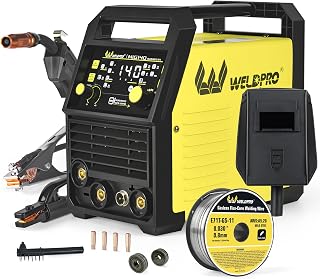 WELDPRO 140A MIG Welder 110/220VCheck price on Amazon
GarageToolHQ earns a commission when you buy through links on our product pages, at no extra cost to you. Read our affiliate disclosure.
Below: the short answer, the four MIG machines ranked with what their listings actually state, when each process is the better choice, and how to read a welder listing without getting fooled by the spec table.
Spot welder vs mig welder: the short answer
A spot welder makes one kind of joint, a spot weld between overlapping sheets, and it makes it fast: clamp, squeeze, done, with no filler wire and little cleanup. It is the tool for auto body panel work and thin sheet metal where speed matters more than versatility. A MIG welder makes many kinds of joints, butt, lap, fillet and tack, on steel, stainless and, with the right setup, aluminum. It handles thicker material and longer seams, but each joint takes longer and needs filler wire plus shielding gas or flux-cored wire.
The trade is simple. If your work is mostly thin sheet metal panels that need quick, repeatable joints, a spot welder earns its place. If your work ranges from thin sheet to frame brackets, exhaust and general fabrication, a MIG welder covers more of it. For a home garage that does both, the ARCCAPTAIN below is worth a look: it is a MIG welder that also lists a spot welding mode, so one box covers both ends of this comparison.
The four MIG machines in this guide, ranked
1. ARCCAPTAIN MIG200P: the only one with a spot mode
Ranked first because it is the only listing here that speaks to both sides of this guide. The ARCCAPTAIN MIG200P is a 200A, 7-in-1 multi-process machine: Pulse MIG, Standard MIG, Gasless Flux Core, Lift TIG and MMA Stick, plus spool gun support. Its display lets you adjust wire feed speed, welding current, voltage, burn-back time, spot welding time, inductance, hot start and arc force, and the listing states 2T/4T/SPOT modes. Pulse MIG runs with low heat input, which the listing says reduces deformation and burn-through risk on thin stock; the thinnest weldable thickness it states is 0.039″. It runs on 110V/220V, takes 2 lb and 10 lb wire spools, weighs 32.8 pounds, and carries a 2-Year Manufacturer warranty. Safety listings include over-current, over-voltage, overheat and overload protection.
2. Miller Millermatic 211 PRO: the shop-grade pick
Ranked second. The Miller Millermatic 211 PRO is a dual-voltage MIG welder that switches between 120V and 240V with no tools, using MVP plugs. The listing states it welds steel and aluminum to 3/8 in thick, with Dyna-Pulse MIG, BeadVision real-time bead monitoring, Auto-Set simplified setup and Smooth-Start for clean arc starts. Program Memory saves and recalls your most-used weld parameters. The heavy-duty drive system supports .024-.035 in wire, auto-detects a spool gun for aluminum, and ships with a 15-ft MIG gun. Item weight is 47.6 pounds. No spot welding mode is stated, and no output amperage figure is stated in the listing facts.
3. YESWELDER MIG-185DS PRO: the portable 5-in-1
Ranked third. The YESWELDER MIG-185DS PRO is a 5-in-1 machine: Gasless Flux Core MIG, Gas MIG, Spool Gun MIG, Stick and Lift TIG (the lift TIG torch and spool gun are sold separately, ASINs B07YP9TQV1 and B0B12JLSS9). Output is 185 Amp on 110V/220V, and it handles 2LB/10LB spools of .023″/.030″/.035″/.040″ welding wire depending on mode. Synergic MIG matches voltage automatically to the wire feed speed, and Manual MIG lets you set both yourself. The bullets call it 12 lbs with a carrying handle, but the spec table lists Item Weight as 33.4 pounds, so confirm the weight before you plan to carry it to a job. Safety features stated: automatic compensation for voltage fluctuation, plus over-current, over-load and over-heating protection. Aluminum MIG is possible with an added spool gun.
4. VEVOR MIG-270: the highest stated amperage
Ranked fourth. The VEVOR MIG-270 is a 3-in-1 machine (MIG, Lift TIG, Stick) with a stated 270 Amp output on 110/220V, the highest amperage figure in this guide. It uses 0.024″, 0.031″ and 0.039″ flux-cored or solid wire, takes 2.2 pound and 11 pound coiled wire, and has an LCD digital display with knobs for current, voltage and wire-speed control. The listing states suitability for carbon steel, iron and stainless steel, overheat protection with automatic shutdown, and IP21 protection against splashing water. The bullets state 21.7 pounds, but the spec table lists Item Weight as 30 pounds, so confirm before you buy for portability. Included components per the spec table: 2M cables with earth clamp, welder glasses and brush, 3M gas shielded welding torch and 2M argon tube.
When a spot welder is the better choice
Body panels and thin sheet metal are the spot welder’s home turf. When you need dozens of identical joints along a panel flange, nothing beats clamp and squeeze: each weld is quick, there is no filler wire to buy, and the joint needs little grinding. Restoration work, patch panels and floor pans all run faster with a spot welder than with a MIG gun making the same number of tacks. The catch is access: the metal has to fit between the welder’s arms, and you only get spot joints, never a continuous seam.
If you go this route, remember that none of the four listings in this guide is a standalone spot welder. The ARCCAPTAIN’s stated spot welding mode is a MIG machine’s take on the job, not a pair of spot welding tongs. Judge a real spot welder on its own listing, and check the stated throat depth and tip size against the panels you plan to weld.
When a MIG welder is the better choice
Everything that is not thin overlapping sheet points to MIG. Frame brackets, exhaust hangers, trailer repairs, general fabrication and anything thicker than panel steel want a continuous bead, and a MIG welder delivers it. The four machines here show the range: 185 to 270 Amp stated output, 110V/220V or 120V/240V dual voltage, and multi-process boxes that also run stick and lift TIG. For a garage that sees one rusty fender and ten other jobs, a MIG welder is the machine that stays busy.
Match the machine to your outlet before anything else. All four listings state dual voltage, but your 240V outlet and your breaker decide what the machine can actually deliver. A 270 Amp figure on a 110V circuit is not the same machine as on a 220V circuit, so read the manual’s input requirements, not just the headline amperage.
How to read a welder listing
Amps are the headline, voltage is the fine print
Every listing here leads with amperage: 270 Amp, 185 Amp, 200A, or a model number like 211 PRO. But the number only means something at the voltage the listing states. The VEVOR, YESWELDER and ARCCAPTAIN state 110V/220V or 110/220V; the Miller states 120V/240V. Two machines with the same amperage on different input voltages are not the same machine in your garage.
Weight: trust but verify
Two listings in this guide contradict themselves on weight. The VEVOR bullets say 21.7 pounds while its spec table says 30 pounds; the YESWELDER bullets say 12 lbs while its spec table says 33.4 pounds. Use the spec table figure when you plan transport, and treat the bullet figure as marketing until confirmed. The ARCCAPTAIN states 32.8 pounds and the Miller 47.6 pounds with no contradictions.
Wire size and spool size
The listings state wire compatibility precisely: VEVOR 0.024″/0.031″/0.039″, YESWELDER .023″/.030″/.035″/.040″, Miller .024-.035 in. Check your wire against the stated range before ordering, because a drive roll set for one diameter does not feed another well. Spool capacity matters too: 2 lb and 10 lb spools on the YESWELDER and ARCCAPTAIN, 2.2 pound and 11 pound coiled wire on the VEVOR.
Multi-process is a feature list, not a promise
The ARCCAPTAIN lists 7-in-1, the YESWELDER 5-in-1, the VEVOR 3-in-1. Those counts include processes that need extra torches or guns you buy separately, like the YESWELDER’s lift TIG torch and spool gun. Count only the processes that work out of the box, and price the accessories for the rest.
Frequently Asked Questions
Can a MIG welder do spot welding?
One listing here says yes: the ARCCAPTAIN MIG200P states a spot welding mode with adjustable spot welding time. The VEVOR, YESWELDER and Miller listings do not state any spot welding mode. A MIG spot mode still uses a gun and filler wire, so it is not identical to a standalone spot welder’s clamp-and-squeeze joint.
What voltage do these welders need?
All four listings state dual voltage: 110/220V on the VEVOR, 110V/220V on the YESWELDER and ARCCAPTAIN, and 120V/240V with MVP plugs on the Miller. Check your outlet and breaker against the manual before you buy.
Can these welders handle aluminum?
The YESWELDER and Miller listings state aluminum capability with an added spool gun; the Miller also states aluminum to 3/8 in thick. The ARCCAPTAIN listing mentions aluminum among its pulse MIG materials. The VEVOR listing states carbon steel, iron and stainless steel, with no aluminum claim.
Which is best for auto body panel work?
A standalone spot welder is the classic answer for panels, and none of the four listings here is one. Among these four, the ARCCAPTAIN is the only one that states a spot welding mode, which is why it ranks first for this keyword.
What wire sizes do these machines take?
The listings state: VEVOR 0.024″/0.031″/0.039″, YESWELDER .023″/.030″/.035″/.040″, Miller .024-.035 in. The ARCCAPTAIN states a thinnest weldable thickness of 0.039″ rather than a wire range. Match your wire to the stated range.
Related: the engine and shop equipment hub and our garage upgrades guides.