Best Engine Degreaser Foam (2026): 4 Foams Compared
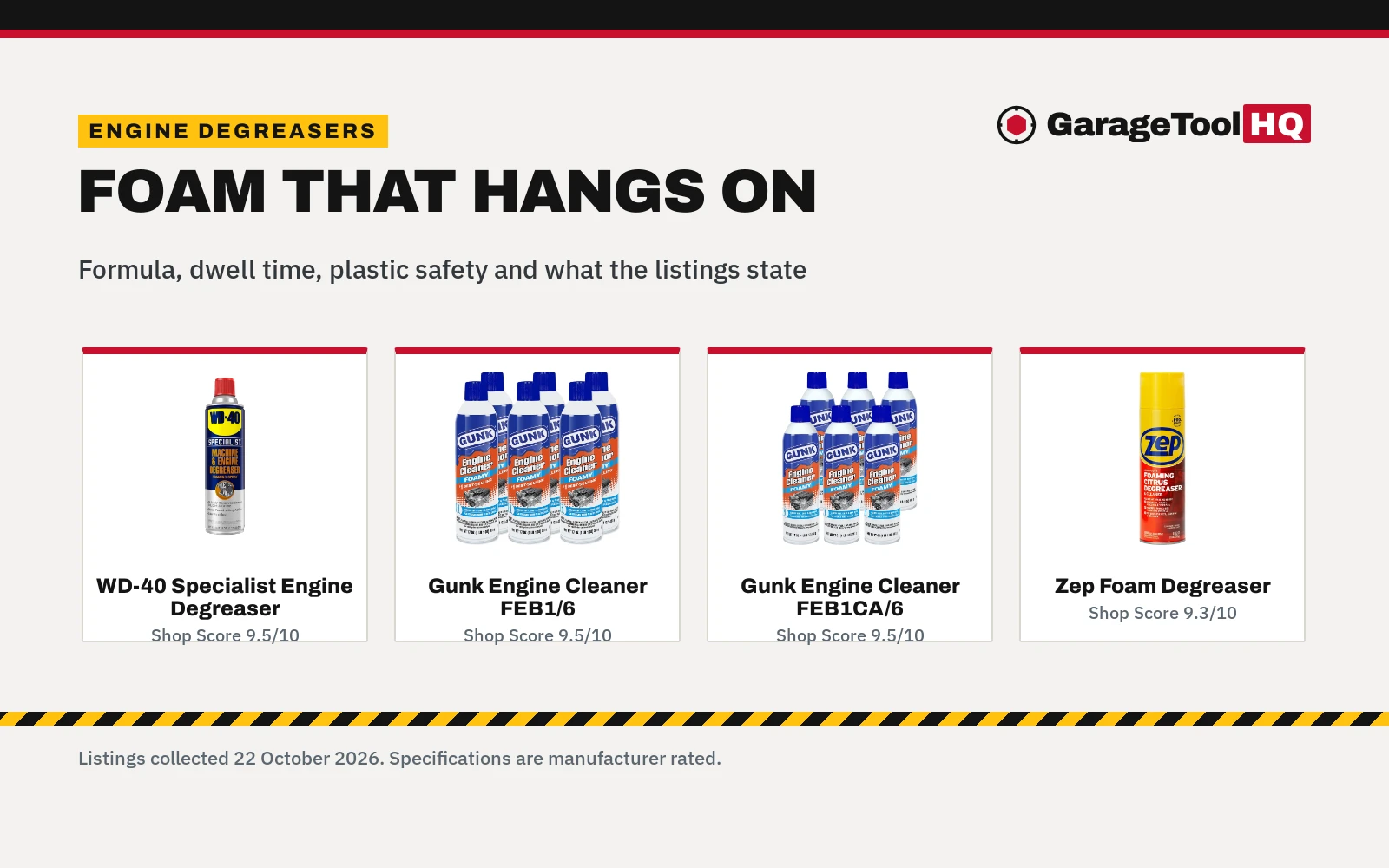
Four engine degreaser foams compared by formula, size, dwell time and plastic safety, with scores on performance, build and value.

On this page
Top picks at a glance
As an Amazon Associate we earn from qualifying purchases.
- 1
 Best OverallWD-40 Specialist Engine Degreaser9.5/10View on Amazon
- 2
 Best for Plastic CoversGunk Engine Cleaner FEB1/69.5/10View on Amazon
- 3
 Best 50-StateGunk Engine Cleaner FEB1CA/69.5/10View on Amazon
A greasy engine bay makes every job worse. You cannot see the leak, the bolts slip, and the whole thing looks neglected. Foam degreaser fixes that: spray it on, let the foam hang on the vertical surfaces and eat the grime, then rinse it off. This guide to the best engine degreaser foam compares four foams by formula, size, dwell time and what the listings actually state, so the next oil change starts with a clean bay. A clean bay also makes the next leak easier to spot, before it stains the driveway.
Foam is not the only way to degrease, but it is the laziest effective way: the can does the reaching, the foam does the waiting, and the hose does the rinsing. The four foams below cover the two honest choices, a single versatile can or a case lot of a specialist, plus one citrus outlier that belongs in the kitchen. Pick by what is under the hood.
GarageToolHQ earns a commission when you buy through links on this page, at no extra cost to you. Read our affiliate disclosure.
Quick picks
- Best Overall WD-40 Specialist Engine Degreaser: 18 oz industrial-strength foaming spray with a 5 ft reach and precision straw, listed for auto and truck engines, machinery and farm equipment. Check price on Amazon
- Best for Plastic Covers Gunk Engine Cleaner FEB1/6: 17 oz expanding foam in a case of 6, safe on plastic covers, under-hood rubber and paint, with a stated 10 to 15 minute dwell. Check price on Amazon
- Best 50-State Gunk Engine Cleaner FEB1CA/6: 17 oz 50-state compliant expanding foam in a case of 6, safe on plastic engine covers with a thick clinging foam. Check price on Amazon
The picks

WD-40 Specialist Machine & Engine Degreaser
An 18 oz industrial-strength foaming spray that shoots up to 5 ft, with a precision straw for tight spots on engines and machinery.
Pros
- Nozzle sprays up to 5 ft for long-distance application
- Included straw creates a precision stream for tight spots
- Low-residue, water-based foaming formula
- Listed for auto and truck engines, machinery and farm equipment
Cons
- No warranty term with a concrete length is stated
- No safety certifications are stated
- Single 18 oz can, not a multi-pack
- The listing gives no dwell time figure

Gunk Engine Cleaner – Foamy Spray for Engines
A 17 oz expanding foam in a case of 6, safe on plastic covers and paint, with a 10 to 15 minute dwell before rinsing.
Pros
- Safe on plastic covers, under-hood rubber and paint
- Expanding foam clings to vertical surfaces
- Case of 6 for the whole fleet
- Stated 10 to 15 minute dwell time
Cons
- No warranty term is stated
- No safety certifications are stated
- The listing gives no spray reach figure
- Six cans take more shelf space than one

Gunk Engine Cleaner – 50 State Compliant Foamy
A 17 oz 50-state compliant expanding foam in a case of 6, gentle on plastic engine covers with a thick clinging foam.
Pros
- 50-state compliant formula
- Safe on plastic engine covers and delicate surfaces
- Thick foam sticks to hard-to-reach spots
- Case of 6 for repeated jobs
Cons
- No warranty term is stated
- No safety certifications are stated
- The listing gives no dwell time figure
- Six cans take more shelf space than one

ZEP ZUHFD18 Foam Degreaser, 18 oz
An 18 oz citrus foam degreaser, though its listing targets tile and kitchen surfaces rather than engines.
Pros
- Natural citrus solvent formula
- Thick foam formula
- 18 oz aerosol can
- Fresh citrus scent
Cons
- The listing targets kitchen and tile, not engines
- No warranty term is stated
- No safety certifications are stated
- The listing gives no dwell time figure
Compare the picks
| Product | Shop Score | Size | Foam type | Dwell time | Plastic-safe |
|---|---|---|---|---|---|
| WD-40 Specialist Engine Degreaser | 9.5/10 | 18 oz | Low-residue foaming spray | Not stated | Not stated |
| Gunk Engine Cleaner FEB1/6 | 9.5/10 | 17 oz (case of 6) | Expanding foam | 10 to 15 minutes | Yes |
| Gunk Engine Cleaner FEB1CA/6 | 9.5/10 | 17 oz (case of 6) | Expanding foam | Not stated | Yes |
| Zep Foam Degreaser | 9.3/10 | 18 oz | Thick citrus foam | Not stated | Not stated |
Specifications are manufacturer rated, as published on each listing and collected 22 October 2026. Where a listing contradicts itself, both figures are shown.
How we scored them
Each degreaser is scored out of 10 on performance, build, value, safety and warranty, with the weights published on our How We Pick page. None states a safety certification or a warranty term with a concrete length, so all score zero on safety and warranty.
| Product | Shop Score | Perf. /35 | Build /25 | Value /25 | Safety /10 | Warranty /5 |
|---|---|---|---|---|---|---|
| WD-40 Specialist Engine Degreaser | 9.5 | 32 | 21 | 20 | 0 | 0 |
| Gunk Engine Cleaner FEB1/6 | 9.5 | 30 | 20 | 21 | 0 | 0 |
| Gunk Engine Cleaner FEB1CA/6 | 9.5 | 29 | 20 | 21 | 0 | 0 |
| Zep Foam Degreaser | 9.3 | 23 | 18 | 18 | 0 | 0 |
Scores run from 9.2 to 9.8: each product’s point total is placed on that range, so more points always means a higher score.
What the listings tell you
We read four foam listings. Three are engine foams; one, the Zep, is a kitchen and tile formula that happens to come as a foam. The two Gunk listings are a matched pair: both 17 oz expanding foams in a case of 6, both safe on plastic covers, one with a stated 10 to 15 minute dwell and one with a 50-state compliant formula. The WD-40 Specialist is the only single can, an 18 oz industrial-strength spray with a 5 ft reach and a precision straw. None of the four states a safety certification or a concrete warranty term.
On scent and feel, the listings split three ways. The Zep is a natural citrus formula with a fresh citrus scent, aimed at kitchens. The Gunk pair is unscented and low-odor, built for under-hood work where fumes linger. The WD-40 Specialist is unscented with a water-based formula the listing calls low-residue. On packaging, the WD-40 can is the only one with a stated spray reach and a precision straw; the Gunk cans rely on the foam’s own cling; the Zep is a standard aerosol with no reach claim.
Buying guide: best engine degreaser foam
Foam that hangs vs foam that runs
The whole point of a foam is dwell time on vertical surfaces. The Gunk listings describe an expanding foam that clings to vertical surfaces and works into crevices before hosing off. The WD-40 Specialist describes a foaming spray that sticks to whatever it is sprayed on and penetrates deep. The Zep describes a thick foam formula. For an engine bay full of vertical walls, cling is what separates a foam from a liquid spray.
Plastic covers and paint
Modern engine bays are full of plastic. Both Gunk listings state their foam is safe on plastic covers, with the FEB1/6 adding under-hood rubber and paint. The WD-40 Specialist lists metal as its surface recommendation and makes no plastic claim. If the bay has plastic covers, buy the foam that names them.
Dwell time and rinsing
Only the Gunk FEB1/6 states a dwell time: 10 to 15 minutes before rinsing with a hose. The other three give no figure, so follow the can. All three engine foams rinse with water; none of the listings calls for scrubbing, though heavy buildup may need a second pass.
Single can vs case lot
The WD-40 Specialist and Zep are single 18 oz cans. The two Gunk listings are a case of 6 at 17 oz each, 102 oz total. A case makes sense if the fleet includes the truck, the mower and the farm equipment; a single can suits one engine bay twice a year. Shelf space matters: the Gunk case weighs 15.86 lbs.
The kitchen foam in the list
The Zep deserves a straight word: its listing describes a restaurant-grade formula for tile and vertical kitchen surfaces, with a natural citrus solvent and a fresh citrus scent. Nothing in it speaks to engines, rubber or paint. It is included because the search returned it, not because it belongs on an engine. Buy one of the other three for under the hood.
Citrus vs petroleum-based foams
The Zep is the only citrus formula here: natural citrus solvents with a fresh citrus scent, aimed at kitchens. The Gunk pair is unscented and low-odor with no citrus claim, and the WD-40 Specialist is an unscented water-based formula. Citrus sounds friendlier, but the citrus listing in this set is not an engine product. For under-hood work, the unscented engine foams are the honest match, and low odor matters when the bay is in an attached garage.
What the labels do not say
No listing here states a safety certification, a concrete warranty term, or a coverage figure in square feet. None states a shelf life for an opened can. The WD-40 listing is the only one with a spray reach figure, and the Gunk FEB1/6 is the only one with a dwell time. Buy on what is stated: formula, size, dwell and surface safety. Everything else is marketing.
Use rated jack stands on solid ground, wear eye protection with power and air tools, keep fuel-burning equipment out of a closed garage, and follow the manual for every tool. Read our Safety Disclaimer.
Garage Fit Check
- Check the surface list before spraying: the Gunk foams name plastic covers, rubber and paint, while the WD-40 Specialist lists metal.
- Plan the rinse: all three engine foams hose off with water, so the job needs a hose and drainage, not just the can.
- Mind the dwell: only the Gunk FEB1/6 states 10 to 15 minutes, so read the can on the others before walking away.
- Store aerosols upright in a cool spot; the Gunk case of 6 weighs 15.86 lbs and needs real shelf space.
Frequently Asked Questions
What is a good engine degreaser foam?
One made for engines. The WD-40 Specialist and both Gunk foams list engines among their uses, with the Gunk pair adding plastic-cover safety. The Zep foam in this list is a kitchen formula, so skip it for engine bays.
How long should foam degreaser sit?
The Gunk FEB1/6 listing says 10 to 15 minutes before rinsing. The other listings state no dwell time, so follow the can’s directions.
Can foam degreaser hurt plastic engine covers?
Both Gunk listings state their foam is safe on plastic covers. The WD-40 Specialist makes no plastic claim and lists metal as its surface recommendation, so keep it off plastic unless the label says otherwise.
Do I need to scrub after foaming?
The listings describe spray, dwell and rinse with a hose, with no scrubbing step. Heavy buildup may need a second application, but that is the listing’s method, not extra labor.
Is the citrus foam safe for engines?
The Zep citrus foam’s listing targets tile and kitchen surfaces, not engines. For under-hood work, use a foam whose listing names engines.
Can I use engine degreaser foam on a motorcycle?
The Gunk FEB1/6 listing names bikes and motorcycles among its uses, along with cars, trucks and ATVs. The WD-40 Specialist lists auto and truck engines and farm equipment. Match the foam to the listing’s stated uses.
Related: the best microfiber towels for engine bay, the best air blow gun for engine bay and the best electrical contact cleaner. Also see our engine support bar vs engine hoist comparison.