Best Motion Sensor Garage Lights (2026): 4 Picks
Four motion sensor garage lights, from a 7500-lumen hardwired security fixture to solar and E26 bulbs, compared on performance, build, value, safety and warranty.

On this page
Top picks at a glance
As an Amazon Associate we earn from qualifying purchases.
- 1
 Best OverallLUTEC 72W 7500LM Security Light9.7/10View on Amazon
- 2
 Best SolarTuffenough 2500LM Solar Light9.6/10View on Amazon
- 3
 Best BulbGE LED+ Motion Sensor Bulb9.5/10View on Amazon
- 4
 Best Dusk-to-DawnTorkase Motion Sensor Bulb9.4/10View on Amazon
- 5
 Motion Sensor Garage LightView on Amazon
- 6
 LED Garage Light Motion SensorView on Amazon
- 7
 Motion Sensor Garage Lights for Ceiling 80W 8000LM 1PackView on Amazon
- 8
 260W Motion Sensor Garage Lights with Remote ControlView on Amazon
- 9
 UME LED Security Light Motion Sensor Outdoor LightsView on Amazon
- 10
 200W Motion Sensor Garage LightView on Amazon
The best motion sensor garage lights turn on when you pull in and off when you leave, with enough brightness to work under. A good one covers the driveway approach as well as the interior, so you are never fumbling for a switch with your hands full of groceries or tools. We compared four motion sensor lights on performance, build, value, safety and warranty, from a 7500-lumen hardwired fixture to screw-in bulbs.
GarageToolHQ earns a commission when you buy through links on this page, at no extra cost to you. Read our affiliate disclosure.
Quick picks
- Best Overall LUTEC 72W 7500LM Security Light: 7500LM, 72W, 5000K, 180-degree sensing to 69 ft, IP65. Check price on Amazon
- Best Solar Tuffenough 2500LM Solar Light: 2500LM solar, 210 LEDs, remote, 3 modes, IP65. Check price on Amazon
- Best Bulb GE LED+ Motion Sensor Bulb: 15W PAR38, E26, no hub or Wi-Fi, 5-year term. Check price on Amazon
- Best Dusk-to-Dawn Torkase Motion Sensor Bulb: 13W, 100W equivalent, dusk-to-dawn, 90-day term. Check price on Amazon
The picks

LUTEC 72W 7500LM LED Security Lights Motion Sensor
For maximum brightness: 7500 lumens at 5000K with 180-degree sensing to 69 ft.
Pros
- 7500 lumens at 5000K, brightest here, equal to 720W incandescent per the listing
- 180-degree sensing to 69 ft with a 1, 3 or 10 minute timer
- IP65 stated
- 3-year limited term stated
Cons
- Hardwired 120V, needs wiring
- 72W draw, the most here, though listed as 88% savings over incandescent
- Single fixed head
- Overkill for a small garage

Tuffenough Solar Outdoor Lights 2500LM 210 LED
For no-wiring installs: a 2500-lumen solar light with remote and 3 modes.
Pros
- Solar powered, no wiring
- 2500 lumens from 210 LEDs
- Remote with 3 lighting modes, no ladder needed to switch
- IP65 stated
Cons
- 1-year term, shortest here
- Needs sun to charge; cloudy stretches need 2 to 3 days of charging with the light off
- 2500 lumens, a third of the LUTEC
- Remote can be misplaced

GE LED+ Motion Sensor LED Light Bulbs, 15W
For the simplest upgrade: a 15W PAR38 motion bulb that screws into an E26 fixture.
Pros
- Screws into any E26 medium-base fixture; 15W with 90W equivalent stated
- No app, hub or Wi-Fi needed
- 5-year term stated
- Soft white light option
Cons
- No safety certification stated
- 15W, modest brightness
- Needs an existing fixture
- Bluetooth features need the app

Motion Sensor Light Bulbs
For dusk-to-dawn automation: a 13W E26 bulb with PIR motion and 30 to 45 second shutoff.
Pros
- Dusk-to-dawn plus PIR motion
- 100W equivalent at 13W
- Turns off 30 to 45 seconds after motion
- E26 base fits standard open downward-facing fixtures
Cons
- No safety certification stated
- 90-day term, shortest coverage
- 8 to 16 ft range is the shortest here
- Only lights below 15Lux
More options to compare
 Motion Sensor Garage LightCheck price on Amazon
 LED Garage Light Motion SensorCheck price on Amazon
 Motion Sensor Garage Lights for Ceiling 80W 8000LM 1PackCheck price on Amazon
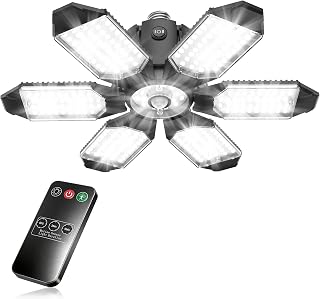 260W Motion Sensor Garage Lights with Remote ControlCheck price on Amazon
 UME LED Security Light Motion Sensor Outdoor LightsCheck price on Amazon
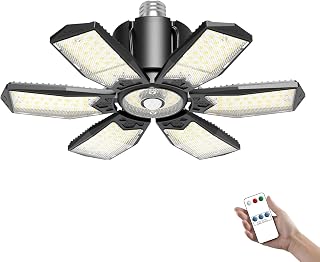 200W Motion Sensor Garage LightCheck price on Amazon
Compare the picks
| Light | Shop Score | Brightness | Power |
|---|---|---|---|
| LUTEC 72W 7500LM Security Light | 9.7/10 | 7500LM | Hardwired 120V |
| Tuffenough 2500LM Solar Light | 9.6/10 | 2500LM | Solar |
| GE LED+ Motion Sensor Bulb | 9.5/10 | 15W | E26 bulb |
| Torkase Motion Sensor Bulb | 9.4/10 | 13W | E26 bulb |
Specifications are manufacturer rated as listed, collected 22 October 2026.
How we scored them
Each light is scored out of 10 on performance, build, value, safety and warranty. Safety here means stated ingress protection and certifications: the two fixtures state IP65, while the two bulbs state no certification. All four state a warranty term, from 90 days to 5 years, which is unusually complete coverage for a budget roundup. Our How We Pick page publishes the weights.
| Product | Shop Score | Perf. /35 | Build /25 | Value /25 | Safety /10 | Warranty /5 |
|---|---|---|---|---|---|---|
| LUTEC 72W 7500LM Security Light | 9.7 | 32 | 21 | 20 | 7 | 3 |
| Tuffenough 2500LM Solar Light | 9.6 | 29 | 20 | 21 | 7 | 2 |
| GE LED+ Motion Sensor Bulb | 9.5 | 28 | 20 | 20 | 0 | 4 |
| Torkase Motion Sensor Bulb | 9.4 | 27 | 19 | 21 | 0 | 1 |
Scores run from 9.2 to 9.8: each product’s point total is placed on that range, so more points always means a higher score.
How to choose the best motion sensor garage lights
Fixture or bulb
The LUTEC and Tuffenough are complete fixtures: brighter, with wider sensing, but the LUTEC needs hardwiring at 120V. The GE and Torkase are E26 bulbs that screw into fixtures you already own, which makes them the fastest upgrade. If you have no fixture at all, a bulb alone does nothing for you, so count your existing fixtures before choosing. The LUTEC ships with mounting hardware as a 3-head fixture at 12.99 x 8.07 x 5.12 in. The Tuffenough is a 2-pack of 3-head solar fixtures at 11 x 5.5 x 3.5 in each, fixed with included screws and no wiring at all. The Torkase needs an open, downward-facing fixture: the listing says it will not work properly in enclosed or recessed fixtures, so check the fixture type before counting on a bulb swap. For general garage brightness, see our best LED garage lights for 7 foot ceiling.
How much light is enough
These range from 13W bulbs to a 7500-lumen fixture. A single-car garage does fine with the 2500-lumen solar unit; a two-car workspace or driveway wants the 7500-lumen LUTEC. Lumens matter more than watts here: the 13W Torkase claims a 100W equivalent, so compare brightness figures, not power draw. The LUTEC lists 7500 lumens as equal to a 720W incandescent while drawing 72W, and the GE lists 1200 lumens from 15W as a 90W equivalent. Lifespan figures differ too: the LUTEC lists 50,000 hours, the Torkase 20,000 hours and the GE up to 13.7 years. A brighter fixture also covers more ground per mount, which matters when there is only one good mounting spot.
Sensing range and modes
The LUTEC senses 180 degrees out to 69 ft, the widest stated; the Torkase covers 8 to 16 ft, suited to doorways. The Tuffenough remote offers three modes including a dim sensor mode for all-night glow, while the Torkase shuts off 30 to 45 seconds after motion. Match the range to the space: too wide and every passing car trips it. The LUTEC timer sets 1, 3 or 10 minutes, and its 4 modes include Security, Dusk to Dawn and Manual Override for constant light. The Tuffenough remote switches strong light sensor, dim light sensor and strong long light modes without climbing a ladder. The GE detects at a 90-degree angle out to 24 ft. The Torkase pairs PIR motion with dusk-to-dawn activation below 15 Lux, so daylight never trips it.
Color temperature
The LUTEC states 5000K daylight white, the Tuffenough 6500K, the Torkase 5000K and the GE 3000K warm white with a soft white option. Higher Kelvin reads cooler; 5000K daylight white renders detail well for working under. The bulbs also state color rendering index: 80 on the GE and 85 on the Torkase, so compare those figures if color accuracy matters at the bench. Our 5000K vs 6500K LED shop light guide explains the trade in depth.
Brightness versus coverage
Do not conflate the two. Brightness is lumens or watts: 7500 on the LUTEC down to 13W on the Torkase. Coverage is the sensor: 69 ft of 180-degree sensing versus 8 to 16 ft. A bright light with a short sensor leaves you working in the dark until you are nearly under it, so check both figures on the listing before you buy. Head count shapes coverage too: the LUTEC and Tuffenough are 3-head fixtures with adjustable heads, so one mount washes a wide area, while the bulbs throw from a single point. The Tuffenough adds a 270-degree wide lighting angle on top of its 26 ft sensing. For a wide driveway, one 3-head fixture beats two bulbs; for a doorway, a bulb is plenty.
What the warranty tells you
Terms here run from 90 days to 5 years, and longer usually tracks with build confidence. The GE bulb carries 5 years, the LUTEC 3 years, the Tuffenough 1 year and the Torkase 90 days. A long term on a bulb you can swap in seconds matters less than the same term on a hardwired fixture. The Torkase pairs its 90-day return with a 36-month warranty, and the Tuffenough and LUTEC state limited terms of 1 year and 3 years. Weigh the term against the install effort: the 5-year GE term is easy to claim since the bulb unscrews, while the 3-year LUTEC term covers a fixture you hardwire once.
Solar versus wired
The Tuffenough runs on solar with no wiring at all, which suits detached garages and sheds without power. The trade is dependence on sun: shaded mounts underperform. The hardwired LUTEC and the screw-in bulbs need household power but work the same every night. The Tuffenough carries an 1800mAh rechargeable battery on a 10W solar draw; the listing says to switch it off and charge 2 to 3 days facing the sun after cloudy stretches. Mounting height matters for the sensor: the listing recommends 6.5 to 8 ft, warning that too high or too low affects motion sensing. Our best LED garage lights for detached garage guide covers more no-power options.
Use rated jack stands on solid ground, wear eye protection with power and air tools, keep fuel-burning equipment out of a closed garage, and follow the manual for every tool. Read our Safety Disclaimer.
Garage Fit Check
- Measure the mounting height and distance: the LUTEC senses to 69 ft, the Torkase only 8 to 16 ft.
- The LUTEC is hardwired at 120V; plan the circuit before you buy, and use a licensed electrician.
- Solar units need direct sun on the panel; check the mounting spot at midday first.
- Bulb picks need an existing E26 fixture rated for outdoor use where applicable.
Angle the 3-head fixtures to cover door and driveway separately; the LUTEC and Tuffenough heads adjust.
Frequently Asked Questions
Do motion sensor lights work in daylight?
These are night-oriented. The Torkase stays off above 15Lux, the LUTEC deactivates during daylight hours, and the GE lights on motion detected at night. Daytime motion will not waste power on any of these four.
How far away does the motion sensor reach?
From 8 to 16 ft on the Torkase bulb to 180 degrees and 69 ft on the LUTEC fixture, per the listings. The GE lists a 90-degree angle out to 24 ft, between the two extremes. Wider is not always better: a 69 ft sensor on a busy street will trip all night.
Can I install the hardwired light myself?
The LUTEC is hardwired at 120V and ships with mounting hardware. Electrical work of that kind calls for a licensed electrician, not a DIY attempt. The bulbs and the solar fixture need no wiring at all.
Will the solar light work in winter?
It depends on sun exposure. Shorter days and shaded mounts cut charging, and the listing gives a recovery routine: switch the light off on cloudy and rainy days and charge facing the sun for 2 to 3 days before turning it on again. Mount the panel where winter sun actually lands, free from obstructions, at the recommended 6.5 to 8 ft height. If your winters are dark, a wired or bulb pick is the safer bet.
What does IP65 mean on these lights?
Both the Tuffenough and LUTEC listings state IP65 and describe outdoor use in rain and snow. The GE bulb is described as wet-rated and weather-resistant instead. Compare the codes as stated; the listings do not spell out the digits.
Can I use these indoors?
The bulbs suit garage interiors; the fixtures are listed for outdoor use, though many buyers mount them inside. Check the listing’s stated indoor or outdoor usage before mounting.
Related guides
Related: the best LED garage lights for 7 foot ceiling, the best LED garage lights for detached garage, our linear vs high bay LED shop light comparison and our 5000K vs 6500K LED shop light guide.