Magnetic Drill vs Drill Press: Which One Should You Buy?
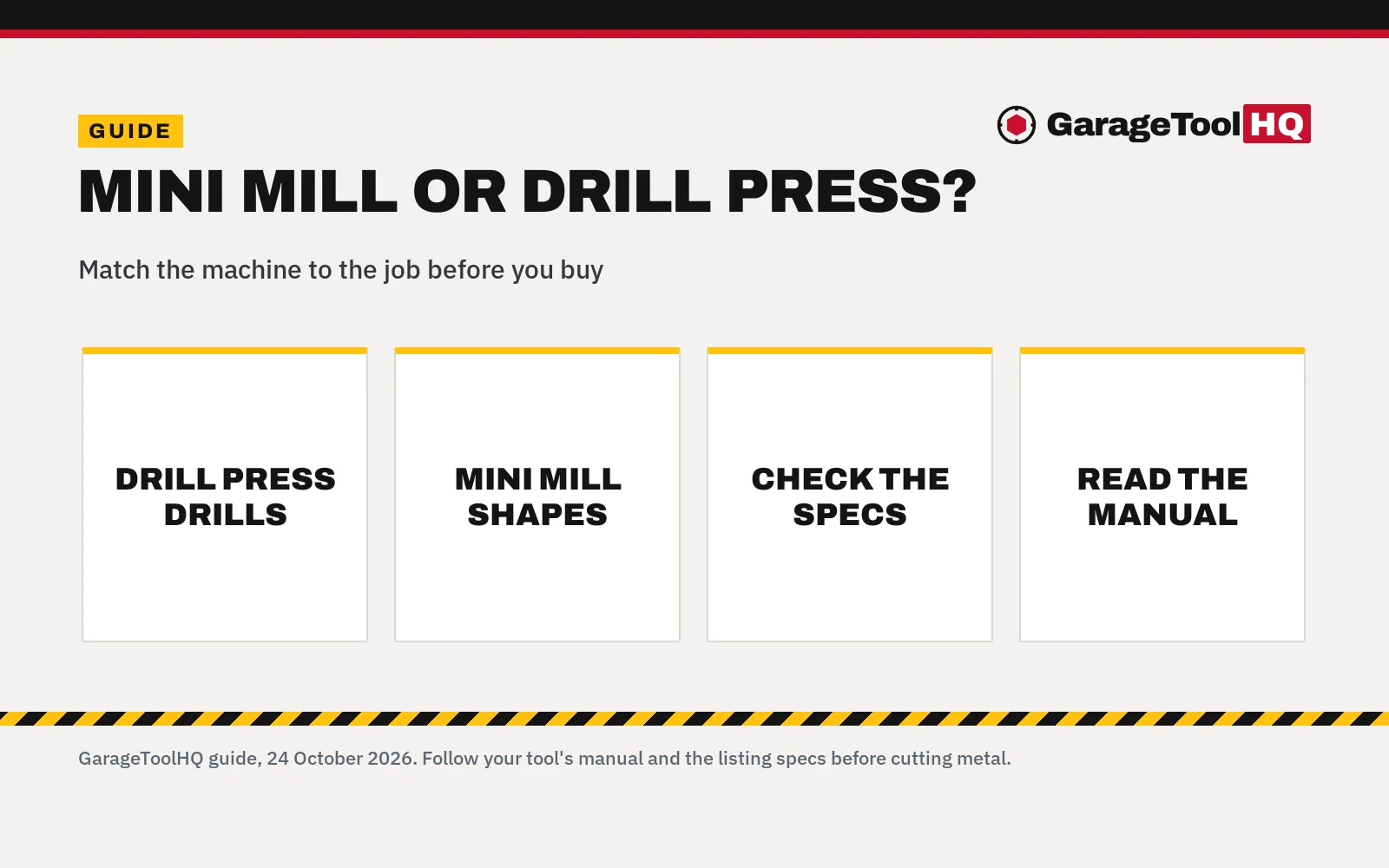
Magnetic drill vs drill press for the home shop: three magnetic drill examples compared on holding force, speed, capacity and warranty, with the drill press side covered in general terms.

On this page
Top picks at a glance
As an Amazon Associate we earn from qualifying purchases.
- 1
 Evolution Heavy Duty 1-1/8 inch Industrial Magnetic Drill9.6/10View on Amazon
- 2
 JET 12" Benchtop Drill Press9.8/10View on Amazon
- 3
 Heavy Duty Bench Vise 4.5 Inch: Table Clamp Woodworking Vice9.5/10View on Amazon
- 4
 VEVOR Magnetic DrillView on Amazon
- 5
 VEVOR Magnetic Drill Press 1400 W 2810 lbf Power Portable MagView on Amazon
- 6
 VEVOR Mag Drill PressView on Amazon
- 7
 Hougen HMD904 115-Volt Magnetic DrillView on Amazon
- 8
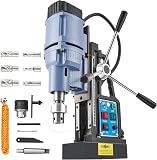 Magnetic Drill Press with 6 Drill BitsView on Amazon
- 9
 VEVOR Low Profile Magnetic Drill PressView on Amazon
Verdict: Choose a magnetic drill if you drill steel where it sits: beams, plate and frames on site, held in place by the magnet. Choose a drill press if you want a stationary bench or floor machine for repeatable holes in the shop. Note that all three listings here describe magnetic drills, so the drill press side is covered in general terms.
The trailer frame needs a new crossmember, and the holes have to go through steel where it sits. This magnetic drill vs drill press comparison covers both sides, with three magnetic drill examples from the listings we reviewed.
GarageToolHQ earns a commission when you buy through links on this page, at no extra cost to you. Read our affiliate disclosure.

Evolution Heavy Duty 1-1/8 inch Industrial
A 10A, 1200W magnetic drill with 2860 lbs of holding force from a 2-stage magnet, on-board coolant and a 3-year warranty, in a carry case.
Pros
- 2860 lbs of holding force with a 2-stage magnet
- 3-year warranty with US-based customer service
- On-board coolant bottle included
- Carry case, safety strap and safety guard included
Cons
- 480 rpm, slower than the VEVOR at 900 rpm
- 26 pounds, the heaviest here
- No safety listing such as UL stated
- 1-1/8 in capacity is the smallest of the three

VEVOR Mag Drill Press, 1200W, 1.5" Boring
A 1200W magnetic drill press with 2248 lbf of magnetic force, 900 rpm, 1.5 in boring capacity and overload shut-off.
Pros
- 900 rpm, the highest speed here
- 2248 lbf magnetic force, holds on vertical or sloped surfaces per the listing
- Overload shut-off and metal housing
- 1.5 in boring capacity with Weldon shank
Cons
- No warranty term is stated
- The title describes a magnetic drill, not a stationary drill press
- Included components list only a drill attachment
- No safety listing such as UL stated

Evolution Power Tools EVOMAG42 1 5/8" Diameter x
A 1200W, 10A magnetic drill with 450 rpm, 1-5/8 in by 2 in capacity and a 5-1/16 in stroke, described as portable and lightweight.
Pros
- 1-5/8 in diameter by 2 in depth capacity, the largest here
- 5-1/16 in stroke length
- Integrated coolant system
- Described as portable and lightweight
Cons
- No warranty term is stated
- The spec table lists 0.27 g item weight, which cannot be right for a mag drill
- 450 rpm, slower than the VEVOR at 900 rpm
- No safety features are stated
More options to compare
 VEVOR Magnetic DrillCheck price on Amazon
 VEVOR Magnetic Drill Press 1400 W 2810 lbf Power Portable MagCheck price on Amazon
 VEVOR Mag Drill PressCheck price on Amazon
 Hougen HMD904 115-Volt Magnetic DrillCheck price on Amazon
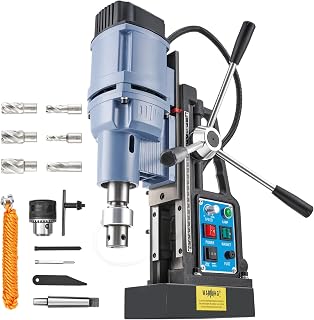 Magnetic Drill Press with 6 Drill BitsCheck price on Amazon
 VEVOR Low Profile Magnetic Drill PressCheck price on Amazon
Magnetic drill vs drill press: side by side
| Magnetic drill | Drill press | Notes | |
|---|---|---|---|
| How it drills | Clamps to the steel with an electromagnet, drills where it sits | Not stated in the listings; a stationary bench or floor machine | All three examples are magnetic drills. |
| Best jobs | Drilling steel beams, plate and frames on site | Not stated in the listings | The listings describe on-site metal work. |
| Holding force (examples) | 2860 lbs (S28MAG); 2248 lbf (VEVOR) | Not stated in the listings | Force keeps the drill from walking. |
| Speed (examples) | 480 rpm, 450 rpm and 900 rpm | Not stated in the listings | All three are single speed. |
| Capacity (examples) | 1-1/8 in, 1-5/8 in by 2 in, 1.5 in | Not stated in the listings | Check the cutter size you need. |
| Coolant | On-board bottle or integrated system on all three | Not stated in the listings | Coolant extends cutter life. |
| Weight (examples) | 26 lbs and 23.4 lbs; third listing gives no usable weight | Not stated in the listings | The EVOMAG42 spec table says 0.27 g. |
| Warranty (examples) | 3-year (S28MAG); not stated for the other two | Not stated in the listings | Only the S28MAG states a term. |
Example figures are manufacturer rated, as published on each listing and collected 23 October 2026.
How each one drills
A magnetic drill clamps itself to the work with an electromagnet and drills where it sits: on a beam, a plate, a frame rail. All three examples here work that way, with holding forces of 2860 lbs and 2248 lbf stated in the listings. A drill press is the stationary alternative: the work comes to the machine and gets clamped on its table. If the steel cannot move, the mag drill goes to it; if the work fits on a table, the drill press gives repeatable holes.
Speed and capacity
The examples run 450, 480 and 900 rpm, all single speed, with capacities of 1-1/8 in, 1-5/8 in by 2 in and 1.5 in. The VEVOR at 900 rpm has the highest speed here; the EVOMAG42 at 450 rpm the lowest. Match the speed to the cutter and the steel, and check the capacity against the holes you drill most.
Coolant and control
All three listings include coolant: an on-board bottle with a quick push-fit tube on the S28MAG, an integrated system on the EVOMAG42 and built-in cooling on the VEVOR. The S28MAG adds a 2-stage magnet for accurate positioning, and the VEVOR lists precise scales for depth control with a high-precision spindle.
Weight and portability
The S28MAG weighs 26 pounds and the VEVOR 23.4 pounds, both built to be carried to the work. The EVOMAG42 listing describes its machine as portable and lightweight, but its spec table gives 0.27 g, which is clearly wrong, so its weight is effectively unstated. A drill press stays where it is bolted; a mag drill rides in the truck.
Choose a magnetic drill if
- You drill steel beams, plate and frames where they sit
- You need the drill to hold itself with the magnet
- You work on site as well as in the shop
- You want on-board coolant and a carry case
Choose a drill press if
- Your work fits on a machine table
- You drill repeatable holes in one shop spot
- You want a stationary machine that stays put
- You do not need to take the drill to the steel
Example drills
For more choices, see the best drill press for metal work, and the benchtop vs floor drill press comparison.
Use rated jack stands on solid ground, wear eye protection with power and air tools, keep fuel-burning equipment out of a closed garage, and follow the manual for every tool. Read our Safety Disclaimer.
Garage Fit Check
- Check the steel first: a mag drill needs flat, thick ferrous metal for the magnet to hold.
- Plan the power: the S28MAG runs on 120 volts and the VEVOR on 110 volts.
- Match the capacity: 1-1/8 in, 1-5/8 in by 2 in and 1.5 in are the three examples here.
- Keep coolant filled: all three listings include a coolant system for cutter life.
- Read the weight as stated: 26 pounds and 23.4 pounds, with the third listing giving no usable figure.
Frequently Asked Questions
Is a magnetic drill better than a drill press?
Neither is better in general. A magnetic drill wins when the steel cannot come to the machine, since it clamps on with its magnet and drills in place. A drill press wins for repeatable holes at a bench, where the work is clamped on the table.
Can a magnetic drill replace a drill press?
Only for metal work on site. A mag drill drills steel where it sits, but it cannot do what a stationary press does for small parts, wood and repeat setups. Many shops keep both.
How strong is the magnet on these examples?
The S28MAG lists 2860 lbs of holding force with a 2-stage magnet, and the VEVOR lists 2248 lbf. The EVOMAG42 listing states no holding force. A stronger magnet means the drill is less likely to walk on the cut.
Do magnetic drills need coolant?
Yes, for cutter life. All three listings include it: an on-board bottle on the S28MAG, an integrated system on the EVOMAG42 and built-in cooling on the VEVOR.
What does the VEVOR listing get wrong about sides?
It is tagged for the drill press side, but its title and bullets describe a magnetic drill press, which is a mag drill. Read it as a third magnetic drill example, not as a stationary drill press.
Related: the best drill press for metal work, the benchtop vs floor drill press comparison and the best drill press for beginners.