Gl4 vs Gl5 Gear Oil: Which One Should You Buy?
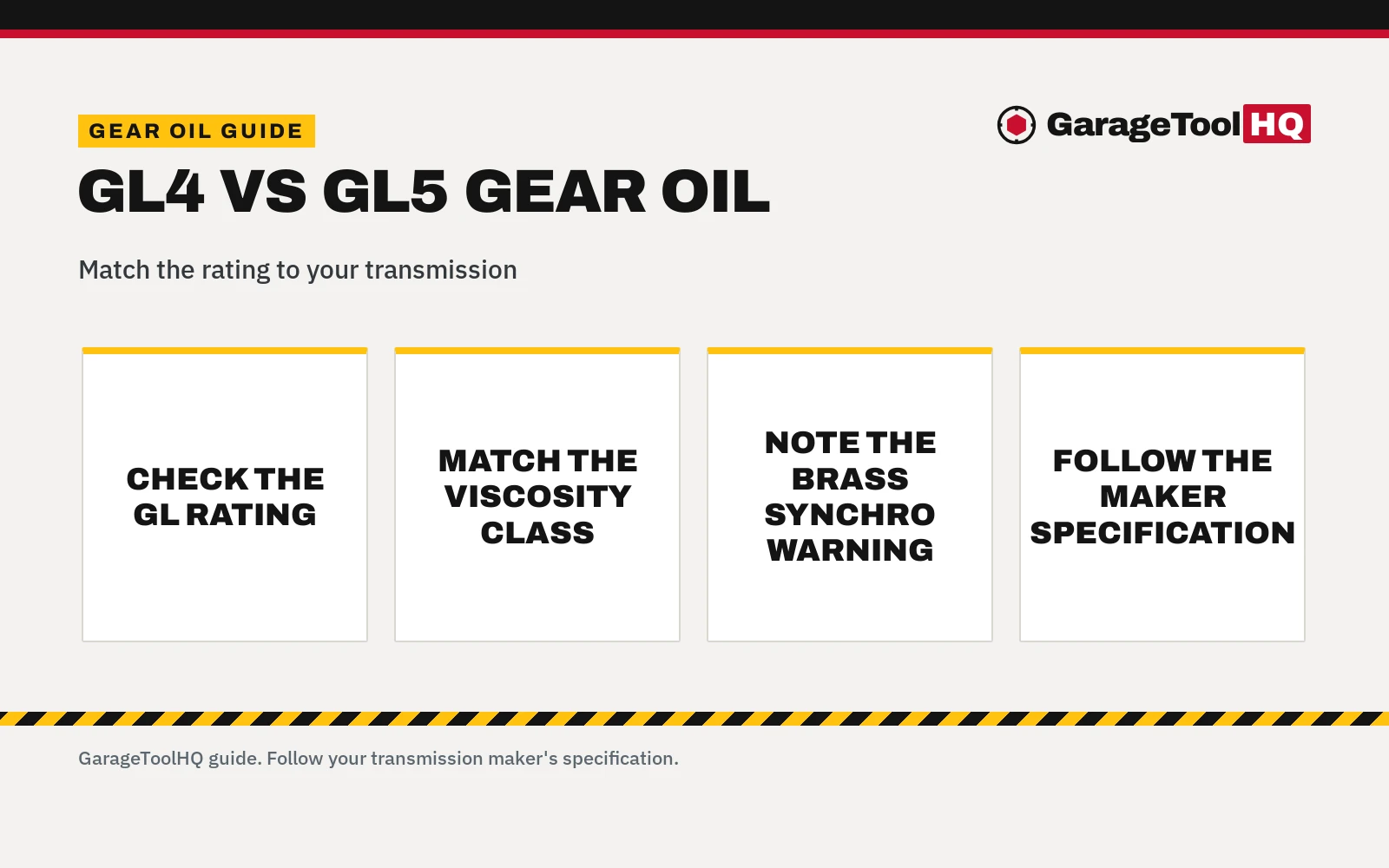
GL-4 and GL-5 are different gear oil ratings, not steps on one ladder, so match the rating and viscosity your transmission maker specifies.

On this page
Top picks at a glance
As an Amazon Associate I earn from qualifying purchases.
- 1
 Oil Extractor Pump 12V 80W9.6/10View on Amazon
- 2
 SAE 75W-90 Full Synthetic Gear Oil API GL-5 MT-1 Limited Slip9.6/10View on Amazon
- 3
 Oil Pump 12V 100W9.5/10View on Amazon
- 4
 Liqui Moly Gear OilView on Amazon
- 5
 CRC Sta-Lube API/GL-4 Multi-Purpose Gear Oil 85W90View on Amazon
- 6
 Driven Racing Oil Gear OilView on Amazon
- 7
 Red Line 58404 Lightweight Shockproof Gear OilView on Amazon
- 8
 VP Classic Gear Oil GL4 SAE 80W-90View on Amazon
- 9
 Driven Racing Oil GL4 Gear Oil SAE 80w-90View on Amazon
A transmission that calls for GL-4 oil should get GL-4 oil, and a GL-5 label does not make an oil a better choice for that transmission. That is the short answer to the gl4 vs gl5 gear oil question, and it matters most where brass synchros are involved, because the Red Line listing says its GL-4 oil lacks the reactive sulfurs found in most GL-5 oils that cause damage. Check the rating and the viscosity class your transmission maker specifies, then pick a listing that matches those specifications, rather than picking by the higher number in the rating.
Other tools worth a look
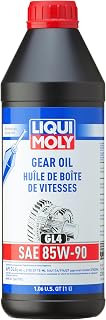 Liqui Moly Gear OilCheck price on Amazon
 CRC Sta-Lube API/GL-4 Multi-Purpose Gear Oil 85W90Check price on Amazon
 Driven Racing Oil Gear OilCheck price on Amazon
 Red Line 58404 Lightweight Shockproof Gear OilCheck price on Amazon
 VP Classic Gear Oil GL4 SAE 80W-90Check price on Amazon
 Driven Racing Oil GL4 Gear Oil SAE 80w-90Check price on Amazon
GarageToolHQ earns a commission when you buy through links on our product pages, at no extra cost to you. Read our affiliate disclosure.
Below: what the GL rating means in these listings, how the GL-4 listings differ, and a checklist for matching a listing to a transmission.
Gl4 vs Gl5 Gear Oil: What the Rating Means
In these listings, the GL rating appears alongside the application, not as a quality ladder. The Red Line listing recommends its oil for GL-1, GL-3 and GL-4 applications, and for places where most special synchromesh fluids are specified. The CRC listing states suitability for standard transmissions and differentials requiring API GL-3 and GL-4 oils. The Liqui Moly listing describes its oil for transmissions and axle drives where an API GL 4 gear oil is required. Read together, the listings treat the rating as a maker specification to match, and the viscosity class as another specification to match, with the Liqui Moly listing warning to keep to the viscosity class stipulated by the transmission manufacturer.
| Rating | What the listings say | Watch for |
|---|---|---|
| GL-4 | Red Line recommends its oil for GL-1, GL-3 and GL-4 applications; CRC states suitability for differentials requiring GL-3 and GL-4 | Match the viscosity class as well as the rating |
| GL-5 | GL-5 is covered here as a contrast: the Red Line listing describes reactive sulfurs in most GL-5 oils | The Red Line listing says most GL-5 oils contain reactive sulfurs that cause damage to brass synchros |
This guide compares the GL-4 listings in the gear section below against the GL-5 contrast the Red Line listing describes, staying with what the listings state and adding no guess.
Gear Picks From the Listings
Red Line MT-85, 1 Quart
The Red Line listing presents its MT-85 oil as a GL-4 gear oil in a 1 Quart bottle, with a viscosity class of 75W85. The listing recommends it for GL-1, GL-3 and GL-4 applications, and for places where most special synchromesh fluids are specified, with gear protection, longer synchro life, and quicker shifts from balanced friction control. The listing also says the oil is safe for brass synchros, because its GL-4 oil lacks the reactive sulfurs found in most GL-5 oils that cause damage, and it names synchro manual transmission applications for Nissan, Mitsubishi Evolution, Hyundai, Kia and Quaife. Note a contradiction in the listing: the spec table lists a viscosity of 5w-30, while the title lists 75W85, and this guide follows the title and the bullets.
Liqui Moly Gear Oil, 1 L
The Liqui Moly listing presents a mineral transmission oil in a 1 L bottle, with a viscosity class of 85W-90, for transmissions, particularly manual transmissions, and axle drives with normal to high loading where an API GL 4 gear oil is required. The listing claims a stable lubricating film, wear reduction, extremely good lubrication properties and outstanding corrosion protection. The listing also says to keep to the viscosity class stipulated by the transmission manufacturer, that the oil is miscible with all branded gear oils, and that it is fully effective only when used alone. The listing pairs those points: mixing is possible, but full effectiveness is tied to using the oil alone.
CRC Sta-Lube Gear Oil, 1 Gallon
The CRC listing presents a multi-purpose GL-4 gear oil in a 1 Gallon bottle, with a viscosity class of 85W90. The listing claims low pour points and high temperature properties for lubrication over a wide temperature range, with anti-rust and anti-wear EP additives for corrosion protection in drives and hypoid gears. The listing states the formula is not corrosive to copper, bronze or other non-ferrous alloy bearings and bushings, and that it is safe for yellow metals. For applications, the listing states suitability for auto, truck and bus standard transmissions, and differentials requiring API GL-3 and GL-4 oils, which makes this listing the clearest differential example in the set.
Red Line MT-85, 4 Pack
The Red Line 4 Pack listing presents, in its title and bullets, the same MT-85 oil as the quart listing above, with a viscosity class of 75W85, in a 4 Pack. The bullets repeat the same claims: gear protection, longer synchro life, quicker shifts, balanced friction control, and safety for brass synchros, with the same recommendation for GL-1, GL-3 and GL-4 applications and synchromesh fluids. The listing names the same synchro manual transmission applications for Nissan, Mitsubishi Evolution, Hyundai, Kia and Quaife. The difference in the title and bullets here is pack size alone, so a reader who already matches this oil should compare the pack size with the job, rather than treating the 4 Pack as a different oil.
How to Choose a Listing for Your Transmission
Start with the maker specification, not with the rating number. Check whether the transmission maker specifies GL-4, and check the viscosity class the maker stipulates, since the listings here state 75W85 and 85W90, with the Liqui Moly listing writing the second class as 85W-90. Next, check the application: Red Line points to synchro manual transmissions, Liqui Moly points to manual transmissions and axle drives, and CRC points to standard transmissions and differentials requiring GL-3 and GL-4. For brass synchros in a transmission that specifies GL-4, stay with the GL-4 specification, because the Red Line listing ties damage to the reactive sulfurs found in most GL-5 oils. Finally, check pack size against the job: the listings offer a 1 Quart bottle, a 1 L bottle, a 1 Gallon bottle, and a 4 Pack, and the right size is the match for the job without leaving a reader to guess at a volume the listings do not state.
Use rated jack stands on solid ground, wear eye protection with power and air tools, keep fuel-burning equipment out of a closed garage, and follow the manual for every tool. Read our Safety Disclaimer.
FAQ: garage tools
Can I use GL-5 oil where GL-4 is specified?
Match the GL rating the maker specifies instead of substituting a GL-5 listing where GL-4 is specified, especially for brass synchros, because the Red Line listing says most GL-5 oils contain reactive sulfurs that cause damage. Match the GL rating the maker specifies, and match the viscosity class as well.
Is GL-5 better because the number is higher?
No. The rating is a specification to match, not a ladder, and Red Line recommends its oil for GL-1, GL-3 and GL-4 applications, while CRC lists GL-4 for differentials requiring GL-3 and GL-4. A higher number in the rating does not make an oil right for every transmission.
What viscosity class should I pick?
Pick the viscosity class stipulated by the transmission manufacturer, as the Liqui Moly listing warns. The listings here state 75W85 and 85W90, with the Liqui Moly listing writing the second class as 85W-90, so the choice is the class the maker specifies, not the class that sounds heavier or lighter.
Can GL-4 oil go in a differential?
Yes, where the differential requires GL-3 and GL-4 oils, as the CRC listing states. The Liqui Moly listing separately covers axle drives where an API GL 4 oil is required, which is an axle-drive specification rather than a differential permission. That permission is tied to the specification, so a differential that specifies a different rating needs a different listing.
What does the Red Line listing say about GL-5 oils?
The Red Line listing says its GL-4 oil lacks the reactive sulfurs found in most GL-5 oils that cause damage, and it recommends its oil for GL-1, GL-3 and GL-4 applications. Match the GL rating the transmission maker specifies before choosing a listing.
Related: best gear oil GL-5, best gear oil for trucks and best heavy duty gear oil.