Dial Caliper vs Digital Caliper: Which One Should You Buy?
Dial and digital calipers compared for a home garage: how each reads, range and accuracy, units and modes, power needs, and one example of each side.

On this page
Top picks at a glance
As an Amazon Associate I earn from qualifying purchases.
- 1
 Starrett Dial Caliper9.5/10View on Amazon
- 2
 NEIKO 01407A Electronic Digital Caliper Measuring Tool9.5/10View on Amazon
- 3
 Starrett Dial Caliper9.5/10View on Amazon
- 4
 iGaging Dial Caliper 6" Fractional & Decimal Inch CombinationView on Amazon
- 5
 HARDELL Digital Caliper 6 InchView on Amazon
- 6
 Mitutoyo 505-732 Dial CaliperView on Amazon
- 7
 iGAGING 6-Inch 150 mm Dial CaliperView on Amazon
- 8
 IP54 Grade Digital CaliperView on Amazon
- 9
 iGaging IP54 Electronic Digital Caliper 0-6" DisplayView on Amazon
Verdict: Choose a dial caliper if you want a needle reading with no battery to watch, and a simple inside and outside tool for the bench. Choose a digital caliper if you want digits on a screen, quick unit switching, and depth and step modes in the same tool.
A brake job reaches the point where sight alone stops answering the question: a pad, a bushing, or a bolt shoulder needs a real measurement before it goes back on the car. That is the job a caliper exists for, and the dial caliper vs digital caliper choice comes down to how you want that measurement to reach your eyes.
GarageToolHQ earns a commission when you buy through links on this page, at no extra cost to you. Read our affiliate disclosure.
NEIKO 01407A Electronic Digital Caliper Measuring
A 0-6 inch stainless steel digital caliper with inch, fraction and millimeter conversion, a large LCD screen, and a gray case.
Pros
- Inch, fraction and millimeter conversion, quick-change button
- 0.001 inch / 0.02 mm accuracy stated
- Four modes: inside, outside, depth and step
- Gray case plus an extra LR44 battery
Cons
- Spec table Range of 150 has no units, unlike the title and bullets
- Splash and dust resistance stated, no rating figure
- No drop rating stated for the gray case
- No warranty term is stated
Starrett Dial Caliper, Adjustable Bezel
A 0-6 inch Starrett dial caliper with a white face, 0.001 inch graduations, a fitted case, and a hardened stainless steel bar.
Pros
- 0.001 inch graduations, +-0.001 accuracy stated
- Positive split-gear anti-backlash control
- Knife-edge contacts for inside and outside
- Fitted case, lock screws for bezel and jaw
Cons
- Inches only, no unit switching stated
- Inside and outside only, no depth or step mode
- 16 ounces for the 0-6 inch size
- No warranty term is stated
Starrett Dial Caliper, Adjustable Bezel
A 0-8 inch Starrett dial caliper with a white face, 0.001 inch graduations, a fitted case, and a hardened stainless steel bar.
Pros
- 0-8 inches of range, the longest example here
- 0.001 inch graduations, +-0.001 accuracy stated
- Positive split-gear anti-backlash control
- Fitted case, lock screws for bezel and jaw
Cons
- Inches only, no unit switching stated
- Inside and outside only, no depth or step mode
- 1.3 pounds, heavier than the 0-6 inch dial example
- No warranty term is stated

Digital Caliper, Adoric Calipers 0-6 Inch
A 0-6 inch Adoric digital caliper with inch and millimeter conversion, four measuring modes, a large LCD screen, and auto-off.
Pros
- Inch and millimeter conversion with one button
- Four modes: inside, outside, depth and step
- Zero setting for differential measuring
- Large LCD screen, auto-off after 5 minutes
Cons
- Plastic body, unlike the stainless steel examples
- 0.01 inch / 0.2 mm accuracy, coarser than NEIKO
- No case stated
- No warranty term is stated
Other tools worth a look
 iGaging Dial Caliper 6" Fractional & Decimal Inch CombinationCheck price on Amazon
 HARDELL Digital Caliper 6 InchCheck price on Amazon
 Mitutoyo 505-732 Dial CaliperCheck price on Amazon
 iGAGING 6-Inch 150 mm Dial CaliperCheck price on Amazon
 IP54 Grade Digital CaliperCheck price on Amazon
 iGaging IP54 Electronic Digital Caliper 0-6" DisplayCheck price on Amazon
Dial caliper vs digital caliper side by side
| Dial caliper | Digital caliper | Takeaway | |
|---|---|---|---|
| How it reads | Needle on a dial face, 0.001 inch graduations | Digits on a large LCD screen | Digital examples need a battery |
| Range | 0-6 inches and 0-8 inches | 0-6 inches on both examples | Longest example is a dial caliper |
| Accuracy | +-0.001 on both dial examples | 0.001 inch NEIKO; 0.01 inch Adoric | Varies by listing, not by side |
| Units | Inches from the dial | Inch and millimeter Adoric; inch, fraction, millimeter NEIKO | Digital examples switch units |
| Modes | Inside and outside, both dial examples | Inside, outside, depth, step, both digital examples | Digital examples list more modes |
| Power | No battery stated | 1 LR44 battery, both digital examples | Dial examples state no battery |
| Case | Fitted case, both dial examples | Gray case NEIKO; no case stated Adoric | Check the listing for a case |
| Material | Hardened stainless steel, both dial examples | Stainless steel NEIKO; plastic Adoric | Material varies by listing |
Example figures are manufacturer rated, as published on each listing and collected 29 October 2026.
How each caliper reads
A dial caliper reads with a needle over a dial face. The Starrett examples list a white face with 0.001 inch graduations, a thumb-operated fine adjustment roll for one-hand use, and lock screws for the dial bezel and the sliding jaw. The reading is direct: the needle points at the measurement, and nothing needs power.
A digital caliper reads with digits on a large LCD screen. The Adoric example lists a zero setting function, and both digital examples list a button for switching units.
Range and accuracy
Range is where the examples split. The dial examples cover 0-6 inches and 0-8 inches, while both digital examples cover 0-6 inches, stated as 0-150 mm. The longest example here is a dial caliper.
Accuracy does not split cleanly by side. Both dial examples state +-0.001 accuracy. On the digital side, the NEIKO example states 0.001 inch / 0.02 mm, while the Adoric example states 0.01 inch / 0.2 mm. Compare the accuracy line of the listing in hand, not the side alone.
Units, modes and power
Units favor the digital examples. The Adoric example switches between inch and millimeter with one button, and the NEIKO example switches between inch, fraction and millimeter. The dial examples read in inches from the dial face, with no unit switching stated.
Modes favor the digital examples too. Both dial examples list knife-edge contacts for inside and outside measurements. Both digital examples list four modes: inside, outside, depth and step, using two sets of jaws and a probe.
Power is the dial side’s quiet advantage. Neither dial listing states a battery. Both digital examples require 1 LR44 battery, the NEIKO example includes an extra battery, and the Adoric example shuts off after 5 minutes without operation.
Choose a dial caliper if
- You want a needle reading with no battery to watch
- Your work is mostly inside and outside measurements
- You want a hardened stainless steel bar and a fitted case, as the Starrett examples list
- You prefer a direct reading from a dial face
Choose a digital caliper if
- You want digits on a large LCD screen
- You switch between inch, millimeter or fraction units
- You need depth and step modes as well as inside and outside
- You want a zero setting for differential measuring, as the Adoric example lists
Example calipers
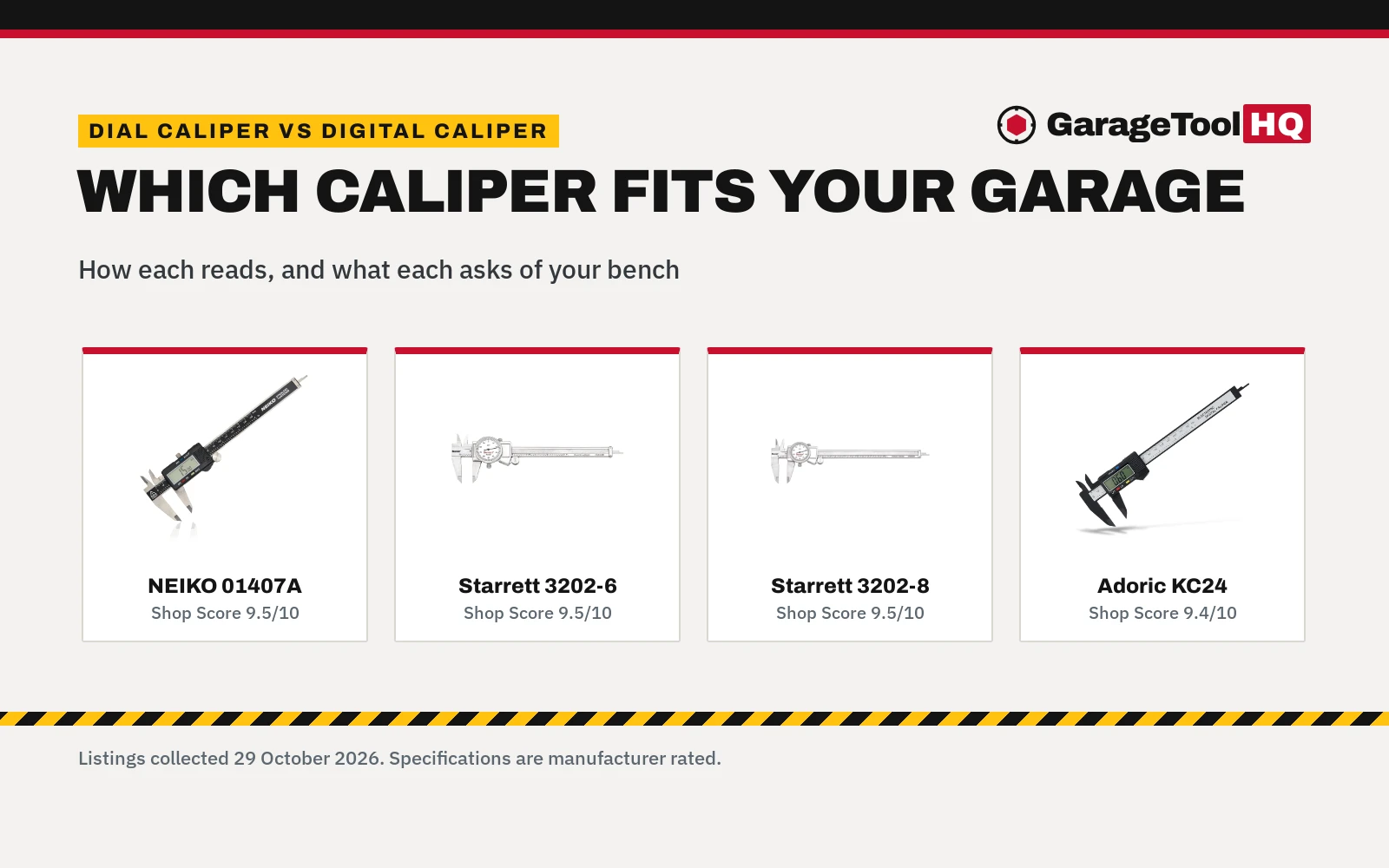
The examples below cover both sides: two dial calipers from Starrett and two digital calipers, one from NEIKO and one from Adoric.
Use rated jack stands on solid ground, wear eye protection with power and air tools, keep fuel-burning equipment out of a closed garage, and follow the manual for every tool. Read our Safety Disclaimer.
Garage Fit Check
- Check the range against the parts you plan to measure: the examples run 0-6 inches, with one dial example at 0-8 inches.
- Keep a spare LR44 battery with a digital caliper.
- Store the caliper in its case between jobs; the dial examples include a fitted case and the NEIKO example a gray case.
- If a digital caliper’s readings look off, the Adoric listing instructs sliding the screen to the left end and pressing zero.
FAQ: garage tools
Is a dial caliper or a digital caliper better for a home garage?
It depends on the work. A dial caliper suits simple inside and outside measuring with a needle reading and no battery. A digital caliper suits work that needs unit switching, depth and step modes, and digits on a screen.
Do digital calipers need batteries?
Yes. Both digital examples require 1 LR44 battery. The NEIKO example includes an extra battery, and the Adoric example shuts off after 5 minutes without operation.
Can a digital caliper measure in millimeters?
Yes. The Adoric example converts between inch and millimeter, and the NEIKO example converts between inch, fraction and millimeter, each with a quick-change button.
What range do the examples cover?
The dial examples cover 0-6 inches and 0-8 inches. Both digital examples cover 0-6 inches, stated as 0-150 mm.
Do the examples include a case?
The dial examples include a fitted case, and the NEIKO example includes a gray case. No case is stated for the Adoric example.
Related: the engine and shop equipment hub and the split beam vs micrometer torque wrench comparison.