Synthetic vs Conventional Motor Oil: Which One Should You Buy?
How synthetic, conventional and synthetic blend motor oil differ, how to choose by your engine manual, and gear examples from the listings.

On this page
Top picks at a glance
As an Amazon Associate I earn from qualifying purchases.
- 1
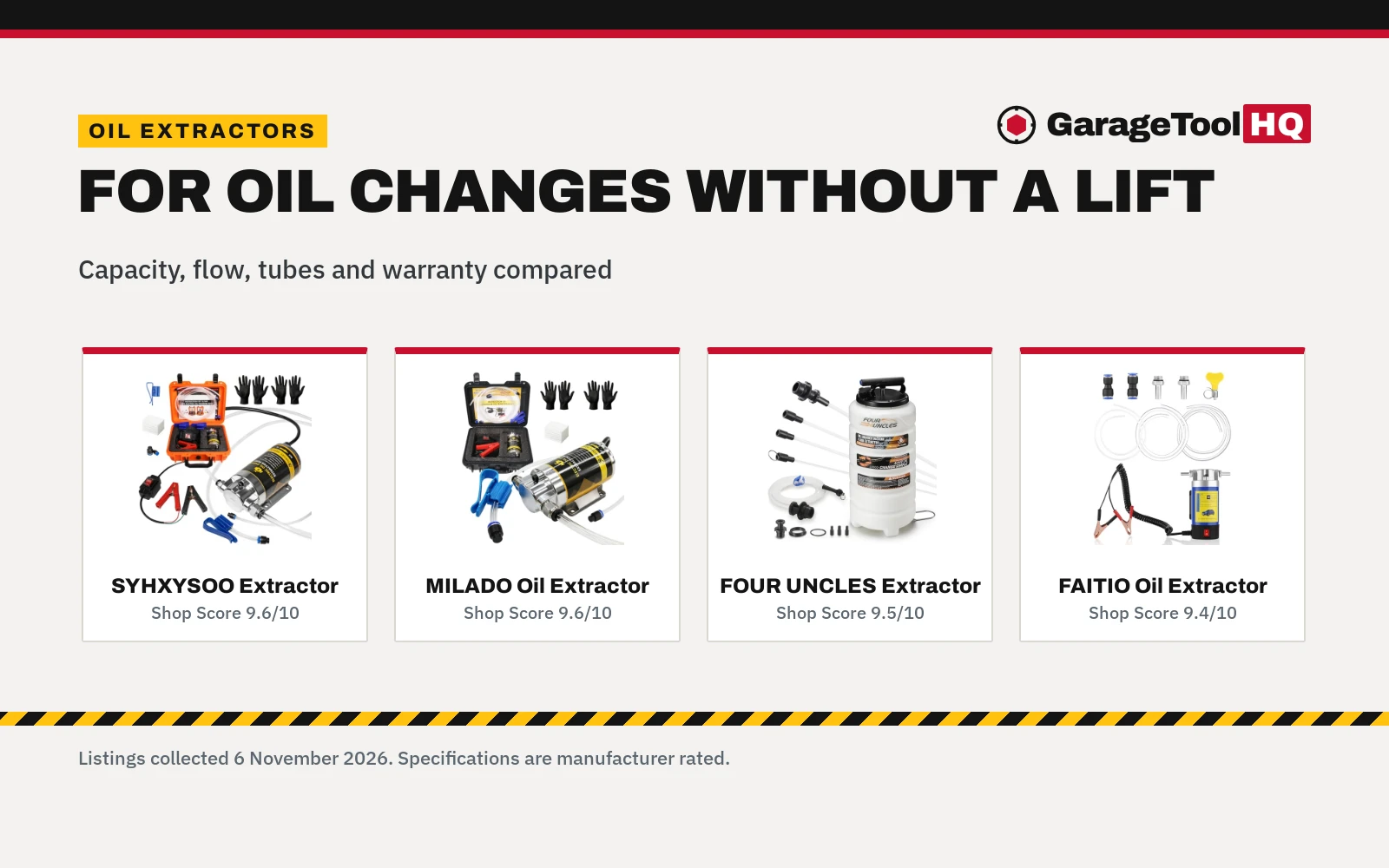
 Oil Extractor Pump 12V 80W9.6/10View on Amazon
- 2
 Castrol EDGE 5W-30 Advanced Full Synthetic Motor Oil9.6/10View on Amazon
- 3
 Castrol GTX High Mileage 5W-30 Synthetic Blend Motor Oil9.5/10View on Amazon
- 4
 Valvoline Advanced Full Synthetic SAE 5W-20 Motor Oil 5 QTView on Amazon
- 5
 Valvoline MaxLife High Mileage 5W-20 Synthetic Blend MotorView on Amazon
- 6
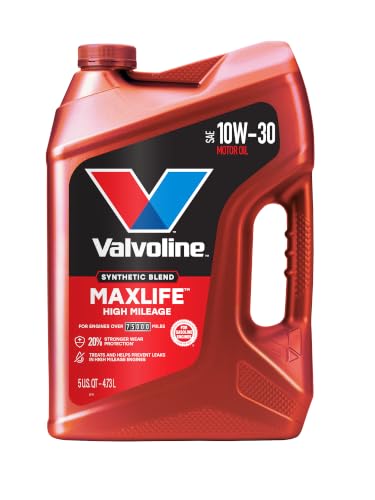 Valvoline MaxLife High Mileage 10W-30 Synthetic Blend MotorView on Amazon
- 7
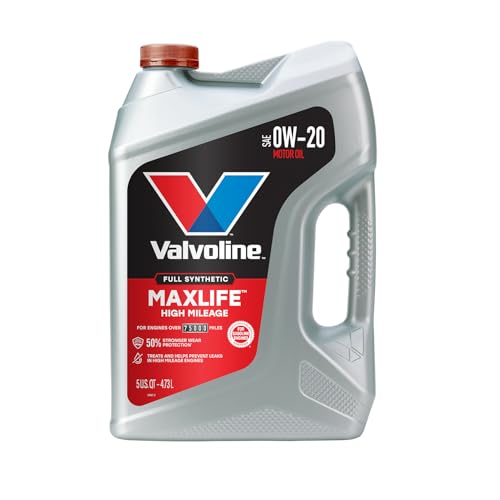 Valvoline™ Full Synthetic High Mileage with MaxLife™View on Amazon
- 8
 Valvoline MaxLife High Mileage 5W-30 Synthetic Blend MotorView on Amazon
- 9
 Shell Rotella T6 Full Synthetic 15W-40 Diesel Engine OilView on Amazon
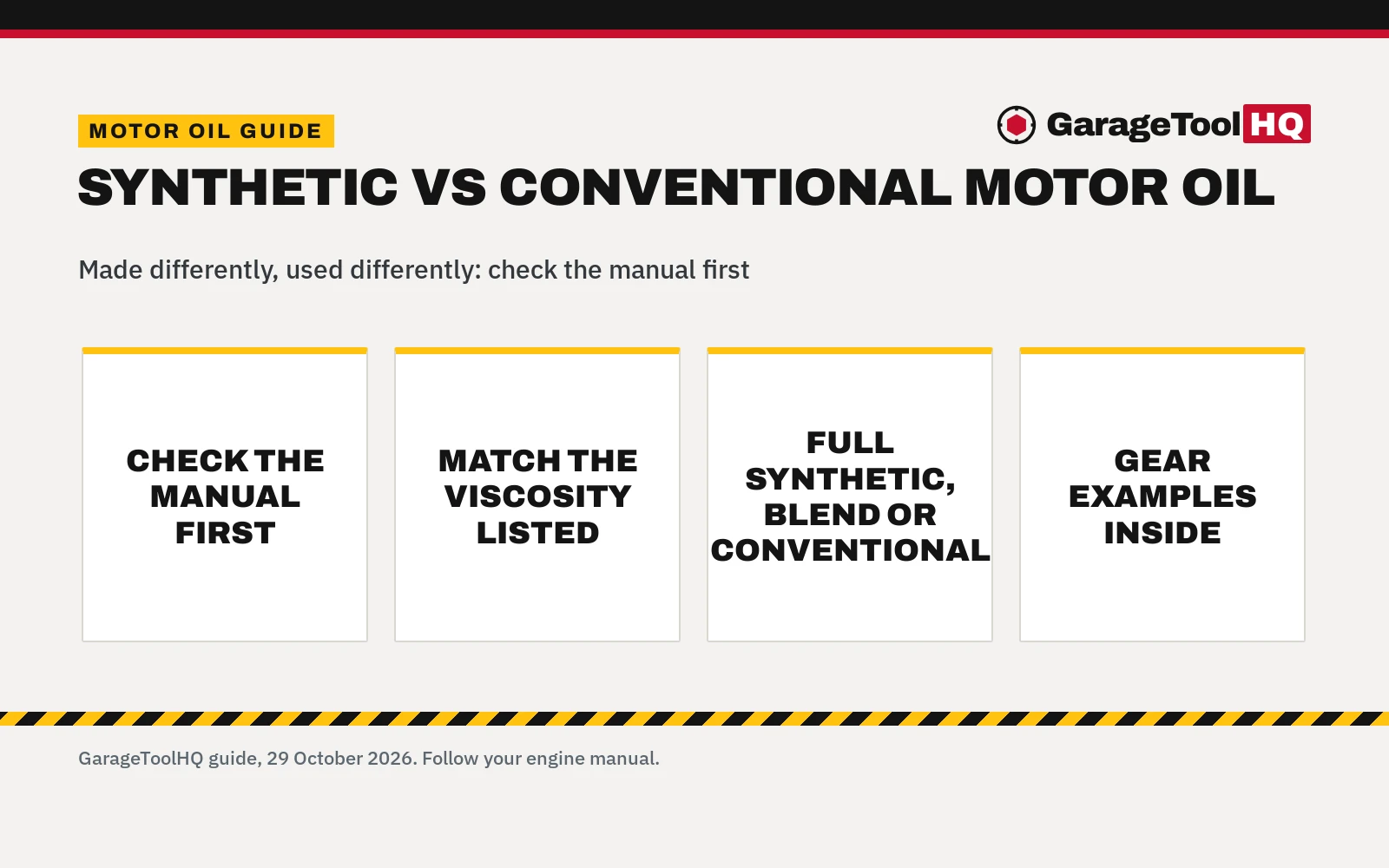
Synthetic vs conventional motor oil comes down to how the oil is made. Synthetic oil is engineered, conventional oil is refined from crude oil, and a synthetic blend mixes the approaches. Use the viscosity grade and performance standards your engine manual calls for: where the manual requires a synthetic oil, use a synthetic oil that meets those standards, and where the manual allows conventional oil, a conventional oil that meets the grade and standards remains an option.
Other tools worth a look
 Valvoline Advanced Full Synthetic SAE 5W-20 Motor Oil 5 QTCheck price on Amazon
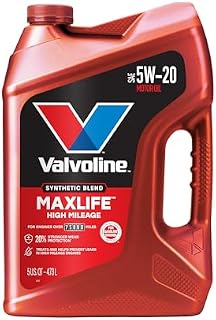 Valvoline MaxLife High Mileage 5W-20 Synthetic Blend MotorCheck price on Amazon
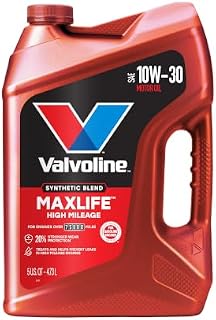 Valvoline MaxLife High Mileage 10W-30 Synthetic Blend MotorCheck price on Amazon
 Valvoline™ Full Synthetic High Mileage with MaxLife™Check price on Amazon
 Valvoline MaxLife High Mileage 5W-30 Synthetic Blend MotorCheck price on Amazon
 Shell Rotella T6 Full Synthetic 15W-40 Diesel Engine OilCheck price on Amazon
GarageToolHQ earns a commission when you buy through links on our product pages, at no extra cost to you. Read our affiliate disclosure.
Below: what each type means, how to choose by manual and use, and gear examples from the listings, with no conventional example in the gear section.
What synthetic, conventional and blend oil mean
Synthetic oil starts from an engineered base oil, built to behave in a consistent way across the conditions an engine sees. Conventional oil starts from crude oil that is refined into a lubricant. A synthetic blend starts from both approaches, with synthetic base oil mixed into conventional base oil. That difference in starting point is the core of the synthetic vs conventional question, and it is why the manual matters more than the label on the jug.
Additives do a separate job from the base oil. The listings here mention sludge-fighting additives, detergents, friction-fighting additives and seal conditioners. Those additives are listed per product, not per category, so a claim for one listing does not transfer to another listing, and it does not transfer to a whole category.
Synthetic vs conventional motor oil: the differences that matter
The differences that matter in the garage are the base oil, the additives a listing states, the viscosity grade a listing states, and the standards a listing states. A full synthetic example and a blend example can share a viscosity grade and still differ in base oil, and a conventional oil can share a grade with a synthetic oil and still differ in base oil. Grade alone does not tell you the type, and type alone does not tell you the grade.
| Type | How it is made | What to check |
|---|---|---|
| Synthetic | Engineered base oil | Manual, viscosity grade and standards listed for the example |
| Synthetic blend | Mix of synthetic and conventional base oil | Manual, viscosity grade and standards listed for the example |
| Conventional | Refined from crude oil | Manual for viscosity and change interval; no conventional example appears in the gear section below |
Standards are the clearest check in the listings here. The Valvoline examples list ILSAC GF-7A, API SQ, API SP, API SN with SN PLUS and Resource Conserving, plus maker-specific specifications. Those standards belong to those listings, not to synthetic oil in general, and a listing that does not state a standard is not credited with it here.
How to choose: manual, viscosity and use
Start with the manual. It names the viscosity grade and the performance standards for the engine, and it names the change interval for that engine. The examples here list 0W-20 and 5W-20 grades, but those grades belong to those examples, not to every engine, and a different grade from another listing is not a reason to change grades.
Use the listings to fit the engine. The high mileage examples here are listed for engines with 75,000 miles or more, with seal conditioners stated for those examples. The fuel economy example here is the Mobil 1 Advanced Fuel Economy listing, with fuel economy and engine efficiency claims stated for that listing. A high mileage listing and a fuel economy listing are different fits, and the manual still decides which fit applies to the engine in front of you.
For an oil change job, the manual, the viscosity grade and the standards on the listing are the three checks to run before buying. If the manual calls for a grade or a standard that a listing does not state, that listing is not a match for that engine, however strong its other claims read.
Gear examples from the listings
The gear section below lists the four examples in order of stated protection and standards coverage, with full synthetic examples first, then the synthetic blend example. No conventional example appears here, so no conventional figure is claimed from these listings, and no figure from one listing is applied to another.
Valvoline Advanced Full Synthetic 0W-20, 5 QT. The maker claims 40% stronger wear protection than industry standards, 15% better deposit defense vs. industry standards, and up to 2.5X better heat protection vs. industry standards, with low-temperature flow for cold starts. It meets the requirements of ILSAC GF-7A, API SQ, API SP, API SN with SN PLUS, Resource Conserving and all preceding API and ILSAC gasoline categories, with Ford WSS-M2C962-A1, Chrysler MS-13340 and GM dexos 1 Gen 3 also listed. No warranty term is stated for this listing.
Mobil 1 Advanced Fuel Economy Full Synthetic 0W-20, 5 Quart. The listing focuses on fuel economy and engine efficiency, with additives to help fight sludge and suitability for hybrid vehicles stated. The listing contradicts itself on protection: the title states 10,000-Mile Protection while the bullets state protection for 15,000 miles, so both figures are reported here and neither is treated as settled. The spec table lists a limited warranty with no term stated, and no term is claimed here.
Mobil 1 High Mileage Full Synthetic 0W-20, 5 Quart. This is a high mileage full synthetic listing for engines with 75,000+ miles, with a seal conditioner and additives to help fight sludge stated. The listing describes it as helping extend engine life of higher mileage vehicles, with protection for 15,000 miles stated in the bullets. The spec table lists a limited warranty with no term stated, and no term is claimed here.
Valvoline MaxLife High Mileage 5W-20 Synthetic Blend, 5 Quart. This is a synthetic blend, not a full synthetic, listed for engines with 75,000 miles or more, with seal conditioners to help prevent oil leaks and reduce oil consumption stated. The maker claims 20% better wear protection and 15% better sludge defense than industry standards, with extra detergents and friction-fighting additives stated. It meets or exceeds ILSAC GF-7A, API SQ, API SP, API SN with SN PLUS, Resource Conserving and all preceding API and ILSAC gasoline categories, with Ford WSS-M2C970-A-1 and Chrysler MS-13340 also listed. No warranty term is stated for this listing.
Check the manual for oil type and viscosity before an oil change, and never run an engine in a closed garage.
Use rated jack stands on solid ground, wear eye protection with power and air tools, keep fuel-burning equipment out of a closed garage, and follow the manual for every tool. Read our Safety Disclaimer.
FAQ: garage tools
Is synthetic oil better than conventional oil?
For an engine that calls for synthetic oil, use synthetic oil. For an engine where the manual allows conventional oil, a conventional oil that meets the manual’s grade and standards remains an option. A blend is an option only where it meets the manual’s grade and standards. The gear examples above are all full synthetic or synthetic blend, so no conventional example is claimed here.
What does 0W-20 mean?
0W-20 and 5W-20 are viscosity grades listed in the examples here. Use the grade your manual calls for, and do not switch grades because another listing uses a different grade.
Can I use synthetic oil in a high mileage engine?
Yes, where the manual allows it. The high mileage examples here are listed for engines with 75,000 miles or more, with seal conditioners stated for both high mileage examples.
How long does synthetic oil last?
There is no single figure in these listings that applies to every synthetic oil. The Mobil examples here list protection for 15,000 miles in their bullets, with a title figure of 10,000 miles for the Advanced Fuel Economy example, so check the listing and the manual for the engine in question. No mileage figure is stated for the Valvoline examples here.
Is a synthetic blend the same as full synthetic?
No. The MaxLife example is listed as a synthetic blend, while the other three examples are listed as full synthetic. A blend mixes synthetic and conventional base oil, while a full synthetic listing is listed as full synthetic.
Related: Synthetic vs Conventional Gear Oil: Which One Should You Buy?, Best Motor Oil Cleaner (2026), Best Oil Filter for Car (2026): Picks Compared and Best Oil Change Kit for Beginners (2026): 4 Picks Compared.