Crimp vs Solder Connectors: Which One Should You Buy?
When a garage wiring repair needs a joint that survives moisture and vibration, a crimped heat-shrink butt connector is the practical pick.

On this page
Top picks at a glance
As an Amazon Associate I earn from qualifying purchases.
- 1
 200pcs 12-Sizes9.7/10View on Amazon
- 2
 Kuject Heat Shrink Solder Seal Wire Connectors Kit 120PCS9.6/10View on Amazon
- 3
 haisstronica 120PCS Solder Seal Connectors Kit with AWG 24-109.4/10View on Amazon
- 4
 Blue Female Spade Connector 16-14 AWG/Gauge Disconnect CrimpView on Amazon
- 5
 22View on Amazon
- 6
 100 pcs Low Voltage B Connectors Crimp Splice TerminalsView on Amazon
- 7
 AIRIC 16View on Amazon
- 8
 AIRIC 22View on Amazon
- 9
 Yellow Female Spade Connector 12-10 AWG/Gauge DisconnectView on Amazon
A trailer light goes dark on a Friday evening, and the fault turns out to be a corroded splice tucked behind a bumper. The repair is a short length of wire and a joint that has to survive rain, road salt and vibration. That is the everyday garage job behind crimp vs solder connectors: for many exposed wiring repairs under a car, a crimped heat-shrink butt connector is the practical choice, because crimping and then heating the tubing seals the joint against moisture. Solder fits better where a joint stays still and dry and is protected from flex.
Other tools worth a look
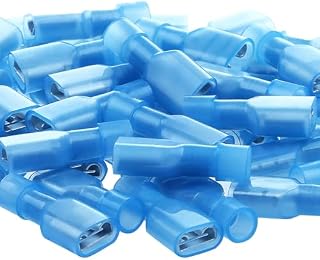 Blue Female Spade Connector 16-14 AWG/Gauge Disconnect CrimpCheck price on Amazon
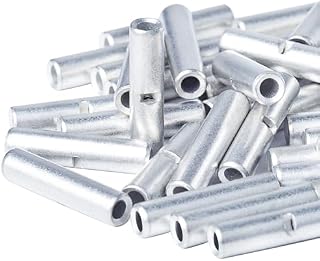 22Check price on Amazon
 100 pcs Low Voltage B Connectors Crimp Splice TerminalsCheck price on Amazon
 AIRIC 16Check price on Amazon
 AIRIC 22Check price on Amazon
 Yellow Female Spade Connector 12-10 AWG/Gauge DisconnectCheck price on Amazon
GarageToolHQ earns a commission when you buy through links on our product pages, at no extra cost to you. Read our affiliate disclosure.
Below: how each joint works, when each one fits a garage job, the heat-shrink butt connector kits in this guide ranked by their listings, and answers to the questions that come up before the first crimp.
Crimp vs solder connectors: how each joint works
A crimp joint is a mechanical joint. The stripped wire ends slide into a metal barrel, a crimping tool squeezes the barrel tight around the wires, and heat shrinks the outer tubing down over the joint. The TICONN, AIRIC and Qizpcer listings describe heat-shrink butt connectors with a heat-activated adhesive lining inside, so heating the joint both shrinks the tube and seals it. The Oiojuct listing describes waterproof insulation but states no adhesive lining, dual-wall tubing or shrink ratio, so that sealing description does not apply to every kit in this guide. A solder joint is a metallurgical joint. The wires are heated, solder flows into the strands and hardens, and the joint is then insulated, usually with its own sleeve or tape. The two methods fail in different ways. A poor crimp slips or leaves a loose strand that heats up under load. A solder joint that is moved while it cools, or that flexes in service, can crack where the solder ends and the flexible wire begins.
| Point | Crimped heat-shrink joint | Soldered joint |
|---|---|---|
| How it holds | Barrel squeezed around the wire strands | Solder bonded into the wire strands |
| Moisture sealing | On adhesive-lined versions, the tubing seals as it shrinks | Needs separate insulation and sealing after soldering |
| Flex and vibration | Wire flexes again past the barrel, but the barrel section itself is stiff | Stiff section at the joint can crack under repeated flex |
| Tools | Crimping pliers and a heat gun | Soldering iron, solder and insulation |
| Rework | Cut out and redo with a fresh connector | Reheat and reflow, then reinsulate |
When a crimp joint fits the job
Crimping fits most automotive wiring repair: trailer lighting, boat consoles, bilge pumps, vehicle harnesses and outdoor speakers all appear in these listings as intended uses. The reason is the environment. A joint under a truck or inside a boat hull sees moisture, and the TICONN, AIRIC and Qizpcer listings stress sealing: dual-wall tubing, hot melt adhesive inside and, in the TICONN listing, a 360-degree seal around the crimp, with corrosion resistance stated for marine use and, in the TICONN listing, engine bays. A crimped heat-shrink joint delivers the mechanical connection in the crimp step and the weather seal in the separate heating step. Color-coded tubing also helps in a dim garage: the TICONN listing codes red for AWG 22-16, blue for AWG 16-14 and yellow for AWG 12-10, the colors in its 100 piece assortment. Its color-code bullet also names black for AWG 14-12 and white for AWG 24-22, but those colors are not in the stated assortment, and the codes overlap at 16, 14 and 12, while white for AWG 24-22 sits outside the kit’s AWG 22-10 range, so color alone does not settle the size at the shared gauges.
When solder fits the job
Solder fits joints that stay put. Inside a cabin or on a bench harness that stays still, a soldered joint is compact and tidy, and the solder bonds the strands into one conductive joint. The case against solder in a garage is about movement and moisture, not about strength on the bench. A soldered splice in a door jamb harness, a trailer cord or an engine bay harness can flex in service, and an unsealed solder joint has no moisture barrier of its own. Where a joint will be handled, bent or splashed, the sealed crimp is usually the better pick. Where it will sit still and dry, solder is a fair choice.
The gear: heat-shrink butt connectors, ranked
The four kits below are ranked by what their listings state: barrel quality, sealing, wire range and pack makeup. All four are crimp connectors, so the ranking is about which listing gives the most complete, best-supported kit for garage wiring work, not about crimp against solder.
TICONN 100PCS Heat Shrink Butt Connectors. The listing states a seamless tinned copper barrel that grips without splitting, dual-wall tubing with a 3:1 shrink ratio and a heat-activated adhesive lining, and a color-coded range from AWG 22-10 across red, blue and yellow connectors in a 100 piece kit. Stated uses run from marine and automotive to trailer and outdoor wiring, including engine bays and underground conduit. It ranks at the top because the listing shares the widest stated wire range, AWG 22-10, with the Oiojuct kit, and pairs it with the clearest sizing system and the fullest sealing description.
AIRIC Heat Shrink Wire Butt Connector Kit, 100 pcs. The listing splits the kit into 50 red connectors for 22, 20, 18 and 16 gauge wires, 40 blue connectors for 16 and 14 gauge wires and 10 yellow connectors for 12 and 10 gauge wires, with a dual-wall tube, a 3:1 shrink ratio and hot melt glue inside. The maker also states UL, CE, ROHS, SGS and ISO9001-2005 quality system certification. One contradiction to note: the spec table lists NumberOfItems as 1, while the title and bullets describe a 100 piece kit, so the bullet count is the figure to trust. It ranks second, just behind TICONN, on the strength of the stated certifications and the exact pack split.
Qizpcer Heat Shrink Butt Connectors, 22-16 AWG, 100 Pcs, Red. The listing states a heavy-duty tinned copper core, marine grade heat shrink tubing with a 3:1 shrink ratio and hot melt adhesive inside for waterproof performance, with stated uses in automotive, marine, electrical and electronic work. It is a solid single-size kit, but the range is narrower than the two kits above: only red connectors for AWG 22-16, so heavier gauge work needs a different kit. It ranks third for that narrower coverage.
Oiojuct 600Pcs Heat Shrink Wire Connectors Electrical Kit. The listing states a 600 piece assortment of butt, ring, spade and fork terminals, described as waterproof with insulation for marine and automotive use. The sheer count and the mix of terminal types make it a good bench stock kit, but for a butt-splice job the box also contains ring, spade and fork terminals, so not every piece is a butt connector, and the listing says less about barrel construction and sealing than the kits above. It ranks fourth for butt-splice work specifically, while remaining a useful general assortment.
Sizing the connector to the wire
Match the connector color to the wire gauge to help the barrel grip: an oversized barrel may not grip, and an undersized barrel may not accept the wire. Across these listings the combined working range is AWG 22-10, with the TICONN color code as the clearest guide for the colors in its kit: red for AWG 22-16, blue for AWG 16-14 and yellow for AWG 12-10. Note that the codes share gauges at 16, 14 and 12, so check the gauge against the connector size, not color alone. Strip only enough insulation to seat the wire fully in the barrel, crimp with a standard tool where a listing names one, then apply heat until the tubing has shrunk tight; on the adhesive-lined kits, the adhesive seals the ends. If the tubing has not closed around the wire, the joint is not finished.
Before the first crimp
Disconnect the battery before cutting into vehicle wiring, and keep the work area clear of fuel and solvents. A heat gun is hot enough to burn skin and melt nearby trim, so aim the heat at the tubing only and keep the gun moving. Check the finished joint by sight and by a gentle tug: the tubing should be tight, the adhesive sealed at both ends on the adhesive-lined kits, and the wire should not move inside the barrel. The Qizpcer listing names crimping pliers and a heat gun, and the TICONN listing names a standard tool and heat; the AIRIC and Oiojuct listings state no tools, so no other special equipment is stated for those kits.
Use rated jack stands on solid ground, wear eye protection with power and air tools, keep fuel-burning equipment out of a closed garage, and follow the manual for every tool. Read our Safety Disclaimer.
FAQ: garage tools
Are crimp connectors waterproof?
The heat-shrink butt connectors in this guide are described by their makers as waterproof. The TICONN and AIRIC listings describe dual-wall tubing, and the TICONN, AIRIC and Qizpcer listings describe a heat-activated adhesive lining that seals around the crimp; the Oiojuct listing states waterproof insulation without describing either feature. That sealing depends on heating the tubing fully so the adhesive closes both ends on the adhesive-lined kits. A crimp that has not been heated, or tubing that has not shrunk tight, is not sealed.
Do I need a heat gun for heat-shrink butt connectors?
The listings describe heating after crimping: the Qizpcer listing names a heat gun, and the TICONN listing says to apply heat. On the TICONN, AIRIC and Qizpcer kits, the heat shrinks the tubing at its stated 3:1 shrink ratio and activates the adhesive lining; the Oiojuct listing states no shrink ratio. Without heat, the connector is only a crimp, with no weather seal from the tubing.
What wire sizes do these kits cover?
Across the four kits the combined stated range is AWG 22-10. The TICONN kit codes red for AWG 22-16, blue for AWG 16-14 and yellow for AWG 12-10, while the AIRIC kit splits its 100 pieces into red for 22, 20, 18 and 16 gauge, blue for 16 and 14 gauge and yellow for 12 and 10 gauge. The Qizpcer kit covers AWG 22-16 only.
Can a crimp connector be used in an engine bay?
The TICONN listing states suitability for engine bays and other demanding environments, and the AIRIC and Qizpcer listings state marine and automotive use. The TICONN listing describes a dual-wall adhesive seal; no temperature rating is stated in these listings, so the engine bay claim rests on that listing’s stated suitability, not on a stated heat rating.
Crimp or solder for a trailer wiring repair?
Crimp, with a heat-shrink butt connector. Trailer wiring flexes, gets splashed and sits outside, and the sealed crimp handles all three: the barrel holds the wire, the tubing seals out moisture, and the wire flexes again past the barrel, even though the barrel section itself is stiff. A soldered trailer splice would need separate sealing and would still stiffen at the joint.
Related: the best automotive wire, the best automatic wire stripper and 8 gauge automotive wire picks.