Tube Bender vs Pipe Bender: Which One Should You Buy?
Tube benders and pipe benders compared for a home garage: how each bends, the sizes each covers, and one example of each side.

On this page
Verdict: Choose a tube bender if you bend thin-wall copper, brass, aluminum or thin steel tube by hand. Choose a pipe bender if you bend rigid pipe and need leverage or hydraulic power.
A brake line, a copper water line, a handrail repair: sooner or later a garage job asks you to put a clean bend in a length of tube or pipe without kinking it. That is the whole question behind tube bender vs pipe bender. The two tools look alike on a shelf, but they are sized for different stock, and picking the wrong one leaves you with a kinked tube or a tool that cannot grip the pipe.
As an Amazon Associate I earn from qualifying purchases. GarageToolHQ earns a commission when you buy through links on this page, at no extra cost to you. Read our affiliate disclosure.
| # | Product | Shop Score | Buy |
|---|---|---|---|
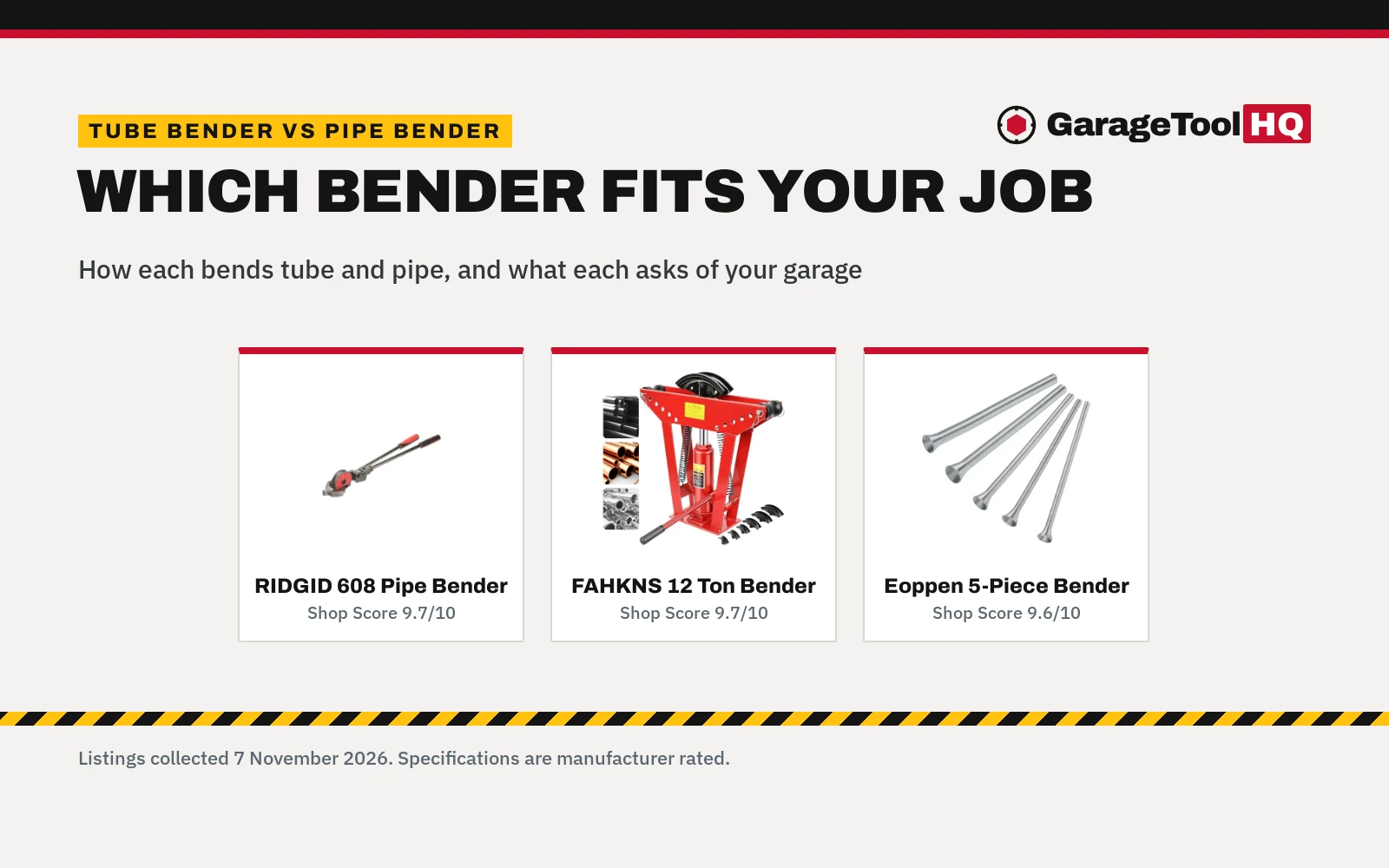
| 1 |  RIDGID 38048 Model 608 Heavy-Duty Stainless Steel | 9.7/10 | Buy on Amazon |
| 2 |  12 Ton Hydraulic Pipe Bender | 9.7/10 | Buy on Amazon |
| 3 | 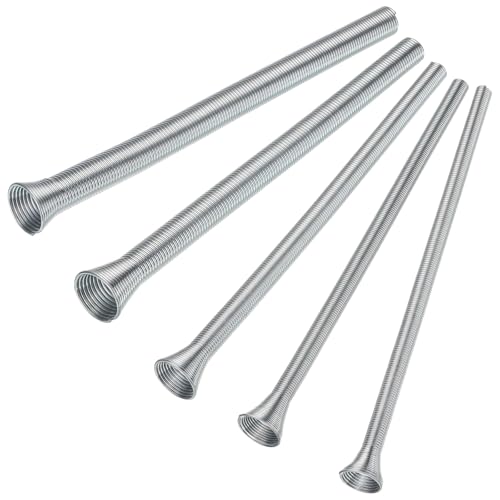 Eoppen Spring Tubing Benders Kit 1/4, 5/16, 3/8 | 9.6/10 | Buy on Amazon |
RIDGID 38048 Model 608 Heavy-Duty Stainless Steel
A heavy-duty stainless steel pipe and tubing bender for 1/2 in pipe with extra long handles.
Pros
- Heavy-duty stainless steel build
- Extra long handles for leverage
- Bends 1/2 in pipe
- 12 month warranty stated
Cons
- Covers one size, 1/2 in pipe
- No bend angle stated
- Bullets name an unrelated category
- 24.0 in long, needs more storage room than a spring set
12 Ton Hydraulic Pipe Bender
A 12 ton manual hydraulic pipe bender with 6 dies for 1/2 to 2 in pipe, bending 90 to 180 degrees.
Pros
- 12 ton hydraulic power
- 6 dies from 1/2 to 2 in
- Bends 90 to 180 degrees
- Adjustable height, 12.9 in minimum to 18.1 in maximum
Cons
- No weight stated
- No warranty term stated
- Four-leg frame needs more floor space than a hand bender
- Oil capacity of 750g (1.65 lbs) needs oil on hand
Eoppen Spring Tubing Benders Kit 1/4, 5/16, 3/8
A 5-piece spring tube bender set for 1/4 to 5/8 in outside diameter tube in copper, brass, aluminum and thin steel, bending up to 180 degrees.
Pros
- Five sizes from 1/4 to 5/8 in outside diameter
- Bends up to 180 degrees without collapsing the tube
- Spring steel with a galvanized surface
- Covers copper, brass, aluminum and thin steel tube
Cons
- For thin-wall tube only, not rigid pipe
- Hand bending, no leverage frame
- No weight stated
- No warranty term stated
Side by side
| Tube bender | Pipe bender | Notes | |
|---|---|---|---|
| How it bends | A spring slipped over the tube, bent by hand | A lever frame or a hydraulic ram | Spring kits suit thin-wall tube; frames suit rigid pipe |
| Sizes covered | 1/4 to 5/8 in outside diameter | 1/2 in to 2 in | Check the listing for your pipe size |
| Bend angle | Up to 180 degrees | 90 to 180 degrees | RIDGID example states no angle |
| Power | Hand power only | Hand power, or hydraulic on the 12 ton example | No power outlet needed for any of the three |
| Weight | Not stated | 6.61386786 pounds for the RIDGID example | FAHKNS example states no weight |
| Warranty | Not stated | 12 months for the RIDGID example | FAHKNS example states no warranty term |
| Best for | Thin-wall tube bends | Rigid pipe bends | Match the tool to the tube or pipe |
Example figures are manufacturer rated, as published on each listing and collected 6 November 2026.
Tube bender vs pipe bender: how they differ
The split starts with what each tool is sized for. A tube bender works with tube measured by outside diameter, and the spring kit example here covers thin-wall tube in copper, brass, aluminum and thin steel. A pipe bender works with pipe, which is sized by nominal size, and the examples here cover pipe from 1/2 in up to 2 in. The tube side bends by hand with a spring slipped over the tube, while the pipe side uses a lever frame for extra leverage or a hydraulic ram, because rigid pipe takes more force than a bare hand bend.
How each tool bends
The spring bender is the simplest of the three. You slip the spring over the tube, bend it to the angle you want, then slide the spring off; the listing says it keeps thin-wall tube from curling or collapsing, and it bends up to 180 degrees. The RIDGID frame bender works the other way: its extra long handles give the leverage to bend 1/2 in pipe. The FAHKNS hydraulic bender uses a 12 ton ram with a gear at the end of the hydraulic rod that controls the opening and closing, and six roller dies set the bend from 90 to 180 degrees, with a four-leg frame built for stable, continuous pipe bending.
Sizes and bend angles
Size coverage is where the two sides separate most clearly. The Eoppen spring set covers five outside diameters, 1/4, 5/16, 3/8, 1/2 and 5/8 in, so one kit handles the small tube sizes a home garage sees most. The RIDGID example covers one size, 1/2 in pipe, and states no bend angle. The FAHKNS hydraulic example covers 1/2 to 2 in pipe with six dies, 1/2, 3/4, 1, 1-1/4, 1-1/2 and 2 in, and bends from 90 to 180 degrees. Small copper tube work suits the spring kit; pipe above 1/2 in is covered here only by the hydraulic example.
Power and effort
None of the three examples needs a power outlet. The spring kit and the RIDGID frame run on hand power, and the FAHKNS runs on manual hydraulics. The difference is effort: the spring kit asks your hands to do the bending, the RIDGID frame adds leverage through its extra long handles, and the hydraulic ram multiplies your effort through a 12 ton ram with a 5.12 (130 mm) stroke. The hydraulic example also lists an oil capacity of 750g (1.65 lbs), so keep oil on hand for it.
Choose a tube bender if
- You bend thin-wall copper, brass, aluminum or thin steel tube
- Your tube is 1/4 to 5/8 in outside diameter
- You want a light kit with no frame
- You bend by hand and want a simple tool
Choose a pipe bender if
- You bend rigid pipe, not thin-wall tube
- Your pipe runs from 1/2 in up to 2 in
- You want leverage or hydraulic power
- You bend pipe often enough for a frame
Example benders
For more choices, see the best copper tube bender and the best brake pipe bender.
Use rated jack stands on solid ground, wear eye protection with power and air tools, keep fuel-burning equipment out of a closed garage, and follow the manual for every tool. Read our Safety Disclaimer.
Garage Fit Check
- Measure your tube first: the spring set covers 1/4 to 5/8 in outside diameter, and nothing outside that range.
- Check the die sizes on the hydraulic example: six dies cover 1/2 to 2 in pipe.
- Give the four-leg hydraulic frame floor space.
- The RIDGID example measures 24.0 in x 4.0 in x 3.0 in, so check your shelf space.
- Keep oil on hand for the hydraulic example, which lists an oil capacity of 750g (1.65 lbs).
FAQ: garage tools
Can a tube bender bend pipe?
A spring tube bender is made for thin-wall tube measured by outside diameter, and the example here covers 1/4 to 5/8 in. Pipe is sized by nominal size, so use a pipe bender for pipe.
What size tube does a spring bender handle?
The Eoppen example covers five outside diameters: 1/4, 5/16, 3/8, 1/2 and 5/8 in. Measure the outside diameter of your tube and match it to one of those sizes.
Do I need a hydraulic pipe bender?
It depends on the pipe. The FAHKNS hydraulic example bends 1/2 to 2 in pipe with 12 ton of force, which suits larger pipe and repeated bends. For 1/2 in pipe, the RIDGID frame bender does the job by hand.
What is the difference between tube and pipe sizes?
Tube is measured by outside diameter, and the spring set here lists outside diameters from 1/4 to 5/8 in. Pipe is sized by nominal size, and the pipe bender examples here list 1/2 in and 1/2 to 2 in.
Can I bend copper tube with a pipe bender?
The FAHKNS listing says its pipe bender suits copper pipe, and it bends 1/2 to 2 in pipe. For thin-wall copper tube in smaller sizes, use the spring tube bender.
Related: the best copper tube bender, the best tube bender kit, the best tube bender for aluminum and the best brake pipe bender.