Nitrogen vs Air Tire Inflation: Which One Should You Buy?
Nitrogen and portable air both fill a tire, but they need different gear: a cylinder and caps on the nitrogen side, a portable inflator and a gauge on the air side.

On this page
Verdict: Pick nitrogen if you keep a filled cylinder and a regulator in the garage and want dry, inert gas in the tires. Pick air if you top off tires at home or on the road: a 12V DC inflator and a gauge cover that job.
A tire sits low on pressure on a cold morning, and the garage offers a fill from a cylinder of nitrogen in the corner or air from a portable inflator. The question is nitrogen vs air tire inflation, and the answer turns on gear and habit.
As an Amazon Associate I earn from qualifying purchases. GarageToolHQ earns a commission when you buy through links on this page, at no extra cost to you. Read our affiliate disclosure.

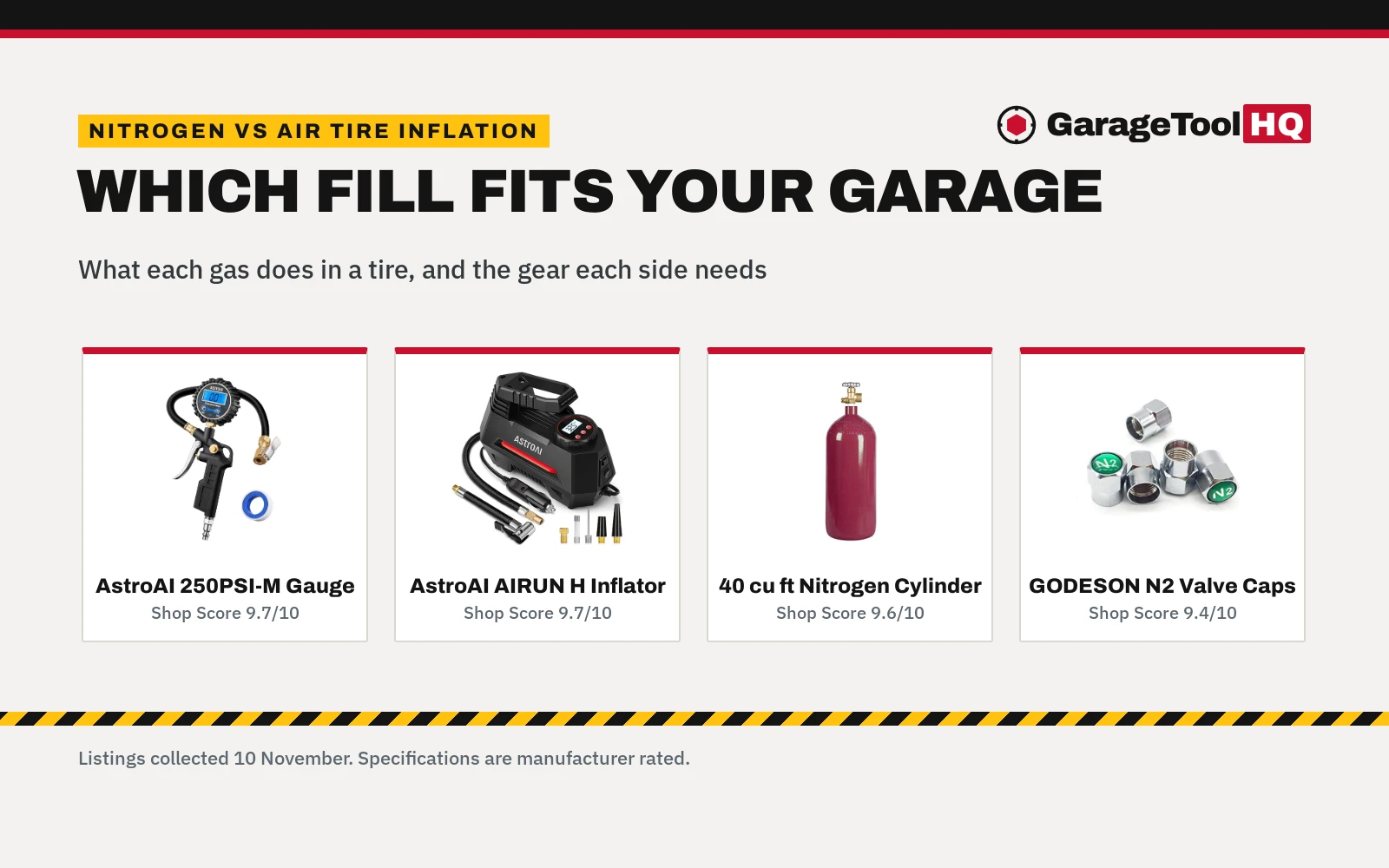
AstroAI Digital Tire Pressure Gauge with Inflator
A gauge with inflator reading 3 to 250 PSI, 0.1 PSI resolution, a 19.7 in hose, a solid brass chuck and a 3-year warranty.
Pros
- Reads 3 to 250 PSI with 0.1 PSI resolution
- Solid brass chuck and brass fitting for a tight seal
- 3-in-1: trigger to inflate, button to deflate
- Backlit LCD and LED flashlight for dim garages
Cons
- No pump inside: it needs a compressor behind it
- Readings can differ by about 2 PSI between checks
- Display shuts off after 15 seconds of inactivity
- No storage case is stated

AstroAI AIRUN H Tire Inflator Portable Air
A 12V DC portable inflator with a 120W motor, 35L/min airflow, auto shut-off at a preset pressure and a 2-year warranty.
Pros
- Fills a standard car tire (195/65 R15) from 30 to 36 PSI in under 1 minute (stated)
- Digital preset with auto shut-off across 4 pressure units
- 9.84-foot cord reaches all tires without repositioning
- Kit includes 2 air nozzles, a needle valve and a Presta-to-Schrader adapter
Cons
- Shuts off after 15 minutes of continuous use, then a 10-minute cool-down
- Not designed for high-volume inflatables such as pool floats or air mattresses
- Runs only on a 12V DC car outlet; no battery inside is stated
- Bullets state 2.2 lbs while the spec table states 1.98 pounds

40 cu ft Steel Nitrogen Cylinder - CGA580 Valve
A 40 cu ft steel nitrogen cylinder with a CGA580 valve, 2524 PSI service pressure and DOT approval, shipped empty for refills.
Pros
- 40 cu ft capacity in a mid-size steel tank
- 2524 PSI service pressure with a CGA580 valve
- DOT, ISO/UN approved for safe transport and storage
- Multi-gas valve works with nitrogen, argon, helium, neon and a CO2/nitrogen mix
Cons
- Ships empty: fill at a local compressed gas supplier before use
- Bullets state 29 lb; the spec table states 30.0 pounds
- No warranty term is stated
- 7 in diameter and 22.3 in height at 29 lb

GODESON Chrome Plated Brass Tire Valve Stem Caps
A set of 5 chrome-plated brass valve caps with a red O-ring seal, an N2 logo and 1 spare, on a standard US 8V1 thread.
Pros
- Chrome-plated brass with an N2 logo that marks nitrogen-filled tires
- Red O-ring seal with a dustproof design
- Standard US 8V1 thread fits most cars, trucks, motorcycle and bikes
- 5 caps in the set with 1 spare included
Cons
- Caps only: they mark a nitrogen fill, they do not fill a tire
- Spec table lists Green; the title and bullets describe chrome-plated silver
- No warranty term is stated
- No certification is stated
Nitrogen vs Air Tire Inflation Side by Side
| Nitrogen | Air tire inflation | ||
|---|---|---|---|
| What fills the tire | Nitrogen gas from a cylinder | Air from a portable inflator | |
| Gear in this article | Valve caps and a 40 cu ft cylinder | A portable inflator and a gauge with inflator | |
| Fill at home | Needs a filled cylinder and a CGA580 regulator | Plugs into a 12V DC car outlet | |
| Pressure figures stated | 2524 PSI service pressure on the cylinder | Gauge reads 3 to 250 PSI | |
| Keep it going | Refill the cylinder at a compressed gas supplier | Runs on the car outlet | |
| Watch out for | Cylinder ships empty and weighs 29 lb | 15 minutes of use, then a 10-minute cool-down | |
| Fit for | Drivers who want dry, inert gas in the tire | Drivers who top off tires at home or on the road |
Example figures are manufacturer rated, as published on each listing and collected 9 November 2026.
What nitrogen brings to a tire
Nitrogen arrives as a dry, inert gas from a cylinder, and the cylinder in this article lists tire inflation among its uses. The fill needs a filled cylinder and a CGA580 regulator, and the cylinder ships empty.
What portable air brings
Air on this side comes from a pump that plugs into the car: the inflator in this article runs on 12V DC, fills a standard car tire (195/65 R15) from 30 to 36 PSI in under 1 minute, and stops at a preset pressure. A gauge with an inflator reads 3 to 250 PSI and handles inflate and deflate at the valve.
Filling at home: cylinder or compressor
A 40 cu ft cylinder measures 7 in across and 22.3 in high with a 29 lb tare weight. A portable inflator weighs 2.2 lbs, measures 8.4 in by 6.8 in by 3.9 in, and plugs into a 12V DC outlet with a 9.84-foot cord.
Pressure and the gauge
Pressure is where the air side shows its range. The gauge reads 3 to 250 PSI with 0.1 PSI resolution and readings within ±1%. The nitrogen cylinder states 2524 PSI service pressure and lists a 3365 PSI figure: cylinder figures, not tire figures.
Choose nitrogen if
- You keep a filled cylinder and regulator
- You want dry, inert gas in the tires
- You already use nitrogen for HVAC, beverage or shop work
- You have floor space for a 40 cu ft cylinder
Choose air if
- You top off tires at home or on the road
- You want a 12V DC inflator for the glove box
- You want a gauge that inflates at the valve
- You skip the trip to a gas supplier
Example picks
For more choices, see the best 12V portable tire inflator with digital gauge and the best cordless tire inflator, and for the gauge side of the job, tire pressure gauge vs tire inflator.
Drain the tank after use so water does not rust it from the inside, never exceed the tool's rated pressure, wear eye protection, and run 240V units on the circuit the manual calls for. Do not run a gas engine compressor in a closed garage. Read our Safety Disclaimer.
Garage Fit Check
- Space: the cylinder measures 7 in across and 22.3 in high; the inflator is 8.4 in by 6.8 in by 3.9 in.
- Power: the inflator plugs into a 12V DC car outlet with 15A fuse protection; the gauge needs a compressor behind it.
- Storage: the cylinder ships empty, so plan the first fill at a compressed gas supplier.
- Before the first job: confirm the CGA580 regulator fits the cylinder valve and the chuck seats on a standard Schrader valve.
FAQ: garage tools
Is nitrogen better than air for everyday car tires?
The listings do not settle that question with a head-to-head figure: the nitrogen side offers dry, inert gas, while the air side offers a 12V DC inflator and a gauge.
Can I fill tires with nitrogen at home?
Yes, with a filled cylinder and a CGA580 regulator: the cylinder in this article ships empty, so the first fill starts at a local compressed gas supplier.
What pressure should I fill my tires to?
Use the figure the vehicle maker lists for the car. The gauge reads 3 to 250 PSI with 0.1 PSI resolution, and the inflator listing uses a standard car tire (195/65 R15) filled from 30 to 36 PSI as its example.
How long can I run a portable tire inflator?
The inflator in this article shuts off after 15 minutes of continuous use, and the listing recommends a 10-minute cool-down period before resuming.
Related: the best 12V portable tire inflator with digital gauge, the best cordless tire inflator, the tire pressure gauge vs tire inflator, the best air compressors and the air compressors hub.