AGM vs Gel Battery Tester: Which One Should You Buy?
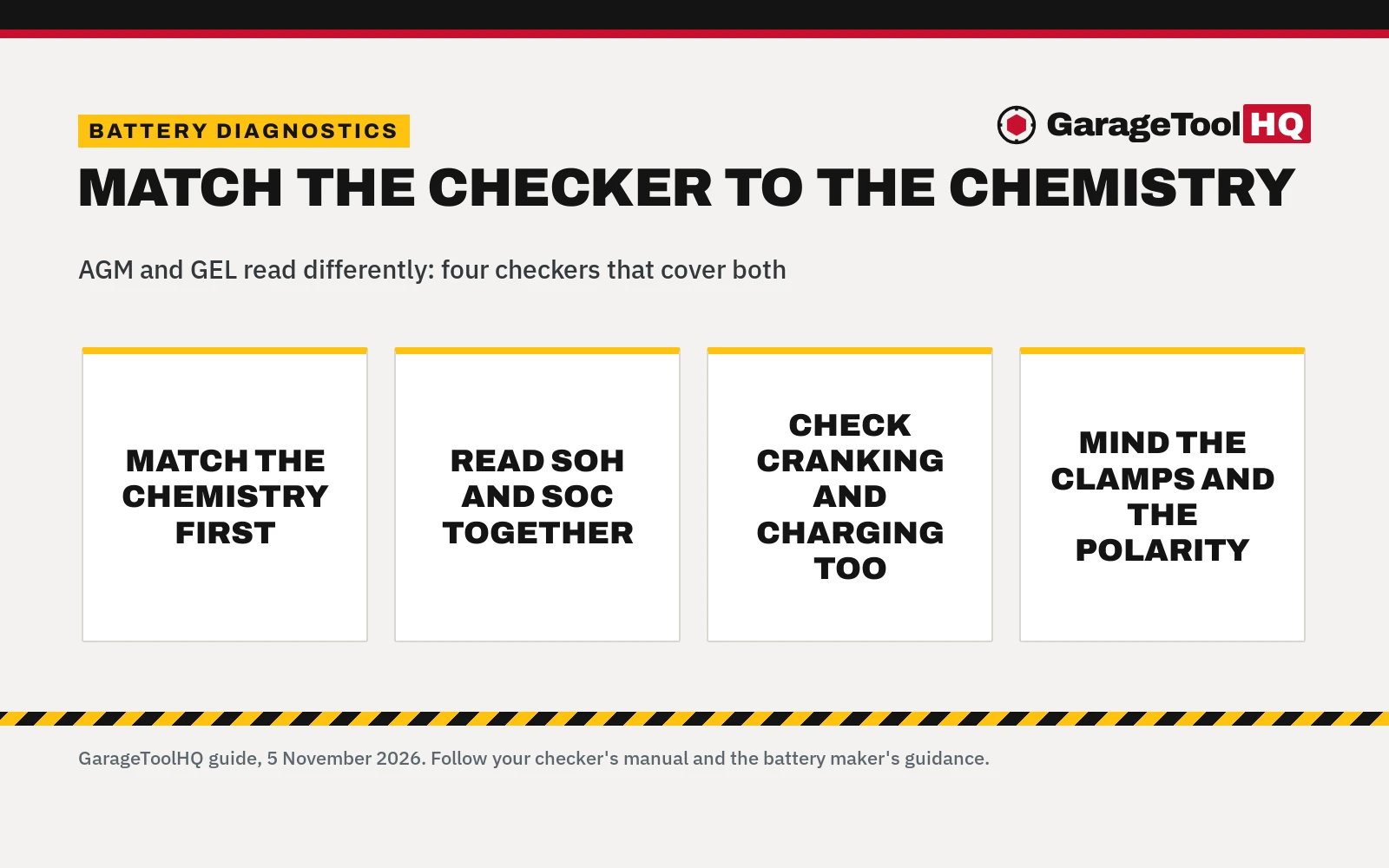
A checker that reads AGM and GEL batteries has to match the chemistry first: this guide compares both types and four tools that cover both.

On this page
A car that cranks slow on a cold morning leaves one question hanging in the garage: is the battery done, or is something else at fault? The answer starts with a checker matched to the battery in front of you, because an AGM battery and a GEL battery do not read the same way. An agm vs gel battery tester has to know which chemistry it is looking at, and this guide compares the AGM and GEL chemistries and the four checkers below that cover both.
As an Amazon Associate I earn from qualifying purchases. GarageToolHQ earns a commission when you buy through links on our product pages, at no extra cost to you. Read our affiliate disclosure.
Below: what sets AGM and GEL batteries apart, how the four checkers compare on voltage, range and chemistry cover, and the questions that come up most in the garage.
AGM vs Gel Battery Tester: What Changes Between the AGM and GEL Chemistries
AGM and GEL are both sealed lead-acid designs, and both need a checker that lets you pick the chemistry before it reads. AGM holds its electrolyte in glass mat separators, while GEL holds it in a silica gel, and each one charges and ages in its own way. A checker that reads one chemistry with the other chemistry’s settings can call a good battery bad, or a bad battery good, so the chemistry setting is the first thing to match.
The four checkers in this guide all list AGM and GEL among the chemistries they cover, along with flooded and EFB types. They differ in voltage cover, in the CCA range they read, and in what they show you after the check: a printed report, a color screen with next-step guidance, or a stored result you can play back.
| Checker | Voltages | CCA range | Chemistries listed | Standout |
|---|---|---|---|---|
| ANCEL BST600 | 12V and 24V | 100-2000 CCA | Flooded, AGM Flat, AGM Spiral, EFB, GEL | Built-in printer |
| AUTOOL BT360 | 12V and 24V | 30-2000 CCA | Flooded, AGM, EFB, gel | Color display, 3-year limited warranty |
| VEHLIVE BT900 | 6V and 12V | 5-3000 CCA | Flooded, AGM Flat, AGM Spiral, GEL, EFB | 8.2 ft cable, next-step guidance |
| TOPDON BC100 | 12V | 100-2000 CCA | Flooded, AGM Flat, AGM Spiral, GEL, EFB | Data playback, 31.5-inch cables |
The range matters more than the brand name. The VEHLIVE BT900 reads from 5 to 3000 CCA, the widest span here, and it is the only one of the four that covers 6V batteries. The AUTOOL BT360 starts at 30 CCA, the lowest floor after the VEHLIVE, while the ANCEL BST600 and the TOPDON BC100 both start at 100 CCA. If the battery on the bench is a 24V truck battery, the ANCEL and the AUTOOL are the only ones that list 24V cover.
The four checkers, in order
ANCEL BST600. The ANCEL leads the order as the complete checker here. It reads 12V and 24V batteries from 100 to 2000 CCA, covers flooded, AGM Flat, AGM Spiral, EFB and GEL types, and reads SOH, SOC, rated and measured CCA, voltage, internal resistance and battery temperature. Its built-in thermal printer records the battery type and the readings, plus the last four VIN digits, date and time, for customer, work-order or fleet records with no app or external printer.
The ANCEL runs off the connected vehicle battery, with no internal battery included or required, and it lists reverse-polarity protection with a low-current method. It is not for lithium batteries or EV high-voltage battery packs, and at 12.8 by 7.87 by 3.35 inches and 1.0 pounds it is the largest checker here. Skip it if the job is only ever a 12V car battery in a home garage: the smaller checkers below cover that job with less bulk.
AUTOOL BT360. The AUTOOL reads 12V and 24V batteries from 30 to 2000 CCA, covers flooded, AGM, EFB and gel types, and shows SOH, SOC, internal resistance and real-time voltage on a color backlit display. It lists reverse polarity protection and heavy-duty clamps, and it is the only one of the four with a stated warranty: a 3-year limited warranty, with questions answered within 24 hours.
At 5.5 by 3.0 by 1.2 inches it is a compact handheld, and the maker lists a 30 days return beside the warranty. The display is its edge over the plain LCD below, but the AGM cover is listed as AGM rather than by flat or spiral form, so check the label on the battery first. Skip it if the battery is a 6V unit: the AUTOOL lists 12V and 24V only.
VEHLIVE BT900. The VEHLIVE reads 6V and 12V batteries from 5 to 3000 CCA, the widest span here, and covers flooded, AGM Flat, AGM Spiral, GEL and EFB types. Its 8.2 ft cable lets one person view the screen from the driver seat while raising and holding RPM for the charging check, and its color results come with a second page of next-step guidance: recharge, recheck, check the charging system, or replace the battery.
Guided setup screens help pick the battery location, type, standard and value from the battery label, and it reads CCA, EN, SAE, DIN, JIS, IEC, CA, MCA and BCI standards. It is not for 24V systems or lithium batteries. Skip it if the job includes a 24V truck battery: the ANCEL and the AUTOOL cover 24V, and this one does not.
TOPDON BC100. The TOPDON reads 12V batteries from 100 to 2000 CCA, covers flooded, AGM Flat, AGM Spiral, GEL and EFB types, and checks battery condition, cranking voltage and alternator and charging-system voltage in one tool. Its data playback function stores and reviews past results, and its 31.5-inch cables reach into crowded engine bays. It lists reverse polarity protection and a spark-free design, and it powers up only when correctly connected.
One snag sits in the listing itself: the bullets give the size as 5.37 by 2.97 by 0.89 inches, while the spec table lists 5.3 by 3.0 by 1.0 inches. Trust the bullets, as the listing’s own words, and expect a compact tool either way. No warranty term is stated, only a 30 days return and 12-month customer service note. Skip it if the job needs 24V or 6V cover: this one is 12V only.
Lead-acid batteries can release hydrogen while charging, so charge in a ventilated space away from sparks and flames, connect positive first and negative last, set the charger to the battery type (flooded, AGM, gel, lithium), and wear eye protection. Read our Safety Disclaimer.
FAQ: garage tools
Do AGM and GEL batteries need different checker settings?
Yes. The four checkers here all list AGM and GEL as separate chemistries to pick before the check, because each chemistry reads in its own way. Pick the chemistry from the battery label first, then read the result. A checker run on the wrong setting can call a good battery bad.
Can one checker read a 6V battery and a 24V battery?
None of the four covers both. The VEHLIVE covers 6V and 12V, the ANCEL and the AUTOOL cover 12V and 24V, and the TOPDON covers 12V only. Match the checker to the voltage on the battery label before you clamp on.
What do SOH and SOC mean on the screen?
SOH is battery health and SOC is charge level, and the ANCEL and the AUTOOL show both on the screen. A low SOC with a good SOH usually means the battery needs charging, not replacing. The ANCEL prints both figures on its report, so the numbers travel with the work order.
Does a checker charge the battery?
No. These tools read battery condition, cranking voltage and charging-system output; they do not put charge back into the battery. The TOPDON listing states its charging system check does not charge the battery. A charger is a separate tool, and the Related links below point to charger picks.
What should I do when the checker says recharge and recheck?
Follow the guidance on the screen. The ANCEL says a battery may be good, need recharging and rechecking, or need replacement, and the VEHLIVE shows the same choice on its next-step page. Charge the battery, then check it again and read the new result before deciding to replace it.
Is reverse polarity protection standard on these checkers?
The ANCEL, the AUTOOL and the TOPDON list reverse polarity protection in their listings. The VEHLIVE listing does not state it. Either way, clamp red to positive and black to negative, and check the connections before you start.
Related: battery terminal protector vs dielectric grease, battery warmer vs block heater, the best smart battery charger picks, and the Bluetooth vs wired OBD2 scanner comparison.