Bench Grinder vs Angle Grinder: Which One Should You Buy?
Bench grinder vs angle grinder for the home shop: a stationary 6 to 8 in grinder for sharpening against a handheld grinder for cutting, compared on wheel size, speed, power and the jobs each does best.

On this page
Top picks at a glance
As an Amazon Associate we earn from qualifying purchases.
- 1
 HTC Adjustable Bench Grinder Stand Pedestal9.8/10View on Amazon
- 2
 JET Grinder Stand9.7/10View on Amazon
- 3
 6" Bench Grinder Wheel 120 Grit & Wire Wheel Brush with 1/2"9.7/10View on Amazon
- 4
 WEN BG4282 4.8-Amp 8-Inch Single Speed Bench Grinder with LEDView on Amazon
- 5
 JET 8-Inch Industrial Bench GrinderView on Amazon
- 6
 Grizzly Industrial T24463-6" Bench Grinder with Work LightView on Amazon
- 7
 DEWALT DW758 8-Inch Bench GrinderView on Amazon
- 8
 DEWALT 6 Inch Bench GrinderView on Amazon
- 9
 WEN BG4276 2.1-Amp 6-Inch Single Speed Bench Grinder withView on Amazon
Two grinders, two jobs. Bench grinder vs angle grinder comes down to where the work happens: a bench grinder is a stationary tool that holds the wheel in one place for sharpening and deburring, while an angle grinder is a handheld tool that carries the disc to the workpiece for cutting and grinding anywhere. Buy the bench grinder for sharpening drill bits, chisels and mower blades; buy the angle grinder for cutting stock, grinding welds and working away from the bench. Many shops own both, because neither replaces the other.
More options to compare
 WEN BG4282 4.8-Amp 8-Inch Single Speed Bench Grinder with LEDCheck price on Amazon
 JET 8-Inch Industrial Bench GrinderCheck price on Amazon
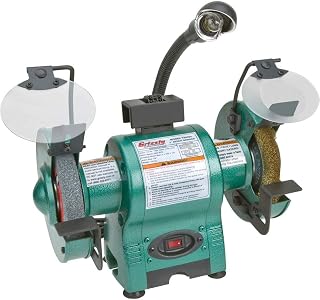 Grizzly Industrial T24463-6" Bench Grinder with Work LightCheck price on Amazon
 DEWALT DW758 8-Inch Bench GrinderCheck price on Amazon
 DEWALT 6 Inch Bench GrinderCheck price on Amazon
 WEN BG4276 2.1-Amp 6-Inch Single Speed Bench Grinder withCheck price on Amazon
GarageToolHQ earns a commission when you buy through links on our product pages, at no extra cost to you. Read our affiliate disclosure.
bench grinder vs angle grinder: the quick answer
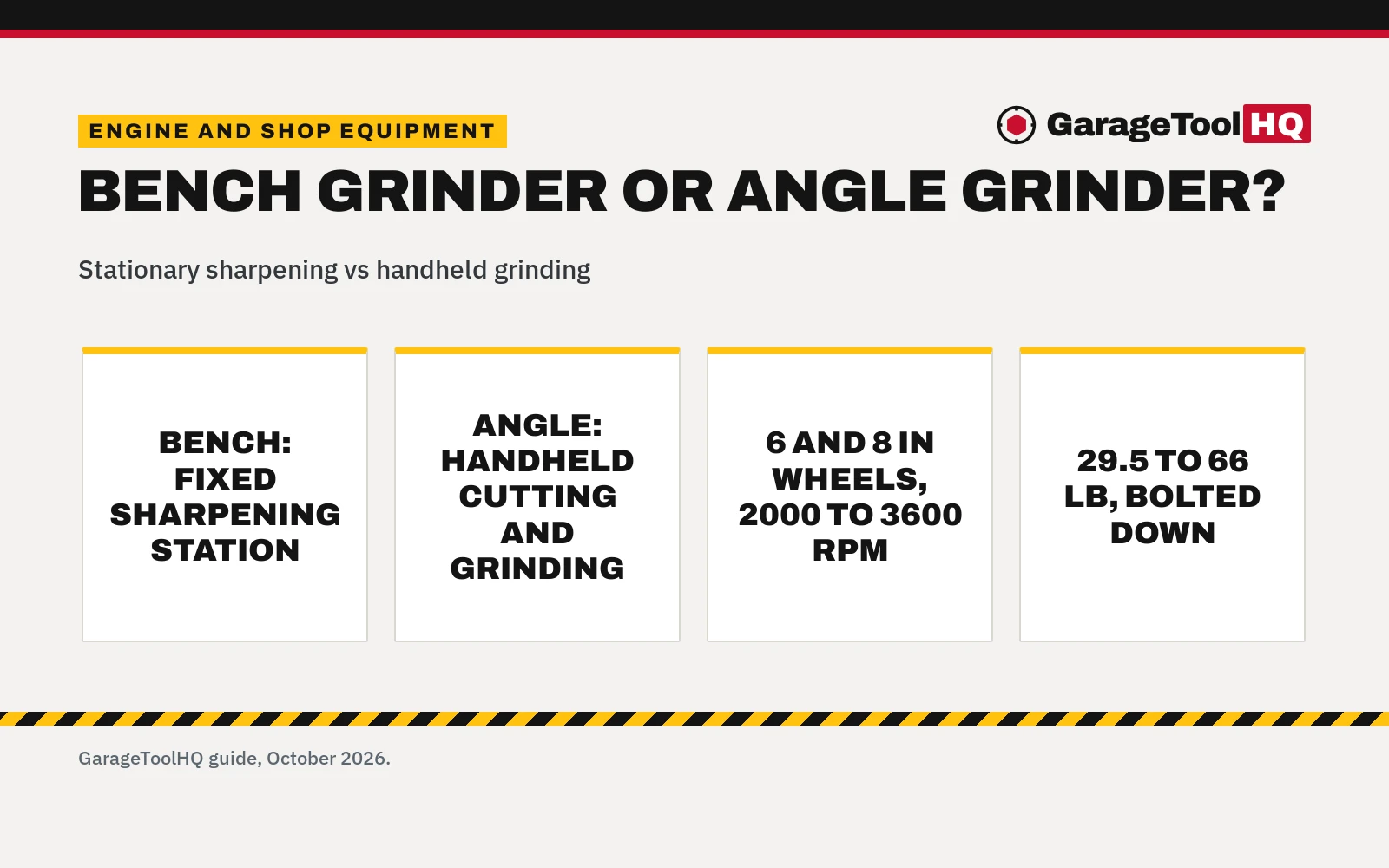
The listings here are all bench grinders: 6 and 8 in wheels running 2000 to 3600 RPM on the full-size models, weighing 29.5 to 66 lb, bolted to the bench. A bench grinder stays put and you bring the tool to the wheel, which is why it owns sharpening: drill bits, chisels, mower blades and deburring. An angle grinder goes the other way: you bring the disc to the work, which is why it owns cutting and weld grinding on the car, the fence or the trailer. If your work is mostly at the bench, start with the bench grinder; if it is mostly on the vehicle or the structure, start with the angle grinder. See our DEWALT 20V MAX angle grinder review for the handheld side.
What a bench grinder does well
Sharpening and deburring at a fixed station. The Delta 23-196 is a 6 in variable speed grinder from 2000 to 3400 RPM with a 300W induction motor and a drill bit rest milled into the tool rest for the correct angle on the tip. The WEN BG4282 is an 8 in single speed grinder at 3450 RPM with a 4.8A motor, LED work lights and a quenching tray for cooling workpieces. The Jet JBG-6W is a 6 in grinder at 3450 RPM with a 1/2 HP motor, a 36-grit wheel and a crimped wire wheel for rust and paint removal. Both wheel stations work at once: grind on one side, deburr or wire-wheel on the other. The tool rests adjust, the eye shields guard, and the work stays repeatable because the wheel never moves.
What an angle grinder does well
Cutting, grinding and flap-disc work anywhere. An angle grinder carries its disc to the workpiece: cutting exhaust pipe under the car, grinding a weld on the trailer, or cutting rebar at the fence line. It swaps discs quickly between cutting wheels, grinding wheels, flap discs and wire wheels. Where the bench grinder needs the work brought to it, the angle grinder works where the work is. It is the rougher, louder, more versatile tool, and the one that leaves the bench.
Wheel size and speed
Bench grinder wheels run 6 and 8 in in these listings, with a 3 in mini from Ecarke. Full-size models run 2000 to 3600 RPM: the Delta varies 2000 to 3400 RPM and the second Woodskil 2000 to 3450 RPM with a digital display, while the WEN, Jet JBG-6W and first Woodskil run single speed at 3450 to 3600 RPM. The Ecarke 3 in mini varies 2000 to 10000 RPM for small work. Variable speed matters when you sharpen: slower speeds put less heat into the edge. The Jet IBG-8VS adds a brake resistor that brings the wheel from 3600 to 0 in under 20 seconds. Angle grinder discs spin far faster than bench wheels, which is why they cut so aggressively. Never swap discs between the two tools: the speeds and arbors do not match.
Power, weight and where it lives
The full-size bench grinders here are corded shop tools: the Delta and both Woodskils list 120V, the Jet JBG-6W lists 115V, and the Jet IBG-8VS is dual-voltage 115/230V. Motors run 1/2 HP on the Jet JBG-6W, 3/4 HP on both Woodskils, 1 HP on the Jet IBG-8VS. They weigh 29.5 lb for the Delta, 30.5 lb for the WEN, 31 lb for the Jet JBG-6W and 66 lb for the Jet IBG-8VS, and they bolt down: the Jet JBG-6W lists a pre-drilled base, and the second Woodskil lists a pre-drilled rigid steel base. An angle grinder weighs a fraction of that and hangs on a hook or rides in the toolbox. The trade is permanence: the bench grinder is always set up and always ready, while the angle grinder goes where the job is. The Ecarke 3 in mini splits the difference: a bench grinder at 1.6 kg that runs on a DeWalt 20V battery or its AC adapter, for a sharpening station that moves.
Which one first
Buy the bench grinder first if your work is sharpening and deburring: drill bits, chisels, mower blades and hand tools. Buy the angle grinder first if your work is cutting and weld grinding on vehicles and structures. The two overlap at deburring and rust removal: the Jet JBG-6W ships a wire wheel for that, and an angle grinder takes a wire wheel too. If the budget covers one tool, pick the one that matches the jobs you actually do. Most home shops end up with both before long.
Frequently Asked Questions
Can an angle grinder sharpen a mower blade?
It can, but the bench grinder’s tool rest and fixed wheel give a more consistent bevel, and the Delta even mills a drill bit rest into the rest for the correct tip angle. For a quick touch-up in the field, the angle grinder does fine.
What speed should I grind at?
The variable speed listings with a stated range run 2000 to 3400 or 3450 RPM: slower for sharpening to control heat, faster for deburring. The WEN’s quenching tray helps cool the workpiece during long grinding sessions.
Do bench grinders need to be bolted down?
They should be. The Jet JBG-6W and the second Woodskil list pre-drilled bases, and at 29.5 to 66 lb these grinders walk across the bench under load if they are not mounted.
Are the included wheels enough?
Most listings ship a 36-grit wheel for grinding and a 60-grit wheel for sharpening; the Jet JBG-6W instead pairs its 36-grit wheel with a crimped wire wheel for rust and paint removal. Finer finishing may want a finer wheel bought separately.
Corded or cordless?
The full-size models are all corded: the Delta and both Woodskils list 120V, the Jet JBG-6W lists 115V, and the Jet IBG-8VS is dual-voltage 115/230V. The exception is the Ecarke 3 in mini, which runs on a DeWalt 20V battery or its AC adapter, with the battery not included.
Related: DEWALT 20V MAX angle grinder review, straight vs angled die grinder, best air die grinder for rust removal and the engine and shop equipment hub.