Bench Vise Types: Workshop Guide for Home Garages
A complete breakdown of bench vise types for garage workshops, comparing mechanics, woodworking, pipe, multi-purpose, and rotating vises for DIY projects.

On this page
Top picks at a glance
As an Amazon Associate we earn from qualifying purchases.
- 1
 Wilton Mechanics Pro Bench Vise9.7/10View on Amazon
- 2
 Wilton Reversible Bench Vise9.7/10View on Amazon
- 3
 Yost Vises 455 Combination Vise9.6/10View on Amazon
When you need to press a stubborn bearing cap, hold a rusted caliper bracket steady, or trim an exhaust hanger with a hacksaw, a reliable clamping tool is essential. What are the primary bench vise types for a home garage? The main bench vise types are mechanic’s vises for general metalwork, combination vises with built-in pipe jaws, woodworking vises for lumber, multi-purpose rotating vises for varied angles, and drill press vises for machine tables. For a typical home garage, a mechanic’s bench vise or a combination vise provides the most practical balance of clamping force, throat clearance, and durability.
GarageToolHQ earns a commission when you buy through links on our product pages, at no extra cost to you. Read our affiliate disclosure.
Below: how the main bench vise types differ, which styles belong on a garage workbench, a practical checklist for choosing and mounting a vise, and how casting materials affect clamping strength.
Bench vise types: how workshop vises differ
A bench vise serves as the mechanical anchor of a home workspace. Clamping workpieces firmly prevents rotation during drilling, stops vibration while cutting metal, and keeps hands clear of sharp cutting edges. However, different bench vise types approach holding tasks with specialized geometries, distinct jaw patterns, and varied mounting structures. Selecting a model that does not align with your garage projects can lead to slipped workpieces, damaged soft metals, or cracked cast iron bodies.
Workshop vises differ across several fundamental characteristics:
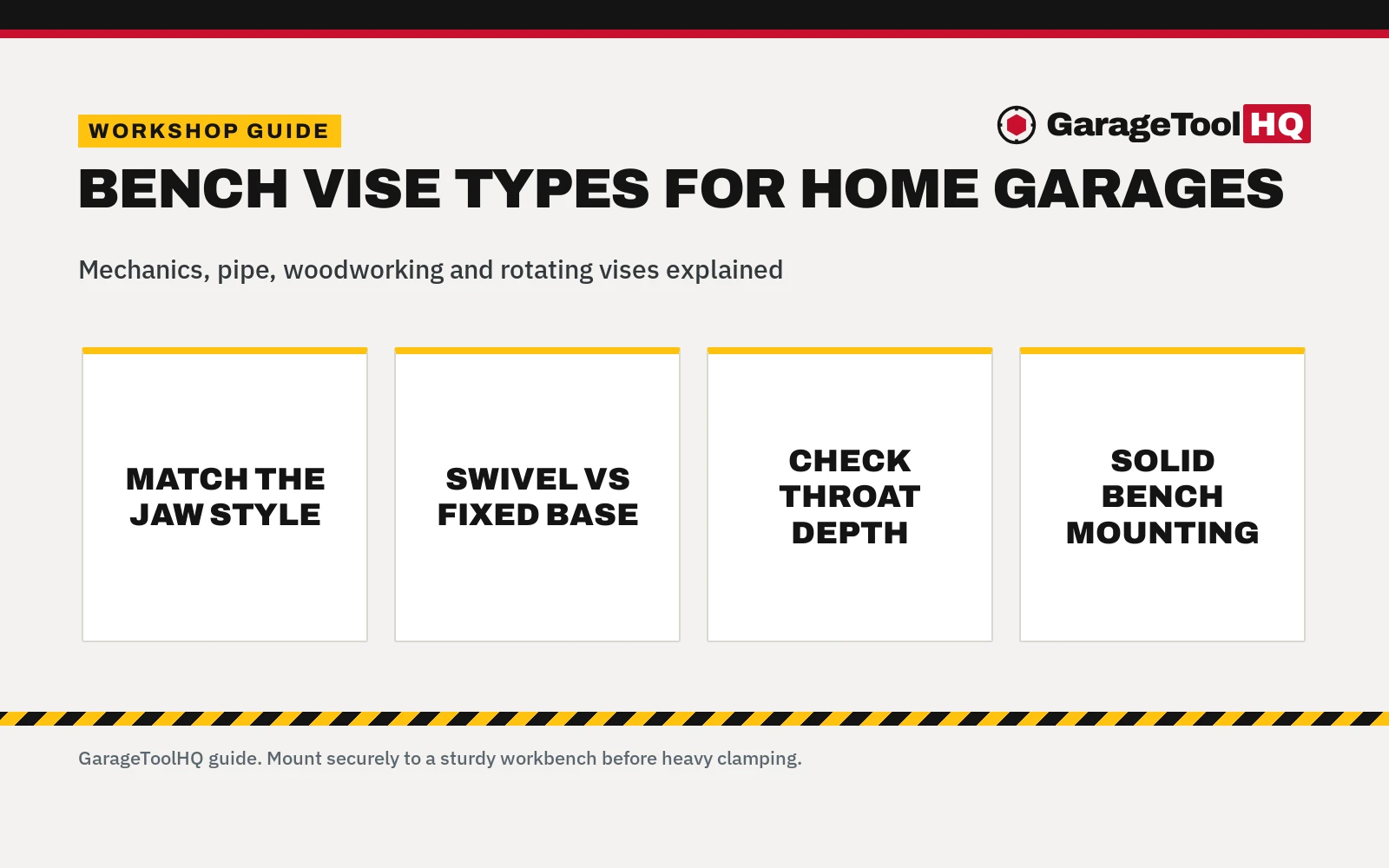
- Jaw configuration. Parallel serrated steel jaws bite into hard metal for heavy torque, smooth jaws protect soft alloys from cosmetic marring, and curved pipe jaws wrap around cylindrical tubing to distribute clamping pressure evenly.
- Base engineering. Fixed-base vises bolt flat to the workbench surface to provide maximum rigidity under heavy clamping force and bending torque, whereas swivel-base models rotate to allow long workpieces to angle past workbench obstructions.
- Throat depth. The vertical span between the top of the jaw faces and the slide or screw housing below determines how deep a workpiece can drop into the body before bottoming out.
- Anvil striking area. Many workshop vises incorporate a flat rear anvil surface behind the stationary jaw, providing a firm surface for light tapping, straightening cotter pins, or flattening sheet metal brackets.
Primary kinds of bench vises, and which styles belong in a garage
| Vise Type | Jaw Configuration | Best Garage Jobs |
|---|---|---|
| Mechanic’s bench vise | Hardened serrated steel jaws with flat rear anvil area | General automotive repair, cutting bolts, filing metal brackets, light assembly work |
| Combination pipe and bench vise | Parallel flat jaws situated above curved serrated pipe jaws | Exhaust pipe fabrication, suspension sleeves, conduit, and round axle shafts |
| Woodworking bench vise | Wide flat wooden or smooth metal faces mounted flush to benchtop | Planing boards, woodworking projects, cabinetry, and non-marring assemblies |
| Multi-purpose rotating vise | Rotating head assembly with opposing flat and curved jaws | Versatile home shops requiring varied angles and mixed workpiece shapes |
| Drill press machine vise | Low-profile slotted casting with parallel ground jaws | Holding metal stock securely on drill press tables during boring operations |
The projects you tackle most often determine which style belongs on your workbench. For standard automotive chores, a mechanic’s vise or a combination pipe vise offers the required clamping grip and structural mass. Woodworking vises feature broad jaws that distribute clamping force across wide boards to prevent crushing wood grain, but their lack of hardened faces and anvil surfaces makes them unsuitable for automotive metal shaping. Machine vises excel on drill press tables because their low profile fits under chucks, but they lack the throat depth and anvil area required for general bench work.
How to select a bench vise for your garage: the checklist
- Match jaw width to your routine projects. Wide jaw surfaces secure longer workpieces with minimal deflection, while narrower jaws fit into confined spaces and concentrate clamping pressure on small metal components.
- Evaluate throat depth for vertical clearance. A deep throat measurement allows tall brackets, long threaded rod, or suspension components to extend downward past the main screw housing without obstruction.
- Choose between swivel and fixed bases. A swivel base with locking handles allows you to angle long exhaust tubing across open garage space instead of colliding with the wall, while a fixed base eliminates rotating joints for maximum strength during heavy bending.
- Look for replaceable jaw inserts. Hardened steel jaw faces with diamond serrations grip rough metal securely. Choosing a vise with jaw plates secured by screws allows you to replace worn gripping surfaces over time, or you can attach magnetic soft covers over the serrations when handling polished components.
- Verify pipe jaw inclusion. If you frequently service exhaust pipes, steering linkages, or round conduit, integrated pipe jaws below the main parallel faces keep cylindrical parts centered and slip-free.
- Check for an enclosed lead screw. A fully enclosed screw housing keeps metal shavings, grinding grit, and shop dust away from lubricated threads, preventing premature binding and abrasive wear over time.
- Plan for substantial bench mounting. A heavy vise requires a rigid mounting surface made from solid hardwood or steel plate, secured with through-bolts, flat washers, and underside backing plates rather than lag screws.
- Never apply a cheater pipe to the handle. Vise handles are engineered to deliver appropriate clamping force by hand leverage without extra extensions. Slipping a pipe over the handle overloads internal screw threads and risks snapping cast iron components.
While most mechanic’s bench vises include a small flat pad behind the rear jaw, this striking face is intended only for light tapping, shaping thin brackets, or driving pins. Never strike heavy cold chisels or swing large shop hammers against a vise anvil, as cast iron bodies can fracture under heavy shock loads.
Use rated jack stands on solid ground, wear eye protection with power and air tools, keep fuel-burning equipment out of a closed garage, and follow the manual for every tool. Read our Safety Disclaimer.
Cast iron vs forged steel bench vises
The metallurgy of a bench vise determines how well the tool withstands heavy clamping pressure, mechanical stress, and incidental hammer strikes:
- Grey cast iron: Found in many economy workshop vises. Grey iron dampens vibration effectively and offers adequate rigidity for light-duty clamping, but it possesses limited tensile strength and can crack when subjected to severe shock or over-tightening.
- Ductile iron: Formulated with nodular graphite structures that improve elasticity and tensile resilience compared to traditional grey iron. Ductile iron vises endure substantial clamping force and moderate impact without brittle failure.
- Forged steel: Formed under extreme pressure from solid steel billets. Forged steel provides superior yield strength and exceptional impact resistance, making it ideal for demanding fabrication work and high-torque clamping.
- Mounting rigidity: Regardless of whether a vise body is cast or forged, clamping performance depends directly on bench stability. Bolting a heavy-duty vise to a thin or flexible workbench allows the surface to twist, robbing the tool of effective holding power.
Before selecting a vise, determine the right dimensions for your workspace by checking our guide on the best bench vise size. When you are ready to compare specific models across different build materials, explore our roundup of the best bench vise for garage workshops, or consider a dedicated work bench with vise package for an integrated clamping station.
Safe vise mounting and workbench placement
Proper placement on your workbench determines how easily you can clamp awkward or oversized objects. Mount the vise close to a sturdy bench leg rather than at the center of a wide unsupported span. Placing the tool directly over a leg transfers downward striking forces and clamping pressure straight into the garage floor, preventing benchtop flex and bouncing.
Position the stationary rear jaw so that it sits flush with or slightly ahead of the front edge of the workbench when facing forward, while keeping all mounting bolt holes fully supported on the solid benchtop. This forward placement ensures that long pipes, angle iron, or threaded rod clamped vertically can extend downward toward the floor without striking the bench face or storage drawers below. Fasten the base using high-strength through-bolts fitted with wide fender washers or a thick steel backing plate beneath the benchtop. If you also operate a bench grinder nearby for cleaning parts, maintain adequate separation or review our recommendations for the best bench grinder for garage workspaces to keep abrasive grinding dust away from lubricated vise guide channels.
Frequently Asked Questions
What is the most versatile bench vise for a home garage?
A combination mechanic’s bench vise equipped with a swivel base and integrated pipe jaws offers exceptional versatility for home mechanics. It clamps flat metal stock for cutting and filing, grips round exhaust tubing or suspension sleeves securely, and rotates to position workpieces comfortably within the workspace.
What is the difference between a mechanic’s vise and a woodworking vise?
A mechanic’s vise bolts to the top of the workbench, using hardened serrated steel jaws for metal clamping and a small anvil pad for light shaping. A woodworking vise mounts underneath or flush with the workbench edge, utilizing broad wooden or smooth metal faces that distribute clamping pressure across wide boards without crushing soft wood grain.
Why does throat depth matter on a bench vise?
Throat depth measures the vertical distance from the top of the jaw faces down to the slide or screw housing below. A deeper throat clearance allows tall brackets, long bolts, and wide metal plates to drop down into the vise body without colliding with the lead screw housing.
Is a swivel base better than a fixed base bench vise?
A swivel base provides superior flexibility by rotating the vise body, allowing long pipes or metal bars to extend into open garage space rather than hitting nearby walls. However, a fixed base eliminates rotating joints, offering maximum rigidity and structural strength for heavy bending operations.
Can I hammer on a bench vise anvil?
Light tapping, pin driving, and gentle sheet metal straightening are appropriate on the built-in anvil surface. Heavy striking with large sledges or driving cold chisels should be performed on a dedicated anvil or heavy steel block, as severe shock loads can crack cast iron vise bodies.
How do I prevent a bench vise from marring soft metal parts?
Fit magnetic soft jaw covers made from aluminum, copper, brass, or polyurethane over the hardened steel jaws. These protective accessories cushion the workpiece, preventing serrated jaw teeth from leaving impressions on polished chrome, brass fittings, or aluminum brackets.
Related: our sizing breakdown on the best bench vise size, our top recommendations for the best bench vise for garage, our guide to choosing a work bench with vise, and our complete overview of engine and shop equipment.