Best Automotive Voltage Checker (2026): 4 Probes Compared
Four automotive circuit probes for garage electrical troubleshooting, compared by DC voltage range, display style, cord reach, safety and warranty.

On this page
Top picks at a glance
As an Amazon Associate we earn from qualifying purchases.
- 1
 Best OverallAWBLIN NS-8369.7/10View on Amazon
- 2
 Best Wide-Voltage RangeATOBLIN AT-1809.5/10View on Amazon
- 3
 Best Wire-Piercingallsun GK52259.3/10View on Amazon
- 4
 Best Powered Diagnostic ProbeChazcool Circuit Probe9.3/10View on Amazon
- 5
 Test Light AutomotiveView on Amazon
- 6
 AstroAI Digital Multimeter Tester 2000 Counts with DC ACView on Amazon
- 7
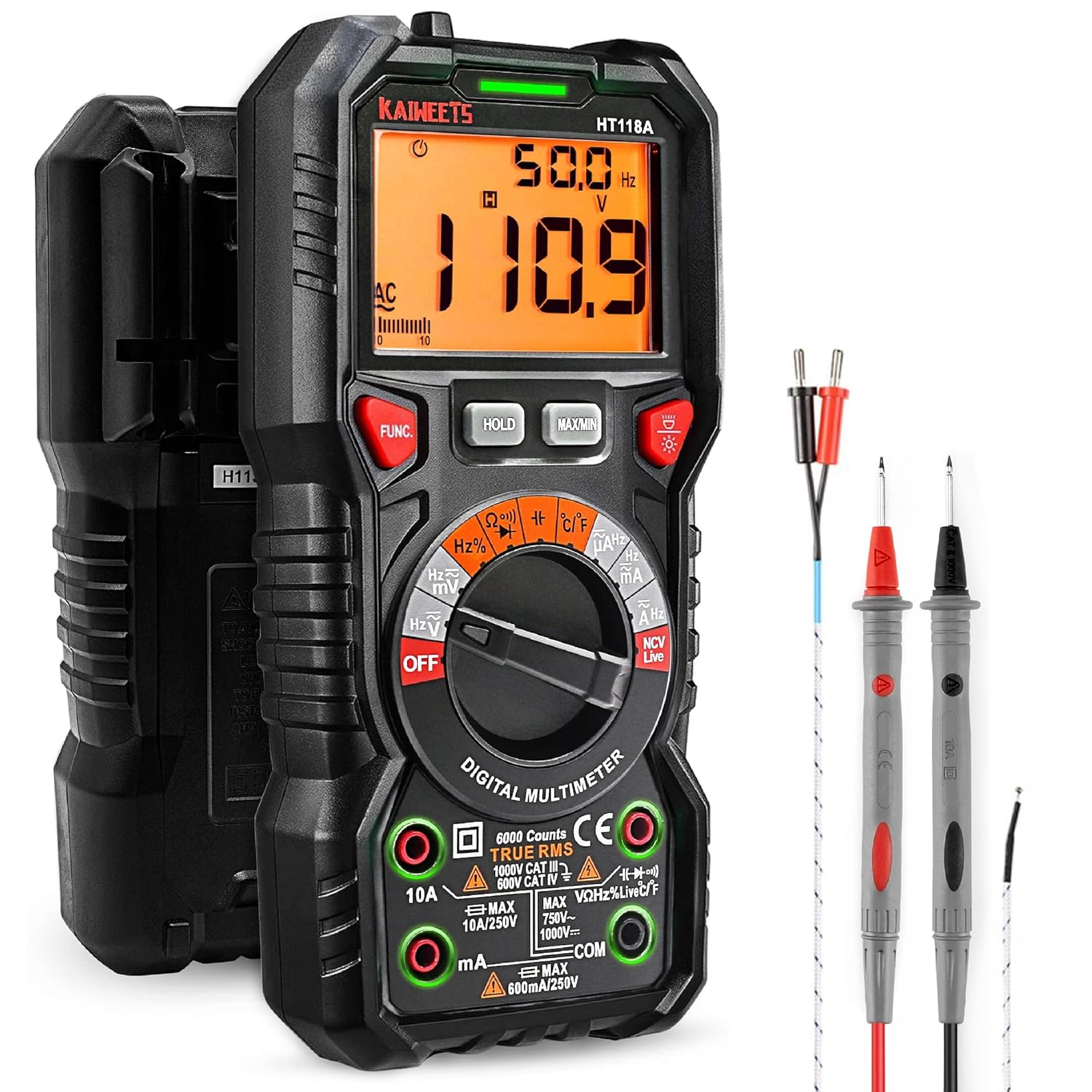 KAIWEETS Digital Multimeter Automotive TRMS Tester 6000View on Amazon
- 8
 Automotive Circuit Fault Probe TesterView on Amazon
When a trailer taillight refuses to illuminate or a 12V power accessory circuit drops out during a weekend wiring repair, grabbing the right diagnostic tool saves hours of guessing. A dedicated circuit probe quickly confirms whether power reaches a fuse, switch or connector without stripping wire looms. This roundup compares four options to find the best automotive voltage checker for home garages, evaluating DC voltage range, display design, lead cord reach, safety ratings and warranty terms.
GarageToolHQ earns a commission when you buy through links on this page, at no extra cost to you. Read our affiliate disclosure.
Quick picks
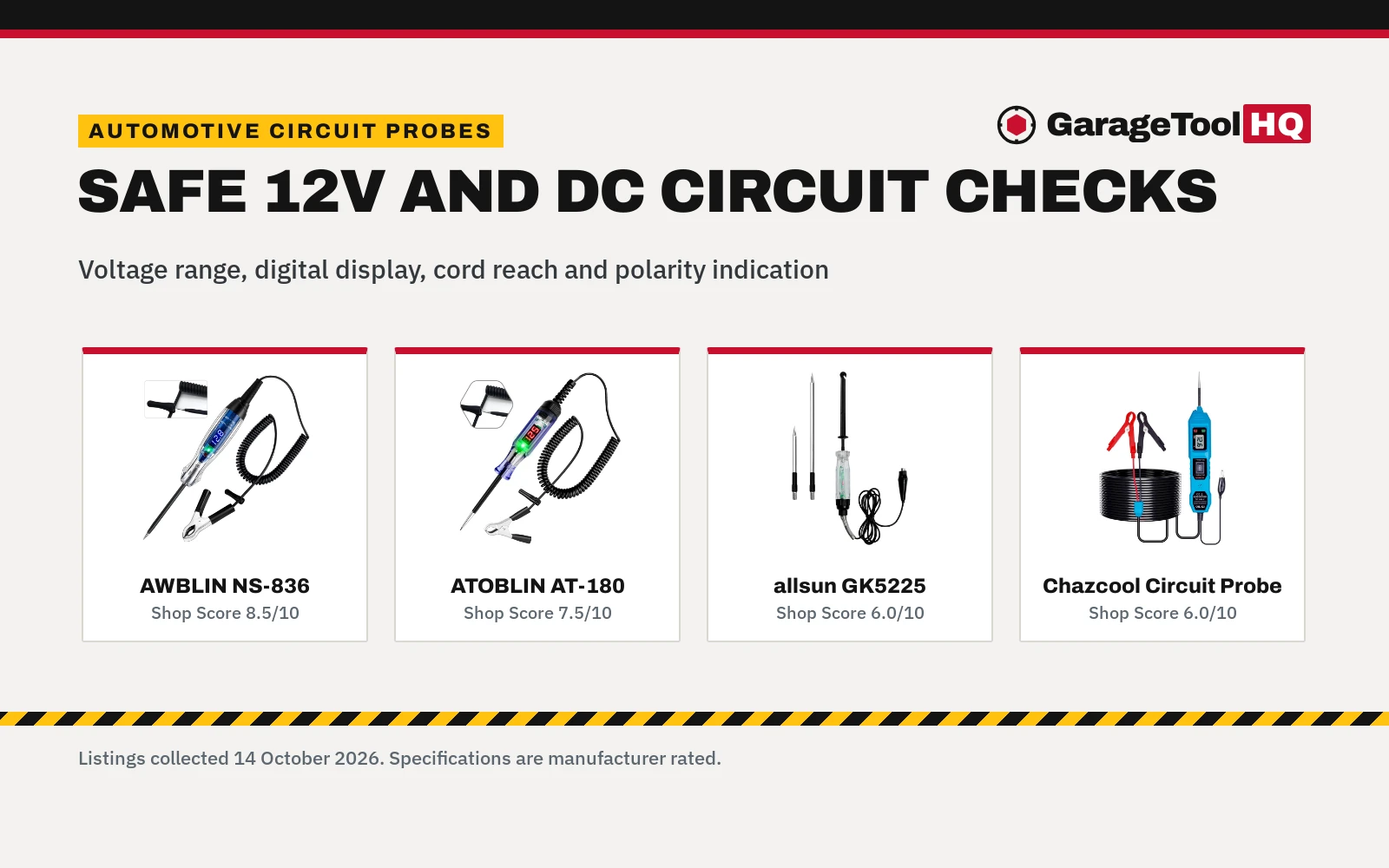
- Best Overall AWBLIN NS-836: 3 to 60V DC digital LED display with 0.1V resolution, computer-safe circuit board, 102-inch coiled cord and UL specification listing. Check price on Amazon
- Best Wide-Voltage Range ATOBLIN AT-180: 3 to 120V DC measurement range covering cars, trucks and heavy equipment, with digital readout, dual polarity LEDs and 96-inch reach. Check price on Amazon
- Best Wire-Piercing allsun GK5225: Hands-free wire hook and piercing probe for 6 to 12V circuits, with dual LEDs and an audible buzzer for noisy garage bays. Check price on Amazon
- Best Powered Diagnostic Probe Chazcool Circuit Probe: 6 to 24V powered probe with 14.8-foot lead, LCD display, forward LED work light and 1 to 8A overload protection for tracking short circuits. Check price on Amazon
The picks
AWBLIN Automotive Test Light 3-60V DC Digital LED
A 3 to 60V DC digital circuit probe with 0.1V resolution, bidirectional polarity LEDs, integrated needle guard, and UL specification compliance.
Pros
- DC 3 to 60V operating range with 0.1V digital resolution
- Integrated needle guard cap prevents accidental puncture injuries
- Computer-safe internal circuit board chip protects vehicle modules
- Coiled spring lead extends up to 102 inches
Cons
- Spec table lists power source as battery powered rather than circuit powered
- Illumination field in specification table reads no data
- Not rated for AC household circuits or DC systems above 60V
- Heavier than simple incandescent bulb probes at 0.16 kg
Test Light Automotive 3-120V DC LED Digital
A 3 to 120V DC circuit probe with a digital voltage display, bidirectional polarity LEDs, integrated needle guard, and CE compliance.
Pros
- Broadest DC range here, spanning 3 to 120V DC
- Integrated anti-lost needle guard shields the probe point
- Internal circuit chip protects onboard vehicle computers
- Spring wire stretches up to 96 inches with anti-bending tail
Cons
- No warranty term is stated on the listing
- No UL, ETL or CSA electrical safety certification stated
- Spec table lists power source as battery powered
- Resolution ratio is not specified in the listing table

ALLOSUN Automotive Wire Piercing DC Voltage
A 6 to 12V DC wire-piercing hook probe with dual LED bulbs, an audible buzzer, three interchangeable probe tips, and a 59-inch heat-resistant cord.
Pros
- Audible buzzer sounds alongside dual LED visual indicators
- Hook mechanism captures wire for hands-free operation
- Three interchangeable probes included (long, short and pierce-type)
- Insulated 59-inch lead cord resists engine heat and oil
Cons
- Narrow DC operating range restricted to 6 to 12V (maximum 15V)
- Listing explicitly advises against use on sensor or computer wiring
- No digital voltage readout provided
- No UL, ETL or CSA safety listing stated

6-24V DC Circuit Tester Automotive
A 6 to 24V DC powered diagnostic probe with a 14.8-foot cable, LCD screen, forward LED light, and 1 to 8A overload breaker protection.
Pros
- Long 14.8-foot (4.5 m) cable reaches from battery to trailer hitch
- Powered probe can supply battery voltage or ground to components
- Rated current 1 to 8A with built-in overload protection
- LCD voltage screen paired with forward LED illumination
Cons
- No warranty term is stated on the listing
- Probe tip generates sparks and is prohibited in flammable areas
- Bulkier and heavier than passive probes at 1.08 pounds
- Restricted to 6 to 24V DC and cannot be used above 36V or on AC
More options to compare
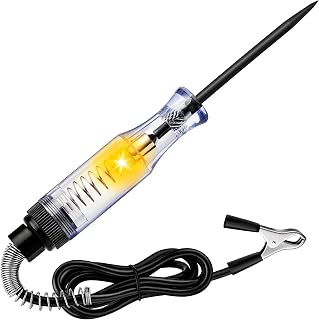 Test Light AutomotiveCheck price on Amazon
 AstroAI Digital Multimeter Tester 2000 Counts with DC ACCheck price on Amazon
 KAIWEETS Digital Multimeter Automotive TRMS Tester 6000Check price on Amazon
 Automotive Circuit Fault Probe TesterCheck price on Amazon
Compare the picks
| Model | Shop Score | Voltage range | Display | Cord length | Polarity indicator | Warranty |
|---|---|---|---|---|---|---|
| AWBLIN NS-836 | 9.7/10 | 3 to 60V DC | Digital LED (0.1V resolution) | 102 in coiled | Red (pos) / Green (neg) | 1 year |
| ATOBLIN AT-180 | 9.5/10 | 3 to 120V DC | Digital LED | 96 in coiled | Red (pos) / Green (neg) | Not stated |
| allsun GK5225 | 9.3/10 | 6 to 12V DC | Dual LEDs and buzzer | 59 in straight | Not stated | 1 year |
| Chazcool Circuit Probe | 9.3/10 | 6 to 24V DC | LCD with forward LED light | 14.8 ft straight | Red (pos) / Green (neg) | Not stated |
Specifications are manufacturer rated, as published on each listing and collected 14 October 2026. Where a listing contradicts itself, both figures are shown.
How we scored them
Each diagnostic probe is scored out of 10 on performance, build, value, safety and warranty, with the weights published on our How We Pick page. Only one model states a recognized UL safety specification, and two listings state a clear manufacturer warranty term.
| Product | Shop Score | Perf. /35 | Build /25 | Value /25 | Safety /10 | Warranty /5 |
|---|---|---|---|---|---|---|
| AWBLIN NS-836 | 9.7 | 32 | 21 | 21 | 7 | 3 |
| ATOBLIN AT-180 | 9.5 | 33 | 21 | 21 | 0 | 0 |
| allsun GK5225 | 9.3 | 22 | 18 | 18 | 0 | 3 |
| Chazcool Circuit Probe | 9.3 | 28 | 19 | 19 | 0 | 0 |
Scores run from 9.2 to 9.8: each product’s point total is placed on that range, so more points always means a higher score.
What the listings tell you
We examined four automotive circuit probe listings in detail. Three models provide a digital voltage readout, while one relies on dual LEDs and an audible buzzer. Operating ranges vary substantially: one model spans 6 to 12V DC, while another handles 3 to 120V DC. Two tools feature integrated anti-lost needle guards to protect against puncture injuries, and two include stated 1-year warranty coverage. Only one listing cites recognized UL and IEC safety specifications, while two listings describe line-powered probes as battery powered in their specification tables.
Best Automotive Voltage Checker Buying Guide
Voltage range and system compatibility
Most passenger cars, SUVs and light trucks run on 12V electrical systems, where a 3 to 60V tool covers alternator charging and sensor drops. Heavy-duty trucks and commercial machinery frequently operate on 24V circuits. For multi-vehicle garages, wider DC spans prevent overloading the tool when probing beyond 12V.
Digital readouts vs bulb indicators
Basic incandescent light probes only tell you if power is present, leaving you blind to high resistance connections or low voltage drops. A digital LED readout displays actual circuit voltage to within 0.1V, confirming whether a circuit delivers full voltage or suffers voltage loss. Bidirectional polarity LEDs add quick visual feedback by glowing red for positive power and green for ground.
Lead wire reach and ground clamps
A diagnostic probe is only as useful as its working radius. Coiled spring leads that extend between 96 and 102 inches provide ample reach across engine bays while recoiling neatly to avoid catching on belts or fan shrouds. For long trailer wiring or truck frames, an extended 14.8-foot straight cord reaches from the battery all the way to the rear bumper.
Computer-safe circuitry and module safety
Modern vehicles contain sensitive electronic control units and delicate sensors. Older incandescent probes can draw excessive current that risks damaging computer drivers. Look for probes with built-in circuit board chips designed specifically to protect vehicle computers.
Active power probes vs passive circuit checkers
Passive probes measure existing circuit voltage and ground. Active powered probes connect directly to battery terminals, allowing the operator to supply power or ground through a switch to activate components, or trace short circuits with 1 to 8A overload breaker protection.
Piercing probes versus connector back-probing
Reaching an electrical conductor inside a weather-sealed harness often tempts mechanics to jam probes through wire insulation. Basic straight pins can core out insulation jackets, allowing moisture and road brine to corrode copper strands. A dedicated hook probe, like the allsun GK5225 with its three interchangeable tips, captures the wire in a recessed plastic cradle. The slender piercing needle penetrates the outer jacket cleanly without gouging conductors, leaving a minimal puncture that self-seals or requires only a dab of liquid electrical tape. For back-probing weather-pack connectors at sensor plugs, slim needle tips slip past silicone weather seals without tearing moisture barriers.
Coiled lead cord management and bench reach
Working around an engine bay requires enough lead slack to move between the battery post and remote fuse boxes without tugging clips loose. Coiled spring leads stretching 96 inches on the ATOBLIN or 102 inches on the AWBLIN provide practical reach while pulling excess slack upward away from oily steering racks, rotating pulleys, and hot exhaust heat shields. Molded anti-bending sleeves where the wire joins the handle prevent internal conductor breakage caused by repetitive flexing. When working along long vehicle frames, straight extension leads like the 14.8-foot cable on the Chazcool probe let you trace harness faults from the front battery all the way to rear trailer light sockets without repositioning battery clamps.
Audible tones versus visual indicators
Visual readouts work well when the tool remains in your direct field of vision, but automotive electrical troubleshooting frequently forces you under dashboards, behind instrument clusters, or under truck beds. Probes featuring dual LEDs paired with a loud buzzer alert you the instant power or ground is detected, eliminating the need to take your eyes off tight wire bundles to look at a screen. Digital displays showing 0.1V resolution remain essential when checking whether circuit voltage drops under load, but dual-action light and sound indicators excel during fast continuity tracing across multi-pin harness plugs.
Complementary electrical diagnostic tools
While a circuit probe is ideal for quick voltage checks at fuse blocks and harness connectors, complex sensor diagnosis and resistance measurements call for a dedicated automotive multimeter. For a broader look at garage diagnostic equipment, explore our diagnostics and electrical hub.
Garage Fit Check
- Lead cord reach: verify whether a 59-inch cord reaches your work area or if a 96-inch, 102-inch, or 14.8-foot lead is needed for rear trailer harnesses.
- Computer circuit safety: confirm the tool features high-impedance circuitry before probing sensitive control modules, and heed warnings against sensor probing on basic hook probes.
- Voltage matching: select a probe rated for your vehicle voltage, checking whether the job involves 6V, 12V, 24V or higher DC banks up to 120V.
- Sharp probe storage: inspect protective needle guards and keep active sparking probes away from flammable fuel vapors and battery gases.
Use rated jack stands on solid ground, wear eye protection with power and air tools, keep fuel-burning equipment out of a closed garage, and follow the manual for every tool. Read our Safety Disclaimer.
Frequently Asked Questions
What is the best automotive voltage checker?
The AWBLIN NS-836 earns top marks because it delivers a broad 3 to 60V DC range, 0.1V digital resolution, computer-safe circuitry, an integrated needle guard, UL specification compliance, and a stated 1-year warranty.
How do you check electrical circuits on a car?
Clamp the ground lead securely to a clean chassis ground or negative battery post, then touch the stainless probe tip to a fuse terminal, connector pin, or wire. The digital screen or polarity LEDs will illuminate immediately to indicate live voltage and polarity.
Can a circuit probe damage a car computer?
Traditional low-impedance bulb tools can draw excessive current that damages sensitive electronic control modules. Probes with integrated circuit board chips draw minimal current, making them safe for modern computerized vehicles.
What does bidirectional polarity indication mean?
Bidirectional polarity means the ground clamp can attach to either positive or negative ground. On-board LEDs show circuit state: red indicates positive power and green indicates negative ground connection.
Why use a wire-piercing hook probe?
A wire-piercing hook secures the wire inside an insulated collar and drives a slender pin through the insulation, allowing hands-free reading without manually stripping or holding the wire against a sharp point.
Related: our diagnostics and electrical hub, the best automotive multimeter, our guide on how to use automotive multimeter, the best battery charger maintainer, the best obd2 scanner for diy, and the best jump starter. Also see our guide on garage tools every homeowner should own.