Best Belt Sander for Metal Work (2026)
Four belt sanders compared for metal work: pneumatic, corded, cordless and bench models scored on belt speed, power source, weight, included belts and warranty.

On this page
Top picks at a glance
As an Amazon Associate we earn from qualifying purchases.
- 1
 Top PickIngersoll Rand 360-4189.5/10View on Amazon
- 2
 Runner-UpWEN 6307 File Sander9.5/10View on Amazon
- 3
 Cordless PickMaxMore 20V File Sander9.4/10View on Amazon
- 4
 Shop PickKFMK 2×42 Belt Sander9.3/10View on Amazon
- 5
 WEN Benchtop Belt and Disc Sander with 4 x 36 in. BeltView on Amazon
- 6
 WEN Benchtop Belt and Disc Sander with 1 x 30 in. Belt and 5View on Amazon
- 7
 3/8" Pneumatic Belt Sander SetView on Amazon
- 8
 SEESII bench Grinder and Belt Sander Combo: 2"x27" Belt + 6"View on Amazon
- 9
 SKIL 6 Amp 3"x18" Belt Sander with Pressure ControlView on Amazon
- 10
 Makita 9403 4" x 24" Belt SanderView on Amazon
When a rusty trailer hitch bolt snaps and the stub is fused to the bracket, a grinder is too blunt and a hand file is too slow. The middle tool is the best belt sander for metal work: a narrow belt that takes down spot welds, rust and burrs without gouging the base metal. This guide compares four belt sanders by belt size, belt speed, power source, weight, included belts and warranty.
GarageToolHQ earns a commission when you buy through links on this page, at no extra cost to you. Read our affiliate disclosure.
Quick picks
- Top Pick Ingersoll Rand 360-418: 0.6 hp air motor, 20,000 rpm, 4,700 sfpm, tool-free belt changes, 1 year warranty. Check price on Amazon
- Runner-Up WEN 6307 File Sander: Corded file sander: 1,080-1,800 FPM variable speed, auto-tracking belt, 2 year warranty. Check price on Amazon
- Cordless Pick MaxMore 20V File Sander: Cordless 20V file sander, up to 2,100 FPM, 6 speeds, 1.9 lb, no cord needed. Check price on Amazon
- Shop Pick KFMK 2×42 Belt Sander: Bench combo: 2 x 42 in belt and 6 in disc, vertical or horizontal belt, shop grinding. Check price on Amazon
The picks

Ingersoll Rand 360-418 1/2" x 18" Air Belt Sander
A 1/2 x 18 in pneumatic belt sander with a 0.6 hp motor, up to 20,000 rpm and 4,700 sfpm, tool-free belt changes and an articulating arm.
Pros
- 0.6 hp pneumatic motor, up to 20,000 rpm and 4,700 sfpm
- Power regulator and right-angle head for tight spots
- Tool-free belt changes and articulating arm
- Includes 3 Norton belts (60, 80, 100 grit) and hex wrench
Cons
- An air compressor is not included
- Only 3 belts included (60, 80, 100 grit)
- Spec table lists 230 volts on an air tool
- Pneumatic only: no good without shop air

WEN 6307 Variable Speed Detailing File Sander
A corded electric 1/2 x 18 in detailing file sander with 1,080 to 1,800 FPM variable speed, auto-tracking belt and tool-free belt changes.
Pros
- Variable speed dial: 1,080 to 1,800 FPM
- Auto-tracking belt, no tensioning or adjustments
- Tool-free belt installation
- Includes 3 belts, dust port attachment and a 2 year warranty
Cons
- Belt pivot stated as both 50 and 55 degrees
- Slower belt speed than the pneumatic and cordless picks
- Only 3 belts included, all 120 grit
- Corded: needs an outlet nearby

MaxMore Cordless Detail Band file Sander
A cordless 20V finger belt sander compatible with DEWALT 20V MAX batteries, with a 1/2 x 18 in belt up to 2,100 FPM across 6 speeds (tool only).
Pros
- Up to 2,100 FPM across 6 variable speeds
- Compatible with DEWALT 20V MAX batteries
- 1.9 lb with a compact one-hand design
- Safety lock button and low-voltage protection
Cons
- No battery or charger included (tool only)
- No warranty term is stated
- Belt count contradicts itself: 3 belts vs 10
- Grit type listed only as Medium

2x42 in. Belt Sander & 6" Disc Sander Combo
A bench combo with a 2 x 42 in belt sander and a 6 in disc sander, the belt positioned vertically or horizontally, for metalworking and knife making.
Pros
- 2 x 42 in belt plus 6 in disc in one bench machine
- Belt runs vertical or horizontal
- Disc table tilts to 45 degrees
- Includes tool rest, miter gauge, flat wrench and 3 hex keys
Cons
- Motor rating contradicts itself: 3.5 A vs 1/2 HP
- No warranty term is stated
- 15.54 kg bench machine, not handheld
- Stated disc speed only; no belt FPM given
More options to compare
 WEN Benchtop Belt and Disc Sander with 4 x 36 in. BeltCheck price on Amazon
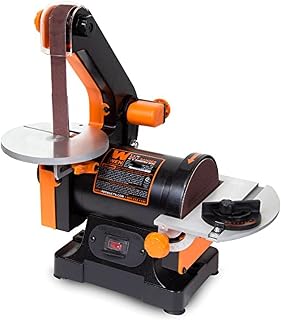 WEN Benchtop Belt and Disc Sander with 1 x 30 in. Belt and 5Check price on Amazon
 3/8" Pneumatic Belt Sander SetCheck price on Amazon
 SEESII bench Grinder and Belt Sander Combo: 2"x27" Belt + 6"Check price on Amazon
 SKIL 6 Amp 3"x18" Belt Sander with Pressure ControlCheck price on Amazon
 Makita 9403 4" x 24" Belt SanderCheck price on Amazon
Compare the picks
| Model | Shop Score | Power Source | Belt Size | Belt Speed | Weight | Warranty |
|---|---|---|---|---|---|---|
| Ingersoll Rand 360-418 | 9.5/10 | Pneumatic | 1/2 x 18 in | 4,700 sfpm | 2.4 lb | 1 year |
| WEN 6307 File Sander | 9.5/10 | Corded electric | 1/2 x 18 in | 1,080 to 1,800 FPM | 2.4 lb | 2 year |
| MaxMore 20V File Sander | 9.4/10 | Battery (DEWALT 20V) | 1/2 x 18 in | Up to 2,100 FPM | 1.9 lb | Not stated |
| KFMK 2×42 Belt Sander | 9.3/10 | Corded electric | 2 x 42 in belt, 6 in disc | Not stated (FPM) | 15.54 kg | Not stated |
*Shop Score is our weighted rating across performance, build, value, safety and warranty, from the ratings shown in the score table. Specifications are manufacturer rated, as published on each listing and collected 19 October 2026.
How we scored them
Each sander is scored out of 10 on performance, build, value, safety and warranty, with the weights published on our How We Pick page. Stated safety-relevant features earn safety points; a stated warranty term with a concrete period earns warranty points.
| Product | Shop Score | Perf. /35 | Build /25 | Value /25 | Safety /10 | Warranty /5 |
|---|---|---|---|---|---|---|
| Ingersoll Rand 360-418 | 9.5 | 30 | 21 | 20 | 0 | 2 |
| WEN 6307 File Sander | 9.5 | 28 | 20 | 20 | 0 | 3 |
| MaxMore 20V File Sander | 9.4 | 27 | 20 | 19 | 3 | 0 |
| KFMK 2×42 Belt Sander | 9.3 | 26 | 19 | 19 | 0 | 0 |
Scores run from 9.2 to 9.8: each product’s point total is placed on that range, so more points always means a higher score.
What the listings tell you
We read four belt sander listings. Three are handheld file sanders on a 1/2 x 18 in belt and one is a bench combo. The listings disagree with themselves in a few places: the WEN bullets give the belt arm’s pivot as 50 degrees in one spot and 55 degrees in another; the MaxMore bullets say 3 sanding belts are included while its spec table says 10; the KFMK title names both 3.5 amps and 1/2 HP for the same motor, which do not line up; and the Ingersoll Rand spec table lists 230 volts on a compressed-air tool, which makes no sense. In each case we trust the title and bullets over the spec table.
Buying guide: the best belt sander for metal work
Belt size for tight metal work
A 1/2 x 18 in belt is the detail size: it reaches spot welds, seams and tight corners where a big belt cannot go. Three picks here use that size. The bench pick runs a 2 x 42 in belt for longer passes on blades and bar stock, plus a 6 in disc for flat work.
Air, corded or cordless
The pneumatic pick runs off shop air and delivers the highest belt speed here, 4,700 sfpm, with a power regulator to dial it down. The corded electric pick plugs in and runs a variable 1,080 to 1,800 FPM. The cordless pick frees you from the cord at up to 2,100 FPM, but the battery is not included, so it suits owners who already run DEWALT 20V packs.
Belt changes and grits
All three handheld picks advertise tool-free belt changes, which matters when you step from coarse to fine grit in one job. The listings include coarse grits for rust and spot welds (60, 80 or P40) and finer grits for finishing (100, 120 or P120). The bench pick includes a tool rest, miter gauge and wrenches for setup.
Eye protection and dust
Metal sanding throws sparks and dust. Wear eye protection, work in a ventilated area, and keep flammables away from the work zone. The WEN includes a dust port attachment, and the MaxMore ships with a vacuum tube adapter.
Keeping the pneumatic pick fed matters: our guide to CFM for air tools covers sizing, and how to oil air tools covers upkeep. If you are torn between sander styles, see belt sander vs DA sander, or browse the best air belt sander roundup and the air tools hub.
Use rated jack stands on solid ground, wear eye protection with power and air tools, keep fuel-burning equipment out of a closed garage, and follow the manual for every tool. Read our Safety Disclaimer.
Sander setup: belts, speed and power
Match the belt speed to the job. The pneumatic Ingersoll Rand runs at 4,700 sfpm from a 0.6 hp motor at up to 20,000 rpm, the fastest material removal here, with a power regulator to dial it down for finishing passes. The corded WEN runs a variable 1,080 to 1,800 FPM on a dial, and the cordless MaxMore tops out at 2,100 FPM across 6 speed settings. For weld cleanup, start fast and coarse, then slow down and go fine: the listings include 60, 80 and 100 grit Norton belts with the Ingersoll Rand, P40, P80 and P120 with the MaxMore, and 120 grit medium belts with the WEN.
Plan the power source before you buy. The Ingersoll Rand needs shop air, and its listing states the compressor is not included. The WEN plugs into a standard outlet at 2 A, and the KFMK bench unit is listed at 3.5 A. The MaxMore runs on DEWALT 20V MAX packs but ships as tool only, so it suits owners who already own the batteries.
Look at how the belt is changed and aimed. All three handheld picks advertise tool-free belt changes, which matters when you step through grits in one session. The Ingersoll Rand adds a tool-free articulating arm for tight spots, and the WEN pivots its belt arm for angled work. The KFMK takes a different approach: a bench machine whose 2 x 42 in belt runs vertical or horizontal, with a 6 in disc whose table tilts to 45 degrees, a tool rest, a miter gauge and wrenches in the box. At 15.54 kg it stays put, while the handhelds weigh 2.4 lb for the Ingersoll Rand and WEN and 1.9 lb for the MaxMore.
Garage Fit Check
- The pneumatic pick needs an air compressor; the listing states the compressor is not included. Plan hose routing before the first job.
- The bench pick weighs 15.54 kg and runs a 2 x 42 in belt, so it needs a solid bench and room to tilt the belt vertical or horizontal.
- Stock the grits you will use: the listings include 60, 80 and 100 grit, P40, P80 and P120, and 120 grit medium belts across the picks.
- The cordless pick runs on DEWALT 20V MAX packs (tool only); keep a charged battery on the bench or the sander sits idle.
- A 1/2 x 18 in belt is a standard detail size, so replacement belts are easy to find.
Frequently Asked Questions
How do you use a belt sander on metal?
Keep the belt moving across the work and let the grit do the cutting; lingering in one spot digs a groove. Start with a coarse grit such as 60 or P40 for heavy rust and spot welds, then step to 100, 120 or P120 for a smoother finish.
How do you change the belt on a belt sander?
On all three handheld picks the listings state tool-free belt changes: release the tension, slide the old belt off and the new one on, then re-tension. The bench pick includes wrenches for assembly and adjustment.
How does an air belt sander work?
Compressed air from your compressor drives a pneumatic motor. The Ingersoll Rand pick lists a 0.6 hp motor with up to 20,000 rpm free speed and a power regulator, so you set the air flow to match the job.
What grit belt should I start with for metal?
Match the grit to the job. The listings include 60 and 80 grit (and P40, P80) for rust, spot welds and burrs, and 100, 120 or P120 grit for finishing passes. Finer grits remove less material and leave a smoother surface.
Related: best air belt sander, belt sander vs DA sander, how to oil air tools, what CFM do air tools need and the air tools hub.