Best Bench Grinder Under $100: 4 Grinders Compared (2026)
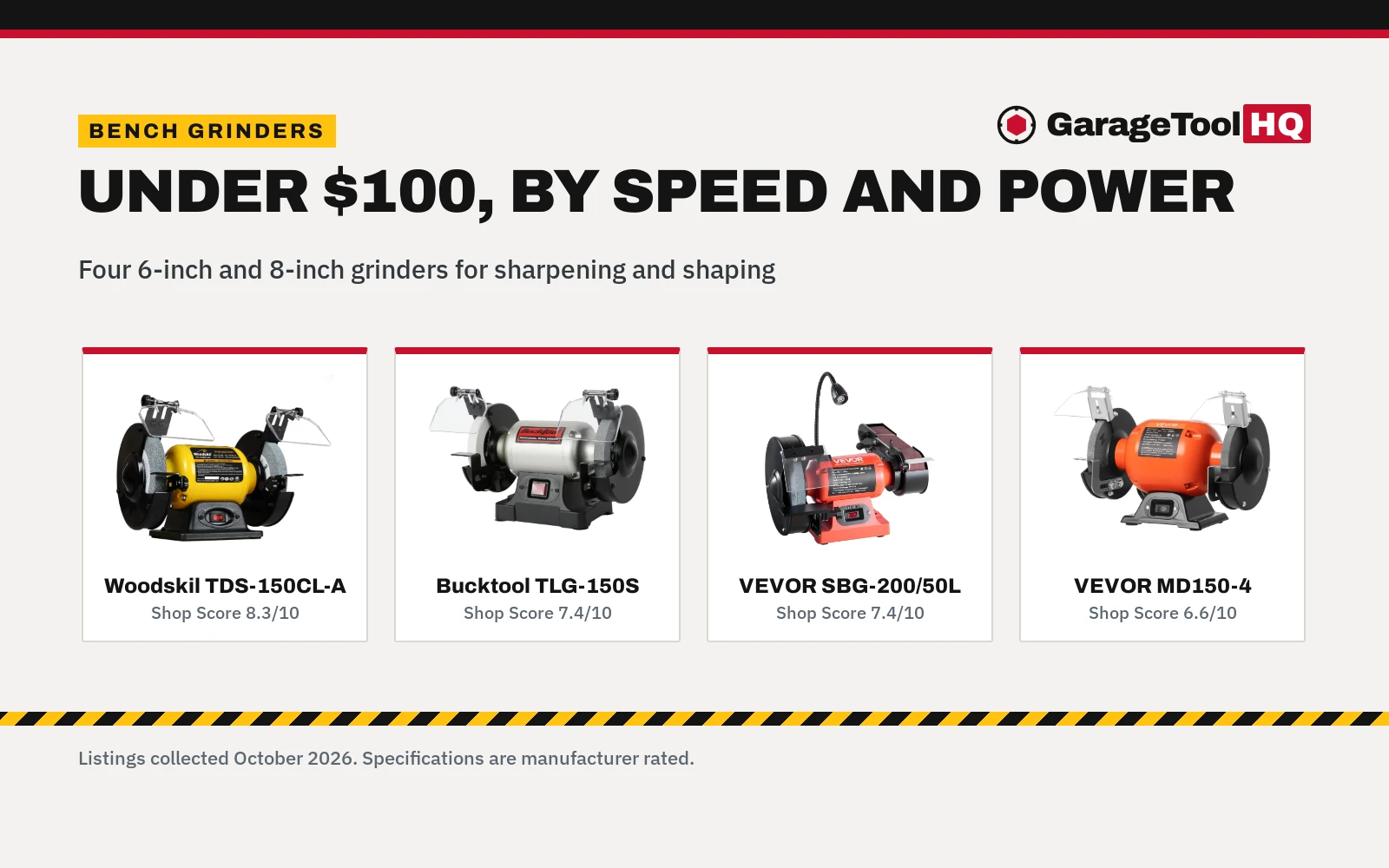
Four bench grinders under $100 compared by wheel speed, motor power, wheel grits, safety certification, weight and warranty coverage.

On this page
Top picks at a glance
As an Amazon Associate we earn from qualifying purchases.
- 1
 Best OverallWoodskil TDS-150CL-A9.7/10View on Amazon
- 2
 Best for SharpeningBucktool TLG-150S9.5/10View on Amazon
- 3
 Best Grinder Sander ComboVEVOR SBG-200/50L9.5/10View on Amazon
- 4
 Best Compact Low-SpeedVEVOR MD150-49.4/10View on Amazon
- 5
 WEN BG4276 2.1-Amp 6-Inch Single Speed Bench Grinder withView on Amazon
- 6
 WEN BG4260 2.1-Amp 6-Inch Single Speed Bench GrinderView on Amazon
- 7
 Genesis GBG600L 6" Bench Grinder with DualView on Amazon
Cleaning up a mushroomed punch, sharpening a dull lawn mower blade, or deburring cut steel tubing are standard weekend jobs that stall without a solid grinder on the bench. Finding the best bench grinder under 100 means balancing motor power, operating speed, and wheel selection against workshop space and safety. This guide compares four 6-inch and 8-inch bench grinders by motor power, rotational speed, wheel grits, housing build, electrical safety listings, and warranty coverage.
GarageToolHQ earns a commission when you buy through links on this page, at no extra cost to you. Read our affiliate disclosure.
Quick picks
- Best Overall Woodskil TDS-150CL-A: A 1/2 HP motor running at 3450 RPM, CSA electrical certification, 36 and 60-grit wheels, and a 2-year warranty. Check price on Amazon
- Best for Sharpening Bucktool TLG-150S: A 1750 RPM low-speed motor, 60 and 80-grit aluminum oxide wheels, cast aluminum base, and a 2-year warranty. Check price on Amazon
- Best Grinder Sander Combo VEVOR SBG-200/50L: An 8-inch grinding wheel paired with a 2 by 28-inch sanding belt powered by a 350W motor. Check price on Amazon
- Best Compact Low-Speed VEVOR MD150-4: A 1750 RPM low-speed induction motor, 36 and 60-grit wheels, and a cast iron body with a steel plate base. Check price on Amazon
The picks

Woodskil 6" 1/2HP High Speed Bench Grinder
A 6-inch, 1/2 HP high-speed bench grinder rated at 3450 RPM and 2.8A with CSA certification and a 2-year warranty.
Pros
- CSA-certified electrical listing stated
- 1/2 HP, 2.8A motor delivers 3450 RPM for fast metal removal
- Includes both 36-grit and 60-grit aluminum oxide wheels
- Backed by a 2-year limited warranty
Cons
- 3450 RPM high speed generates friction heat on edge tools
- Weight listed in kilograms at 7.71 kg without stated pound figure
- Coarser wheels than dedicated sharpening setups
- Rigid steel base rather than heavier cast iron

BUCKTOOL 6" 1/3HP Low Speed Bench Grinder,High
A 6-inch, 1/3 HP low-speed bench grinder running at 1750 RPM with 60 and 80-grit wheels and a 2-year warranty.
Pros
- 1750 RPM low speed reduces heat buildup during blade sharpening
- Includes 60-grit brown and 80-grit white aluminum oxide wheels
- Tool-free adjustable work rests on both wheels
- Stated 2-year warranty coverage
Cons
- No electrical safety certification stated
- 1/3 HP motor rated at 250W slows under heavy pressure
- Weight listed in kilograms at 10.16 kg rather than pounds
- Slower material removal on heavy fabrication jobs

VEVOR 8" Bench Grinder & 2" x 28" Belt Sander
An 8-inch bench grinder and 2 by 28-inch belt sander combo powered by a 350W motor with an LED work light.
Pros
- Combined 8-inch grinding wheel and 2 by 28-inch sanding belt
- Sanding arm adjusts between 0 and 90 degrees
- Integrated LED work light over the grinding wheel
- 29.1 lb steel body provides solid bench stability
Cons
- No warranty term is stated
- No electrical safety certification stated
- Single 80-grit wheel included without coarse option
- Larger footprint requires more bench workspace

VEVOR Bench Grinder, 6-inch Single Speed Bench
A 6-inch low-speed bench grinder with a 250W, 2.0A induction motor running at 1750 RPM with 36 and 60-grit wheels.
Pros
- 1750 RPM low speed helps protect blade temper
- Includes both 36-grit coarse and 60-grit fine wheels
- Cast iron body with steel plate base and rubber feet
- Tool-free adjustable work rests
Cons
- No warranty term is stated
- No electrical safety certification stated
- Listing contradiction gives horsepower as 250 watts
- 2.0A induction motor can bog under aggressive grinding
More options to compare
 WEN BG4276 2.1-Amp 6-Inch Single Speed Bench Grinder withCheck price on Amazon
 WEN BG4260 2.1-Amp 6-Inch Single Speed Bench GrinderCheck price on Amazon
 Genesis GBG600L 6" Bench Grinder with DualCheck price on Amazon
Compare the picks
| Model | Shop Score | Wheel Size | Speed | Motor | Included Grits | Safety Cert | Warranty |
|---|---|---|---|---|---|---|---|
| Woodskil TDS-150CL-A | 9.7/10 | 6 in | 3450 RPM | 1/2 HP (370W, 2.8A) | 36 & 60 grit | CSA listed | 2 years limited |
| Bucktool TLG-150S | 9.5/10 | 6 in | 1750 RPM | 1/3 HP (250W) | 60 & 80 grit | Not stated | 2 years |
| VEVOR SBG-200/50L | 9.5/10 | 8 in (2×28 in belt) | 3450 RPM (wheel) | 350W (2.9A) | 80 grit | Not stated | Not stated |
| VEVOR MD150-4 | 9.4/10 | 6 in | 1750 RPM | 250W (2.0A) | 36 & 60 grit | Not stated | Not stated |
Specifications are manufacturer rated, as published on each listing and collected 12 October 2026. “Not stated” means the listing does not give the figure.
How we scored them
Each grinder is scored out of 10 on performance, build, value, safety and warranty, with the weights published on our How We Pick page. Only one model states an independent electrical safety listing, which lowers the safety scores across the rest of the group.
| Product | Shop Score | Perf. /35 | Build /25 | Value /25 | Safety /10 | Warranty /5 |
|---|---|---|---|---|---|---|
| Woodskil TDS-150CL-A | 9.7 | 30 | 20 | 21 | 8 | 3 |
| Bucktool TLG-150S | 9.5 | 28 | 21 | 21 | 0 | 3 |
| VEVOR SBG-200/50L | 9.5 | 30 | 21 | 22 | 0 | 0 |
| VEVOR MD150-4 | 9.4 | 27 | 19 | 20 | 0 | 0 |
Scores run from 9.2 to 9.8: each product’s point total is placed on that range, so more points always means a higher score.
What the listings tell you
Comparing these four listings reveals clear divisions in motor specifications and workshop intended use. Motor power ranges from 250W (1/3 HP) up to 370W (1/2 HP) and 350W on the belt sander combo. Rotational speeds divide evenly: two run at 1750 RPM for controlled sharpening, while two run at 3450 RPM for rapid material removal. Only Woodskil states an electrical safety certification, carrying CSA listing; the other three listings do not state UL, ETL, or CSA approval. Warranty terms show similar variation, with two brands publishing 2-year warranty coverage and two listings omitting warranty terms entirely. Inside the VEVOR MD150-4 listing, a spec contradiction lists horsepower as 250 watts rather than a mechanical horsepower rating.
Buying guide: best bench grinder under 100
Motor speed: 1750 RPM vs 3450 RPM
Operating speed dictates how a bench grinder behaves against tool steel. A 1750 RPM low-speed motor produces less friction heat, making it the preferred choice for sharpening woodworking chisels, plane irons, turning tools, and drill bits where overheating ruins the blade temper. In contrast, a 3450 RPM high-speed motor strips metal rapidly, making it suitable for mower blades, beveling steel plate, and smoothing rough welds. Motor wattage connects directly to this performance: the 250W motors on the Bucktool and VEVOR 6-inch units prioritize controlled edge work, while the 350W and 370W motors deliver the torque needed to grind without stalling when pressing hard against a coarse wheel. For general garage duty, a high-speed machine gets rough shaping jobs done faster, but delicate blade work benefits from lower RPM.
Wheel diameter and belt attachments
Most options in this price tier feature 6-inch wheels, which balance bench space with sufficient clearance for common sharpening tasks. Woodskil lists wheel dimensions of 6 by 3/4 by 1/2 inch, which matches standard replacement abrasive wheels and wire wheels with a 1/2-inch arbor. The VEVOR combo steps up to an 8-inch wheel and adds a 2 by 28-inch sanding belt, expanding utility to flat stock surfacing, deburring bracket edges, and shaping wooden handles. Because the belt arm tilts from 0 to 90 degrees, it functions in both horizontal and vertical positions, providing flexibility that standard twin-wheel grinders lack. When choosing between wheel diameters, consider replacement wheel availability and bench depth, or compare dedicated units in our best bench grinder for garage guide and our breakdown of best bench grinder wheels.
Work rests and tool positioning
A stable work rest is what turns an abrasive wheel into a precise shaping tool. The Bucktool TLG-150S and VEVOR MD150-4 feature tool-free adjustable work rests, allowing quick repositioning as wheel diameters decrease with wear or when altering sharpening angles on a chisel. The Woodskil TDS-150CL-A and VEVOR SBG-200/50L provide dedicated slotted worktables that lock down with fasteners. Setting the rest close to the wheel surface without making contact prevents small workpieces or drill bits from being pulled down between the rest and the spinning abrasive.
Spark arrestors and transparent eye shields
Safety hardware on these entry grinders includes clear eye shields and steel spark arrestors mounted above each wheel. Woodskil and Bucktool explicitly list spark arrestors designed to deflect hot metal particles downward into the wheel guard housing rather than toward the operator. While transparent shields block flying grit without obscuring the workpiece, always wear wrap-around safety glasses. Eye shields protect against straight-line debris, but airborne dust circulates around bench machinery during prolonged grinding.
Base construction and vibration control
Grinding precision requires a steady machine. Cast iron bodies and heavy steel bases reduce operational wobble and absorb vibration. While rubber feet isolate bench rumble, secure mounting is essential. Bolting the grinder directly to a sturdy workbench or a dedicated pedestal prevents creeping across the work surface during heavy contact. Explore dedicated mounting options in our guide to the best bench grinder stands, or pair your setup with clamping solutions from our best bench vise for garage review.
Grinding wheel grits and abrasive materials
Stock abrasive wheels vary by compound and grit rating. Brown aluminum oxide wheels in 36-grit or 60-grit excel at coarse stock removal, rust stripping, and edge shaping. White aluminum oxide wheels, typically provided in 80-grit, friate more readily during use, exposing fresh sharp abrasive grains that grind cooler on hardened carbon steel tools.
Use rated jack stands on solid ground, wear eye protection with power and air tools, keep fuel-burning equipment out of a closed garage, and follow the manual for every tool. Read our Safety Disclaimer.
Garage Fit Check
- Space: Check your bench depth before unboxing; the Woodskil measures 12.4 by 9.53 inches and the VEVOR 6-inch measures 15 by 7.9 inches, while the VEVOR 8-inch combo needs clearance for an 8-inch wheel and a 28-inch sanding arm that pivots up to 90 degrees.
- Power: All four models operate on standard 120V corded electric circuits, pulling between 2.0A (250W) and 2.9A (350W) or 370W, running easily on standard household garage wiring without special electrical drops.
- Base mounting: Pre-drilled holes in the Woodskil rigid steel base and cast iron or cast aluminum bases on the other units allow bolt-down installation to eliminate vibration before spinning wheels.
- Pre-job check: Verify that clear eye shields and spark arrestors are aligned and ensure tool rests are secured close to the wheel surfaces before switching on the motor.
Frequently Asked Questions
Why choose a 1750 RPM low-speed bench grinder?
A 1750 RPM bench grinder runs at half the speed of standard 3450 RPM models. This lower rotational speed generates significantly less friction heat against metal, preventing delicate tool edges like woodworking chisels, plane irons, turning gouges, and drill bits from overheating, softening, and losing their hardened carbon steel temper. While material removal is slower on heavy steel, the control gained during precision blade sharpening makes 1750 RPM models like the Bucktool TLG-150S or VEVOR MD150-4 ideal for maintaining keen edges without burning tool steel.
Can a 6-inch bench grinder sharpen lawn mower blades?
Yes. A 6-inch bench grinder running 36-grit or 60-grit wheels handles lawn mower blade maintenance with ease. The 3450 RPM motor speed on models like the Woodskil TDS-150CL-A quickly grinds out rock nicks and restores a clean cutting bevel along the blade edge. When sharpening mower blades, keep the blade moving across the wheel face to prevent localized heat buildup, and periodically check the blade balance on a balancer cone before reinstalling it on the mower deck.
What is the difference between brown and white aluminum oxide wheels?
Brown aluminum oxide wheels, such as the 36-grit and 60-grit wheels included on the Woodskil and VEVOR models, are tough, dense abrasives engineered for aggressive metal removal, weld dressing, and deburring rough stock. White aluminum oxide wheels, like the 80-grit wheel on the Bucktool TLG-150S, are more friable, meaning the grains fracture under grinding pressure to continuously expose fresh, sharp cutting points. This action generates far less heat, making white wheels the superior choice for sharpening fine woodworking tools.
Do bench grinders under $100 have electrical safety certifications?
Most models in this entry-level price tier omit formal third-party electrical certifications from their published listings. In this four-way comparison, only the Woodskil TDS-150CL-A publishes an independent certification, carrying a CSA listing for electrical safety. The remaining three models list standard 120V corded electric operation but do not state UL, ETL, or CSA approval marks on their specifications.
Should a bench grinder be bolted to the workbench?
Yes. Although rubber-cushioned feet absorb minor motor vibrations, bolting the grinder down through the pre-drilled holes in its base provides essential stability and safety. Heavy grinding pressure against spinning wheels can cause an unbolted machine to walk across a slick bench top. Fastening the grinder to a sturdy workbench or a dedicated steel stand keeps the work rests and eye shields rigidly positioned and minimizes operational noise.
Related: the best bench grinder for garage, the best bench grinder wheels, the best bench grinder stands, the best bench vise for garage, and our engine and shop equipment hub.