Best Car Battery Memory Saver (2026): 5 Picks Compared
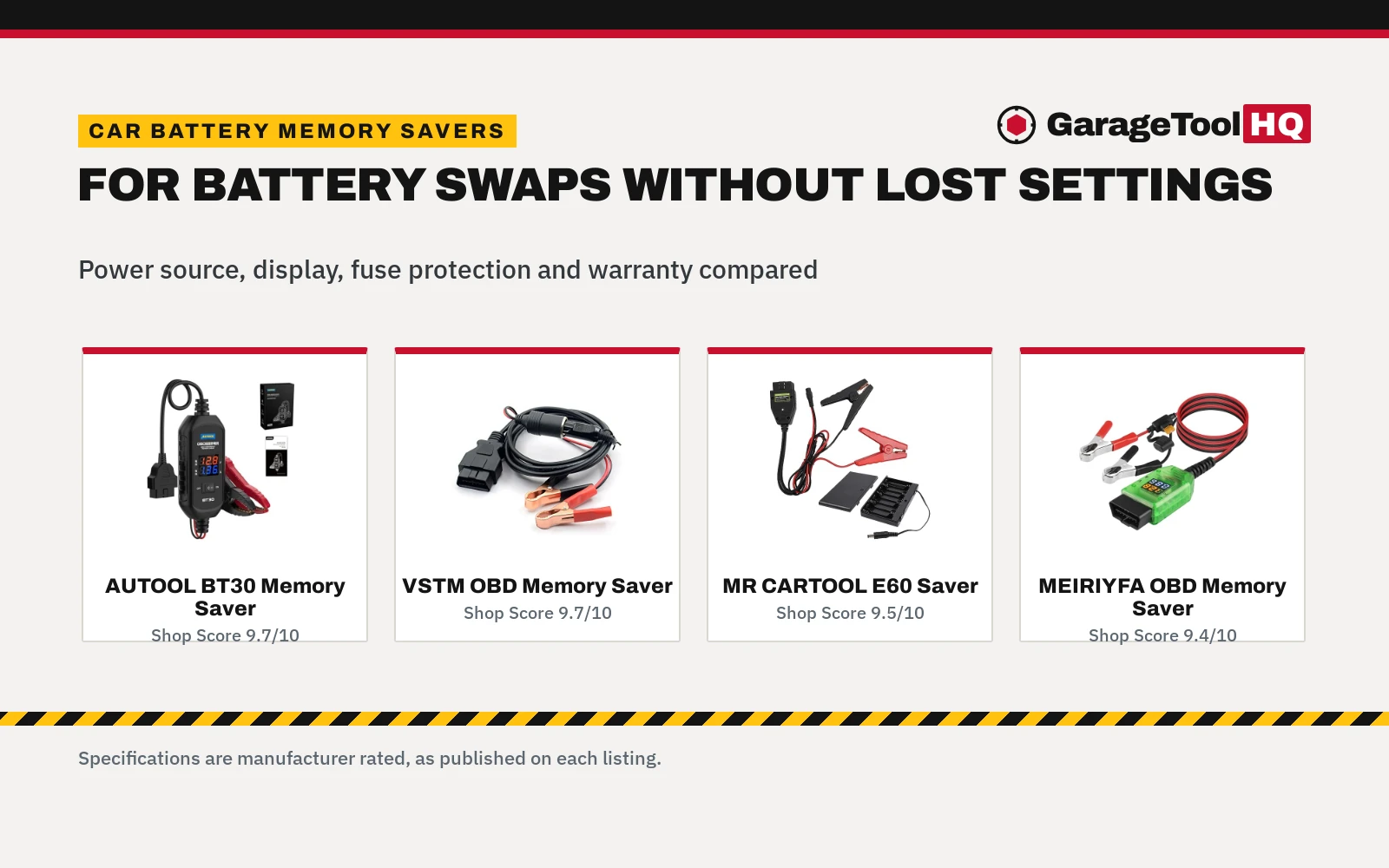
Car battery memory savers that hold vehicle settings through a battery swap, compared by power source, display, fuse protection and warranty.

On this page
Top picks at a glance
As an Amazon Associate I earn from qualifying purchases.
- 1
 Best OverallAUTOOL BT30 Memory Saver9.7/10View on Amazon
- 2
 Best Protected CableVSTM OBD Memory Saver9.7/10View on Amazon
- 3
 Best Dual PowerMR CARTOOL E60 Saver9.5/10View on Amazon
- 4
 Best Display ValueMEIRIYFA OBD Memory Saver9.4/10View on Amazon
- 5
 Best Simple SaverYUANTUO 9V Memory Saver9.3/10View on Amazon
- 6
 Clore Automotive SOLAR ESA30 OBD II Memory Saver ConnectorView on Amazon
- 7
 Memory Saver for Car Battery On-Board ComputersView on Amazon
Swap a car battery and the radio loses its presets, the clock resets, and a stereo may ask for a security code that nobody remembers. Late-model vehicles rely on onboard computers for stereo and transmission settings, and cutting power can reset those settings to factory defaults. A memory saver keeps a small backup supply connected through the diagnostic port while the main battery comes out, so those settings survive the swap. That is the job the best car battery memory saver is made for, holding vehicle memory through a battery change.
GarageToolHQ earns a commission when you buy through links on this page, at no extra cost to you. Read our affiliate disclosure.
Quick picks
- Best Overall AUTOOL BT30 Memory Saver: Display, leakage detection and a multi-year warranty. Check price on Amazon
- Best Protected Cable VSTM OBD Memory Saver: Long copper cable with reverse and fuse protection. Check price on Amazon
- Best Dual Power MR CARTOOL E60 Saver: Battery clip or battery box, no lighter needed. Check price on Amazon
- Best Display Value MEIRIYFA OBD Memory Saver: Display saver with strong clips for a swap. Check price on Amazon
- Best Simple Saver YUANTUO 9V Memory Saver: Simple saver for standard diagnostic ports. Check price on Amazon
Picks for the garage
AUTOOL OBD II Car Memory Saver Cable 12V Vehicle
An OBD memory saver with a digital display for voltage and current, leakage detection use, fuse and reverse connection protection, and a stated multi-year warranty.
Pros
- Displays voltage and current during a battery swap
- Leakage detection by watching current as fuses are removed
- Built-in fuse and reverse connection protection
- Stated 3 year manufacturer warranty
Cons
- No cable length is stated in the listing
- Display use needs the main battery disconnected for a load
- Leakage detection needs a circuit diagram comparison
- No cigarette lighter input is described in the listing
VSTM OBD II ECU Memory Saver Cable,12V Emergency
An OBD memory saver with a long copper cable, gold-plated pins, reverse polarity protection and a fast-blow fuse, for most gasoline vehicles with a standard diagnostic port.
Pros
- Long cable with gold-plated pins for stable contact
- Reverse polarity protection to avoid computer damage
- Fast-blow fuse that cuts off on overload or overvoltage
- Works with jump starters, lead-acid batteries and outlets
Cons
- Not for higher voltage, hybrid, electric or older pre-1996 vehicles
- Cigarette lighter input may not suit every vehicle outlet
- No display for voltage or current is described
- Warranty term is shorter than the top pick here
MRCARTOOL E60 OBDII Vehicle Emergency Power Supply
An OBD emergency power cable with dual power methods, a clip to a battery or a battery box, that preserves radio and clock presets during a car battery replacement.
Pros
- Two power methods: battery clip or battery box
- No cigarette lighter connection needed on the vehicle
- Preserves radio and clock presets during replacement
- Stated 24-months warranty term
Cons
- Battery box batteries are not included
- No fuse or reverse protection is stated in the listing
- Emergency supply only, not for long-term computer power
- No display for voltage or current is described
MEIRIYFA OBD2 Car Battery Change Saver Memory
An OBD memory saver with a digital display for voltage and current, a fuse, and strong alligator clips, for supplying power to the vehicle computer during a battery change.
Pros
- Displays voltage and current during a battery change
- Green light shows a successful connection
- Strong alligator clips with nickel-plated treatment
- Works with any 12V DC power source described
Cons
- Listing states no warranty
- No reverse polarity protection is stated in the listing
- Display readings depend on backup battery voltage
- No cable length is stated in the listing
9V Battery Powered Memory Saver for Car Battery
A simple 9V battery powered memory saver for all 16-pin diagnostic interfaces, maintaining power to vehicle electronic systems and memory during a battery disconnect.
Pros
- Fits all 16-pin diagnostic interfaces, per the listing
- Maintains power to electronic systems during replacement
- Simple connection: battery plus diagnostic connector
- Lightweight at 0.11 pounds, per the listing
Cons
- No warranty term is stated in the listing
- No safety listing is stated in the listing
- 9V battery is not included in the package
- No display, fuse or reverse protection is stated
Other tools worth a look
 Clore Automotive SOLAR ESA30 OBD II Memory Saver ConnectorCheck price on Amazon
 Memory Saver for Car Battery On-Board ComputersCheck price on Amazon
Compared on paper
| Model | Shop Score | Power Source | Fuse | Display | Warranty |
|---|---|---|---|---|---|
| AUTOOL BT30 Memory Saver | 9.7/10 | Any 12V DC source | 3A Fuse | Voltage and Current | 3 year manufacturer |
| VSTM OBD Memory Saver | 9.7/10 | 12V sources | 8A Fuse | Not stated | 1 Year |
| MR CARTOOL E60 Saver | 9.5/10 | Battery or battery box | Not stated | Not stated | 24-months |
| MEIRIYFA OBD Memory Saver | 9.4/10 | Any 12V DC source | 5A Fuse | Voltage and Current | No warranty |
| YUANTUO 9V Memory Saver | 9.3/10 | 9V battery | Not stated | Not stated | No term stated |
Specifications are manufacturer rated, as published on each listing and collected 30 October 2026.
How the points were given
Each memory saver is scored on performance, build, value, safety and warranty, with the weights published on our How We Pick page. Performance covers power source options and memory protection described. Build covers cable, clips and display design. Value covers versatility across vehicles and power sources. Safety covers reverse polarity protection and fuse protection stated. Warranty covers a stated term only.
| Product | Shop Score | Perf. /35 | Build /25 | Value /25 | Safety /10 | Warranty /5 |
|---|---|---|---|---|---|---|
| AUTOOL BT30 Memory Saver | 9.7 | 29 | 21 | 20 | 8 | 4 |
| VSTM OBD Memory Saver | 9.7 | 30 | 21 | 20 | 8 | 3 |
| MR CARTOOL E60 Saver | 9.5 | 28 | 20 | 20 | 0 | 3 |
| MEIRIYFA OBD Memory Saver | 9.4 | 27 | 20 | 19 | 0 | 0 |
| YUANTUO 9V Memory Saver | 9.3 | 26 | 19 | 19 | 0 | 0 |
Scores run from 9.2 to 9.8: each product’s point total is placed on that range, so more points always means a higher score.
What the listings tell you
The listings in this guide cover OBD-connected memory savers powered by a backup battery, a jump starter, another vehicle outlet, a battery box, or a small battery, depending on the pick. Two listings add a digital display for voltage and current, plus a leakage detection use that follows current changes as fuses are removed one by one. Fuse protection and reverse polarity protection appear on some listings and not others, so safety features cannot be assumed across every pick. Warranty terms also vary, from a stated multi-year term to an explicit statement of no warranty.
Buying guide: best car battery memory saver
How a memory saver works
A memory saver connects a backup power source to the vehicle through the diagnostic port, then the main battery is disconnected and replaced while the backup supply holds vehicle memory. The VSTM listing describes connecting the saver to a backup source first, then plugging the connector into the vehicle port, replacing the battery, and removing the adapter last. The AUTOOL listing notes that the vehicle main battery must be disconnected for a load to be present, since power will not be drawn from the backup circuit while the main battery remains connected and charged.
Power source options
Power source flexibility decides whether a saver fits the garage on hand. The AUTOOL and MEIRIYFA listings describe working with any 12V DC power source, including a running starter, a lead-acid battery, or another automotive power outlet. The VSTM listing describes compatibility with jump starters, lead-acid batteries and another vehicle power outlet, plus a cigarette lighter input. The MR CARTOOL listing describes two methods: a clip to a battery, or a battery box that requires batteries not included. The YUANTUO listing uses a small battery that is not included in the package.
Display and leakage detection
A display adds a check that power is actually flowing. The AUTOOL listing displays voltage and current, with red for voltage and blue for current, and describes leakage detection by watching current as fuses are removed one by one, where a sudden drop points to the circuit on that fuse. The MEIRIYFA listing displays voltage and current as well, with a green light for a successful connection and a screen showing voltage and current. Other listings here describe no display, so connection must be confirmed by the device design rather than a screen.
Fuse and reverse polarity protection
Protection features differ sharply. The VSTM listing describes reverse polarity protection plus a fast-blow fuse that blows when input current exceeds a stated figure or voltage goes over a stated figure, cutting off the circuit to protect the wire and vehicle computer. The AUTOOL listing describes a built-in fuse for overload protection, plus reverse connection protection where the display does not light after a reverse connection. The MEIRIYFA listing describes a fuse as well. Other listings here state no fuse or reverse protection, so check the listing for the pick chosen.
Compatibility limits
Compatibility is not universal, even where a listing says it fits many vehicles. The VSTM listing states it fits most gasoline vehicles with a standard port, and not vehicles with a higher voltage system, high-voltage hybrid or electric vehicles, or older pre-1996 vehicles without the standard port. The MR CARTOOL listing describes compatibility with a wide range of vehicles equipped with a diagnostic port, while noting the device is only an emergency power supply for battery replacement and cannot power car computers for a long time. Check port type and voltage before buying.
Use rated jack stands on solid ground, wear eye protection with power and air tools, keep fuel-burning equipment out of a closed garage, and follow the manual for every tool. Read our Safety Disclaimer.
Garage Fit Check
- Check the diagnostic port on the vehicle: most picks here use a standard 16-pin port, and older vehicles without it are excluded on some listings.
- Check the backup power source on hand: a jump starter, a spare battery, another vehicle outlet, or a battery box each suit different picks.
- Check fuse and reverse protection before connecting: not every listing states a fuse or reverse polarity protection.
- Check the work plan: replace and install the new battery as soon as possible, since these devices are emergency supplies for a swap, not long-term power.
FAQ: garage tools
How to use a battery memory saver?
Connect the memory saver to a backup power source first, then plug its connector into the vehicle diagnostic port, then disconnect and replace the main battery, and remove the adapter last. During replacement, ensure the vehicle is powered off with no electrical work underway, as described on the AUTOOL listing, to avoid a sudden excessive current.
Do I need a memory saver to change a battery?
A memory saver suits a late-model vehicle that relies on onboard computers for stereo and transmission settings, since cutting power can reset saved settings to factory defaults or trigger a stereo security code lock, as described on the VSTM listing. An older vehicle with simple battery replacement may not need one, so need depends on the vehicle and its electronics.
How does a car battery memory saver work?
It supplies a small backup current through the diagnostic port while the main battery is disconnected, so vehicle computers keep their fault codes and customized data intact during the swap. Once the new battery is installed, the saver is removed last, and the vehicle runs on the new battery alone.
What power source does a memory saver use?
Power sources vary by pick: a jump starter, a lead-acid battery, another vehicle outlet, a battery box with batteries not included, or a small battery not included in the package. Check the listing for the pick chosen, since a saver that needs a battery box will not work without the batteries it requires.
Does Honda need a battery memory saver?
No listing in this guide states a Honda-specific requirement, so this guide cannot say that a particular Honda model needs one. The listings here describe standard diagnostic port compatibility in general terms, so check the vehicle port type and the listing compatibility notes before buying for any specific vehicle.
Related: the jump starter for mobile mechanic, the battery charger for lead acid batteries, the OBD2 scanner for Honda Odyssey, and our diagnostics and electrical hub.