Blind Rivet vs Closed End Rivet: Which One Should You Buy?
Blind rivet vs closed end rivet: which type suits the joint, what the listings state about size, material and grip, and when a sealed end matters.

On this page
Top picks at a glance
As an Amazon Associate I earn from qualifying purchases.
- 1
 Wensilon9.7/10View on Amazon
- 2
 uxcell 100Pcs 3/16"x3/8" Aluminum Closed End Dome-Head Blind9.5/10View on Amazon
- 3
 Tri-Fold Pop Rivets 3/16" x 1-1/4"9.6/10View on Amazon
- 4
 Fastenere Pop RivetsView on Amazon
- 5
 Fastenere Large Flange Pop RivetsView on Amazon
- 6
 QWORK Closed End Aluminum Blind RivetsView on Amazon
- 7
 Metal Magery 100 Aluminum Closed End Pop Rivets 3/16" x 3/8"View on Amazon
- 8Metal Magery 100 Aluminum Closed End Pop Rivets 1/8" x 1/4"View on Amazon
- 9Metal Magery 100 Aluminum Closed End Pop Rivets 3/16" x 1/4"View on Amazon
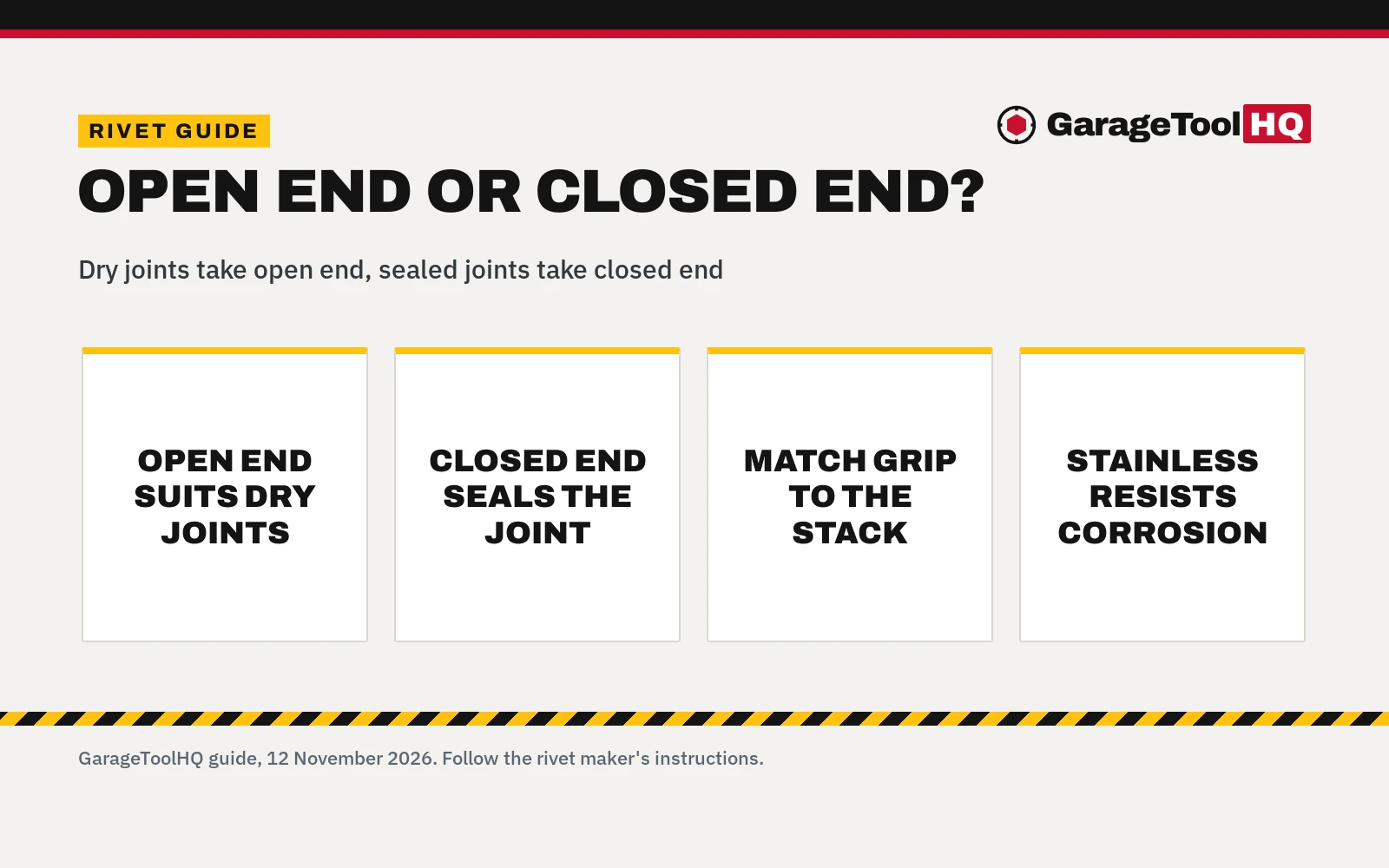
A sheet metal patch on a trailer, a bracket on a toolbox, or a panel on a boat leaves the same choice: blind rivet vs closed end rivet. A standard blind rivet suits a dry joint where the back of the work stays hidden, and a closed end rivet suits a joint that must keep moisture, air, or dust out. Both set from one side with a rivet gun, and both leave the head on the front. The difference sits at the blind end: open on a standard rivet, sealed shut on a closed end rivet.
Other tools worth a look
 Fastenere Pop RivetsCheck price on Amazon
 Fastenere Large Flange Pop RivetsCheck price on Amazon
 QWORK Closed End Aluminum Blind RivetsCheck price on Amazon
 Metal Magery 100 Aluminum Closed End Pop Rivets 3/16" x 3/8"Check price on Amazon
- Metal Magery 100 Aluminum Closed End Pop Rivets 1/8" x 1/4"Check price on Amazon
- Metal Magery 100 Aluminum Closed End Pop Rivets 3/16" x 1/4"Check price on Amazon
GarageToolHQ earns a commission when you buy through links on our product pages, at no extra cost to you. Read our affiliate disclosure.
Below: how both types differ, when each one earns its place, what the listings in this guide state about size, material and grip, and the questions buyers ask before they order.
Blind rivet vs closed end rivet: what each one does
A blind rivet, also called a pop rivet, joins sheets from one side. The rivet gun pulls the mandrel, the blind end upsets, and the mandrel snaps off, leaving the head on the front and an open hole at the blind end. A closed end rivet sets the same way, but the blind end is sealed shut, so nothing passes through the rivet body. The listings in this guide cover both types: open end rivets in aluminum and stainless steel, and one closed end aluminum rivet.
| Rivet | Type | Size and material | Grip and use |
|---|---|---|---|
| Wensilon Black Aluminum | Open end | 3/16 x 1/2 inch, black aluminum, 150 pcs | Large cap head |
| Wensilon Aluminum | Open end | 3/16 x 1/2 inch, aluminum, 150 pcs | Large cap head |
| Fastenere Stainless Steel | Open end | 1/8 x 1/8 inch, grade 305 stainless steel, 100 pcs | Gap 0.063-0.125 inch, dome head |
| ALLCLEAN Closed End | Closed end | 3/16 x 1/2 inch, aluminum with steel mandrel, 120 pcs | Grip 0.376-0.5 inch, seals out moisture |
Open end blind rivets: when they win
An open end blind rivet is the default choice for a dry joint. The Wensilon listings in this guide are both 3/16 x 1/2 inch large cap rivets in packs of 150, one in black aluminum and one in plain aluminum. Both are open end blind rivets with a large cap head. The black set lists black aluminum as its material, and the plain set lists aluminum. Neither listing states a grip range, a mandrel material, or a warranty term, so the listings leave those details unstated.
The Fastenere listing is the stainless steel example: 1/8 x 1/8 inch open end dome head rivets in a pack of 100, made from grade 305 stainless steel with a stainless steel mandrel. The maker states the dome head style gives a low-profile finish, with a head twice as wide as the rivet body diameter, and the listing states a gap of 0.063-0.125 inch. Stainless steel suits joints where corrosion resistance matters, and the maker states these rivets offer greater tensile and shear values than aluminum rivets with aluminum mandrels. That is the maker’s comparison, and it describes this listing only.
Closed end rivets: when they win
A closed end rivet earns its place where the joint must stay sealed. The ALLCLEAN listing is a 3/16 x 1/2 inch closed end aluminum blind rivet with a steel mandrel, in a pack of 120, with a stated grip of 0.376-0.5 inch and a dome head. The maker states these rivets are designed for watertight applications, sealing out moisture, air, and other contaminants, and offer higher tensile and shear strength than equivalent open end rivets. The listing names boats, aircraft, machinery, electrical equipment and furniture among the uses. The size is also stated in metric: 4.8 x 12 mm.
How to pick between them
Match the rivet to the joint, not to the habit. An open end rivet suits a dry, hidden joint: a bracket, a patch, or a panel where nothing passes through. A closed end rivet suits a joint that faces rain, wash water, dust, or air leaks: a boat, a trailer, or an enclosure. Size matters as much as type: the listings here are 3/16 x 1/2 inch except for the Fastenere set at 1/8 x 1/8 inch, and the ALLCLEAN closed end rivet states a grip of 0.376-0.5 inch. Check the grip range the listing states before ordering, since a rivet that cannot grip the stack will not hold.
Wear eye protection with every air tool, use impact-rated sockets on impact wrenches, disconnect the air line before changing accessories, and finish lug nuts with a torque wrench to the vehicle's spec. See OSHA eye and face protection. Read our Safety Disclaimer.
Which one should you buy?
For a dry joint, an open end blind rivet does the job, in aluminum or in stainless steel where corrosion resistance matters. For a joint that must stay sealed, the closed end rivet is the pick, and the ALLCLEAN listing states the grip range plainly at 0.376-0.5 inch. Either way, match the diameter and grip to the stack, and use a rivet gun that fits the rivet size.
FAQ: garage tools
What is the difference between a blind rivet and a closed end rivet?
A blind rivet sets from one side and leaves the blind end open. A closed end rivet sets the same way, but the blind end is sealed shut, so moisture, air, and dust cannot pass through the rivet body. The ALLCLEAN listing states its closed end rivets seal out moisture, air, and other contaminants.
Are closed end rivets stronger than open end rivets?
The ALLCLEAN listing states its closed end rivets offer higher tensile and shear strength than equivalent open end rivets. That is the maker’s comparison for its own listing. The Fastenere listing states its stainless steel open end rivets offer greater tensile and shear values than aluminum rivets with aluminum mandrels. Strength depends on the material and the listing, not on the end type alone.
What size blind rivet do I need?
Match the diameter and grip to the stack. The listings in this guide are 3/16 x 1/2 inch, except for the Fastenere set at 1/8 x 1/8 inch with a stated gap of 0.063-0.125 inch. The ALLCLEAN closed end rivet states a grip of 0.376-0.5 inch. Check the grip range the listing states before ordering.
Can you use blind rivets on a boat?
The ALLCLEAN listing names boats among the uses for its closed end rivets, which seal out moisture, air, and other contaminants. An open end rivet leaves the blind end open, so it does not seal the joint. For a boat, pick a closed end rivet and check the grip range.
Do blind rivets need access to both sides?
No. A blind rivet sets from one side: the gun pulls the mandrel, the blind end upsets, and the mandrel snaps off. That is why blind rivets suit panels, brackets, and enclosures where the back of the work stays hidden.
Related: blind rivet vs rivet nut, the best blind rivets for soft materials, the best pneumatic rivet gun and the air tools hub.