Breaker Bar vs Torque Multiplier: Which One Should You Buy?
When a breaker bar handles a stuck fastener and when a geared torque multiplier is the right step up, with four breaker bar listings ranked for the gear shelf.

On this page
Top picks at a glance
As an Amazon Associate we earn from qualifying purchases.
- 1
 toolant 13-Piece 1/2" Torque Wrench Set9.8/10View on Amazon
- 2
 LEXIVON Torque Wrench 1/2-Inch Drive Click 10~1509.7/10View on Amazon
- 3
 WORKPRO 16-inch Dual Drive Breaker Bar9.7/10View on Amazon
- 4
 Neiko 00200A 1/2" Drive Extension Breaker BarView on Amazon
- 5
 MAXPOWER 18-inch Breaker Bar Dual drive 1/2" and 3/8" FlexView on Amazon
- 6
 EPAuto 1/2-Inch Drive by 24" Length Breaker BarView on Amazon
- 7
 TEKTON 3/8View on Amazon
- 8
 DURATECH 1/2" Drive 17.5-Inch Heavy Duty Breaker Bar withView on Amazon
- 9
 WORKPRO 16-inch Dual Drive Breaker BarView on Amazon
A lug nut that will not budge with a ratchet is where the breaker bar vs torque multiplier question starts. Start with a breaker bar: it is the right tool for most stuck fasteners in a home garage. A torque multiplier is the step up for heavy-duty fasteners where a long bar and full arm strength still fall short, like truck lug nuts and large axle hardware. A breaker bar is a long, non-ratcheting handle that turns your pull into torque at the fastener through leverage. A torque multiplier is a geared tool that multiplies a modest input into higher torque at the socket. Use the bar first; bring in the gears when the job outgrows it.
More options to compare
 Neiko 00200A 1/2" Drive Extension Breaker BarCheck price on Amazon
 MAXPOWER 18-inch Breaker Bar Dual drive 1/2" and 3/8" FlexCheck price on Amazon
 EPAuto 1/2-Inch Drive by 24" Length Breaker BarCheck price on Amazon
 TEKTON 3/8Check price on Amazon
 DURATECH 1/2" Drive 17.5-Inch Heavy Duty Breaker Bar withCheck price on Amazon
 WORKPRO 16-inch Dual Drive Breaker BarCheck price on Amazon
GarageToolHQ earns a commission when you buy through links on our product pages, at no extra cost to you. Read our affiliate disclosure.
Below: how each tool works, a side-by-side comparison, four breaker bar listings for the gear shelf, and safe-use notes.
Breaker bar vs torque multiplier: how they differ
| Breaker bar | Torque multiplier | |
|---|---|---|
| What it is | A long, non-ratcheting handle with a socket drive head | A geared tool that multiplies input torque at the socket |
| How it makes force | Leverage: a longer handle turns the same pull into more torque at the fastener | Gearing: internal gears trade input turns for higher output torque |
| Best for | Rusted or overtightened lug nuts, suspension and brake hardware in a home garage | Heavy-duty fasteners where a long bar falls short, such as truck lug nuts and large axle hardware |
| What to watch | Needs room to swing the handle; the MAXPOWER listing warns never to add a cheater pipe | Bulkier and slower to use; read the maker’s instructions before the first use |
The listings behind this guide are all breaker bars, the tool most home garages reach for first. They describe 15 to 24 inch handles, 180-degree to 360-degree flex or pivoting heads, and chrome vanadium or AISI 4140 steel, built to break rusted and stuck fasteners loose.
When a breaker bar is enough
For most stuck fasteners, a breaker bar is enough. The four listings here describe bars from 15 to 24 inches long in 1/2 inch drive, with the MAXPOWER adding a 3/8 inch drive and the TEKTON sold as a 2-piece 3/8 and 1/2 inch set. Their makers describe them the same way: long handles for leverage, flex or pivoting heads that work at an angle in tight spaces, and hardened chrome vanadium or alloy steel. The TEKTON listing adds that its external head design better resists spreading, twisting, or fracturing than an internal head design. The stated jobs are rusted, stuck or overtightened nuts and bolts, including lug nuts. Three of the four describe a spring-loaded ball bearing that holds the socket on the drive, and radius corners on the NEIKO drive reduce socket wear by gripping the sides of the fastener rather than the edges.
The MAXPOWER listing is the only one of the four that states torque figures: 202 N.m (149 lb.ft) on the 3/8 inch drive and 512 N.m (378 lb.ft) on the 1/2 inch drive. The others state length and build and leave the force to the handle. If the fastener moves with steady pressure on a long bar, the job is done; if the bar is loaded hard and nothing moves, that is the sign to stop and reconsider rather than to add a pipe.
When a torque multiplier earns its place
A torque multiplier earns its place when the fastener’s resistance is clearly beyond what a breaker bar and a full pull can handle. Think heavy truck lug nuts, large axle nuts and big equipment bolts, where shops keep a multiplier on hand for the same reason they keep a long bar: controlled force without impact. No listing in this guide is a torque multiplier, so compare multipliers on the maker’s stated ratio and output, and read the instructions before the first use, since the gearing and the reaction arm need the setup the maker describes.
Breaker bar gear: four listings, ranked
The four listings below are all breaker bars, ordered from the strongest stated package to the simplest. The MAXPOWER MXP33 leads: an 18 inch bar with dual 1/2 and 3/8 inch drives, a 360-degree rotating chrome-molybdenum head, forged chrome vanadium steel and an ergonomic handle, with the only stated torque figures of the four, 202 N.m (149 lb.ft) on 3/8 inch and 512 N.m (378 lb.ft) on 1/2 inch. It also carries the clearest safety note: never use a cheater pipe or extension bar, and always pull the bar toward your body rather than pushing.
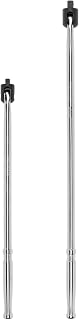
Next, the TEKTON SBH99200 2-piece set covers 3/8 and 1/2 inch drives with a 230-degree pivoting head, an internal spring that holds the head position, and an AISI 4140 steel head the maker describes as heat-treated to be stronger and more ductile than the handle; the spec table lists 18 inches and 5.2 pounds. The EPAuto ST-18A-1 is the longest of the four at 24 inches, a 1/2 inch drive bar in hardened chrome vanadium steel with a chrome plated, mirror polished finish and a 180-degree heat treated chrome moly flex head; the maker says it breaks free rusted, stuck lug nuts with ease. The NEIKO 00200A measures 15 inches, the least length of the four, a 1/2 inch drive bar in drop forged, heat-treated chrome vanadium with a 180-degree flexible head and a mirror/chrome polish finish, with a spring-load ball bearing and square drive radius corners that lock onto the sides of the fastener.
Safe use, from the listings
The MAXPOWER listing states the safety rules plainly: never use a cheater pipe or extension bar on a breaker bar, and always pull the bar toward your body rather than pushing, for safer and more controlled force. Match the drive to the socket, 1/2 inch or 3/8 inch, and let the spring-loaded ball bearing seat the socket fully before you pull. Give the handle room to swing, keep your footing set, and stop if the fastener does not move: a bar that will not move it is telling you to change tools, not to add leverage.
Use rated jack stands on solid ground, wear eye protection with power and air tools, keep fuel-burning equipment out of a closed garage, and follow the manual for every tool. Read our Safety Disclaimer.
Frequently Asked Questions
Can I use a cheater pipe on a breaker bar?
No. The MAXPOWER listing warns never to use a cheater pipe or extension bar, and to pull the bar toward your body rather than pushing. A longer bar or a different tool is the safe answer.
What is the difference between a breaker bar and a ratchet?
A breaker bar is a long, non-ratcheting handle built for breaking fasteners loose; a ratchet has a ratcheting mechanism for turning fasteners in tight swings. The listings here describe breaker bars as leverage tools for rusted, stuck or overtightened nuts and bolts.
Do I need a torque multiplier for lug nuts?
Start with a breaker bar: the EPAuto and MAXPOWER listings describe breaking rusted, stuck lug nuts loose, and the MAXPOWER states 512 N.m (378 lb.ft) on its 1/2 inch drive. A torque multiplier is the step up when a long bar and a full pull still fall short, such as on heavy truck hardware.
What drive size breaker bar should I get?
The listings here are 1/2 inch drive, the common size for lug nuts and suspension work; the MAXPOWER adds a 3/8 inch drive and the TEKTON comes as a 2-piece 3/8 and 1/2 inch set. Match the drive to the sockets you already own.
Can a breaker bar tighten a fastener?
It can turn one, but that is not its job: breaker bars are made for loosening, and the listings describe breaking rusted and stuck fasteners free. For tightening to a spec, use a torque wrench.
Related: the breaker bar vs ratchet, the impact wrench vs breaker bar, the best breaker bar for lug nuts, the best breaker bar for home mechanics and the best 1/2 inch torque wrench.