Carb Cleaner vs Throttle Body Cleaner: Which One Should You Buy?
Four carb and throttle body cleaners compared side by side, with the listings' stated sizes, sensor-safety claims and shop scores, and a verdict on which side fits your engine.

On this page
Top picks at a glance
As an Amazon Associate we earn from qualifying purchases.
- 1
 Gumout 540269 Carb & Choke Jet Spray Carburetor Cleaner9.6/10View on Amazon
- 2
 CRC Throttle Body and Air Intake Cleaner for Gasoline Engines9.4/10View on Amazon
- 3
 CRC 05078 Throttle Body and Air-Intake Cleaner9.4/10View on Amazon
- 4
 Valvoline CarbView on Amazon
- 5
 CRCView on Amazon
- 6
 Genuine Toyota Fluid 00289-1TP00 Throttle Plate CleanerView on Amazon
- 7
 LIQUI Moly Pro-Line Throttle Valve CleanerView on Amazon
Verdict: In this carb cleaner vs throttle body cleaner comparison, pick a carb cleaner if your engine has a carburetor: the two carb-side listings aim at carburetors, chokes, linkages and PCV systems on cars, trucks, tractors, outboards, ATVs, motorcycles, chainsaws and pressure washers. Pick a throttle body cleaner if your engine is fuel injected: the two throttle-body listings are made for the throttle body and air intake on fuel-injected gasoline engines.
Saturday morning, and the old mower at the side of the garage coughs on choke, idles rough and quits when you open the throttle. You grab the spray can from the shelf, then hesitate: the shelf holds two different cans, and you are not sure they do the same job. They do not. This is carb cleaner vs throttle body cleaner, and the two are built for different air and fuel hardware.
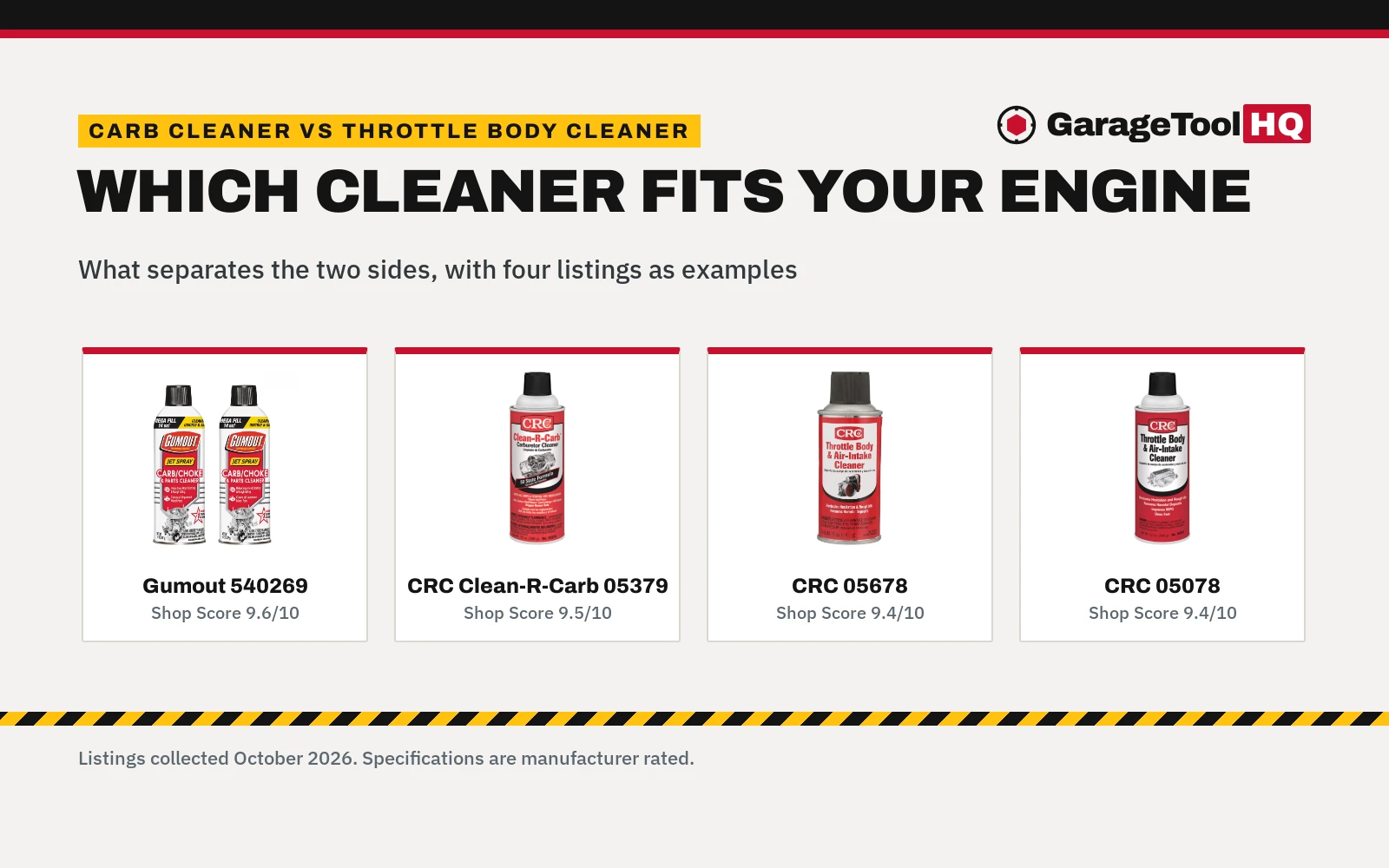
Below, the two sides are compared on what each one is made for, can size, stated sensor safety and VOC compliance, with four listings as concrete examples.
GarageToolHQ earns a commission when you buy through links on this page, at no extra cost to you. Read our affiliate disclosure.


Gumout 540269 Carb & Choke Jet Spray Carburetor
A two-can pack (14 oz each, 28 fluid ounces total) of carb and choke jet spray, 50 state VOC compliant and stated safe on O2 sensors and catalytic converters when used as directed.
Pros
- 28 fluid ounces in total across two 14 oz cans
- Stated safe on O2 sensors and catalytic converters when used as directed
- 50 state VOC compliant per the listing
- Names many uses: trucks, tractors, outboards, ATVs, motorcycles, chainsaws and pressure washers
Cons
- Weight fields disagree slightly: 1.8 pounds in one field, 1.75 pounds in the package dimensions
- No warranty term is stated
- Aimed at carbureted hardware, so it is the wrong can for a fuel-injected throttle body
- Aerosol jet spray only; no non-aerosol option is listed

CRC Clean-R-Carb Carburetor Cleaner
A 12 wt oz carburetor cleaner with a 50-state formula, stated harmless to catalytic converters and oxygen sensors.
Pros
- Stated harmless to catalytic converters and oxygen sensors
- 50-state formula that meets all state and federal VOC regulations
- Aims at the venturi, linkages, butterflies and PCV systems
- Spec table lists biobased material features
Cons
- Single 12 oz can, against the Gumout pack's 28 fluid ounces
- Warranty field says 'limited warranty' with no concrete term, so we scored warranty at zero
- Written for carbureted hardware, not for a fuel-injected throttle body
- Almond scent is stated, where two listings here are unscented

CRC Throttle Body and Air Intake Cleaner
A 5 wt oz fast-drying, low-VOC throttle body and air intake cleaner with a 50 state formula.
Pros
- Fast-drying, low-VOC formula per the title
- 50 state formula
- Aims at gum and varnish on the throttle valves and body of fuel-injected gasoline engines
- Smallest can in this comparison at 5 oz
Cons
- Smallest volume here: 5 oz against 12 oz and 28 fluid ounce listings
- Weight fields say 0.27 g and 0.01 ounces against 5 oz in the title and bullets
- No sensor-safety or catalytic converter claim is stated
- Warranty field says 'limited warranty' with no concrete term, so we scored warranty at zero

CRC 05078 Throttle Body and Air-Intake Cleaner
A 12 wt oz throttle body and air-intake cleaner in an aerosol can, for fuel-injected gasoline engines.
Pros
- 12 wt oz aerosol can
- Made for all fuel injected gasoline engines, throttle body and multi-port
- Residue free per the spec table
- Aims at carbon, varnish and gum build-up on the throttle body
Cons
- No sensor-safety or catalytic converter claim is stated
- Bullets say aerosol can while the included-components line says bottle
- Warranty field says 'limited warranty' with no concrete term, so we scored warranty at zero
- Single 12 oz can; no larger pack is listed
More options to compare
 Valvoline CarbCheck price on Amazon
 CRCCheck price on Amazon
 Genuine Toyota Fluid 00289-1TP00 Throttle Plate CleanerCheck price on Amazon
 LIQUI Moly Pro-Line Throttle Valve CleanerCheck price on Amazon
Side by side
| Carb cleaner | Throttle body cleaner | What the listings state | |
|---|---|---|---|
| What each one cleans | Carburetors, choke valves and throttle linkages | Throttle body and air intake on fuel-injected gasoline engines | Gumout purpose and targets; CRC 05078 and 05678 bullets |
| Example can sizes | 28 fluid ounces (2 x 14 oz cans); 12 oz | 12 wt oz; 5 oz | All four listings |
| Sensor safety stated | O2 sensor and catalytic converter safe when used as directed; harmless to catalytic converters and oxygen sensors | Not stated | Both carb-side listings |
| VOC compliance stated | 50 state VOC compliant; 50-state formula | 50 state formula | Gumout, Clean-R-Carb and CRC 05678 |
| Warranty term stated | Not stated | Not stated | None of the four listings |
Example figures are as published on each listing and collected 22 October 2026.
Carb cleaner vs throttle body cleaner: what each one does
Carb cleaners are made for engines with a carburetor. The Gumout 540269 lists carburetors, choke valves and throttle linkages as its targets, and its bullets name trucks, tractors, outboards, ATVs, motorcycles, chainsaws and pressure washers as uses. The CRC Clean-R-Carb aims at the venturi, linkages, butterflies and PCV systems. Both carb-side listings state a 50-state formula, and both state their formulas are safe around oxygen sensors and catalytic converters, with the Gumout adding when used as directed.
Throttle body cleaners are made for fuel-injected engines. The CRC 05078 is for the throttle body and air intake on all fuel injected gasoline engines, both throttle body and multi-port, in a 12 wt oz aerosol can. The CRC 05678 is a 5 wt oz fast-drying, low-VOC cleaner for the throttle valves and body on fuel-injected gasoline engines. Neither throttle-body listing states a sensor-safety claim, and neither states whether the formula is safe around a catalytic converter.
The split is the hardware. The Gumout spec table describes its target as mechanical air/fuel mixers: carburetors, choke valves and throttle linkages. The throttle-body listings describe theirs as the throttle body and air intake on fuel-injected gasoline engines. Both sides claim to help rough idle, and the throttle-body listings also claim to eliminate hesitation, so idle quality alone does not pick a side; the hardware you are cleaning does.
Size, claims and what the label leaves out
The four listings span a wide size range. The Gumout comes as a pack of two 14 oz cans, 28 fluid ounces in total. The CRC Clean-R-Carb and the CRC 05078 are each 12 oz. The CRC 05678 is 5 oz. A larger pack suits a shelf that serves several small engines; a single small can suits a throttle body job. That is a shelf and storage call, not a quality call: the listings state nothing that would make more ounces clean better.
Two listings state sensor safety and two do not. The Gumout states it is O2 sensor and catalytic converter safe when used as directed, and the Clean-R-Carb states it is harmless to catalytic converters and oxygen sensors. The two throttle-body listings state no sensor or converter claim. The listings also disagree on weight in places: the Gumout lists 1.8 pounds in one field and 1.75 pounds in the package dimensions, and the 5 oz CRC 05678 lists 0.27 g and 0.01 ounces in its weight fields against 5 oz in the title and bullets. Where the title and bullets disagree with the spec table, the title and bullets win.
Choose a carb cleaner if
- Your engine has a carburetor, choke and linkages to clean
- You keep small engines around: trucks, tractors, outboards, ATVs, motorcycles, chainsaws or pressure washers
- You want a stated sensor-safety claim on the can
- You want the biggest pack here: two 14 oz cans
Choose a throttle body cleaner if
- Your engine is fuel injected and you are cleaning the throttle body and air intake
- You want a fast-drying, low-VOC formula, as the 5 oz CRC states
- You want a can sized for a throttle body job
- 50-state compliance matters to you
Example cleaners
If the rough idle sent you down the diagnostic path, the best OBD2 scanner for DIY compares scan tools that read the codes behind it. For the grime around the bay while you are in there, see the best engine degreaser foam.
Use rated jack stands on solid ground, wear eye protection with power and air tools, keep fuel-burning equipment out of a closed garage, and follow the manual for every tool. Read our Safety Disclaimer.
Garage Fit Check
- Shelf space runs from a 5 oz can to a two-pack totaling 28 fluid ounces; pick the size your shelf and your job list need.
- Match the cleaner to the hardware: carburetors, chokes and linkages call for a carb cleaner; a throttle body and air intake on a fuel-injected engine calls for a throttle body cleaner.
- If sensor safety matters to your car, check the label: the Gumout and CRC Clean-R-Carb listings state it, the two throttle-body listings do not.
- Read the weight fields with care: two listings state different weights in different fields, and the 5 oz can is the one to trust by its title and bullets.
- Use these sprays in a ventilated area, follow the directions on the can, and never run an engine in a closed garage.
Frequently Asked Questions
Can I use carb cleaner on a throttle body?
The listings position them for different hardware. The carb-side listings target carburetors, chokes and linkages on mechanical air/fuel mixers; the throttle-body listings target the throttle body and air intake on fuel-injected gasoline engines. Match the can to the hardware you are cleaning.
Can I use throttle body cleaner on a carburetor?
The same logic applies in reverse. The CRC throttle-body listings are written for fuel-injected engines, and neither claims carburetor use. The two carb-side listings are the ones that name carburetors, choke valves and linkages.
Are these cleaners safe for oxygen sensors and catalytic converters?
Two of the four listings say so. The Gumout states it is O2 sensor and catalytic converter safe when used as directed, and the CRC Clean-R-Carb states it is harmless to catalytic converters and oxygen sensors. The two CRC throttle-body listings state no sensor or converter claim, so the listing leaves it unclear there.
What sizes do the four listings come in?
The Gumout is a pack of two 14 oz cans, 28 fluid ounces in total. The CRC Clean-R-Carb and the CRC 05078 are each 12 oz. The CRC 05678 is a 5 oz can.
Do any of the listings state a warranty?
None states a concrete warranty term. The three CRC listings say “limited warranty” with no years, months or days attached, so we scored warranty at zero for all four.
Related: the best OBD2 scanner for DIY, the best engine degreaser foam, the best fuel line disconnect tool and our engine and shop equipment hub.