Cast Iron vs Steel Bench Vise: Which One Should You Buy?
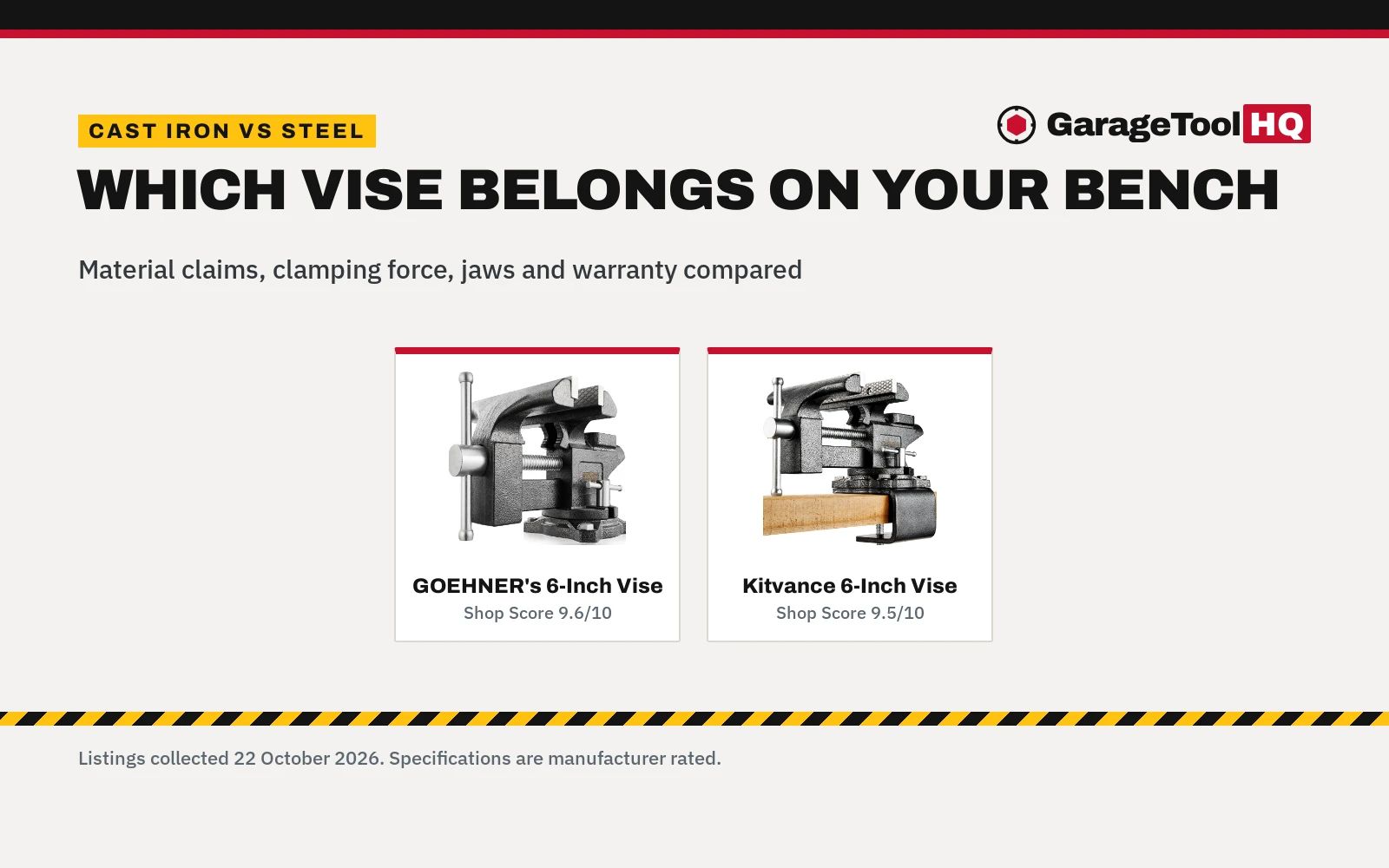
Cast iron vs steel bench vise compared through two 6-inch examples: what each listing claims about material, clamping force, jaws, swivel and warranty.

On this page
Top picks at a glance
As an Amazon Associate we earn from qualifying purchases.
- 1
 Yost Vises 455 Combination Vise9.6/10View on Amazon
- 2
 Yost Vises 750-DI Multi-Jaw Rotating Vise System9.7/10View on Amazon
- 3
 AV Steel 4-1/2" Bench Vise with 240° Flexible Swivel Locking9.4/10View on Amazon
- 4
 Wilton General Purpose Bench ViseView on Amazon
- 5
 Yost Vises 445 Combination ViseView on Amazon
- 6
 Wilton Multi-Purpose Bench ViseView on Amazon
- 7
 BESSEY BV-HD60 Heavy Duty Bench ViseView on Amazon
- 8
 findmall 9 Inch Heavy-Duty Woodworking Front ViseView on Amazon
- 9
 Bench Vise 4.5 Inch Jaw Width 3.3 Inch Jaw Opening Home ViseView on Amazon
Verdict: Pick the cast iron example (GOEHNER’s) if the stated 60,000 PSI clamping pressure and 3-year factory services matter more to you than a clean material claim. Pick the steel example (Kitvance) if you want forged steel stated plainly, with an anvil for hammering, and no stated warranty is acceptable.
Cast iron vs steel bench vise: the question came up when the vise stopped holding halfway through pressing a bearing, and the work slipped at the worst moment. A bench vise earns its bench by holding still under load, and the material question is really about which listing you can trust: the name matters less than whether the listing states it clearly. This comparison puts the two material claims side by side, using one listing that claims cast iron and one that claims forged steel, then scores both examples.
GarageToolHQ earns a commission when you buy through links on this page, at no extra cost to you. Read our affiliate disclosure.

[Upgraded] Bench Vise 6" Table Vice
A 6 in bench vise with a 4.3 in jaw opening, 2 in throat depth and 60,000 PSI clamping pressure stated, with 2-in-1 pipe and flat jaws and a swivel base.
Pros
- 60,000 PSI clamping pressure stated
- 2-in-1 pipe and flat jaws, replaceable and hardened
- Double lockdown feature for precise positioning
- 3-year factory services stated
Cons
- Title says Heavy Cast Steel but bullets and spec table say cast iron
- Title says 360-degree swivel, bullets say 270 degrees
- No anvil listed, unlike the Kitvance
- No safety listing stated

6-Inch Bench Vise, Vice for Workbench with Heavy
A 6 in forged steel bench vise with a 4-3/10 in jaw opening, 2 in throat depth, 2200 lbs of clamping force and a built-in anvil.
Pros
- Forged steel construction stated plainly
- 2200 lbs of clamping force stated
- Built-in anvil, 3.1 x 2.9 in
- Hardened, hammered multi-jaw for flat and pipe work
Cons
- No warranty term stated
- No safety listing stated
- 8.2 kg with no case or mounting bolts listed beyond 4 bolts
- Sprayed finish smoothness is a comfort claim, not a spec
More options to compare
 Wilton General Purpose Bench ViseCheck price on Amazon
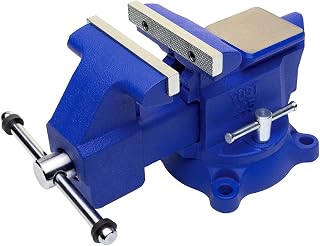 Yost Vises 445 Combination ViseCheck price on Amazon
 Wilton Multi-Purpose Bench ViseCheck price on Amazon
 BESSEY BV-HD60 Heavy Duty Bench ViseCheck price on Amazon
 findmall 9 Inch Heavy-Duty Woodworking Front ViseCheck price on Amazon
 Bench Vise 4.5 Inch Jaw Width 3.3 Inch Jaw Opening Home ViseCheck price on Amazon
Side by side
| Cast iron | Steel bench vise | Notes | |
|---|---|---|---|
| Example listing | GOEHNER’s 6-Inch Vise | Kitvance 6-Inch Vise | |
| Material as the listing states it | Cast iron (bullets, spec table); Heavy Cast Steel (title) | Forged steel | Listing contradicts itself |
| Example clamping force | 60,000 PSI (stated) | 2200 lbs (stated) | Different units |
| Jaw width | 6 in | 6 in | |
| Jaw opening | 4.3 in | 4-3/10 in | |
| Throat depth | 2 in | 2 in | |
| Swivel base | 270 degrees (bullets); 360 degrees (title) | 270 degrees | Listing contradicts itself |
| Anvil | Not stated | 3.1 x 2.9 in | |
| Weight | 13.67 lbs (bullets); 13.7 pounds (spec table) | 8.2 kg | |
| Warranty | 3-year factory services | Not stated |
Example figures are manufacturer rated, as published on each listing and collected 22 October 2026. Where a listing contradicts itself, both figures are shown.
Cast iron vs steel bench vise: what the listings actually claim
Start with the material line, because that is the whole question. The GOEHNER’s title promises Heavy Cast Steel, but its bullets describe a robust cast iron construction and its spec table lists Cast Iron with a 60000 psi tensile strength. That is a listing arguing with itself, and it is why the cast iron side of this comparison comes with an asterisk. The Kitvance listing has no such drama: forged steel construction, stated once and plainly. When a listing cannot agree with itself on the material, treat every other claim on the page with the same care.
Before buying any vise, scroll past the title to the spec table’s Material Type row. The GOEHNER’s title says Heavy Cast Steel, but the spec table lists Cast Iron with a 60000 psi tensile strength; the Kitvance title says Forged Steel and its spec table agrees, listing Alloy Steel with a 2200 pounds tensile strength. When the title and the spec table disagree, trust the spec table, then decide whether the disagreement itself bothers you enough to buy the other vise.
Clamping force
The GOEHNER’s listing states 60,000 PSI of clamping pressure without breaking. The Kitvance listing states 2200 lbs of clamping force. Those are different units for different measurements, pressure against force, so they do not convert into a winner. What you can take from them: both makers chose to publish a number, which is more than many vise listings do.
Neither number tells you the other. The GOEHNER’s 60,000 PSI is a pressure rating for the body, not the force at the jaws; the Kitvance 2200 lbs is the force the jaws can apply. If a listing gives you neither figure, you are buying on faith. If it gives you one, compare like with like and do not convert pressure into force or the other way around, since the listings give no common basis for the math.
Jaws and throat
Both vises list a 6 in jaw width and a 2 in throat depth. The GOEHNER’s gives a 4.3 in jaw opening with 2-in-1 pipe and flat jaws that are replaceable, hardened and engraved. The Kitvance gives a 4-3/10 in maximum jaw opening with a multi-jaw for flat material and pipe or tube, hardened and hammered. The GOEHNER’s adds a double lockdown feature for positioning; the Kitvance adds a built-in anvil at 3.1 x 2.9 in, which the GOEHNER’s does not list.
For home garage work, check the opening against the thickest stock you clamp: the GOEHNER’s opens to 4.3 in and the Kitvance to 4-3/10 in, so both cover the same range of work. The anvil matters if you hammer on the vise. Only the Kitvance lists one, at 3.1 x 2.9 in, so a GOEHNER’s buyer who shapes metal on the anvil will need a separate anvil or a different vise.
Swivel and mounting
Here the GOEHNER’s contradicts itself again: 360 degrees of swivel in the title, 270 degrees in the bullets. The Kitvance states a 270-degree rotation base with dual lock-down nuts and no second figure to argue with. Both ship with 4 bolts for bench mounting. If you work around all sides of the vise, the Kitvance claim is the one you can plan around.
Both listings ship 4 bolts, so the remaining question is the bench itself. The GOEHNER’s lists a 10.86 x 6.38 x 7.08 in footprint; the Kitvance states no footprint at all. Measure the bench and the bolt pattern before drilling, and remember that a vise is only as strong as what it is bolted to.
Warranty and weight
The GOEHNER’s listing offers 3-year factory services and invites you to contact them with issues. The Kitvance listing states no warranty term at all. On weight, the GOEHNER’s lists 13.67 lbs in the bullets and 13.7 pounds in the spec table, while the Kitvance lists 8.2 kg. Neither listing states a safety listing, so both score zero on safety.
On weight, the two listings use different units: the GOEHNER’s lists 13.67 lbs in the bullets and 13.7 pounds in the spec table, while the Kitvance lists 8.2 kg. With no common unit, treat weight as unstated for comparison purposes and judge the vises on the figures they do share.
Choose cast iron if
- You want a stated clamping pressure figure (60,000 PSI)
- A stated 3-year factory service term matters to you
- You read listings closely enough to catch the material contradiction
- Replaceable hardened jaws are on your must list
Choose steel if
- You want forged steel stated plainly, once, with no contradictions
- A built-in anvil for hammering is useful in your work
- You prefer a single clear swivel figure: 270 degrees
- No stated warranty is acceptable to you
Example vises
For more choices, see the best bench vise for a garage, and to size the jaws to your work, the best bench vise size guide.
Use rated jack stands on solid ground, wear eye protection with power and air tools, keep fuel-burning equipment out of a closed garage, and follow the manual for every tool. Read our Safety Disclaimer.
Frequently Asked Questions
Is cast iron or steel better for a bench vise?
The two listings here do not settle it. The GOEHNER’s claims both materials in different places, and the Kitvance claims forged steel only. Judge a vise on the specs its listing states clearly, clamping force, jaw size, throat depth, rather than the material word in the title.
Why does the GOEHNER’s listing say both cast steel and cast iron?
The title says Heavy Cast Steel while the bullets describe a robust cast iron construction and the spec table lists Cast Iron. The listing never resolves the split, so treat the material as unclear and weigh the rest of its stated specs on their own.
Can you compare 60,000 PSI with 2200 lbs of clamping force?
Not directly. PSI is pressure and lbs is force, and the listings give no common basis for conversion. Read each as the maker’s own claim about its own vise, not as a head-to-head score.
Do I need a swivel base on a bench vise?
It helps when you work around all sides of the part. Both examples swivel, though the GOEHNER’s lists two different swivel figures and the Kitvance lists one. If swivel range matters to your work, confirm it with the seller before ordering.
What size bench vise suits a home garage?
Both examples here list a 6 in jaw width with a 2 in throat depth. Match the jaw opening to the thickest stock you clamp, 4.3 in on the GOEHNER’s and 4-3/10 in on the Kitvance.
Related: the best bench vise for a garage, the bench vise vs welding table comparison, the best bench vise size guide and our engine and shop equipment hub.