Dash Cam Types: Front, Dual and Truck Options (2026)
Front-only, front-and-rear, 3-channel and 360° dash cams compared by what each records, with resolution, parking mode, GPS and WiFi figures from the listings.

On this page
A dash cam earns its keep the day something happens in front of your car, or behind it, or inside it. The question is which cameras you need watching, and dash cam types come down to how many channels record at once: a front-only cam, a front-and-rear cam, a cam that adds the cabin, or a multi-channel cam that covers the sides too. This guide walks through each type, what it records, and the resolution, parking mode, GPS and WiFi figures the listings state, so you can match the type to your car and your driving.
As an Amazon Associate I earn from qualifying purchases. GarageToolHQ earns a commission when you buy through links on our product pages, at no extra cost to you. Read our affiliate disclosure.
Below: the types side by side, what each one records, and the details that decide between them: resolution, night vision, parking mode, GPS, WiFi and memory cards.
Dash cam types: front, dual, 3-channel and 360
| Type | Cameras | Records | Parking mode |
|---|---|---|---|
| Front-only | Front camera | The road ahead | Stated per listing |
| Front and rear (dual) | Front and rear cameras | Road ahead and behind | 24H parking mode |
| 3-channel | Front, interior and rear cameras | Road, cabin and rear | 24H with a hardwire kit |
| 4-channel 360° | Front, rear and side cameras | All sides of the car | 24H parking mode |
The listings here are all multi-channel: dual, 3-channel and 4-channel cams. No front-only listing is in the set, so the figures below come from the multi-channel listings.
Front-only: the road ahead
A front-only cam records the road ahead and nothing else. It suits a driver who wants a record of what happened in front of the car and who does not need the rear or the cabin covered. It is the simplest type to fit: a camera on the windshield and a power lead. If a rear-end collision or a parking scrape matters to you, a front-only cam will not have recorded it.
Front and rear: dual-channel
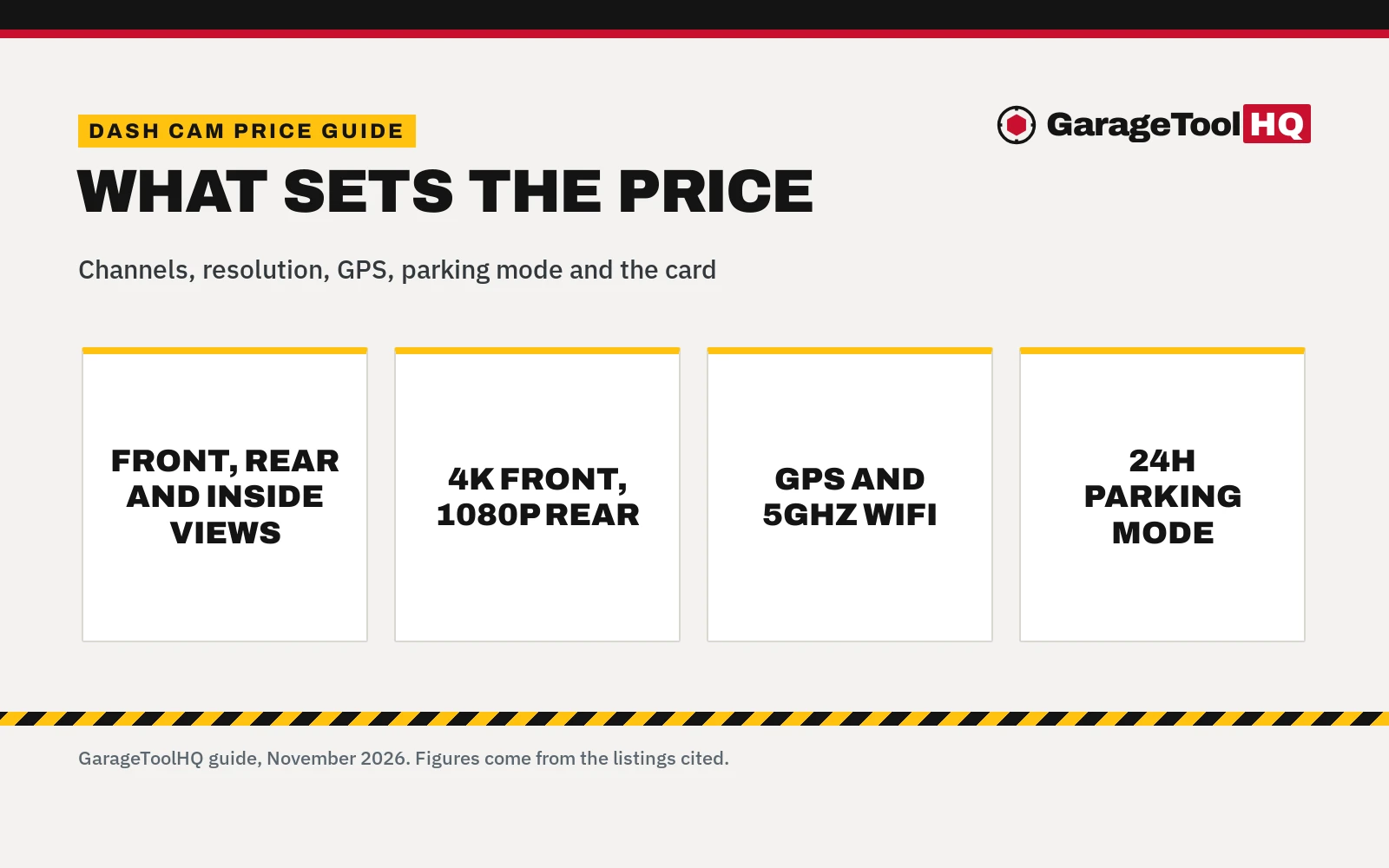
Dual-channel cams record the front and the rear at once. The REDTIGER F7N Touch records 4K front and 1080P rear, the Aputeta records 4K front and 4K rear at 3840x2160P, and the Affver A4 records 4K front and 2.5K rear. Wide angles run 160° to 170° at the front and 140° to 160° at the rear across the listings, so the rear camera covers the road behind and the lanes beside it. The rear camera needs wiring to the front camera, per the listings, and the front camera carries the screen and the controls.
Dual-channel is the middle ground: it covers the two directions that matter in a collision, without the extra wiring of interior and side cameras. For a truck, a front-and-rear cam covers the road ahead and the trailer behind the cab.
3-channel: adding the cabin
3-channel cams add an interior camera to the front and rear cameras. The undersary cam records a 4K front camera with a 170° view, a 1080p interior camera with a 150° view, and a 1080p rear camera with a 160° view, plus infrared light for night recording inside the car. The interior channel records the cabin, which suits rideshare driving.
The interior camera also records the driver, so it suits a car shared between family members or used for hire. It adds wiring and a camera to mount.
4-channel 360°: front, rear and sides
4-channel cams record the front, rear and sides, which the listings describe as 360° coverage. The IIWEY N5 records 1080P on the front, rear, inside and side cameras, with a 170° front and rear view and a 150° side view, plus a 2.5K front mode. The CURRENBA cam records a 4K front camera and 1080P lenses for the rear and sides, with 8 IR lamps for night vision. Both list 24H parking mode, and the IIWEY lists a supercapacitor and a temperature range of -4°F to 167°F.
The side cameras are the difference here: they cover the blind spots and the sides of the car where a parking scrape happens. For a truck, the sides are the largest blind spots. The extra cameras mean extra wiring, and the IIWEY listing says the rear camera must be wired to the front camera for use.
Resolution and night vision
Resolution in the listings runs from 1080P to 4K, with 2K and 2.5K in between. The Aputeta records 4K front and 4K rear at 3840x2160P, the REDTIGER records 4K front and 1080P rear, and the Affver records 4K front and 2.5K rear. Higher resolution shows more detail in a number plate, and the rear resolution matters as much as the front when the incident is behind the car.
Night vision comes from WDR and HDR, infrared lamps and large apertures. The REDTIGER lists a STARVIS 2 sensor with WDR and HDR for low-light recording. The undersary lists 4 infrared lights for night recording, and the CURRENBA lists 8 IR lamps. The Aputeta and the Affver list an f/1.5 aperture, and the Affver listing says its 6-layer lens boosts light intake by 60%.
Parking mode and power
Parking mode records while the car is parked, and every listing here states 24H parking mode. The catch is power: the REDTIGER, undersary, IIWEY and Aputeta listings all say the parking mode needs a hardwire kit, sold separately. The IIWEY lists 2 parking modes: time-lapse at 1fps and impact detection that locks a 10-second video. The Aputeta collision sensor records a 1-minute clip when an event occurs while parked. The undersary G-sensor locks the first 5s and the last 10s around a collision.
Supercapacitors, listed by the REDTIGER and the IIWEY, replace a battery and handle heat better, and the IIWEY lists a temperature range of -4°F to 167°F. The IIWEY must be powered by its original cigarette lighter charger, not a USB cable or a Type-C cable, per its listing.
Use rated jack stands on solid ground, wear eye protection with power and air tools, keep fuel-burning equipment out of a closed garage, and follow the manual for every tool. Read our Safety Disclaimer.
GPS, WiFi and memory cards
GPS puts location, speed and route into the recording: the REDTIGER, Aputeta and Affver listings state built-in GPS, while the IIWEY listing states it has no GPS function. If the speed and route matter for an insurance claim, pick a cam that lists GPS.
WiFi moves footage to a phone. The REDTIGER and the Aputeta list 5.8GHz WiFi at 20MB/s, the Affver lists 5GHz WiFi 6 at up to 10MB/s, and the IIWEY lists 5GHz WiFi that is 4x faster than 2.4GHz. The IIWEY listing says its WiFi turns off after 5 minutes without a connection.
Cards in the listings run 32GB to 128GB: the undersary includes a 32GB card, the Affver and the CURRENBA include a 64GB card, and the REDTIGER, IIWEY and Aputeta include a 128GB card. The IIWEY supports cards up to 256GB. Loop recording overwrites the oldest footage when the card is full, and the G-sensor locks event footage.
Choosing between the types
Match the type to what you need recorded. Front-only covers the road ahead. Front and rear adds the road behind, which matters in a rear-end collision. A 3-channel cam adds the cabin, which suits rideshare driving. A 4-channel cam adds the sides, which covers parking-lot scrapes and blind spots.
Warranties in the listings run 6 months to 24 months: the undersary lists 6 months, the IIWEY lists 12 months, the REDTIGER and the Aputeta list 18 months, and the Affver bullets list 24 months while its spec table lists 1 year, so check the listing before you buy.
FAQ: garage tools
What is the difference between a dual dash cam and a 3-channel dash cam?
A dual cam records the front and the rear. A 3-channel cam adds an interior camera, so it records the front, the cabin and the rear. The undersary 3-channel cam records a 4K front camera, a 1080p interior camera and a 1080p rear camera.
Do dash cams record when the car is parked?
Yes, with parking mode. Every listing here states 24H parking mode, and the REDTIGER, undersary, IIWEY and Aputeta listings say it needs a hardwire kit, sold separately. The IIWEY lists time-lapse at 1fps and impact detection that locks a 10-second video.
Do I need GPS in a dash cam?
GPS adds location, speed and route to the recording, which helps with an insurance claim. The REDTIGER, Aputeta and Affver listings state built-in GPS, while the IIWEY listing states it has no GPS function.
What size memory card does a dash cam need?
The listings include 32GB, 64GB and 128GB cards, and the IIWEY supports cards up to 256GB. Loop recording overwrites the oldest footage when the card is full.
Can a dash cam record at night?
Yes, and the listings state how. The REDTIGER lists a STARVIS 2 sensor with WDR and HDR, the undersary lists 4 infrared lights, the CURRENBA lists 8 IR lamps, and the Aputeta and the Affver list an f/1.5 aperture for low-light recording.
Related: the diagnostics and electrical hub, dash cam how to install, dash cam parking mode vs without, GPS vs non-GPS dash cam and 360 dash cam vs front and rear dash cam. Also see the best truck dash camera 360.