Dead Blow Hammer vs Rubber Mallet: Which One Should You Buy?
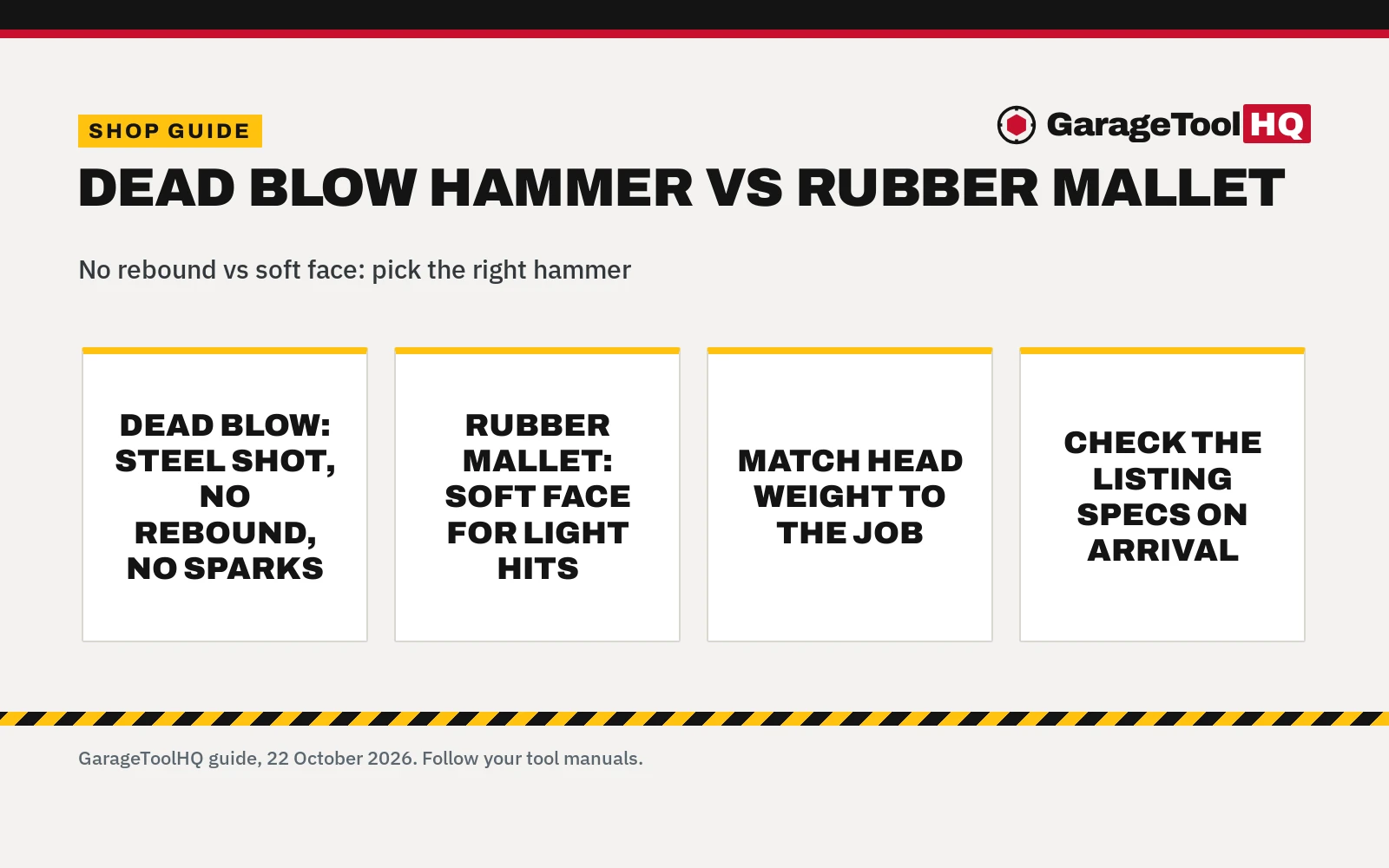
A dead blow hammer uses steel shot for a rebound-free hit on auto body and sheet metal work, while a rubber mallet gives a soft, light tap that will not mar delicate surfaces.

On this page
Top picks at a glance
As an Amazon Associate we earn from qualifying purchases.
- 1
 Capri Tools CP10102 C102 12 lb Dead Blow Hammer9.6/10View on Amazon
- 2
 NEIKO 02851A Dead Blow Hammer9.6/10View on Amazon
- 3
 REAL STEEL Dead Blow Hammer 45 Oz Rubber Mallet Non-Marring9.5/10View on Amazon
- 4
 TEKTON Dead Blow Hammer SetView on Amazon
- 5
 TEKTON 21 oz. Dead Blow HammerView on Amazon
- 6
 TEKTON 26 oz. Dead Blow HammerView on Amazon
- 7
 NEIKO 02889A Dead Blow Hammer SetView on Amazon
- 8
 CRAFTSMAN 28 Oz Dead Blow HammerView on Amazon
- 9
 GIANT 10 LB Dead-Blow Sledge HammerView on Amazon
Dead blow hammer vs rubber mallet: which one should you buy? Buy the dead blow hammer when you need a hard, controlled hit with no rebound (the NEIKO listings also state their hammers prevent sparks), and the rubber mallet when you need a soft, light tap that will not mar the surface. The difference lives in the head: dead blow hammers hide steel shot inside a poly shell, while a rubber mallet relies on a soft rubber face. This guide explains how each works, when to reach for which, and what the four dead blow listings here publish about weight, size and build.
More options to compare
 TEKTON Dead Blow Hammer SetCheck price on Amazon
 TEKTON 21 oz. Dead Blow HammerCheck price on Amazon
 TEKTON 26 oz. Dead Blow HammerCheck price on Amazon
 NEIKO 02889A Dead Blow Hammer SetCheck price on Amazon
 CRAFTSMAN 28 Oz Dead Blow HammerCheck price on Amazon
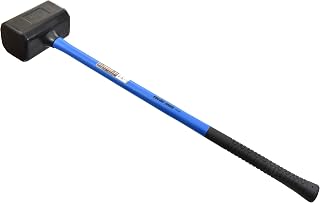 GIANT 10 LB Dead-Blow Sledge HammerCheck price on Amazon
GarageToolHQ earns a commission when you buy through links on our product pages, at no extra cost to you. Read our affiliate disclosure.
Dead blow hammer vs rubber mallet: where the difference comes from
A dead blow hammer is a striking tool with a hollow head partly filled with steel shot. When the head lands, the shot drives forward and kills the rebound, so the force goes into the workpiece instead of back up the handle. The NEIKO listings state that the steel shot filled head adds extra force to hammer blows and eliminates rebound and spark, and name auto body work, woodworking and sheet metal forming as the jobs. A rubber mallet has a solid soft face and no shot: it hits with less force, spreads the blow over a wider area, and leaves a finished surface unmarked. That is the whole decision in one sentence: no rebound and real striking force versus a soft face and a gentle tap.
Note what the four listings here actually are. All four are dead blow hammers or sets, steel shot included. None of the four is a rubber mallet, so the mallet side of this guide is the general tool, not a specific pick. If your work is all delicate assembly and tile setting, you are shopping for a mallet; if it is auto body, sheet metal and shop assembly, you are shopping for one of the dead blows below.
How a dead blow hammer works: the steel shot inside
All four listings state the same core design: a steel shot filled head inside a molded poly, urethane or PVC body. The NEIKO 02849A and the NEIKO 02888A set both state a unicast poly molded body that prevents the hammer from wearing away between the head and handle, with a diamond textured non-slip grip that keeps the hammer in hand after impact. The Performance Tool M7234 set states a urethane coated hammer for non-marring and non-sparking applications with a reinforced steel handle and anti-shock grip. The YIYITOOLS hammer states a steel shot filled head with a PVC surface, an antiskid handle design, and a smooth, shiny striking face.
The shot matters most on rebound. A normal steel hammer bounces off the work and wastes energy; a dead blow head stays put because the shot slams forward at impact. The NEIKO listings also state that the material prevents sparks upon impact, which matters around fuel work and in body shops where grinding dust is in the air. Both NEIKO listings are bright neon orange, which the bullets call out as easy to locate in a tool kit; the Performance Tool set is orange for the same high-visibility reason.
The rubber mallet: soft face, light duty
A rubber mallet does one thing a dead blow cannot: hit softly. With no steel shot and a compressible rubber face, it delivers a cushioned tap for seating parts, fitting trim, and persuading assemblies without denting them. It will not replace a dead blow for driving or forming work, because it lacks the mass and the rebound control the shot provides. The NEIKO 02888A listing is actually titled as a deadblow mallet set, which shows how loosely the words get used: its heads are steel shot filled dead blows, not soft rubber mallets. When a job calls for a genuinely soft strike, buy a real rubber mallet; when it calls for force without bounce or sparks, buy a dead blow.
How to pick between them: the checklist
Start with the job. Sheet metal forming, auto body straightening, seating bearings, and knocking assemblies together all want a dead blow: the force and the lack of rebound keep the work controlled. Delicate assembly, finished trim, tile, and anything where a dent would ruin the part all want a rubber mallet. Then pick the weight. A 4 lb head like the NEIKO 02849A hits hard for heavy forming; a 1 lb hammer like the YIYITOOLS suits light taps; a 1, 2 and 3 lb set like the NEIKO 02888A covers the range in one buy. Check the face size against the work: the NEIKO set lists 1-3/4, 2-1/8 and 2-1/2 in faces across the three hammers, the 02849A lists a 2-1/4 in face, and the YIYITOOLS lists a 1-4/5 in face diameter. Finally, read the spec table with a skeptical eye: the listings here contain contradictions between titles, bullets and spec tables, which the gear section below flags.
The gear: four dead blow picks from the listings
Ranked by our Shop Score, from the strongest listing to the weakest. None of the four states a warranty term or a safety certification, so the ranking comes from performance, build and value on stated specs.
NEIKO 02849A 4 Lb Dead Blow Hammer. The top pick. The listing states a 4-pound head, a 2-3/2 by 5-1/8 in head, a 14-1/2 in overall length, a unibody molded body with a checkered grip, and steel shot that eliminates rebound and spark. One contradiction: the spec table’s listed weight class says 2-1/2 lb and its item weight field reads 0.27 g, neither of which matches a 4 lb hammer; the spec table also lists the head material as alloy steel while the bullets state a poly jacket with steel shot. Trust the title and bullets: 4 lb head, poly jacket, steel shot. For a welder or body worker who wants one heavy dead blow, this is the most complete single-hammer listing here.
NEIKO 02888A 3-Piece Dead Blow Hammer Set. The set pick. The listing states 1 lb, 2 lb and 3 lb hammers with face sizes of 1-3/4, 2-1/8 and 2-1/2 in, head lengths of 4, 4 and 4-5/8 in, handle lengths of 10-1/4, 11-1/4 and 11-7/8 in, and overall lengths of 12, 13-3/8 and 14-3/8 in. The bullets state the same steel shot filled head, unibody molded body, spark and rebound resistance, and diamond textured non-slip grip as the single hammer, plus a non-marring soft mallet description. One contradiction: the spec table lists item weight as 16 ounces, which cannot be the weight of a three-hammer set. For a home garage that wants the full weight range in one buy, the set is the best value here.
YIYITOOLS 1LB Dead Blow Hammer. The light pick. The listing states a 1 lb hammer with a steel shot filled head and a PVC surface, a 31. 5x11x4. 5cm size, a 1-4/5 in face diameter, an 11-2/5 in length and a 10 in handle, with an antiskid checkered grip. One contradiction: the title says 1 lb while the bullets say 673g; the two weight figures do not match. The face and length figures are consistent. The bullets state acid and alkali resistance, corrosion resistance, and suitability for automobiles, construction, wood furniture, lathe work and marble installation where the surface must not be marred or sparked. The title calls the style German while the bullets describe a standard dead blow; that is a style name, not a spec conflict. For light taps and delicate surfaces, this is the one.
Performance Tool M7234 3-Piece Hammer Set. The mixed set. The listing states three hammers: a 12-oz brass hammer for non-sparking applications, a 16-oz ball-peen hammer for striking punches and chisels and shaping unhardened metals, and a urethane coated dead blow hammer for non-marring and non-sparking use, with a reinforced steel handle and anti-shock grip. Two problems: the title says the set includes an 8oz dead blow while the bullets say a 24-oz dead blow, so the dead blow weight is unclear; and the listing states no warranty outright. The spec table lists a 3.2 lb item weight and 2.5 by 5.5 by 14.5 in dimensions. For a shop that wants brass, ball-peen and dead blow in one buy and can live with the weight ambiguity, it works; as a dead blow pick it ranks last.
Frequently Asked Questions
Can a dead blow hammer replace a rubber mallet?
Not always. A dead blow hammer still hits hard; it just does not rebound. The NEIKO listings state their hammers also prevent sparks, but that is their claim, not a property of every dead blow. For taps that need a genuinely soft face on finished surfaces, the rubber mallet is the gentler tool. All four listings here are dead blows, so buy a real mallet separately if your work needs one.
What does the steel shot inside a dead blow hammer do?
It adds extra force to the blow and eliminates rebound and spark, per the NEIKO listings. The shot shifts forward at impact, so the head stays on the workpiece instead of bouncing back up the handle.
Which dead blow hammer weight should I buy?
Match the weight to the job. The NEIKO 02888A set covers 1, 2 and 3 lb in one buy; the 02849A is a 4 lb head for heavier forming and driving; the YIYITOOLS is a 1 lb hammer for light taps. The Performance Tool set’s dead blow weight is unclear: its title says 8oz and its bullets say 24-oz.
Why does the NEIKO 02849A listing disagree with itself?
The title and bullets state a 4-pound head with a poly jacket and steel shot. The spec table’s listed weight class says 2-1/2 lb, its item weight field reads 0.27 g, and its head material says alloy steel. Trust the title and bullets; the spec table fields are inconsistent.
Do any of these hammers state a warranty?
No. None of the four listings states a warranty term. The Performance Tool listing states no warranty outright, and the other three say nothing on the subject.
What is the difference between a dead blow hammer and a dead blow mallet?
The listings use the words interchangeably: NEIKO calls its 02888A set both hammers and a deadblow mallet. All four products here have steel-shot-filled heads, so functionally they are dead blows; a true rubber mallet has no shot and hits softer.
Related: the best dead blow hammer for auto body roundup, the best dead blow hammer roundup, and our tool storage hub.