Digital vs Analog Dial Indicator: Which One Should You Buy?
Digital and analog dial indicators compared by reading, resolution, mounting and battery needs, with 4 listings for garage, lathe and mill work.

On this page
Top picks at a glance
As an Amazon Associate I earn from qualifying purchases.
- 1
 JET 12" Benchtop Drill Press9.8/10View on Amazon
- 2
 Neoteck Digital Dial Indicator Gauge and Magnetic Base Set9.7/10View on Amazon
- 3
 HDLNKAK Digital Dial Indicator 0-1''/25.4mm and Magnetic Base9.6/10View on Amazon
- 4
 Neoteck 1"/25.4mm Digital Dial Indicator 0.0005"/0.01mm DialView on Amazon
- 5
 Neoteck 0-1"/0.0005" Digital Dial Indicator and 176lbsView on Amazon
- 6
 Accusize AGD 2 Dial IndicatorView on Amazon
- 7
 Mitutoyo "2416S" Dial IndicatorView on Amazon
- 8
 Fowler 52-520-485-0 Dial Indicator with Magnetic BackView on Amazon
- 9
 Dial Indicator with Magnetic BaseView on Amazon
Digital vs analog dial indicator: which one should you buy for the garage? Digital if you switch between inch and metric and re-zero often; analog if you want to watch a needle sweep while a part turns. A dial indicator earns its keep on jobs like checking spindle runout, tramming a mill, aligning a table saw or setting up a lathe: the plunger rides the surface, and the display shows how far it moves. Digital and analog versions both cover that job, but they read differently, and the listings show the trade-offs plainly.
Other tools worth a look
 Neoteck 1"/25.4mm Digital Dial Indicator 0.0005"/0.01mm DialCheck price on Amazon
 Neoteck 0-1"/0.0005" Digital Dial Indicator and 176lbsCheck price on Amazon
 Accusize AGD 2 Dial IndicatorCheck price on Amazon
 Mitutoyo "2416S" Dial IndicatorCheck price on Amazon
 Fowler 52-520-485-0 Dial Indicator with Magnetic BackCheck price on Amazon
 Dial Indicator with Magnetic BaseCheck price on Amazon
GarageToolHQ earns a commission when you buy through links on our product pages, at no extra cost to you. Read our affiliate disclosure.
Below: how each type reads, when each one wins, the 4 listings in the gear section, and answers to the questions buyers ask most.
How digital vs analog dial indicator readings differ
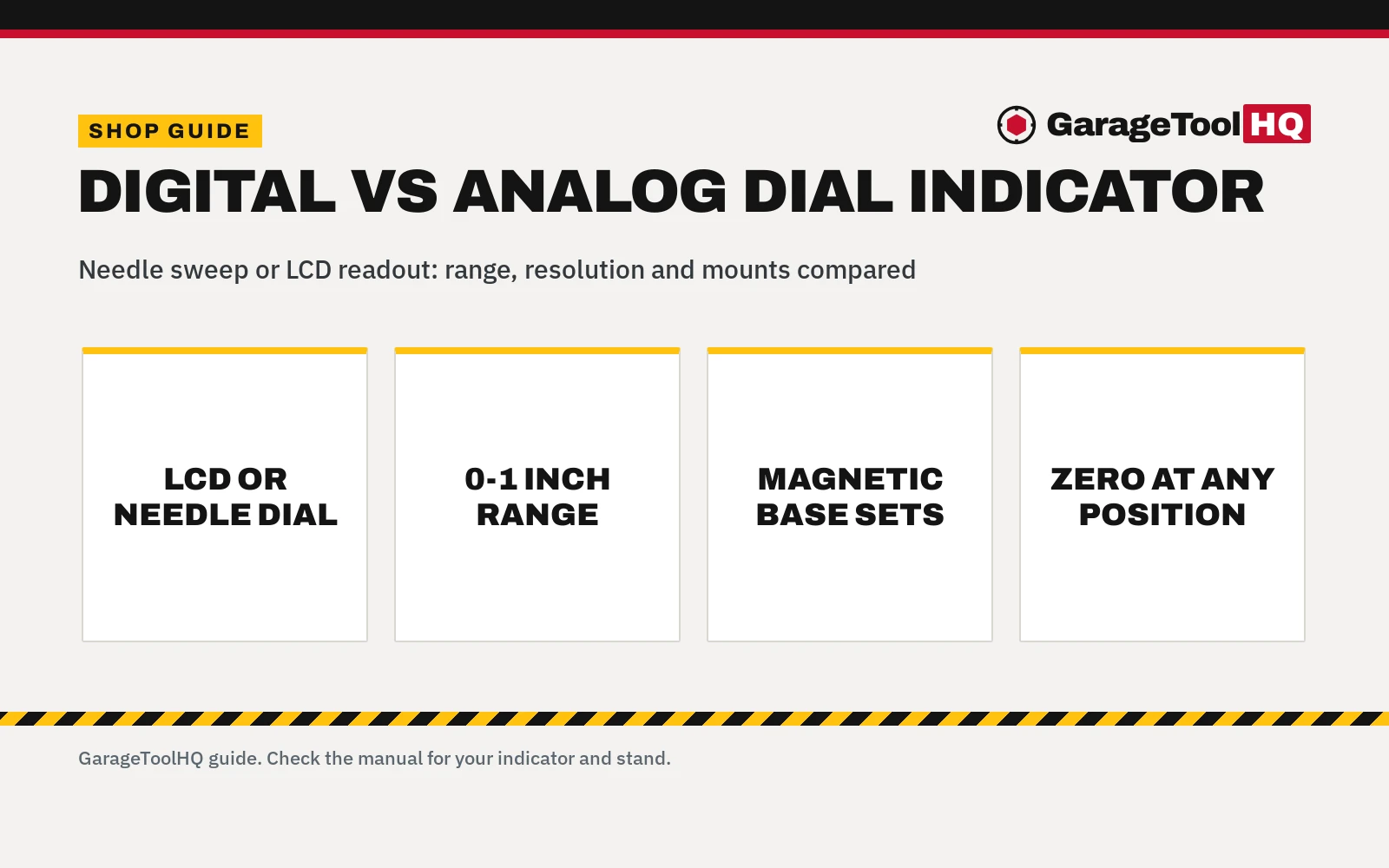
A digital indicator shows the movement as digits on an LCD. The Neoteck digital listings state a measuring range of 0-1 inch (0-25.4 mm) with a resolution of 0.0005 inch (0.01 mm), switching between mm and inch, and zero setting at any position. The standalone listing adds one-press mm/inch switching. That makes unit changes and re-zeroing a setting change instead of arithmetic.
An analog indicator shows the movement as a needle over a dial. The Clockwise Tools listing states a measuring range of 0-1 inch with a resolution of 0.001 inch, a 2 inch dial diameter and a twist-and-lock bezel for scale adjustment. The Accusize listing states the same 0-1 inch range in its title and bullets, with 0.001 inch increments. Watching the needle sweep suits runout checks, where the swing of the needle across a full turn tells the story at a glance.
| Type | Reading | Resolution stated | Mounting stated |
|---|---|---|---|
| Digital | LCD digits, inch or metric | 0.0005 inch (0.01 mm) | Rear cover for magnetic base holder stands; set adds a magnetic base |
| Analog | Needle over a dial | 0.001 inch | Lug back or flat back; Clockwise set adds a magnetic base |
When digital wins, and when analog wins
Digital wins when the job mixes units or needs frequent re-zeroing. Switching between mm and inch removes unit conversion from the job, and zero-at-any-position lets you set a fresh reference wherever the plunger sits. The large LCD display gives a direct digit readout, and the Neoteck set pairs the indicator with a magnetic base and a storage case, so indicator, base and case stay together in one box.
Analog wins when you want to see movement rather than read digits. A needle sweep shows rise and fall across a rotating part without watching digits flicker, and a twist-and-lock bezel (Clockwise Tools) or a rotational bezel with clamp (Accusize) sets the reference without menus. Analog dials also sidestep one digital weakness the standalone Neoteck listing states plainly: it does not remember the zero setting position after auto off, so a digital user re-zeroes after the display sleeps.
Whichever display you choose, the mount still matters. The two magnetic base listings each state 176 lbs, and both tie the figure to metal 30 mm and thicker, so a thinner surface may hold less firmly. Check the mount before trusting a reading.
The gear: 4 dial indicators from the listings
The listings below are in ranked order, from the fullest kit to the simplest gauge. All 4 cover a 0-1 inch range in their titles or bullets; they differ in display, mounting and what comes in the box.
Neoteck digital indicator and magnetic base set
The set pairs a digital indicator with a magnetic base and a storage case. The listing states a measuring range of 0-1 inch (0-25.4 mm), a resolution of 0.0005 inch (0.01 mm), inch/metric switching and zero setting. The base has two arms, a lower arm of 5 inch and an upper arm of 4.5 inch, a total height of 14.1 inch, a clamping hole diameter of 5/16 inch (8 mm) and a maximum tensile force of 176 lbs (80 kg), with the note that full force needs a metal surface 30 mm and thicker. The listing states an 18 months warranty. This is the pick for a buyer starting from nothing: indicator, base and case arrive together.
Neoteck digital indicator alone
The standalone digital indicator states the same range and resolution: 0-25.4 mm (0-1 inch) and 0.01 mm (0.0005 inch), with a large LCD display, inch/metric conversion and zero setting. Its body is aluminum, its rear cover has a hole diameter of 6.5 mm and can be used on different magnetic base holder stands, and the listing states an 18 months warranty. One conflict to note: the package list names 1 x 1.5V battery while the spec table calls for 2 LR44 batteries, so confirm the battery count before ordering. It also does not remember the zero setting position after auto off.
Clockwise Tools analog indicator with magnetic base
The analog set pairs a dial indicator with a magnetic base holder stand. The listing states a measuring range of 0-1 inch, a resolution of 0.001 inch, a 2 inch dial diameter, a 3/8 inch stem diameter, and flat back and lug back options with a hole size of 6.5 mm. The twist-and-lock bezel adjusts the scale without a tightening screw, an anti-dust cap covers the dial, and a carbide anvil ball is fitted for wear resistance. The base has two strong magnetic faces with a maximum pull force of 176 lbs, working best on metal pieces 30 mm and thicker. The listing includes a manufacturer certificate; no warranty term is stated.
Accusize AGD 2 analog indicator
The Accusize gauge is an analog indicator only, with no base or case stated. Its title and bullets state a 0-1 inch range with 0.001 inch increments, a lug back with a 1/4 inch hole, a rotational bezel with clamp, a satin chrome finish and an aluminum body, with an interchangeable hardened contact point. Two conflicts need flagging: the spec table lists a range of 0-0.05 inch and a resolution of 0.0001 inch, against the title and bullets, and the spec table item number P900-S097 does not match the model and part number P900-S102. Trust the title and bullets over the spec table, and confirm both points with the seller before ordering. No warranty term is stated.
Use rated jack stands on solid ground, wear eye protection with power and air tools, keep fuel-burning equipment out of a closed garage, and follow the manual for every tool. Read our Safety Disclaimer.
FAQ: garage tools
Do I need a magnetic base with a dial indicator?
Yes, unless a stand is already in the shop. The standalone Neoteck and Accusize listings state no base, while the Neoteck set and the Clockwise Tools set each include one. A magnetic base also needs a suitable surface: both base listings state 176 lbs on metal 30 mm and thicker.
What resolution do I need: 0.0005 inch or 0.001 inch?
The digital listings state 0.0005 inch (0.01 mm); the analog listings state 0.001 inch. The finer digital step suits work where small movements matter, while the analog step covers runout checks, alignment and setup jobs the listings describe.
Can a digital indicator switch between inch and metric?
The Neoteck digital listings state switching between mm and inch, one-press on the standalone listing. The analog listings state inch ranges only, so a metric reading on an analog dial means converting by hand.
Why does one listing show two different ranges?
The Accusize listing is the one: its title and bullets state 0-1 inch with 0.001 inch increments, while its spec table lists 0-0.05 inch and 0.0001 inch. Treat the title and bullets as the listing’s own lead, and confirm the range before ordering.
Does a digital indicator remember its zero setting?
Not after auto off, on the standalone Neoteck digital listing: it states zero setting at any position, and also states that it does not remember the zero setting position after auto off. Re-zero after the display sleeps.
Related: best digital dial indicator, digital vs analog tread depth gauge, analog vs digital multimeter and our engine and shop equipment hub.