DIY AC Recharge Kit: How to Recharge Car Air Conditioning
A diy ac recharge kit recharges car air conditioning with a charge hose, gauge and refrigerant, and this guide shows the steps, the gear and the signs that mean a shop visit.

On this page
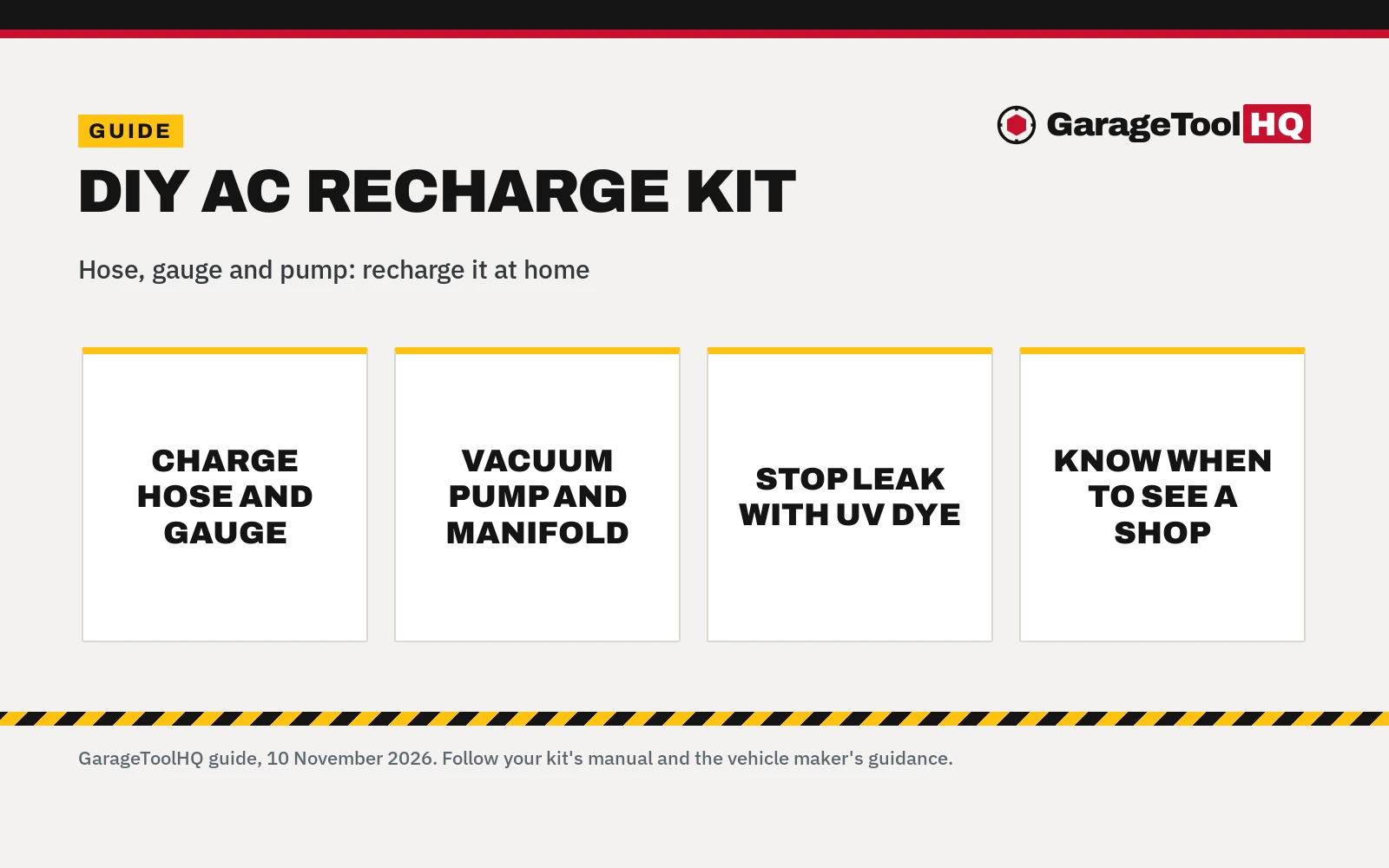
A diy ac recharge kit brings cold air back to a car whose air conditioning blows warm: a charge hose with a gauge connects a can of refrigerant to the low-side port, and the gauge shows the pressure as the system fills. A full kit adds a vacuum pump and manifold gauge set to pull moisture out before charging, and a stop leak with UV dye can seal a small leak and mark a large leak for repair. This guide explains what each part does, how the recharge runs step by step, and the signs that mean a shop should handle it instead.
As an Amazon Associate I earn from qualifying purchases. GarageToolHQ earns a commission when you buy through links on our product pages, at no extra cost to you. Read our affiliate disclosure.
Below: what a kit fixes, how the recharge runs, the gear in the kits, and answers to common questions.
DIY AC Recharge Kit: What It Is and What It Does
A recharge kit is built around the charge hose and gauge: the hose links the refrigerant can to the low-side service port, the gauge reads the low-side pressure while you charge, and a dispensing valve meters the flow. The Vioziis hose kit lists a 19 in hose with a 0.51 in low-side quick coupler, a 1/2 in dispensing valve and a 250 PSI gauge, with a 90-degree push lock coupling. A manifold gauge set reads the high side and the low side together, and the VIVOHOME kit pairs a 4 CFM 1-stage vacuum pump with a manifold gauge set and 3 color-coded hoses of 5 ft each. The pump runs on 110V and the kit includes 0.35 qt of pump oil, and it works with R134a, R12, R22, R502 and R410a systems.
A stop leak is a separate part of the job: the blueseal can holds 2 oz of sealant with UV dye, a reusable hose and a built-in gauge that reads 0-200 PSI, and the maker states a 95%+ seal rate on systems losing 25 oz or less a year. The dye shows the leak under UV light when a seal alone cannot hold it, and the formula has no polymers or particulates, so the maker states it will not clog the compressor, evaporator or recovery unit. The maker describes the formula as OSHA-classified non-hazardous.
The Gear in a Recharge Kit
| Kit | What it does | Key figures |
|---|---|---|
| VIVOHOME pump and manifold set | Evacuates moisture, reads the high side and the low side | 4 CFM, 1/3 HP, 110V, 3 hoses at 5 ft |
| Vioziis charge hose kit | Charges through the low side with a gauge | 19 in hose, 250 PSI gauge, 1/2 in valve |
| blueseal stop leak with UV dye | Seals small leaks, marks large leaks | 2 oz, 0-200 PSI gauge, 95%+ seal rate |
A hose-only kit suits a top-up on a system that still holds pressure, while a pump and manifold set suits a system that was opened or left empty. The VIVOHOME kit also covers home split AC of 1-3 HP. Check the refrigerant type on the label under the hood before buying any kit, since the fittings and the refrigerant must match the system.
What the Gauge Tells You
A gauge that sits low with warm air from the vents points to a system low on refrigerant, and that is the case a recharge kit is made for. A gauge that climbs past the marked zone while the vents stay warm points to trouble beyond a low charge, and adding more refrigerant will not fix it. A gauge that reads nothing at all with the compressor running points to an empty system, and an empty system has a leak somewhere. The reading is only correct while the compressor runs, so a still compressor gives no reading to trust. The blueseal hose gauge shows color-coded zones for fill, alert and warning.
How to Recharge Car AC with a DIY Kit
The recharge runs in the same order whatever kit you hold.
- Find the low-side port. The charge hose quick coupler fits the low side only, so the wrong port will not take the hose. Wipe the port clean before you connect.
- Start the car and run the AC. Set the AC to its coldest setting with the fan up, so the compressor runs while you read the gauge.
- Connect the hose and read the gauge. A low reading with warm air points to a system low on refrigerant, while a gauge that reads nothing points to a system that may be empty and needs a leak check before more refrigerant goes in.
- Add refrigerant in short bursts. Open the dispensing valve in short bursts and let the compressor pull the charge in, watching the gauge and the air from the vents between bursts.
- Stop when the gauge sits in the fill zone and the air from the vents runs cold and steady. Do not keep adding refrigerant past that point: an overcharged system cools poorly and strains the compressor.
- Check for leaks. If the charge fades again soon after, look for dye under UV light at the leak, or let a shop trace the leak.
- Cap the port and store the kit. Put the cap back on the service port and store the kit upright and out of heat.
Wear eye protection and gloves while you work, and keep the can upright while charging so liquid refrigerant does not flood the compressor. Never open the high-side port with a charge hose, and never vent refrigerant to the air: if the system needs emptying, a recovery machine at a shop handles it. The AC refrigerant recovery machine picks cover shop gear for that job.
If the gauge reads nothing while the compressor runs, the system is empty, and an empty system has a leak somewhere. Find the leak with UV dye or let a shop trace it before charging.
Use rated jack stands on solid ground, wear eye protection with power and air tools, keep fuel-burning equipment out of a closed garage, and follow the manual for every tool. Read our Safety Disclaimer.
When a Stop Leak Helps, and When It Does Not
A stop leak suits a slow leak: the blueseal maker states a 95%+ seal rate on systems losing 25 oz or less a year, and the seal forms where air enters the system. It will not fix a leak that empties the system in a rush, a cracked hose, or a failed seal at the compressor. The UV dye in the can helps in that case: it shows the leak under UV light, so a shop can see where the repair belongs. A stop leak with dye is the middle step between a recharge and a repair, and the best AC recharge kit with stop leak picks compare cans that combine sealant and dye, while the best AC recharge kit with dye picks cover dye-only cans.
When to Let a Shop Handle It
Let a shop handle the job when the system is empty, the compressor never engages, or the leak is too large for sealant. A shop evacuates the system, weighs the charge in, and traces leaks with shop gear. The VIVOHOME kit lists a 4 CFM pump for evacuation, but a home pump cannot weigh a charge or recover refrigerant, and a system that was opened for repair needs evacuation before any refrigerant goes in. Check the refrigerant type on the label under the hood before buying a kit: the VIVOHOME kit covers R134a, R12, R22, R502 and R410a with adapters, while the Vioziis hose covers R134a, R12 and R22 and the blueseal can is R134a only, and the wrong refrigerant in the wrong system can damage the compressor. The manifold gauge vs recharge kit guide explains when a manifold set earns its place over a hose alone.
FAQ: garage tools
Can I recharge my car AC myself?
Yes, with a charge hose, a gauge and the right refrigerant for the car: connect to the low-side port, read the gauge with the compressor running, and add refrigerant in short bursts until the vents run cold.
How do I know if my car needs a recharge?
Warm air from the vents with the AC on points to a system low on refrigerant. A gauge on the low side, read with the compressor running, confirms it: a low reading means the charge is down, and a system that holds no pressure at all has a leak.
What refrigerant does my car use?
Most cars on the road use R134a, and the label under the hood names the type the system holds. The VIVOHOME kit covers R134a, R12, R22, R502 and R410a with adapters, while the Vioziis hose covers R134a, R12 and R22 and the blueseal can is R134a only, so match the kit to the label before buying.
Can a stop leak fix my AC leak?
It can seal a slow leak: the blueseal maker states a 95%+ seal rate on systems losing 25 oz or less a year. It will not fix a large leak, a cracked hose or a failed compressor seal, and the UV dye marks the leak under UV light so a shop can find it.
Do I need a vacuum pump to recharge car AC?
A pump evacuates moisture before charging, and the VIVOHOME kit lists a 4 CFM 1-stage pump for that job, with a manifold gauge set and 3 hoses of 5 ft each. A hose-only recharge skips evacuation, so use a pump when the system was opened or left empty.
Will a recharge kit fit my car?
The Vioziis hose fits R134a, R12 and R22 standard interfaces, with a 19 in hose and a 1/2 in dispensing valve. The listing notes it does not fit the 2018 Civic and Tucson, so check fitment before buying.
Related: best AC recharge kit with stop leak, manifold gauge vs recharge kit, digital vs analog AC manifold gauge and the engine and shop equipment hub.