Electric Hoist vs Chain Hoist: Which One Should You Buy?
An electric hoist and a chain hoist compared for a home garage: how each lifts, speed and effort, power needs, example capacities and lift heights, and which jobs each suits.

On this page
Top picks at a glance
As an Amazon Associate we earn from qualifying purchases.
- 1
 VEVOR 3-in-1 Electric Hoist Winch9.4/10View on Amazon
- 2
 JET 1-Ton Hand Chain Hoist9.8/10View on Amazon
- 3
 SPECSTAR Hand Chain Hoist 2 Ton 4400 Lbs Capacity 10 Feet9.6/10View on Amazon
- 4
 VEVOR Electric Hoist with Remote ControlView on Amazon
- 5
 VEVOR 2-in-1 Electric Hoist WinchView on Amazon
- 6
 VEVOR Electric Hoist 440 Lbs with 328ft Wireless 14 ft WiredView on Amazon
- 7
 VEVOR 880lbs Electric Hoist with 14 FT Wired Remote ControlView on Amazon
- 8
 VEVOR 1100 lbs Electric Chain Hoist 15 FT Lifting HeightView on Amazon
- 9
 VEVOR Hand Chain HoistView on Amazon
Verdict: Pick an electric hoist if you lift often and want push-button speed on a standard outlet. Pick a chain hoist if you want the simplest tool that works anywhere, with no power cord and no motor to maintain.
Pulling an engine, setting a heavy machine, or lifting a load to a loft all come down to the same choice. An electric hoist does the work at the push of a button, while a chain hoist trades the motor for a hand chain and a brake you can trust with no electricity at all. This electric hoist vs chain hoist comparison walks through how each lifts, what each asks of your shop, and where the four examples below land.
GarageToolHQ earns a commission when you buy through links on this page, at no extra cost to you. Read our affiliate disclosure.


JET 3/4-Ton Lever Chain Hoist Come Along
A 3/4-ton lever chain hoist with 10 ft of lift, a Weston-style brake and stated ANSI/ASME B30.21 compliance, backed by a limited lifetime warranty.
Pros
- 1,650 lb rating, checked at 125% with a certificate included
- Stated ANSI/ASME B30.21 and HST-3 compliance
- Weston-style automatic brake with a wear indicator
- Lifts, pulls or holds at any angle; 31 lb lever pull
Cons
- Spec table contradicts the title and bullets on capacity, weight and lever pull
- No storage case or slings included
- Lever operation is slower than a motor
- Not for lifting people or for loads over people
VEVOR 3-in-1 Electric Hoist Winch
A 1,100 lb electric hoist with a 1500W motor, 22.9 ft of lift at 13 ft/min, and manual, wired and wireless remote controls.
Pros
- 1,100 lb capacity with a 1500W motor
- Manual, 19 ft wired and 200 ft wireless remote controls
- Overload protection built in
- 22.9 ft of lift at 13 ft/min
Cons
- No warranty term is stated
- No certification is stated
- Needs a 110V/120V outlet wherever you lift
- Do not run unloaded on first use, per the listing

VEVOR 3in1 Electric Hoist Winch
A 1,100 lb electric hoist with a 1500W motor, 25 ft of lift at 16 ft/min, overload protection and three control methods.
Pros
- 1,100 lb capacity with a 1500W all-copper motor
- 25 ft of lift at 16 ft/min, the fastest stated speed here
- Manual, wired and wireless control with two carbon brushes
- Overload protection with a limit switch
Cons
- Spec table contradicts the bullets on weight and load rating
- No warranty term is stated
- No certification is stated
- Needs a 110V outlet wherever you lift
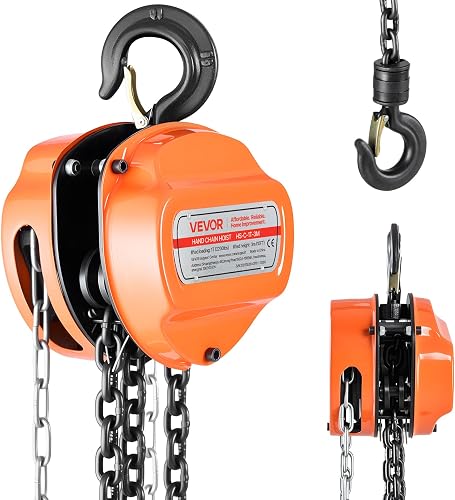
VEVOR Hand Chain Hoist 1 T 2200 lbs Load Capacity
A 1-ton hand chain hoist rated to 2,200 lb with 10 ft of lift, a dual pawl brake and G80 chain.
Pros
- 2,200 lb capacity, the highest rating here
- Dual pawl brake holds the load at height
- G80 heat-treated chain with a reinforced casing
- 360-degree rotating hooks with security locks
Cons
- No warranty term is stated
- No certification is stated
- Hand chain operation takes more effort than a motor
- 340N of pull force needed at full load
More options to compare
 VEVOR Electric Hoist with Remote ControlCheck price on Amazon
 VEVOR 2-in-1 Electric Hoist WinchCheck price on Amazon
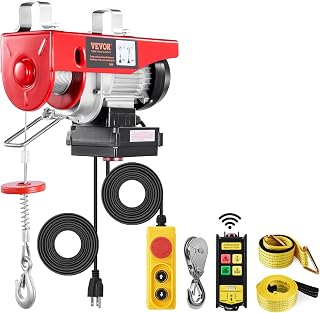 VEVOR Electric Hoist 440 Lbs with 328ft Wireless 14 ft WiredCheck price on Amazon
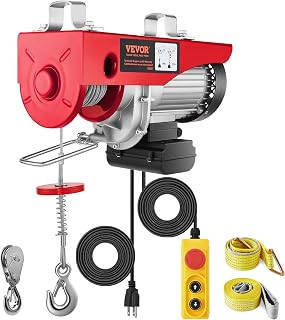 VEVOR 880lbs Electric Hoist with 14 FT Wired Remote ControlCheck price on Amazon
 VEVOR 1100 lbs Electric Chain Hoist 15 FT Lifting HeightCheck price on Amazon
 VEVOR Hand Chain HoistCheck price on Amazon
Side by side
| Electric hoist | Chain hoist | What to check | |
|---|---|---|---|
| How it lifts | Motor winds a wire rope on a drum | Hand chain pulled over a pocket wheel | Match the drive to how often you lift |
| Example capacity | 1,100 lb on both VEVOR examples | 1,650 lb (JET); 2,200 lb (VEVOR) | Match the rating to your heaviest load |
| Example lift height | 22.9 ft and 25 ft | 10 ft on both | Match the height to your tallest pull |
| Lift speed (stated) | 13 and 16 ft/min | Not stated; hand speed | Speed matters most for repeat lifts |
| Power needed | 110V or 120V outlet | None, hand powered | Chain works where cords cannot reach |
| Weight (examples) | 24.2 lb; about 22.05 lb | About 16.8 lb (JET); 18.3 lb (VEVOR) | Lighter hangs and moves easier |
| Brake | Overload protection with limit switch | Weston-style brake (JET); dual pawl brake (VEVOR) | Look for a brake you can inspect |
| Certification (examples) | None stated | ANSI/ASME B30.21 (JET); none stated (VEVOR) | A stated standard is a plus |
Example figures are manufacturer rated, as published on each listing and collected 22 October 2026.
How each hoist lifts
The electric examples here wind a wire rope onto a drum with a motor. The VEVOR examples here run on a standard 110V or 120V outlet, lift at 13 and 16 ft/min, and stop with an overload protection switch. A chain hoist pulls a load chain over a pocket wheel by hand. The JET example is a lever chain hoist: about 31 lb of pull on its 11 in. lever raises the full 1,650 lb rating, and it can lift, pull or hold at any angle. The VEVOR hand chain hoist needs 340N of pull force at full load, per its listing.
Speed and effort
An electric hoist lifts at the push of a button: the two examples here are rated at 13 and 16 ft/min. A chain hoist moves at hand speed, and the brake holds the load wherever you stop pulling. The JET’s lever turns about 31 lb of pull into a 1,650 lb lift. If you lift several times a day, the motor earns its keep; if you lift once a month, the chain hoist is less machine to maintain.
Power and setup: electric hoist vs chain hoist
The two electric examples need a 110V or 120V outlet, and the VEVOR 3-in-1 adds a 19 ft wired remote and a 200 ft wireless remote alongside the manual controls. The chain hoists need no power at all: hang the top hook, pull the chain, and the brake does the holding. That makes the chain side the pick for barns, job sites and anywhere the cord cannot reach. One caution from the listings: the VEVOR electric listing warns not to run the hoist unloaded on first use.
Capacity and lift height in the examples
The chain examples here are rated higher: 1,650 lb for the JET lever hoist and 2,200 lb for the VEVOR hand chain hoist, both with 10 ft of lift. The electric examples are rated at 1,100 lb each, with 22.9 and 25 ft of lift height. Do not read that as a rule about the two types: these are just the four listings we reviewed. Match the rating to the heaviest load you will lift, and the lift height to the tallest pull.
Choose an electric hoist if
- You lift often and want push-button speed
- You have a 110V or 120V outlet where you lift
- You want a remote for positioning loads
- You prefer not to pull a chain for heavy loads
Choose a chain hoist if
- You lift anywhere, with no outlet nearby
- You want the simplest mechanism to maintain
- You want the highest ratings in these examples
- You also want to pull or tension at an angle
Example hoists
For more lifting gear, see the best chain hoist for engine removal.
Check the lift's rated capacity against your heaviest vehicle, and its ceiling and concrete requirements (thickness and strength) before you buy. Install it exactly as the manufacturer specifies, use the mechanical locks before you go under, and look for ALI certification on the model. See the Automotive Lift Institute (ALI). Read our Safety Disclaimer.
Frequently Asked Questions
Can I use a chain hoist to pull an engine?
Yes. The JET lever hoist listing states it can lift, pull or hold at any angle: vertical as a hoist, or angled and horizontal as a puller or come along. The VEVOR electric listing also names hoisting engines among its uses.
Do these electric hoists need special wiring?
Not these two. Both VEVOR electric examples run on 110V or 120V, per their listings.
What does ANSI/ASME B30.21 mean?
It is the standard for manually lever-operated chain hoists. The JET listing states the JLP-075A-10 is checked at 125% of its 3/4-ton rating, ships with its own certificate, and complies with ANSI/ASME B30.21 and HST-3.
Can a hoist lift a person?
No. The JET listing states the hoist is not for lifting people or for loads over people. Never stand under a suspended load.
How much lift height do I need?
Match it to the tallest pull. The chain examples here give 10 ft of lift, while the electric examples give 22.9 and 25 ft. Measure from the hang point to the load’s highest position.
Related: the best chain hoist, the chain hoist vs engine hoist, the best chain hoist for engine removal and our engine and shop equipment hub.