Engine Degreaser vs Brake Cleaner: Which One Should You Buy?
Engine degreaser vs brake cleaner explained: which cleaner belongs on brakes, which on engine bays, and 4 brake cleaners compared.

On this page
Top picks at a glance
As an Amazon Associate I earn from qualifying purchases.
- 1
 WD-40 Specialist Machine & Engine Degreaser Foaming Spray9.5/10View on Amazon
- 2
 GUNK Brake Parts Cleaner9.7/10View on Amazon
- 3
 3D Grand Blast Engine Degreaser9.5/10View on Amazon
- 4
 SQ Brake Cleaner Non ChlorinatedView on Amazon
- 5
 Johnsen's 2417 OTC Compliant Non-Chlorinated Brake CleanerView on Amazon
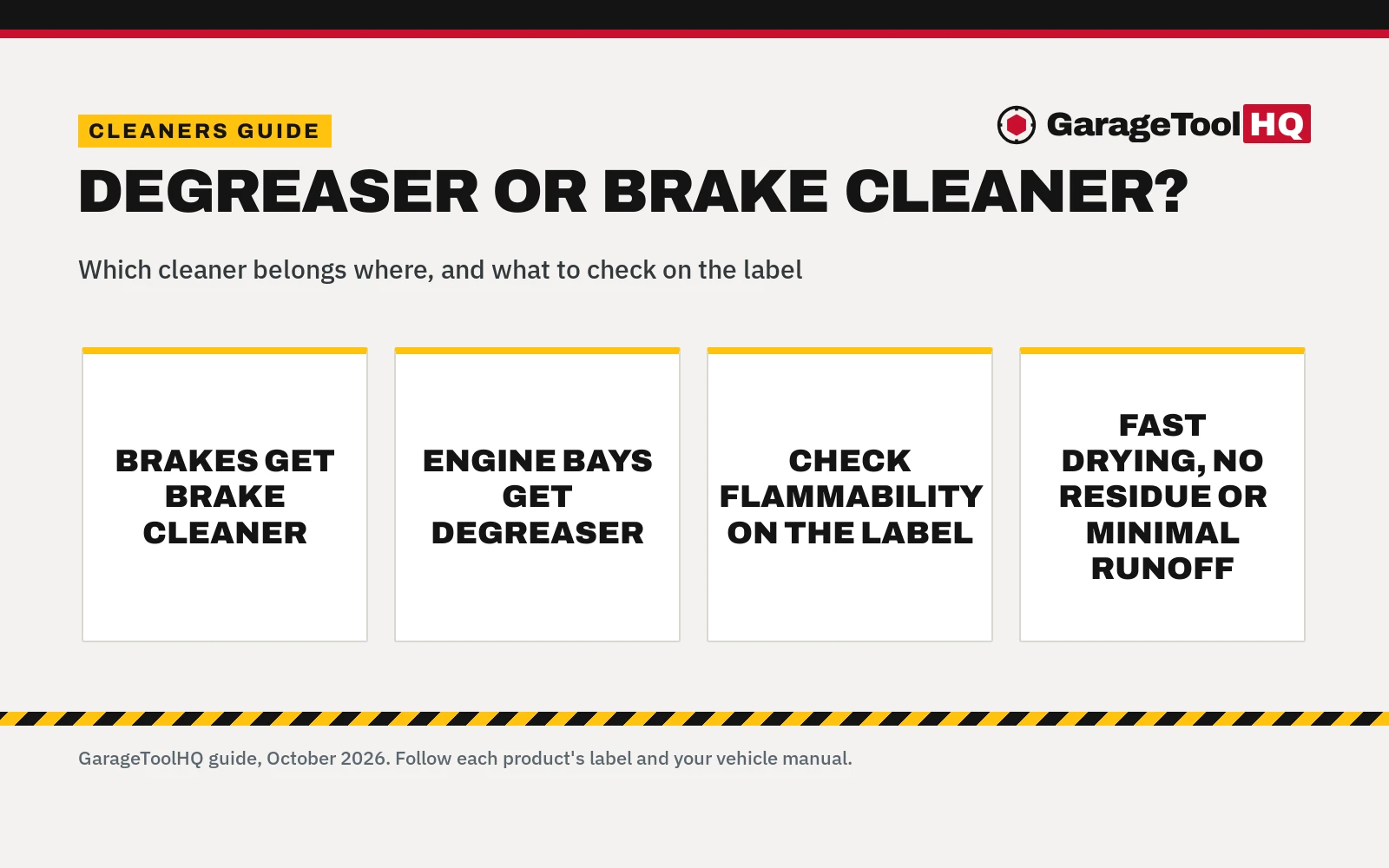
Engine degreaser vs brake cleaner: which one should you buy? Buy a brake cleaner for brake parts and an engine degreaser for greasy engine bays, because the two cleaners are made for different jobs, so each one belongs on the part it is made for. A brake cleaner is a fast-drying solvent for brake parts, made to clean grease and oil from braking surfaces and dry fast; the CRC and Quinton Hazell listings state no residue or a residue-free finish, while the Denco listing states minimal runoff rather than no residue. An engine degreaser is made to cut heavy grease on engine surfaces, where it is applied and then rinsed or wiped away. A degreaser left on brakes risks residue where brakes need a clean surface, while brake cleaner alone does not cut heavy engine-bay grease the way a degreaser does.
Other tools worth a look
 SQ Brake Cleaner Non ChlorinatedCheck price on Amazon
 Johnsen's 2417 OTC Compliant Non-Chlorinated Brake CleanerCheck price on Amazon
GarageToolHQ earns a commission when you buy through links on our product pages, at no extra cost to you. Read our affiliate disclosure.
Below: what each cleaner is for, how they differ, a checklist for choosing, and 4 brake cleaners from current listings, ranked.
Engine degreaser vs brake cleaner: what each one is for
An engine degreaser is a cleaner for greasy engine bays and engine parts. It is built to soak into heavy grease and grime, and the job ends with rinsing or wiping the cleaner and the loosened grease away. A brake cleaner is a solvent spray for brake parts: drums, calipers, pads, discs, shoes, linings and clutch discs. It is built to clean fast and dry fast, with the CRC and Quinton Hazell listings stating no residue or a residue-free finish and the Denco listing stating minimal runoff, because anything left on a braking surface hurts braking.
The gear section below lists 4 brake cleaners: 3 state a non-chlorinated formula, and 1 states a non-flammable formula. No engine degreaser appears in the listings for this guide, so the ranking covers brake cleaners only.
How they differ
| Cleaner | Made for | Leaves residue | Drying | Rinse |
|---|---|---|---|---|
| Engine degreaser | Greasy engine bays and engine parts | Rinsed or wiped away with the grease, not left to dry | Removed by rinsing or wiping, not left to dry | Yes, rinse or wipe |
| Brake cleaner | Brake parts: drums, calipers, pads, discs, clutch discs | No residue, per the listings | Fast drying | No rinse stated |
Flammability also differs by formula, so check the label: 1 pick here states a non-flammable formula, while the rest do not state flammability. VOC content differs too: 3 picks state a low-VOC or 30% VOC formula. One listing notes that its sale is prohibited in DE, NH, MD, CT, UT, CA, RI, MI, CO and NY, so check availability where you live.
How to choose between them: the checklist
- Match the cleaner to the part. Brakes get brake cleaner. Engine bay grease gets engine degreaser. Match the cleaner to the part, rather than swapping them.
- Check flammability on the label. One pick here is non-flammable. If the label does not state it, treat the cleaner as flammable and keep it away from flames and hot surfaces.
- Check the formula. Non-chlorinated formulas are stated on 3 picks here: the CRC non-chlorinated pick and the Denco pick state low-VOC, and the Quinton Hazell pick states 30% VOC.
- Check the size and pack. Cans in the 12-packs run 14 oz, 19 oz and 20.3 fl oz, and the fourth pick is a 24-pack, so a shop that cleans brakes often can stock up.
- Check the application list. The listings name drums, calipers, pads, discs, shoes, linings, cylinders and clutch discs. Match the list to the job at hand.
- Check state availability. One listing notes prohibited sale states. Confirm the cleaner ships to your state before ordering.
- Work with ventilation. Use cleaners in a ventilated area and follow the label directions for the product at hand.
The same garage rule covers cleaning work: never run a car engine in a closed garage while degreasing or cleaning, even with the door partly open, and never use a fuel heater or an open flame near cleaning solvents.
Use rated jack stands on solid ground, wear eye protection with power and air tools, keep fuel-burning equipment out of a closed garage, and follow the manual for every tool. Read our Safety Disclaimer.
The gear section: 4 brake cleaners, ranked
The 4 cleaners below are all brake cleaners, ranked with the largest can first, then the non-flammable pick, a low-VOC pick and the 24-pack.
Quinton Hazell QH6: the largest can
QH6 leads the ranking on size and range: 12 cans of 20.3 fl oz (243.46 fl oz in total), each 600 ml, in a non-chlorinated formula with 30% VOC, a precision spray nozzle and fast drying to a residue-free finish. The listing states it removes grease, oil and dirt from clutches, brake pads, callipers and discs, stops brake squeal and clutch slip, and suits car, bike, van, truck and karting parts. The pack weighs 4.8 kg.
CRC Brakleen Non-Flammable 19 oz: the non-flammable pick
This 12-pack of 19 oz cans (228 ounce in total) is the only pick here that states a non-flammable formula, and it dries fast with no residue. The listing names spring brakes, wedge brakes, brake cylinders, brake drums, brake linings, brake shoes, calipers, clutch discs and disc brake pads. The special ingredient listed is perchloroethylene, and the pack weighs 1.2 pounds.
CRC Brakleen Non-Chlorinated 14 oz: a low-VOC pick
This 12-pack of 14 oz cans (168 fluid ounces in total) states a non-chlorinated, low-VOC formula that removes brake fluid, grease and oil from brake linings and pads. The listing names brake cylinders, brake drums, brake linings, brake shoes, calipers and clutch discs. Each can is unscented, and the pack weighs 1.6 pounds, with a Limited MFG Warranty stated.
Denco 1930: the high-pressure 24-pack
Denco’s 24-pack states a non-chlorinated, low-VOC, low-odor formula with high-pressure spray from full to empty, fast drying and minimal runoff, for grease, oil and brake dust. The listing contradicts itself on size: the title says 13 oz while the bullets and the spec table item volume say 15.3 fluid ounces, and the pack weighs 14 pounds. The listing also notes that sale is prohibited in DE, NH, MD, CT, UT, CA, RI, MI, CO and NY.
FAQ: garage tools
Can I use brake cleaner as an engine degreaser?
No, not as a substitute for a degreaser made for engines. Brake cleaner is made for brake parts: it dries fast, with the CRC and Quinton Hazell listings stating no residue and the Denco listing stating minimal runoff, but it is not made to soak into and cut heavy engine-bay grease. For an engine bay, use a degreaser made for engines, applied and then rinsed or wiped away.
Can I use engine degreaser on brakes?
No, not on brakes. Engine degreasers are made to be rinsed or wiped away, and any residue left on a braking surface can hurt braking. Brakes get brake cleaner for this job, because the brake cleaner listings state fast drying, with no residue on the CRC and Quinton Hazell picks and minimal runoff on the Denco pick.
Is brake cleaner flammable?
It varies by formula, so check the label. One pick here states a non-flammable formula, while the rest do not state flammability. If the label does not state it, treat the cleaner as flammable and keep it away from flames, sparks and hot surfaces.
What is the difference between chlorinated and non-chlorinated brake cleaner?
The difference is the formula family stated on the label. Three picks here state a non-chlorinated formula, and one pick lists perchloroethylene as its special ingredient. Check the label for the formula type before buying, since the listings differ on this point.
Do I need to rinse brake cleaner off?
No rinse is stated on these listings. The picks state fast drying with no residue or minimal runoff, so the cleaner is sprayed on and the part is left to dry. Follow the label directions for the product at hand.
Can I use brake cleaner on painted surfaces?
The listings here state brake parts only: drums, calipers, pads, discs, shoes, linings and clutch discs. They do not state painted surfaces, so check the label before spraying anything painted, and keep the spray on the brake parts it names.
Related: our engine and shop equipment hub, the best brake cleaner for engine cleaning, the best non-flammable brake cleaner, brake cleaner vs carb cleaner and the best engine degreaser foam.