Garage Heater vs Dehumidifier: Which One Should You Buy?
Garage heater vs dehumidifier compared for a home garage: how each side works, what each needs for power and space, and which side fits a cold garage or a damp one.

On this page
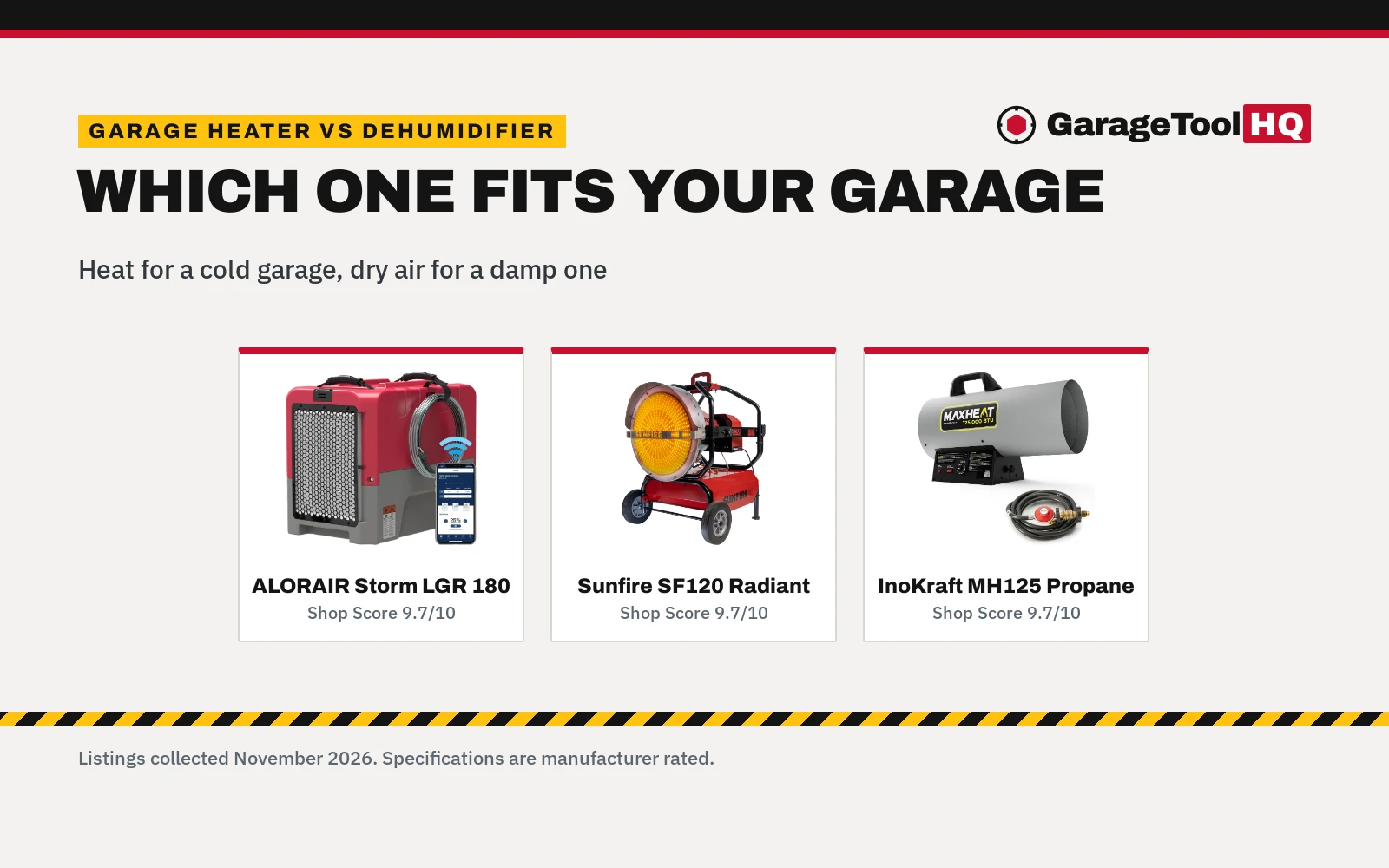
Top picks at a glance
As an Amazon Associate I earn from qualifying purchases.
- 1
 ALORAIR 180 PPD Commercial & Industrial9.7/10View on Amazon
- 2
 SUNFIRE Radiant Heater, 120,000 BTUs9.7/10View on Amazon
- 3
 InoKraft MAXHEAT MH125 125,000BTU Forced Air9.7/10View on Amazon
Verdict: Choose a garage heater if your garage is cold and you need heat to work in it. Choose a dehumidifier if your garage is damp and you need dry air.
A brake job in a cold garage goes better when the air is warm enough to work in, and a damp garage rusts tools. Garage heater vs dehumidifier is the choice between warming the air and drying it, and the two do different jobs. This comparison walks through both sides, then the examples from the listings.
GarageToolHQ earns a commission when you buy through links on this page, at no extra cost to you. Read our affiliate disclosure.
Example heater and dehumidifier
| # | Product | Shop Score | Buy |
|---|---|---|---|
| 1 | ALORAIR 180 PPD Commercial & Industrial | 9.7/10 | Buy on Amazon |
| 2 | SUNFIRE Radiant Heater, 120,000 BTUs | 9.7/10 | Buy on Amazon |
| 3 | InoKraft MAXHEAT MH125 125,000BTU Forced Air | 9.7/10 | Buy on Amazon |
ALORAIR 180 PPD Commercial & Industrial
A 180 PPD commercial dehumidifier with a built-in pump and app control.
Pros
- 180 PPD at saturation, 85 pint at AHAM, with a built-in pump
- 6-year limited warranty is stated
- cETL listed, with automatic defrost and auto shut off
- App control with a digital humidistat and memory starting
Cons
- Weighs 64.3 pounds, so plan the spot before moving it
- Continuous draining needs a drain point for the hose
- Wi-Fi app may not work on some Android devices, per the listing
- Red is the only color stated

SUNFIRE Radiant Heater, 120,000 BTUs
A 120,000 BTU radiant heater with a 14-gallon tank and 16 hours of runtime.
Pros
- 120,000 BTU radiant heat for up to 2,800 sq ft
- 16 hours of runtime from a 14-gallon tank
- Tip-over switch and flame sensor with automatic shutoff
- 2-year bumper-to-bumper warranty is stated
Cons
- Bullets state a 2-year warranty while the spec table lists 1 year
- Measures 32 inches deep and weighs 120 pounds, so it takes real floor space
- Runs on diesel or kerosene, so it needs fuel on hand
- No thermostat is stated

InoKraft MAXHEAT MH125 125,000BTU Forced Air
A 125,000 BTU forced air propane heater with a thermostat from 25 to 95 degrees F.
Pros
- 125,000 BTU forced air for up to 3,200 sq ft
- Thermostat from 25 to 95 degrees F with auto on and off
- CSA certified, with overheat auto-shutoff and gas shutoff protection
- Heats in as little as 5 minutes, per the listing
Cons
- Needs a 20 lb propane tank or larger, plus a 115V outlet
- Designed for well-ventilated areas, so a closed garage is out
- No heater weight is stated
- 1-year manufacturer warranty, where the other examples state 2 years and 6 years
Garage heater vs dehumidifier: side by side
| Garage heater | Dehumidifier | Notes | |
|---|---|---|---|
| What it does | Adds heat to cold air | Pulls moisture from damp air | Heat warms a cold garage; a dehumidifier dries a damp one |
| Example output | 120,000 to 125,000 BTU | 180 PPD at saturation | Heater examples state BTU; the dehumidifier states PPD |
| Power and fuel | Diesel, kerosene or propane; 115V to 120V | 115V, 646 watts | Heaters burn fuel; the dehumidifier runs on power alone |
| Warranty | 1 year to 2 years | 6-year limited | The dehumidifier states the longest warranty here |
Every rating comes from the brand’s listing and is not a shop test (gathered 22 October 2026).
How each side works
A garage heater adds heat to the air. The Sunfire example is a radiant heater: a dish focuses the heat forward, while the InoKraft example blows hot air with a fan. A dehumidifier does a different job: the ALORAIR example pulls moisture from the air and pumps the water away through a hose.
Fuel heaters need ventilation per the maker, and a CO alarm belongs in the garage before the first job. The InoKraft listing states it is designed for well-ventilated areas, so that heater is not for a closed garage. A dehumidifier runs on power alone, so it can run in a closed garage while it dries the air.
Heat output and moisture removal
Heater output is stated in BTU: the Sunfire example lists 120,000 BTU and the InoKraft example lists 125,000 BTU. The Sunfire lists coverage up to 2,800 sq ft and the InoKraft up to 3,200 sq ft. The dehumidifier side states moisture removal instead: the ALORAIR example removes 180 PPD at saturation and 85 pint at AHAM, with 210 cfm of airflow.
BTU and PPD measure different things, so the two sides cannot be scored against each other on output. Judge a heater by BTU and coverage, and a dehumidifier by PPD and airflow.
Power, fuel and running needs
Both heater examples burn fuel: the Sunfire runs on diesel or kerosene with a 14-gallon tank and a 120 volt connection, while the InoKraft runs on propane from a 20 lb tank or larger, with a 10 ft hose and a 115V outlet. The Sunfire listing states about 16 hours of runtime on a tank, and gives flow rates of 0.85 GPH on diesel and 0.78 GPH on kerosene.
The ALORAIR example runs on 115V at 646 watts and 5.62A, with no fuel to buy or store. It does need a drain point for its 19.6 ft condensate hose, since the built-in pump drains continuously.
Choose a garage heater if
- Your garage is cold and you work in it through winter
- You need heat fast, with a thermostat to hold it (InoKraft example)
- You have fuel on hand and ventilation per the maker
- You want to warm a large space, up to 3,200 sq ft with the InoKraft example
Choose a dehumidifier if
- Your garage is damp and tools or stored gear rust
- You need dry air after a flood or in a humid climate
- You want a pump and a long drain hose, with no fuel to buy
- You want the longest warranty here, at 6 years
For more choices, see the best small garage heater and the best dehumidifier for car storage garage.
Never run a fuel-burning heater, generator or engine in a closed garage: carbon monoxide builds up fast and has no smell. Fit a CO alarm, keep clearances to cars and storage, use vented gas heaters installed to code, and put 240V electric heaters on a dedicated circuit. See CPSC carbon monoxide guidance. Read our Safety Disclaimer.
Garage Fit Check
Before you pick a side, check the fit of the example you would buy.
- Sunfire: 32 inches deep by 28.5 inches wide by 33.8 inches high, and 120 pounds, so give it a firm spot on the floor.
- InoKraft: a 20 lb propane tank or larger and a 115V outlet within reach of its 10 ft hose and 1.5 m power cord.
- ALORAIR: 64.3 pounds, and it needs a drain point for its 19.6 ft condensate hose.
- Fuel heaters need ventilation per the maker; fit a CO alarm before the first job.
- Warranties run 2 years on the Sunfire, 1 year on the InoKraft and 6 years on the ALORAIR.
FAQ: garage tools
Should I heat or dehumidify my garage?
Heat if the garage is cold and you work in it; dry if it is damp and tools rust. A heater adds warmth, a dehumidifier pulls moisture from the air.
Can a dehumidifier heat a garage?
No, not as a heater. The ALORAIR example removes 180 PPD at saturation and runs on 646 watts, but it is built to dry air.
Can I run a fuel heater in a closed garage?
Not the InoKraft example: its listing states it is designed for well-ventilated areas. Check the maker’s ventilation rules for the heater you buy, and fit a CO alarm before the first job.
How long does the Sunfire heater run on a tank?
About 16 hours on its 14-gallon tank, per the listing. The listing gives 0.85 GPH on diesel and 0.78 GPH on kerosene.
Which example has the longest warranty?
The ALORAIR dehumidifier, with a 6-year limited warranty. The Sunfire lists 2 years in its bullets and the InoKraft lists 1 year.
Related: the diesel vs propane garage heater guide, the best propane heater for garage with thermostat, the dehumidifier with pump vs gravity drain guide and our garage upgrades hub.