Hand Pump vs Electric Fluid Transfer Pump: Which One Should You Buy?
A hand pump and an electric fluid transfer pump compared for garage fluid jobs: flow, power, setup and storage, with examples from the listings.

On this page
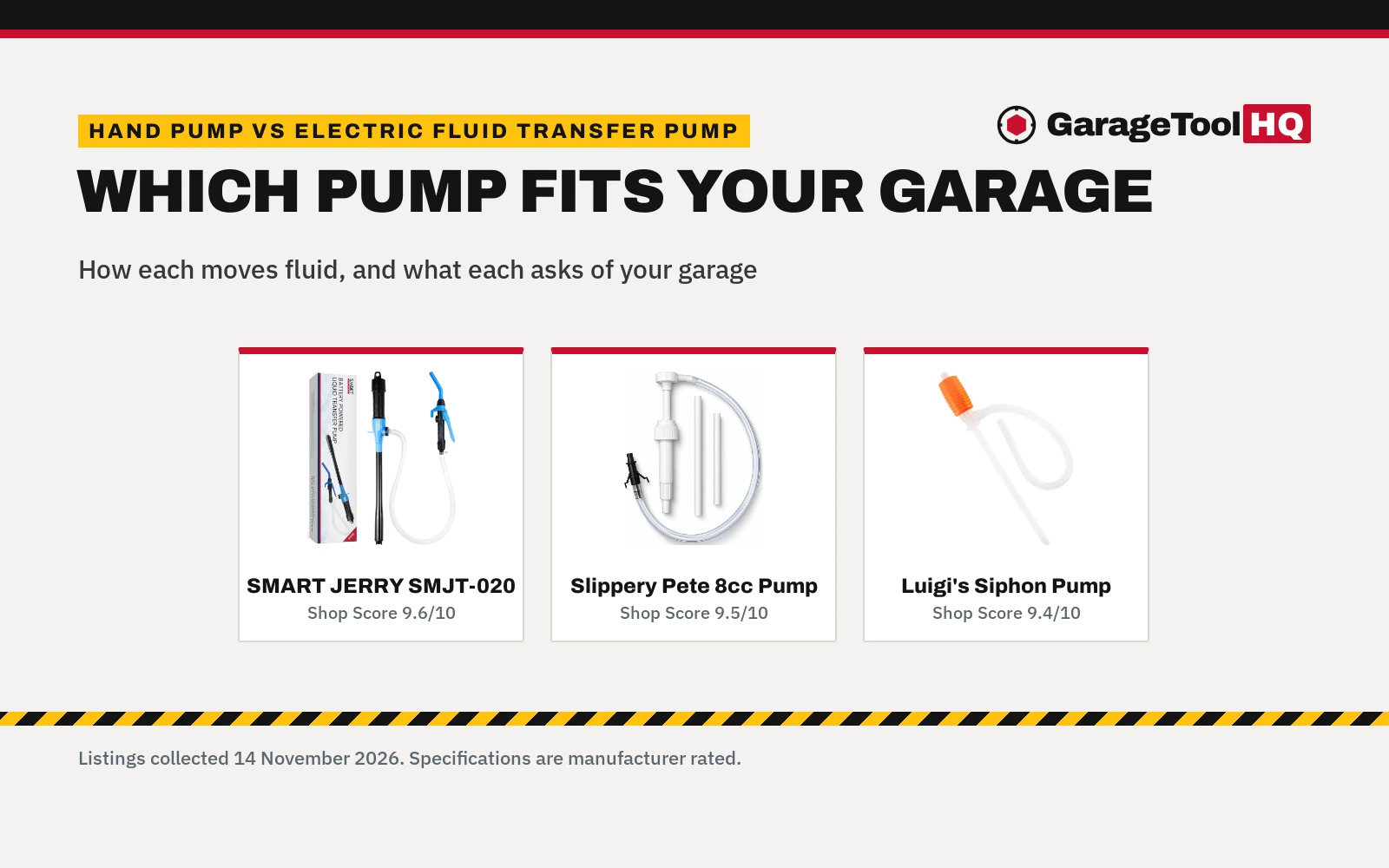
Top picks at a glance
As an Amazon Associate I earn from qualifying purchases.
- 1
 Cordless Fuel Transfer Pump Battery Powered Fluid9.6/10View on Amazon
- 2
 Fluid Pump for Standard Quart Bottles9.5/10View on Amazon
- 3
 Luigi's Siphon Pump - Siphon Hose for Water9.4/10View on Amazon
Verdict: In the hand pump vs electric fluid transfer pump choice, pick a hand pump if you move fluid now and then and want a tool that needs no power at all. Pick an electric fluid transfer pump if you move fluid often and want a motor to do the work.
Moving fluid from a can or a bottle to a machine is a regular garage job: topping up gear oil, draining a tank, or emptying a container before a repair. This comparison covers the hand pump vs electric fluid transfer pump choice, with examples of each side from the listings.
GarageToolHQ earns a commission when you buy through links on this page, at no extra cost to you. Read our affiliate disclosure.
Example pumps
| # | Product | Shop Score | Buy |
|---|---|---|---|
| 1 | Cordless Fuel Transfer Pump Battery Powered Fluid | 9.6/10 | Buy on Amazon |
| 2 | Fluid Pump for Standard Quart Bottles | 9.5/10 | Buy on Amazon |
| 3 | Luigi's Siphon Pump - Siphon Hose for Water | 9.4/10 | Buy on Amazon |

Cordless Fuel Transfer Pump Battery Powered Fluid
A battery-powered fluid transfer pump rated at 2.8 gallons per minute with 6 AA batteries, with a flow-control nozzle and 0.25 inch inlet and outlet connections.
Pros
- Rated at 2.8 gallons per minute with 6 AA batteries
- Flow-control nozzle regulates flow while you pump
- Runs on 2 D batteries or 6 AA batteries, so no outlet is needed
- Moves gasoline, diesel, water, kerosene, oil and transmission fluid
Cons
- Batteries are not included
- Flow drops to 2 gallons per minute with 2 D batteries
- Plastic body
- 0.25 inch connections suit only matching hose

Fluid Pump for Standard Quart Bottles
A hand pump for standard quart bottles with a 28mm opening, moving 8cc per pump stroke, with a 3rd Hand adapter and a 17 inch flexible tube.
Pros
- Moves 8cc per pump stroke
- Fits standard quart bottles with a 28mm opening
- 3rd Hand adapter holds the fill tube while you pump
- Long and short suction tubes cover tall and short quart bottles
Cons
- Suits quart bottles only; check the 28mm opening before ordering
- Max oil viscosity is 80W-90, so thicker oils are out
- No warranty term is stated
- Hand pumping takes effort on every stroke

Luigi's Siphon Pump - Siphon Hose for Water
A manual siphon pump with a flow rate of about 10 liters per minute, made from PE plastic, for water, gasoline and other liquids.
Pros
- Flow rate of about 10 liters per minute
- Needs no power or batteries
- Sturdy PE plastic build
- Handles water, gasoline, biodiesel, chemicals and solvents
Cons
- Squeeze to start the flow and lift the nozzle to stop it
- No warranty term is stated
- Does not suit owners who want a motor to do the work
- The angled end must sit in the liquid while the siphon runs
Side by side
| Hand pump | Electric fluid transfer pump | Notes | |
|---|---|---|---|
| Power source | Manual power; no batteries | 2 D batteries or 6 AA batteries | Batteries not included |
| Stated flow | About 10 liters per minute (Luigi’s); 8cc per pump stroke (Slippery Pete) | 2.8 gallons per minute with 6 AA batteries; 2 gallons per minute with 2 D batteries | Units differ, so no shared figure |
| Fluids listed | Water, gasoline, biodiesel, chemicals, solvents, gear oil, transmission fluid | Gasoline, diesel, water, kerosene, oil, transmission fluid | Check the listing for your fluid |
| Tube and connections | 17 inch flexible tube; 7 and 5.5 inch suction tubes (Slippery Pete) | 0.25 inch inlet and outlet connections; flow-control nozzle | Luigi’s hose length is not stated |
| Max oil viscosity | 80W-90 (Slippery Pete) | Not stated | Only the Slippery Pete listing states a limit |
| Warranty stated | Not stated | 180 days manufacturer warranty | Only the electric example states a term |
We copy each listing’s rated specs exactly as the manufacturer gives them; as of 22 October 2026.
How each pump moves fluid
A hand pump moves fluid with your effort: squeeze, stroke, or siphon, and the flow follows your hand. The Luigi’s example is a siphon pump: place the angled end in the liquid and squeeze the nozzle to start the flow. The Slippery Pete example is a stroke pump for quart bottles: each pump stroke moves 8cc, and the 3rd Hand adapter holds the fill tube while you pump. An electric pump uses a motor instead: the SMART JERRY example runs on batteries, with a flow-control nozzle to set the rate.
Hand pump vs electric fluid transfer pump: flow and effort
The listings state flow in different units, so there is no shared figure to rank the examples by speed. The Luigi’s example states about 10 liters per minute, the Slippery Pete example states 8cc per pump stroke, and the SMART JERRY example states 2.8 gallons per minute with 6 AA batteries and 2 gallons per minute with 2 D batteries.
Power and setup
A hand pump needs no power source at all: the Luigi’s example lists manual power, and the Slippery Pete example works from the bottle it fits. An electric pump needs batteries before it runs: the SMART JERRY example runs on 2 D batteries or 6 AA batteries, and the batteries are not included.
Connections differ too. The SMART JERRY example has 0.25 inch inlet and outlet connections with a quick-connect fitting. The Slippery Pete example fits standard quart bottles with a 28mm opening.
Storage and everyday use
The Slippery Pete example stores easily: it weighs 1.76 ounces and measures 11 by 6 by 1.5 inches, and it comes in a recloseable bag for storage. The Luigi’s example weighs 2.08 ounces.
Choose a hand pump if
- You move fluid now and then, not every day
- You want a pump that needs no power or batteries
- You top up from quart bottles or siphon from a container
Choose an electric fluid transfer pump if
- You move fluid often and want a motor to do the work
- You want to set the flow with a control nozzle
- You keep batteries on hand in the garage
For more choices, see the best fluid transfer pump for gear oil, and the siphon vs electric fuel transfer pump comparison.
Read the manual before first use, wear eye protection, keep the work area clear and ventilated, and stay within every stated rating. Read our Safety Disclaimer.
Garage Fit Check
- Power: the electric example runs on 2 D batteries or 6 AA batteries, and the batteries are not included.
- Fit: the Slippery Pete example fits standard quart bottles with a 28mm opening, so check the bottle before ordering.
- Fluid: check that the fluid you move is among the liquids the maker lists for the pump you pick.
- Connections: the SMART JERRY example has 0.25 inch inlet and outlet connections, so match the hose to them.
FAQ: garage tools
Which is better, a hand pump or an electric fluid transfer pump?
It depends on how often you move fluid. A hand pump suits occasional jobs and needs no power at all. An electric fluid transfer pump suits frequent jobs, since the motor does the work.
What fluids can a hand pump move?
Check the listing for the pump you pick. The Luigi’s example lists water, gasoline, biodiesel, chemicals and solvents, and the Slippery Pete example is made for gear oil, transmission and differential fluid.
Do electric fluid transfer pumps need batteries?
The SMART JERRY example runs on 2 D batteries or 6 AA batteries, and the batteries are not included, so keep a set in the garage before the job.
What size bottle does the Slippery Pete pump fit?
Standard quart bottles with a 28mm opening, with long and short suction tubes for tall and short bottles.
How fast is the SMART JERRY pump?
The maker rates it at 2.8 gallons per minute with 6 AA batteries and 2 gallons per minute with 2 D batteries, with a flow-control nozzle to set the rate.
Related: the drum pump vs fluid transfer pump comparison, the utility pump vs transfer pump comparison, the fuel transfer pump vs oil transfer pump comparison and the best fluid transfer pump for gear oil picks.