How Much Does a Laser Level Cost to Buy (2026)
How much a laser level costs depends on its type, beam, range and kit: cross-line models cost least, 360-degree models cost more, and rotary models cost most.


On this page
Top picks at a glance
As an Amazon Associate I earn from qualifying purchases.
- 1
 Huepar Laser Level9.7/10View on Amazon
- 2
 Laser Level9.6/10View on Amazon
- 3
 Laser Level9.6/10View on Amazon
A shelf line that sags across a garage wall, a row of cabinets that drifts off level, a tile run that wanders as it crosses the room: each job needs a straight reference line to trust. That is the job a laser level does, and how much does a laser level cost is the question to answer before buying. A basic cross-line model costs less than a full-room model, and a rotary model built for outdoor layout costs more again, because each step up adds range, lines and kit contents.
GarageToolHQ earns a commission when you buy through links on our product pages, at no extra cost to you. Read our affiliate disclosure.
Below: what drives the price of a laser level, how the main types compare, and a checklist to run before buying.
How much does a laser level cost? What sets the price
Prices vary widely for a laser level, because the tool spans a wide range of types. A small cross-line level sits at the low end, a 360-degree model that throws lines around a whole room sits higher, and a rotary model made for outdoor grading and drainage sits higher still. The price follows the capability: more lines, longer range, a brighter beam and a fuller kit all add cost.
Beam color is the next driver. Green beams cost more than red beams, and the maker of a green cross-line model states its beam is 4X the brightness of standard red lasers, with a line that stays visible indoors up to 100ft. That visibility matters in a bright garage, where a faint line is hard to read against a light wall.
Range and accuracy add cost as well. A 360-degree model lists a working range up to 98 feet with accuracy of ±1/9 inch at 33 feet, while its outdoor pulse mode extends the range up to 200 feet with a receiver. A cross-line model lists the same accuracy with a visible range up to 100ft indoors. Paying for outdoor pulse range for indoor picture hanging is money spent on a feature that stays switched off.
Kit contents are the last big driver. A bare level costs less than a kit that adds a tripod, a magnetic bracket, a hard carry case and spare batteries. A kit includes a 37.5-inch tripod and a magnetic mount, while another includes a 360-degree magnetic bracket and a hard carry case. A receiver for outdoor pulse work is often sold apart: a maker notes its pulse mode reaches 150ft with a receiver that is not included.
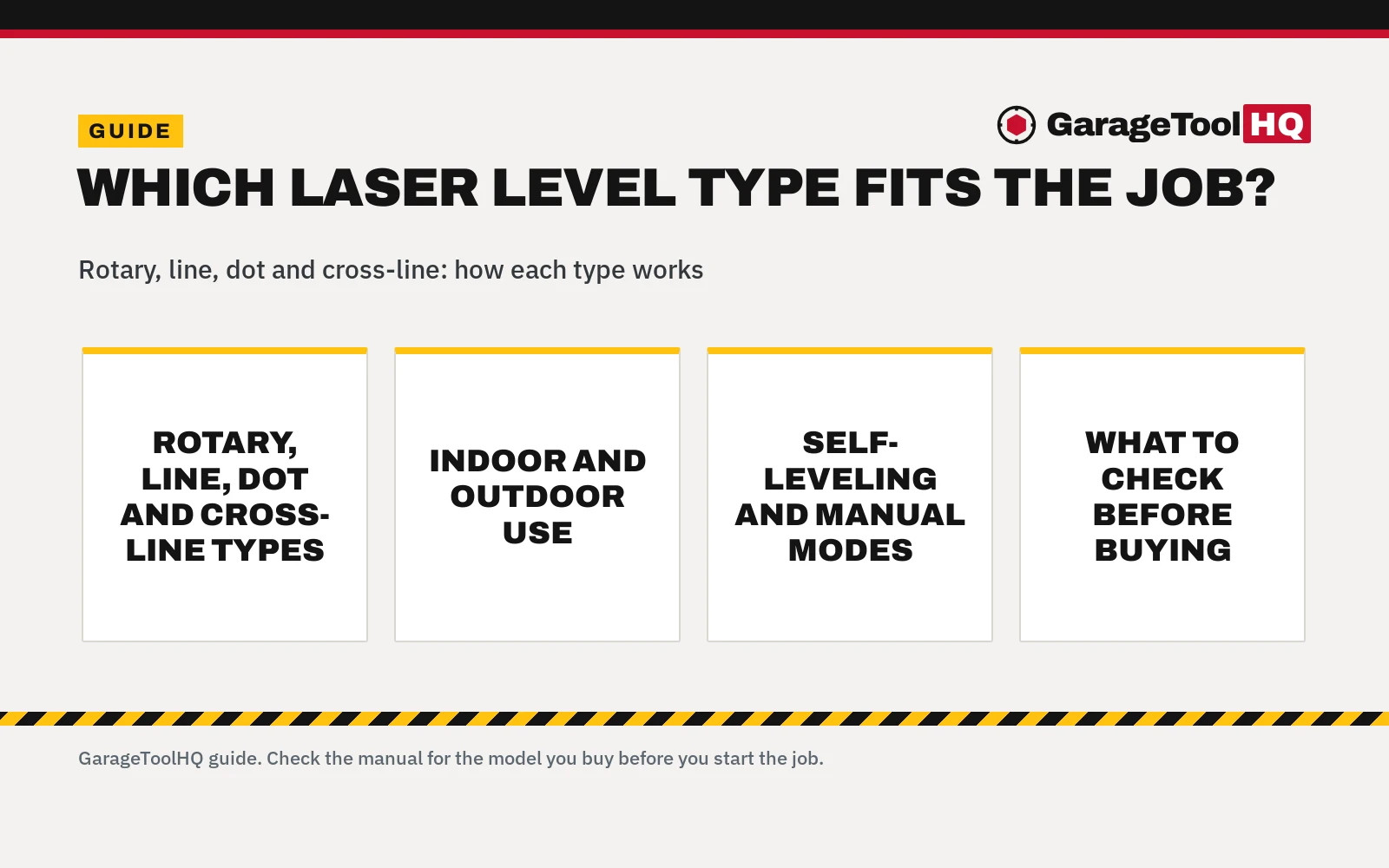
Cross-line, 360-degree and rotary laser levels compared
| Type | What it projects | Garage jobs it fits | What raises its price |
|---|---|---|---|
| Cross-line | Crossing horizontal and vertical lines | Hanging pictures, setting shelves, tile lines | Green beam, longer range, tripod kit |
| 360-degree | Lines that run around the room | Cabinets, ceilings, flooring, wall framing | More lines, pulse mode, rechargeable battery |
| Rotary | A spinning beam for long outdoor runs | Grading, drainage, large outdoor layout | Receiver, range, outdoor rating |
For most garage jobs, a cross-line or 360-degree model covers the work. Match the type to the job, not to the longest range on the shelf.
To see how the types differ in detail, read the guide to the types of laser levels and the beginner guide on how to use a laser level.
Green beam vs red beam: is green worth the extra cost?
Green is the dearer beam, and the reason is visibility. The maker of a green cross-line model states its beam is 4X the brightness of standard red lasers and stays visible indoors up to 100ft, even in well-lit conditions.
Red still has a place. In a dim garage, at short range, a red line reads clearly, and red models sit lower in price for the same layout of lines.
What comes in the box, and what it adds to the cost
Check what comes in the box before comparing prices, because the box contents change the real cost. A cross-line kit ships with a tripod, AA batteries and a carry bag, and carries a 24-month warranty. A 360-degree kit ships with a tripod, lithium batteries, a remote control, a magnetic swivel stand, a charger and a target plate, backed by a 12-month warranty. A rechargeable 360-degree model ships with a magnetic bracket, a hard carry case and a charging cord, with a 5-year warranty on the device.
Batteries deserve a line of their own. A cross-line model runs on AA batteries, while the rechargeable models run on lithium batteries and charge through a type-C port. A 360-degree model lists up to 12 hours of continuous operation, while a rechargeable 360-degree model lists 8 hours. A spare battery in the box means the job does not stop for a charge.
How much does a laser level cost to run and keep?
The purchase price is not the whole cost. Batteries, a tripod, a receiver and a case all add up when bought apart, which is why a fuller kit can work out cheaper than a bare level plus accessories. Warranty length is part of the running cost as well: the models covered here carry 24-month, 12-month and 5-year warranties.
Care costs nothing but attention. A model covered here carries an IP54 rating for dust and water resistance and is stated to withstand drops from up to 30 inches, which suits a garage floor and a busy bench. Keep the lens clean, store the level in its case, and follow the manual for charging and storage.
What to check before you buy
- Match the range to the room. A line visible indoors up to 100ft covers most garage work; outdoor work needs pulse mode and a receiver, with ranges up to 150ft or 200ft stated by the makers.
- Check the accuracy the maker states. The cross-line and 3×360 models covered here state accuracy of ±1/9 inch at 33 feet.
- Check the self-leveling range. Models covered here level within ±4° or within 3°, and flash when the surface tilts past that range.
- Check the beam. Green beams read better in bright light, with a maker stating 4X the brightness of red; red beams cost less and suit dim, close work.
- Count the kit. Tripod, bracket, batteries, charger, case and receiver: a missing piece means buying it apart.
- Read the warranty term. The models covered here carry 24-month, 12-month and 5-year terms, and the term is part of the price.
- Check the mount thread. A 1/4″-20 thread fits a standard tripod, and a magnetic bracket helps on steel shelving and ductwork.
Never point a laser level at eyes, and never stare into the beam. Set the level up, step back, and read the line from the wall.
Read the manual before first use, wear eye protection, keep the work area clear and ventilated, and stay within every stated rating. Read our Safety Disclaimer.
FAQ: garage tools
How much does a laser level cost for hanging pictures?
A basic cross-line model is enough for picture hanging, because the job needs a short, straight line across a wall rather than long range. The green cross-line model covered here stays visible indoors up to 100ft, which is far more range than a picture wall needs.
Do I need a 360-degree laser level for a garage?
It depends on the job. A 360-degree model throws lines around the whole room at once, which suits cabinets, ceilings, flooring and wall framing, and a model covered here projects 16 lines with 4×360° coverage.
What does pulse mode do on a laser level?
Pulse mode lets the level work outdoors in bright light with a receiver. A model extends its range up to 150ft with a receiver, and another reaches up to 200 feet with a detector, while the receiver itself is often sold apart. Check whether the receiver is in the box before paying for the feature.
How long does a laser level battery last?
It varies by model and by how many lines are switched on. A 360-degree model lists up to 12 hours of continuous operation on its lithium batteries, while a rechargeable 360-degree model lists 8 hours of continuous working time.
Is a green laser level worth it over red?
For bright garages and long walls, yes. A green model states its beam is 4X the brightness of standard red lasers and stays visible indoors up to 100ft. For dim rooms and short runs, a red beam reads clearly and costs less.
What warranty should a laser level have?
Look for a stated term in months or years, and compare it across models. The models covered here carry a 24-month warranty, a 12-month warranty and a 5-year warranty on the device, with a maker adding lifetime technical support.
Related: types of laser levels, how to use a laser level, laser level DIY guide, green laser levels under 100, laser levels with a tripod and the garage upgrades hub.