How to Check Drum Brakes at Home (2026)
Pull the drum, read the shoes and measure the lining with a drum gauge and a pad thickness gauge, on rated stands, before the brakes wear too far.

On this page
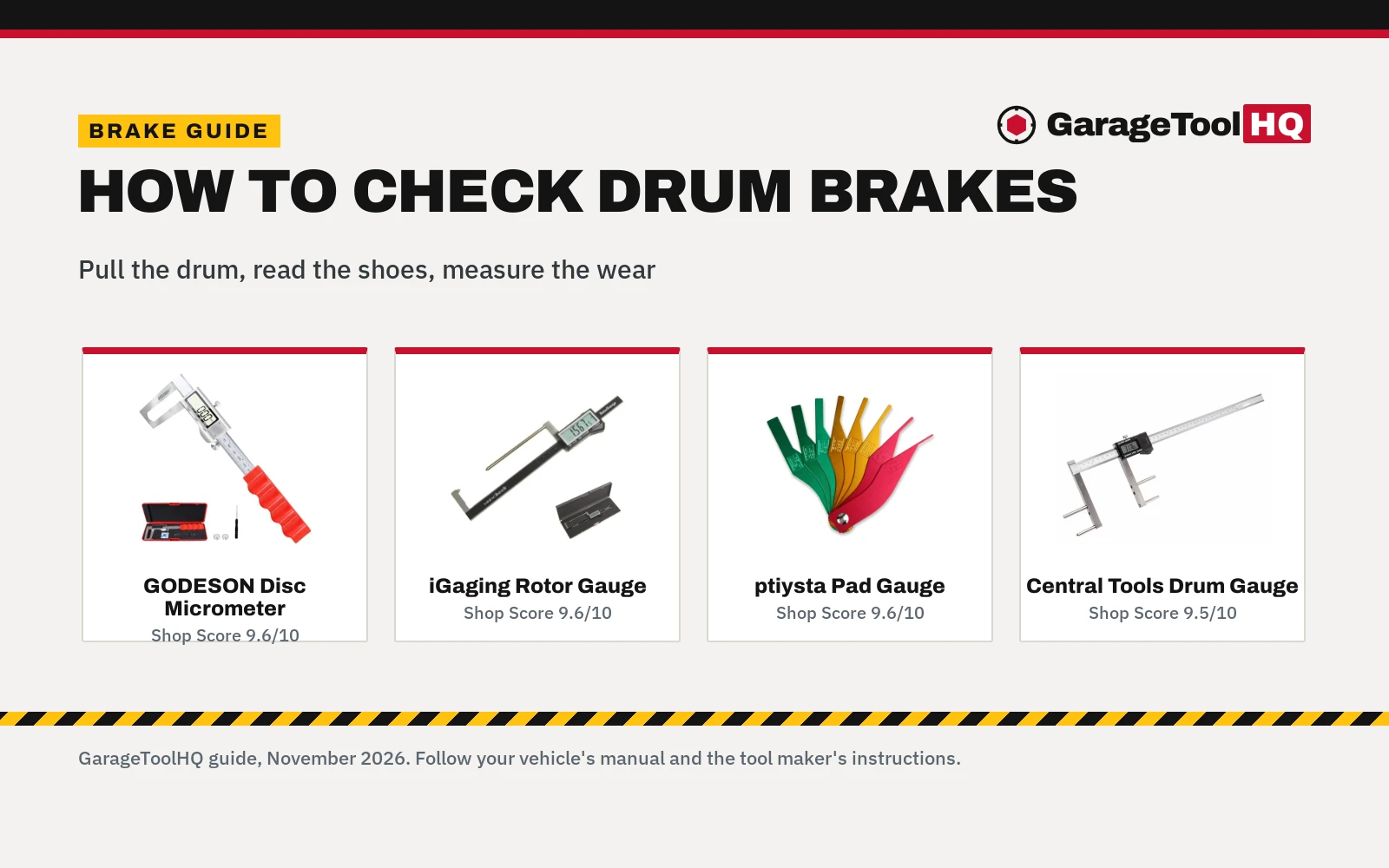
Top picks at a glance
As an Amazon Associate I earn from qualifying purchases.
- 1
 GODESON Disc Brake Rotor Micrometer,Digital9.6/10View on Amazon
- 2
 iGaging Brake Rotor Gauge Wheels On Large Digital9.6/10View on Amazon
- 3
 ptiysta Brake Pad Thickness Gauge9.6/10View on Amazon
- 4
 Central Tools - Electronic Digital Drum Gauge9.5/10View on Amazon
A squeal from the rear wheels on a slow stop, or a parking brake that holds weakly on a slope, usually means the rear drums need a look. Learning how to check drum brakes at home takes rated stands and a few measuring tools.
GarageToolHQ earns a commission when you buy through links on our product pages, at no extra cost to you. Read our affiliate disclosure.
Below: the inspection steps, what to measure, and the tools that cover the job.
GODESON Disc Brake Rotor Micrometer,Digital
A stainless steel disc brake micrometer with a range of 0 to 6 inches, an accuracy of 0.005 in and a large LCD screen.
Pros
- Measuring range of 0 to 6 inches and 0 to 150 mm
- Accuracy of 0.005 in
- Stainless steel body with inch and metric conversion
- Large LCD screen for easy reading
Cons
- Measures brake discs, not drums
- No warranty term is stated
- No protective case is stated
- Stated accuracy of 0.005 in
iGaging Brake Rotor Gauge Wheels On Large Digital
A digital rotor gauge that measures rotors without removing the wheel, with a resolution of 0.0005 in and a protective case included.
Pros
- Measures rotors without removing the wheel
- Resolution of 0.0005 in
- Range of 0 to 3.2 in and 0 to 80 mm
- Protective case included
Cons
- Measures rotors, not drums
- Range tops out at 3.2 in, narrower than the GODESON 0 to 6 in range
- No warranty term is stated
- Weighs 0.95 pounds, more than the GODESON
ptiysta Brake Pad Thickness Gauge
An 8-piece color-coded pad thickness gauge in metric and SAE that reads disc and drum brake pads.
Pros
- 8-piece set in metric and SAE
- Color-coded leaves: green safe, yellow warning, red replacement
- Works on disc and drum brake pads
- Heavy-duty steel construction
Cons
- No digital readout, leaves only
- No warranty term is stated
- Red leaves cover only 2 to 3 mm, a narrow replacement band
- 8 separate leaves to keep track of
Central Tools - Electronic Digital Drum Gauge
An electronic digital drum gauge for brake drums, the only drum gauge here.
Pros
- The only drum gauge here, built for the drum check
- Electronic digital readout
- Measures drums directly, where the micrometers read discs
- Designed with the professional in mind
Cons
- No warranty term is stated
- Weighs 3.0 pounds
- 23.5 in body is the longest here
- Made for drums only, not rotors or pads
How to check drum brakes
Drum brakes hide the wear inside the drum, so the check is a look-and-measure job, not a guess. Work on level ground with the car on rated stands, never under a car on a jack alone.
- Lift the car on rated stands and take the wheel off. Set the stands on solid, level ground.
- Pull the drum off the hub. The shoes, springs and wheel cylinder sit inside; look for lining that is thin, cracked or soaked.
- Measure the drum with a drum gauge. The Central Tools drum gauge reads the drum directly.
- Measure the lining with a pad thickness gauge. The ptiysta gauge reads disc and drum brake pads in metric and SAE leaves.
- Read the color code. Green leaves, 8 to 12 mm, mean safe thickness; yellow leaves, 4 to 6 mm, mean warning level; red leaves, 2 to 3 mm, mean replacement is needed.
- Check the rotors too, where the car has them. The GODESON micrometer measures disc thickness from 0 to 6 inches, and the iGaging gauge measures rotors without removing the wheel.
Write the readings down before the parts go back: a drum reading and a lining reading from the same wheel tell the story together.
What to measure
| Tool | Measures | Range |
|---|---|---|
| GODESON disc micrometer | Disc thickness | 0 to 6 inches |
| iGaging rotor gauge | Rotor thickness, wheel on | 0 to 3.2 inches |
| Central Tools drum gauge | Drum inside diameter | Not stated |
| ptiysta pad gauge | Pad thickness, disc and drum | 2 to 12 mm, color-coded |
The drum gauge and the pad gauge cover the drum check; the GODESON micrometer and the iGaging gauge cover rotors and discs.
Tools that cover the drum brake check
Each tool below handles one part of the check: the drum gauge reads the drum and the pad gauge reads the lining.
Read the manual before first use, wear eye protection, keep the work area clear and ventilated, and stay within every stated rating. Read our Safety Disclaimer.
FAQ: garage tools
How do you know when drum brakes need replacing?
Measure the lining: the ptiysta gauge marks 2 to 3 mm red, and red means replacement is needed. Check the drum with the drum gauge as well.
Can you check drum brakes without removing the wheel?
The iGaging rotor gauge measures rotors without removing the wheel. Drums need the wheel off and the drum pulled before the shoes can be seen.
What does the color code on a pad gauge mean?
Green, 8 to 12 mm, means safe thickness; yellow, 4 to 6 mm, means warning level; red, 2 to 3 mm, means replacement is needed.
Do you need a micrometer or a gauge for drum brakes?
A drum gauge reads the drum, and a pad thickness gauge reads the lining. A disc micrometer reads disc thickness, not drums.
How accurate is a digital brake micrometer?
The GODESON micrometer states an accuracy of 0.005 in. The iGaging gauge states a resolution of 0.0005 in; resolution is the smallest step the display shows, not the accuracy of the reading.
Related: how to remove a drum brake, best brake spring tools for drum brakes and best tools for changing brakes.