How to Choose a Tool Chest: Sizing, Drawers and Weight Capacity
A practical guide to choosing a tool chest for your garage, comparing drawer counts, dimensions, weight capacity, slide hardware and caster construction.

On this page
Top picks at a glance
As an Amazon Associate we earn from qualifying purchases.
- 1
 SHOPMAX 41″ 16-Drawer Tool Chest and Rolling Cabinet Combo9.8/10View on Amazon
- 2
 ShopMax 27 in. 8 Drawer Tool Chest and Rolling Cabinet Combo9.7/10View on Amazon
- 3
 36 in. W x 24.5 in. D Heavy Duty Rolling Tool Chests and9.7/10View on Amazon
- 4
 CRAFTSMAN VERSASTACK 30 Gallon Quick-Access Rolling Tool ChestView on Amazon
- 5
 INTERGREAT 8 Drawers Tool ChestView on Amazon
- 6
 13-Drawer Rolling Tool Chest with Double DoorsView on Amazon
- 7
 CRAFTSMAN Tool Chest Combo with Drawer Liner RollView on Amazon
- 8
 Geinxurn 8-Drawer Red Tool BoxView on Amazon
- 9
 Maxority 7-Drawer Heavy-Duty Rolling Tool Chest Cabinet withView on Amazon
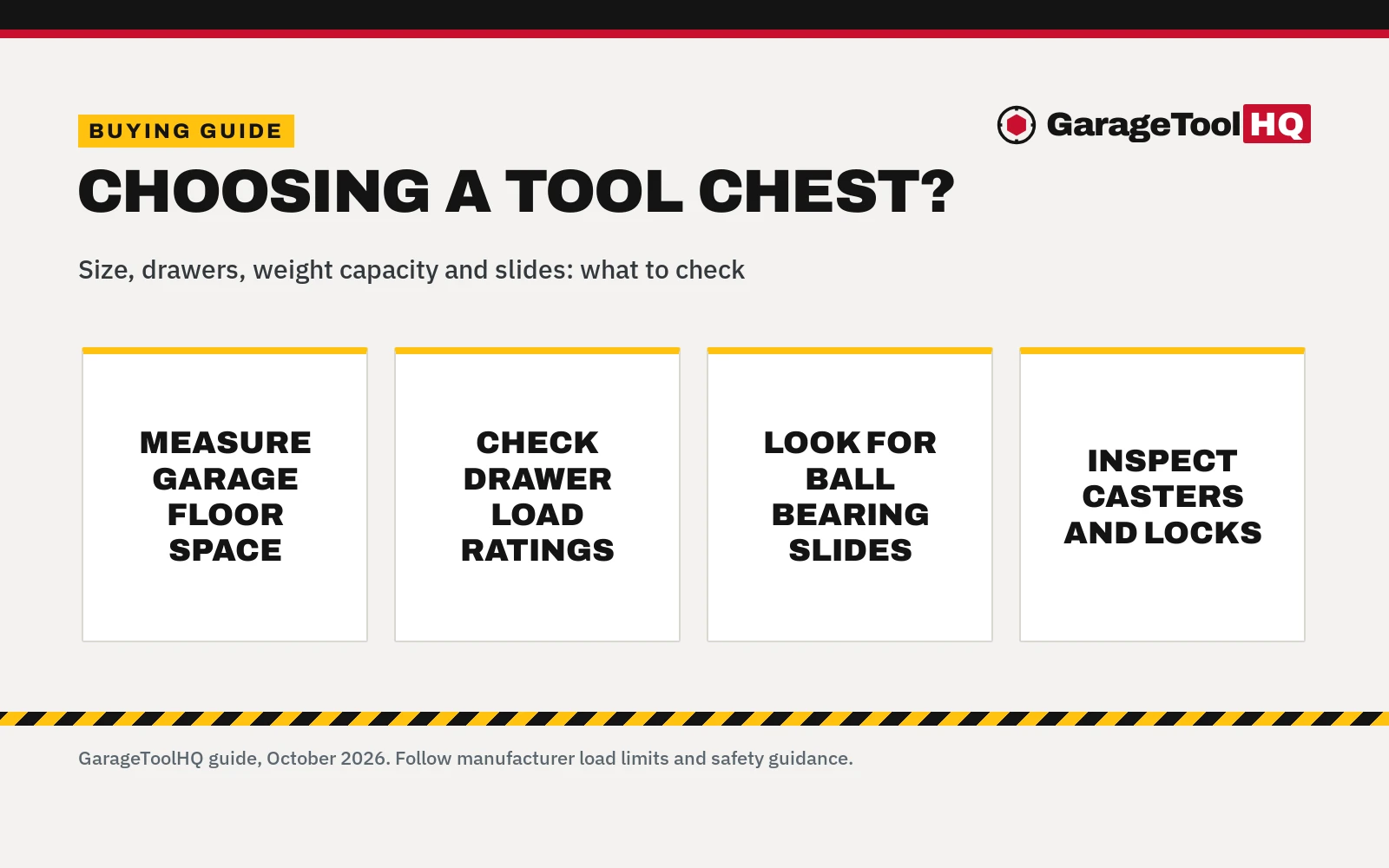
To know how to choose a tool chest, start by measuring your available garage floor space, counting your tools to determine required drawer depth and layout, checking the total weight capacity and slide ratings, and picking between a rolling cabinet, a multi-drawer combo, or a portable box. Choose steel construction with ball bearing drawer slides and locking casters for heavy shop use, or a compact chest if your workspace is limited. Matching drawer dimensions and weight limits to your heaviest tools prevents drawer sag and keeps your workspace organized.
More options to compare
 CRAFTSMAN VERSASTACK 30 Gallon Quick-Access Rolling Tool ChestCheck price on Amazon
 INTERGREAT 8 Drawers Tool ChestCheck price on Amazon
 13-Drawer Rolling Tool Chest with Double DoorsCheck price on Amazon
 CRAFTSMAN Tool Chest Combo with Drawer Liner RollCheck price on Amazon
 Geinxurn 8-Drawer Red Tool BoxCheck price on Amazon
 Maxority 7-Drawer Heavy-Duty Rolling Tool Chest Cabinet withCheck price on Amazon
GarageToolHQ earns a commission when you buy through links on our product pages, at no extra cost to you. Read our affiliate disclosure.
Below: how to plan your storage capacity, how the primary tool chest styles compare, what slide and steel specifications mean, a pre-purchase garage checklist, and how to maintain drawer hardware.
How to choose a tool chest: assessing space and storage needs
Selecting the right tool chest comes down to balancing what your collection requires today with the physical limits of your garage. A chest that is too small leaves sockets and power tools scattered across workbenches, while a unit that is too deep obstructs vehicle doors or pedestrian paths. Before browsing models, evaluate these fundamental storage factors:
- Garage floor footprint and clearance. Measure the wall space where the cabinet will stand, leaving enough room to walk past when drawers are fully pulled out. For tight spaces, a compact rolling unit fits along perimeter walls without blocking car bays. For example, INTERGREAT lists an 8-drawer rolling combo measuring 24.13 inches wide by 13 inches deep by 42.5 inches high, which provides substantial vertical storage on a narrow footprint.
- Tool inventory and drawer volume. Group your tools by category before buying. Sockets, ratchets, and combination wrenches need wide, shallow drawers so tools lie flat and stay visible. Bulky impact wrenches, circular saws, and battery chargers need deep bottom cabinets. Matching your tool profile to drawer depths avoids wasted vertical space.
- Total weight capacity. Hand tools are deceptively heavy. A single drawer packed with solid steel sockets, breaker bars, and torque wrenches can weigh dozens of pounds. Checking total rated capacity ensures the frame will not warp under load. For example, Winado lists a maximum load capacity of 330 pounds on its 24-inch portable metal box, while VEVOR lists a maximum weight capacity of 123.5 pounds on its rolling cabinet.
- Mobility requirements. Decide whether your tools will stay parked in a dedicated spot along a workbench or roll directly to the vehicle you are repairing. Larger rolling cabinets and combos provide high drawer counts in a workshop bay, while compact chests with handles allow you to carry essentials to any project.
Comparing tool chest styles: portable, rolling, combo and utility
| Style | Storage configuration | Mobility and placement | Best suited for |
|---|---|---|---|
| Portable top chest | Shallow drawers with top storage tray and carry handles; for example, Winado lists 5 drawers and Workington lists 9 drawers | Benchtop or cabinet top; portable side handles for vehicle or jobsite transport | Hand tools, screwdrivers, socket sets, and small hardware |
| Rolling tool cabinet | Multiple drawers on a wheeled base; for example, Cobinery lists 7 drawers | Floor standing on swivel casters with brakes; rolls between garage bays | Primary mechanics storage, automotive hand tools, and daily shop equipment |
| Detachable 2-in-1 combo | Top chest stacked onto a rolling bottom cabinet; for example, VEVOR lists 5 drawers with a 123.5-pound capacity, Crownland lists 8 drawers, and Sormols lists 13 drawers with 2 doors | Upper box can separate from lower rolling cart; casters move the full stack | Maximum vertical storage volume on a compact floor footprint |
| Rolling utility chest | Deep tub or bulk chest with heavy wheels; for example, CRAFTSMAN lists 30 gallons of capacity and Keter lists a 66-pound capacity | Telescoping or pull handle with large wheels; rolls over cords and uneven floors | Bulky power tools, extension cords, diagnostic cases, and jobsite gear |
Choosing between these styles depends on how you work in your garage. If you already have a sturdy workbench, adding a top chest provides organized drawer storage without occupying floor area. If you work on cars across multiple bays, a rolling cabinet or combo lets you keep wrenches within arm reach. For larger tool collections, explore our overview of best tool cabinets or compare entry-level options in our guide to budget rolling tool chests and larger units in heavy-duty rolling tool chests.
How to choose a tool chest: the garage buyer checklist
- Measure garage floor space and clearances. Confirm the exact floor footprint where the chest will reside. Account for drawer extension depth and cabinet door swing to ensure unhindered movement around parked vehicles.
- Evaluate drawer count and drawer height distribution. Ensure the chest offers a sensible mix of shallow and deep drawers. Thin drawers keep wrenches and ratchets organized without piling, while deep drawers accommodate bulkier items. For example, Winado lists 5 drawers where the first 4 drawers measure 1.57 inches in height for slim hand tools and the 5th drawer measures 3.30 inches in height for deeper items like socket rails or pliers.
- Verify maximum weight capacity ratings. Check the manufacturer stated load rating against the tools you plan to store. Cast iron tools and steel sockets add weight rapidly. For example, VEVOR lists a maximum weight capacity of 123.5 pounds, while Winado lists a maximum load capacity of 330 pounds on its steel toolbox.
- Select ball bearing drawer slides over friction runners. Quality ball bearing slides glide smoothly when drawers are filled with heavy tools, whereas friction runners tend to drag and bind. When full access to the back of the drawer is needed, look for slides specifically specified for full extension.
- Examine caster size, wheel material, and locking brakes. Mobile chests need rugged casters that roll smoothly across concrete seams and expansion joints. For example, Keter equips its rolling tool box with 7-inch rubber wheels, while VEVOR lists 4 swivel casters with 2 side brakes to keep the unit firmly stationary on level garage floors. Cobinery lists 2 swivel casters with brakes and 3 fixed casters for stable tracking.
- Look for protective drawer liners. Liners protect the painted drawer bottom from scratching and keep tools from sliding when drawers open and close. For example, INTERGREAT supplies 6 non-slip drawer mats and EVA padding, while VEVOR includes 6 EVA pads for sound dampening and tool protection.
- Check locking mechanism design. A dependable lock secures valuable tools and keeps drawers from sliding open during transport or rolling. Workington lists a central cam lock mechanism, Winado features a steel safety lock with key, and OAKANDO provides independent locking systems for the upper chest and bottom cabinet.
- Assess external tool storage and expansion options. Hanging racks and side hooks expand utility without taking up drawer volume. For example, Sormols includes 6 hooks on the side of the cabinet, INTERGREAT provides 8 hooks, and VEVOR includes 3 galvanized hooks alongside a screwdriver rack.
- Check overall steel construction and finish quality. Powder-coated steel resists rust, workshop chemicals, and scratches. For example, OAKANDO lists a steel plate thickness of 1.2mm for solid durability, while VEVOR uses cold-rolled steel with a powder-coated finish.
Never open multiple heavily loaded drawers at the same time. Opening several extended drawers shifts the center of gravity forward, creating a serious tip-over risk that can cause injury or damage equipment. Always engage caster wheel brakes when parked, load the heaviest tools in bottom drawers, and close each drawer before opening another.
Use rated jack stands on solid ground, wear eye protection with power and air tools, keep fuel-burning equipment out of a closed garage, and follow the manual for every tool. Read our Safety Disclaimer.
Ball bearing slides vs friction runners
Drawer slide hardware directly determines how pleasant and durable a tool chest will be in daily use. When comparing models, examine the slide design and steel specs carefully:
- Slide mechanics: ball bearing drawer slides use rows of steel ball bearings to glide smoothly under heavy loads, whereas friction runners rely on metal-on-metal tracks that bind when weighed down.
- Load handling: ball bearing slides maintain smooth travel when filled with dense socket sets and iron wrenches, extending drawer life and preventing sticking.
- Extension travel: full-extension slides let you view and reach tools stored at the very back of the drawer without tilting or reaching blindly.
- Steel thickness and rigidity: thicker steel prevents cabinet twist and drawer sagging over time; for example, OAKANDO lists a steel plate thickness of 1.2mm for rigid durability.
To plan your layout and dimensions before buying, consult our guide to tool chest sizes. If you need portable drawer capacity that moves between workbenches, compare our selections for the tool cart with drawers and mobile workbench with tool storage.
Weight distribution and drawer organization
Proper weight distribution is critical for cabinet stability and smooth drawer operation. Always place your heaviest tools, such as heavy socket sets, impact wrenches, and rotary tools, in the bottom drawers or lower bulk cabinet. Reserve upper shallow drawers for lightweight screwdrivers, pliers, and precision measuring tools. Outfitting shallow drawers with dedicated organizers keeps equipment from rattling and sliding when drawers open and close. Pair your setup with a dedicated socket organizer for tool box drawer and a matching best wrench organizer for tool box to maximize space efficiency.
Frequently Asked Questions
How do I know what size tool chest to buy?
Measure your available floor space and ceiling or bench clearance, then inventory your existing tools with room for future growth. If your floor space is limited, choose a vertical combo chest such as the models from Crownland or INTERGREAT that measure 24.13 to 24.2 inches wide while standing 42.5 inches high, allowing you to match drawer dimensions to your tool collection without crowding the shop floor.
Are ball bearing drawer slides worth it on a tool chest?
Yes. Ball bearing slides use steel bearings to deliver smooth opening and closing even when drawers carry heavy iron tools. Friction slides can drag, stick, and bind under substantial weight, making drawers difficult to pull open. Many ball bearing models also feature full extension, allowing clear access to tools stored at the back of the drawer.
What is the difference between a tool chest and a tool cabinet?
A tool chest traditionally refers to a top chest or portable box with a hinged lid and shallow drawers, designed to sit on a workbench or atop a rolling cabinet. A tool cabinet refers to the larger bottom unit mounted on rolling casters, typically featuring deeper drawers and bulk storage compartments for heavier tools.
How much weight can a tool chest hold?
Weight capacity varies widely depending on cabinet construction and size. For example, Keter lists a portable rolling box rated for a 66-pound capacity, VEVOR rates its 5-drawer rolling cabinet for a maximum capacity of 123.5 pounds, and Winado lists a 24-inch portable steel chest with a maximum load capacity of 330 pounds. Always check manufacturer specifications before loading heavy power tools.
Why are drawer liners important in a tool chest?
Drawer liners cushion your tools, prevent them from sliding when drawers open and shut, and protect the painted steel drawer floor against oil, scratches, and moisture. Non-slip foam or EVA mats keep socket sets and wrench organizers neatly in place, preserving both your tools and the chest finish.
How do I prevent a rolling tool chest from tipping over?
Always lock the caster wheel brakes when the cabinet is stationary on your garage floor. Place your heaviest tools in the bottom drawers to maintain a low center of gravity, and open only one drawer at a time. Never climb or lean on extended drawers, and ensure the chest rests on a level concrete surface.
Related: our guide to tool chest sizes, picks for the best tool cabinets, budget options in budget rolling tool chests, heavy-duty storage in heavy-duty rolling tool chests, mobile organization with a tool cart with drawers, and our complete tool storage hub.