How to Fix Windshield Washer Fluid Pump
A step-by-step guide to finding why a washer pump stays silent or sprays nothing, and how to swap it for a matching 12V pump.

On this page
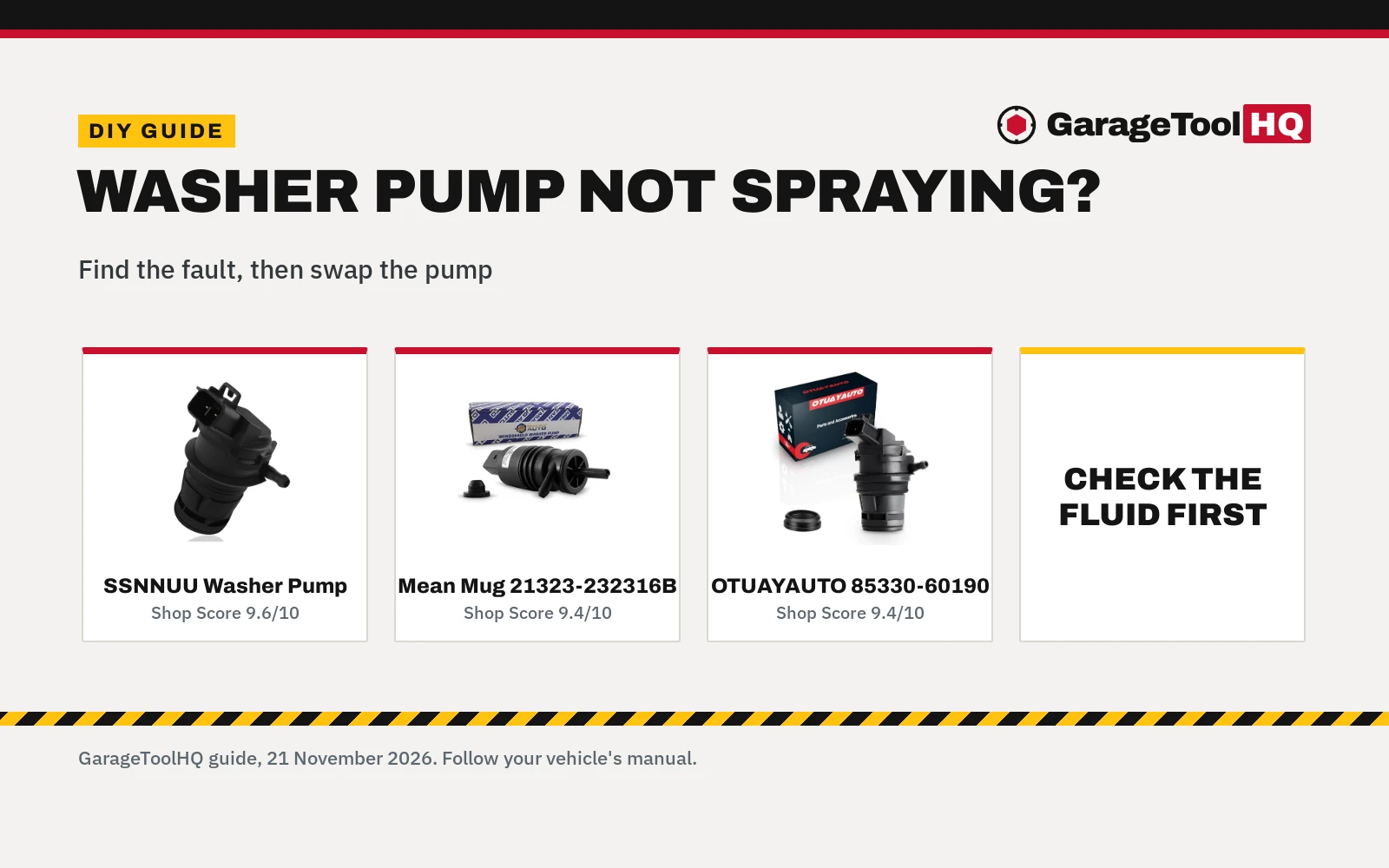
Top picks at a glance
As an Amazon Associate I earn from qualifying purchases.
- 1
 Windshield Washer Pump Replacement9.6/10View on Amazon
- 2
 21323-232316B Windshield Washer Pump w/Grommet9.4/10View on Amazon
- 3
 OTUAYAUTO 85330-60190 Windshield Washer Pump9.4/10View on Amazon
How to fix windshield washer fluid pump problems starts with finding whether the pump is getting power and whether fluid can reach the nozzle. If the pump hums but nothing sprays, the fault is usually a clogged nozzle, a split hose or low fluid. If the pump stays silent, check the fuse and the connector before buying a replacement, and match the new pump to the vehicle by OEM number.
GarageToolHQ earns a commission when you buy through links on our product pages, at no extra cost to you. Read our affiliate disclosure.
Below: how to tell a dead pump from a clogged nozzle or a blown fuse, and the replacement pumps that fit this job.
| # | Product | Shop Score | Buy |
|---|---|---|---|
| 1 | Windshield Washer Pump Replacement | 9.6/10 | Buy on Amazon |
| 2 | 21323-232316B Windshield Washer Pump w/Grommet | 9.4/10 | Buy on Amazon |
| 3 | OTUAYAUTO 85330-60190 Windshield Washer Pump | 9.4/10 | Buy on Amazon |
Windshield Washer Pump Replacement
A 12V washer pump rated at 2200 ml/min with a load current of 4.5A or less, sized 3.04 by 1.14 by 0.76 inch and supplied with a rubber grommet.
Pros
- Flow rate of 2200 ml/min stated by the maker
- Load current of 4.5A or less
- PA66 nylon body with a rubber grommet included
- Fits Toyota, Lexus, Mazda, Honda and Lincoln models
Cons
- Warranty lasts only 3 months
- No stated fitment for BMW or Mercedes-Benz models
- Fitment needs an OEM-number check before ordering
- No hose, nozzle or fluid included
21323-232316B Windshield Washer Pump w/Grommet
A 12V washer pump with a rubber grommet and a one year warranty, listed for BMW, Mercedes-Benz and other makes with flat-pin electrical connections.
Pros
- One year warranty stated
- Listed for BMW, Mercedes-Benz, Audi, Porsche, Volkswagen and GM makes
- Replaces OEM 67128362154 and 67128377612
- Rubber grommet included with the pump
Cons
- Only compatible with flat-pin electrical connections
- No flow rate stated
- No size or dimensions stated
- No hose, nozzle or fluid included
OTUAYAUTO 85330-60190 Windshield Washer Pump
A 12V washer pump with a rubber grommet that replaces OEM 85330-60190, 85330-AE010, 85330-60180 and 85330-21010 across Toyota, Lexus, Subaru, Mazda, Nissan, Acura and Honda models.
Pros
- Replaces four OEM numbers: 85330-60190, 85330-AE010, 85330-60180 and 85330-21010
- Listed for Toyota, Lexus, Subaru, Mazda, Nissan, Acura and Honda
- Stated for front or rear windshield use
- Rubber grommet included
Cons
- No warranty term is stated
- No flow rate stated
- No size or dimensions stated
- No hose, nozzle or fluid included
How to Fix Windshield Washer Fluid Pump: Find the Fault First
Work through the checks in order, easiest first, so a simple clog does not turn into a pump swap.
- Top up the reservoir. A low level starves the pump. Fill it, then look for fluid pooling under the car, which points to a split hose or a leaking reservoir.
- Listen for the pump. Have a helper work the washer switch while you stand near the reservoir; a hum means the pump runs.
- Check the fuse. A silent pump often means a blown washer fuse. Find the fuse in the box the vehicle manual names, look for a broken link inside, and fit one with the same rating.
- Check the connector. Unplug the connector at the pump, look for corrosion or a loose fit, then push it firmly home. Some pumps use flat-pin connections, so match the connector shape before ordering.
- Check the hoses. Follow each hose from the reservoir to the nozzles and look for splits, kinks or loose joints.
- Check the nozzles. A nozzle blocked with wax or dirt stops the spray even when the pump runs. Clear the opening gently with a fine pin, without forcing it or widening the hole.
- Check the grommet. The rubber grommet seals the pump into the reservoir, so a cracked one lets fluid leak out around the pump.
If the pump hums and the lines are clear, the pump itself is the likely fault. If it stays silent with a good fuse and a clean connector, the pump motor is the likely fault, though a failed switch or a broken wire can cause the same silence. In both cases, a replacement pump is the usual fix.
Swapping the pump
Replacing a washer pump is a reservoir job: pull the old pump out of the grommet and fit the new pump with the fresh grommet from the box. Reconnect the hose and the connector, refill the reservoir and work the washer switch until fluid sprays from the nozzles.
Match the replacement by OEM number and connector shape, not by looks alone: pumps that look alike can carry different connectors. The three pumps below each come with a rubber grommet and run on 12V.
The gear for this job
Each pump below handles the replacement step in this guide: it pushes washer fluid from the reservoir to the nozzle, and each one ships with the rubber grommet that seals it into the reservoir.
Read the manual before first use, wear eye protection, keep the work area clear and ventilated, and stay within every stated rating. Read our Safety Disclaimer.
FAQ: garage tools
Why does my washer pump hum but nothing sprays?
A humming pump runs, so the fault sits past the pump: a clogged nozzle, a split hose, or a low reservoir. Check the nozzle and hoses before ordering a pump.
How do I know if the pump or the fuse is the problem?
A silent pump with a blown fuse points at the fuse; fit one with the same rating and listen again. If the fuse is sound and the connector is clean and seated, the pump motor is the likely fault, though a failed switch or a broken wire can cause the same silence.
Can I replace a windshield washer pump myself?
Yes: pull the old pump out of its grommet, fit the new pump with the fresh grommet in the box, reconnect the hose and connector, then refill and spray. Match the new pump by OEM number and connector shape.
Do I need a new grommet with the pump?
Yes, fit a fresh one: the grommet seals the pump into the reservoir, and a cracked grommet leaks fluid around it. Each of the three pumps in this guide comes with a rubber grommet in the box.
What voltage is a windshield washer fluid pump?
The pumps in this guide are all 12V units. Check the connector shape as well as the voltage: one of the pumps here uses flat-pin connections only.
Will one pump fit the front and rear washers?
Some pumps are listed for front or rear windshield use, so check the fitment list and OEM number against the old pump. A pump listed for one end may not fit the other.
Related: how much windshield washer fluid to add, the weight of washer fluid per gallon and the engine and shop equipment hub.